 |
 Remotes
 21 July 2015 | by
  There has been a lot of discussion lately regarding the upcoming ARRL's review of DXCC requirements regarding, amongst other things, the use of "remote" stations. It seems that most folks are either dead against them or all for them, with little middle-ground. But one thing is for certain ... remotes are here to stay and are growing by leaps and bounds.
The biggest controversy seems to be whether DX worked via a remote should count the same as DX worked from one's home station. Many think that DX worked via a remote should still be countable for your DXCC credits but should be in a separate class or have a separate endorsement indicating such ... others see no separation is needed.
I guess a lot depends on how one views the DXCC program overall. Some see it as a competition against other stations while others view it is a personal challenge for one's own satisfaction and the only competition is with one's self.
For example, if a New England 160m amateur spends many years perfecting his system and struggles for those hard-fought Asian or South Pacific contacts, should these contacts be held in the same regard as the New Englander's 160m neighbour who works all of the Asian-Pacific with ease via a remote station on the west coast? Should both DXCC certificates be the same? There is also the question of remote stations "for rent" and the overall ethics or "legality" of such within the amateur radio service.
The only direct exposure I have had to remote station operation is hearing what was clearly an east-coast remote being operated by an amateur on the west coast, while working Europeans. No problem with that, however, the operator was giving his location as CN87, Washington state ... clearly deceptive, as many Europeans were delighted to think that they had just worked a new state in "7-land"!
I suppose that no matter how strict the "rules" for remote operations eventually become, there will always be those willing to play by their own rules, as is human nature.
The genie is out of the bottle and there is no going back. I think the ARRL has some tough decisions to make ... hopefully they will be well-thought out and not based solely on financial interests.
Steve McDonald, VE7SL, is a regular contributor to AmateurRadio.com and writes from British Columbia, Canada. Contact him at [email protected].
Weekly Propagation Summary – 2015 Jul 20 16:10 UTC
Here is this week’s space weather and geophysical report, issued 2015 Jul 20 0508 UTC.
Highlights of Solar and Geomagnetic Activity 13 – 19 July 2015
Solar activity began the period at very low levels on 13 Jul but increased to low levels on 14 Jul with C1 flares from Region 2381 (N14, L=074, class/area Eko/550 on 08 Jul) and 2387 (N17, L=271, class/area Dai/120 on 18 Jul) at 14/0925 UTC and 14/1210 UTC respectively. Very low levels were observed on 15-17 Jul. Ground observatories reported a 22 degree filament eruption, centered near N39E36 at 16/1453-1643 UTC. The associated CME was not geoeffective. Region 2388 (N08, L=024, class/area Cao/020 on 16 Jul) produced a C1 flare at 18/1442 UTC and was accompanied by a Type II radio sweep (est speed 418 km/s). A CME was later observed in SOHO/LASCO C2 coronagraph imagery erupting from the west limb at 18/1512 UTC with an estimated plane of sky speed of 337 km/s. This event is not expected to be geoeffective. A long duration event (LDE) C2 flare was observed at 19/1040 UTC. The LDE was associated with a 23 degree long filament eruption located in the SW quadrant centered near S32W52. CME analysis, and subsequent WSA-Enlil model output, revealed a possible weak glancing blow from the northern flank of the SW-directed CME expected to arrive at Earth early on 23 Jul.
No proton events were observed at geosynchronous orbit.
The greater than 2 MeV electron flux at geosynchronous orbit was at moderate levels on 13 Jul. High levels were reached from 14-19 Jul due to effects from a coronal hole high speed stream.
Geomagnetic field activity reached minor storm levels on 13 Jul due to effects from a positive polarity coronal hole high speed stream. Mostly quiet conditions with isolated unsettled periods were observed from 14-16 Jul as coronal hole effects subsided. Quiet conditions were observed for the remainder of the period.
Forecast of Solar and Geomagnetic Activity 20 July – 15 August 2015
Solar activity is expected to be very low to low from 20-27 Jul. Moderate levels are likely from 28 Jul through 10 Aug due to the return of old Region 2381 followed by a return to very low to low levels for the remainder of the period.
No proton events are expected at geosynchronous orbit.
The greater than 2 MeV electron flux at geosynchronous orbit is expected to remain at high levels from 20-22 Jul before an anticipated glancing blow from the 19 Jul CME is expected to redistribute. Normal to moderate levels are expected from 23-26 Jul followed by a return to high levels from 27-30 Jul following elevated wind speeds from a combination of the CME and a positive polarity coronal hole high speed stream (CH HSS). High flux levels are expected from 03-05 Aug and 10-15 Aug following recurrent negative and positive polarity high speed streams respectively.
Geomagnetic field activity is expected to be at quiet to active levels on 20 Jul due to influence from a positive polarity CH HSS followed by quiet conditions from 21-22 Jul as effects subside. Unsettled to active conditions are expected from 23-24 Jul due to a possible glancing blow from the 19 Jul CME followed in close succession by a recurrent positive polarity HSS. Quiet conditions are expected to prevail from 25-30 Jul. Unsettled to active conditions are expected from 31 Jul-02 Aug due to a recurrent negative polarity CH HSS, with minor storms likely on 01 Aug when the HSS is at its peak strength. Mostly quiet conditions are expected to return from 03-05 Aug. Minor storm conditions are likely from 06-07 Aug due to another recurrent positive polarity HSS, followed by a steady decrease to active and then unsettled conditions from 08-10 Aug as effects wane. Mostly quiet conditions are expected for the remainder of the forecast period.
Don’t forget to visit our live space weather and radio propagation web site, at: http://SunSpotWatch.com/
Live Aurora mapping is at http://aurora.sunspotwatch.com/
If you are on Twitter, please follow these two users: + https://Twitter.com/NW7US + https://Twitter.com/hfradiospacewx
Get the space weather and radio propagation self-study course, today. Visit http://nw7us.us/swc for the latest sale and for more information!
Check out the stunning view of our Sun in action, as seen during the last five years with the Solar Dynamics Observatory (SDO): https://www.youtube.com/watch?v=zXN-MdoGM9g
We’re on Facebook: http://NW7US.us/swhfr
Visit, subscribe: NW7US Radio Communications and Propagation YouTube Channel
Linears in the UK
I think the RSGB must be getting short of articles for RadCom.
Last month they reviewed a linear that cannot be legally used in the UK because of its high power. There were a couple of critical letters about this in the August RadCom. Why did the RSGB print this review at all? We, in the UK, have a power level of 400W pep on most bands and we should encourage UK amateurs to keep to this. I have rarely used more than 5-10W pep and even 100W sounds like incredibly high power! No, let us have more articles in the spirit of amateur radio. Not everyone is interested in big, overpriced radios, linears, towers and huge HF beams. Just a few watts is enough to span the globe.
Anyone can work the world with 1000W and an HF beam on a tower. You can also video conference world wide for free with Skype!
QRP is a real challenge. High power rigs, big HF beam and linears are more about egos. Personally they do little for me.

Roger Lapthorn, G3XBM, is a regular contributor to AmateurRadio.com and writes from Cambridge, England.
Updates
Now that my two major outdoor summer projects have been done, the re-roofing of my yard shed as well as the woodshed roof, I can get back to concentrating on more benchwork soon.


The hardest part of the roofing job was stripping the old cedar shakes (23 years old) and then sheathing the roofs with plywood. The actual laying of the new asphalt shingles (Malarkey) went very quickly. This was my first exposure to shingling and I learned a lot ... hopefully growing some new brain cells in the process. It's a good thing that 6m hasn't been open much at all this summer as I'd still be up on the roof.
 I've just checked the progress of Andy's PS-46 'PicoSat' balloon. It left the east coast of South Africa several days ago, streaking towards the Indian Ocean at 40,000 feet ... however it has not been reported for two days now.
When last heard it was 500km south of Madagascar heading SE. It had maintained 27,000 feet after leaving the African coast but then suddenly starting losing altitude over a 7 hour period. It was at 6,000 feet on the last report.
Hopefully PS-46 is just in a radio-quiet zone in the south Indian Ocean and will pop-up again as it nears Australia. It was well on the way to completing its third circumnavigation of the planet but one wonders just how long PS-46 can go on.
Steve McDonald, VE7SL, is a regular contributor to AmateurRadio.com and writes from British Columbia, Canada. Contact him at [email protected].
Lincoln President Mk2
 I have owned this rig for several months now but it hardly get used as I prefer, because of my poor voice, to run my WSPR beacon on 10m. It certainly works well with my last QSO being a W8 on SSB.
In the picture, the small WSPR beacon is far left with the Lincoln with green illumination on the left of the FT817s and to the right of the WSPR beacon.

Roger Lapthorn, G3XBM, is a regular contributor to AmateurRadio.com and writes from Cambridge, England.
THe MDT kit arrives with a sting!
Less than 10 days later a card dropped through my letterbox. Please pay up? "Unfortunately we can't deliver your item because there is a fee to pay". Meaning it was subject to UK Import Duty of £7.63, plus a £8 Post office charge on top! I really don't mind the Tax, but the Post Office charge of £8, I find this a big no no! A fee for them to handle it and take my money. The Post Office deliver parcels and letters everyday from around the world, and never ask for anymore, until we get into stuff with duty added by customs and then they add this extra sting on top of the bill.
This made the total of the purchase including duty a little over £61. The tax might have taken the icing off the cake, but the kit still represents excellent value for money. Please don't be put off, Ozqrp has done an excellent job of design, and putting this kit together as you will see below:
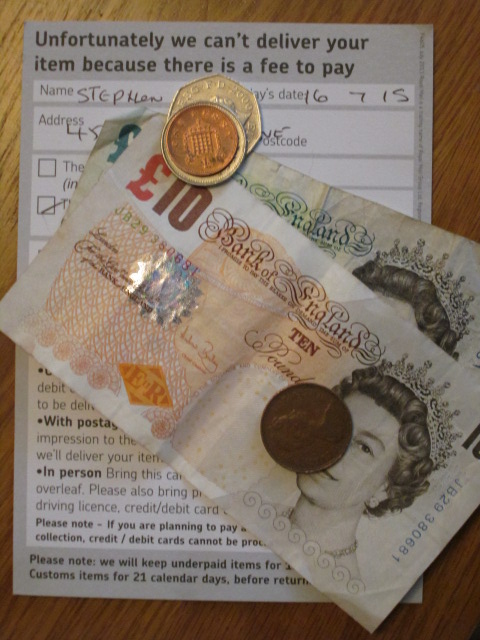
Post office then satisfied, I walked away with a receipt and the MDT goody box..
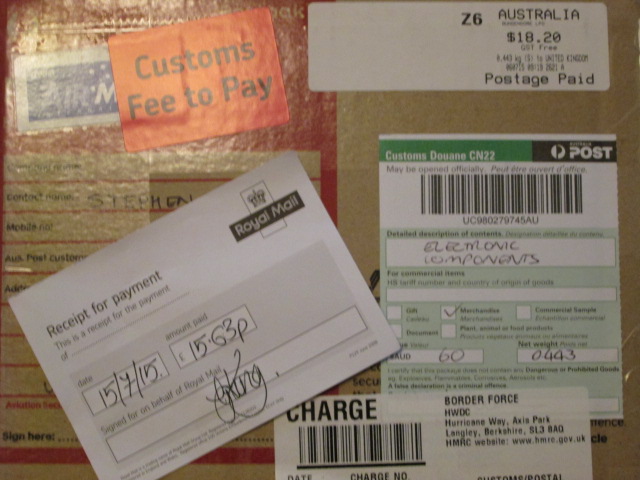
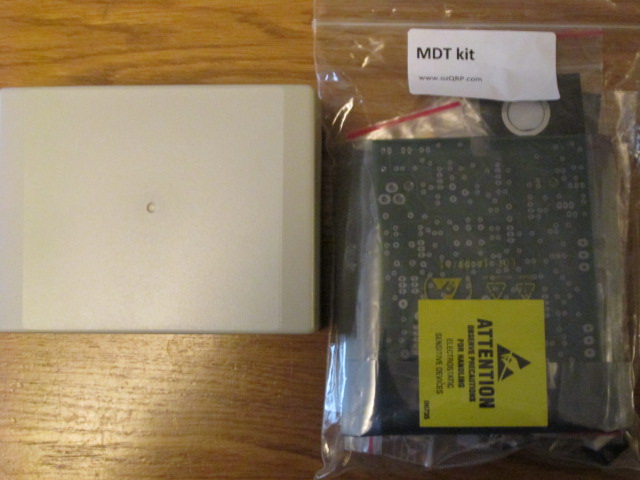
The components came well packaged in a sealed box, with all components wrapped in bubble wrap inside.
VK2DOB the owner of Ozqrp has done an excellent job collating all the components together for the MDT, all which have been separated off into little bags and clearly marked. The case comes with pre drilled, clear labelled, front and rear separate panels for the unit, including the hardware and the knobs. Even a Microphone plug has been included in the kit, so you won't have to spend time hunting around or having to go out to purchase one.
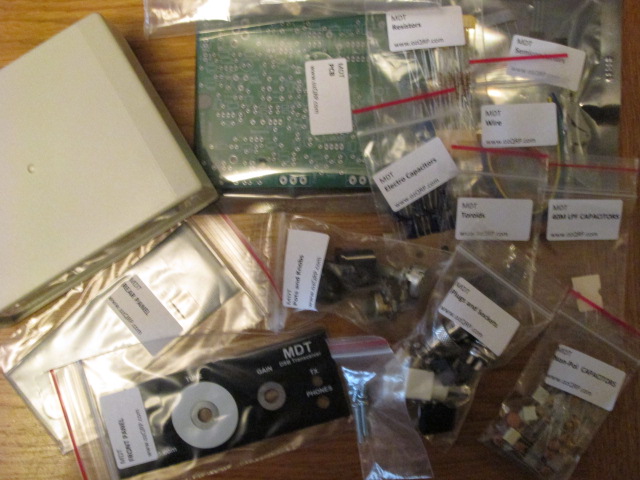
A well designed doubled sided PCB, which already has the only SMD component (the varicap diode) soldered to the board . This will save everyone time from fiddling around, especially those like myself with ailing eyesight.
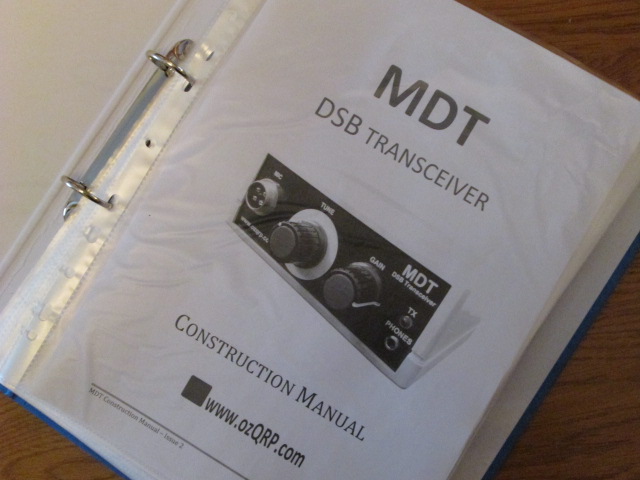
Last night I printed out the manual and bound it up into a simple folder. I recommend everyone print out "all" the 42 pages, and read it from cover to cover a couple of times before starting. Although what may be quite a simple and straight forward process to me, there is still quite a bit for the novice to take in.
The next time I write on this blog I guess certain parts of the kit will be completed? For now, I leave you with two more excellent VK3YE MDT videos, including extra modifications of the unit.
Portable operating with the MDT:
https://www.youtube.com/watch?v=xVvqZlzX8sk
Modifications to the MDT:
https://www.youtube.com/watch?v=rDd4cjkOAi8
Steve, G1KQH, is a regular contributor to AmateurRadio.com and writes from England. Contact him at [email protected].
Amateur Radio Weekly – Issue 69

Receiving New Horizons’ signal from Pluto
The 12-15 watt transmission is not a tight beam. As it travels through space, the radio waves spread out, becoming thinner and more diffuse.
CSIRO
Hamvention attendance up slightly in 2015
The official attendance at the 2015 Dayton Hamvention was 25,621. That’s an increase from the official count of 24,873 visitors last year.
ARRL
Q codes quiz
How well do you know your Q codes?
amateurradio.com
Fldigi adds FSQ mode
The FSQ implementation in Fldigi supports the directed, undirected and image modes of FSQ.
Mac Ham Radio
FSQ mode documentation
FSQ, Fast Simple QSO, is an Incremental-Frequency-Keyed mode using an offset differential modulation scheme similar to DominoEX, and Thor.
W1HKJ
More ISS SSTV July 18-19 on 145.800 MHz FM
ARISS SSTV images will be transmitted this weekend to commemorate the 40th Anniversary of the Apollo-Soyuz Mission.
AMSAT UK
Solar Cycle 25 and beyond
The one bright light is the likelihood of amazingly good low band (160, 80, 40m) conditions for many, many winters.
VE7SL
W4HH’s solar/battery setup
After calculating the Amp-hour load of my low-power radios, I decided to purchase a 12 Amp-hour battery and a solar panel that would put out enough current to charge that battery.
W4HH
Improving on FreeDV 700
Speech coding is the art of “what can I throw away.” Speech codecs remove a bunch of redundant information. As much as they can.
ROWETEL
How to
Working FO-29 semi-duplex
Going by the golden rule of manually tuning for Doppler on satellites, which is always tune the higher frequency, FO-29 can be worked with a semi duplex all mode radio.
AC0RA
Video
Introduction to DMR (Digital Mobile Radio)
Digital Mobile Radio (aka MotoTRBO) – a digital voice mode for VHF/UHF that is becoming more and more popular in Amateur Radio.
HamRadioNow
Amateur Radio Weekly is curated by Cale Mooth K4HCK. Sign up free to receive ham radio's most relevant news, projects, technology and events by e-mail each week at http://www.hamweekly.com.
 Ham Radio Deluxe |
 W5SWL Electronics |
 Ham Radio Prep |
 KB3IFH QSL Cards  Hip Ham Shirts  HamRadioAuctions HamRadioAuctions Reliance Antennas Reliance Antennas Enigma Shop Enigma Shop |  morseDX  Ni4L Antennas  R&L Electronics R&L Electronics antennas.us antennas.us QRV QRV |
- Matt W1MST, Managing Editor
