 |
 Historic adverts?
 26 July 2015 | by
 Thanks to Phil G4HFU (see earlier post) I have been reacquainted with the old PW adverts that got me dreaming over 50 years ago. I wonder if other blog readers can point me in the direction of old UK magazines and adverts? I was first interested in radio and SWLing in the early 1960s.
Back then, the world was a very different place. The Beatles were still in the future. We lived under the constant fear of all out nuclear war (I was terrified in the 1962 Cuba crisis) and most amateur DX was by CW or AM. Although RTTY was around, most digital modes were not. Magazines like Practical Wireless, Radio Constructor and Short Wave Magazine were filled with goodies I drooled over, but could not afford. Even now I do not like parting with money for amateur gear unless there is a good chance of getting very many years of good service from it.

Roger Lapthorn, G3XBM, is a regular contributor to AmateurRadio.com and writes from Cambridge, England.
6m SSSP JA’s
 |
| JA7DYN's Station |
Six meters delivered a mid-afternoon surprise yesterday, with a brief opening between the west coast and Japan. It was one of those openings that would have been missed entirely, a few years ago.
At around 2300Z, JE1BMJ (Han), announced via the ON4KST 50MHz chat page that he would be CQ'ing towards North America on 50.090KHz. I was working at the bench with the receiver running in the background and took a moment to turn my 4el yagi towards Japan and put the receiver on frequency. Nothing was heard for several minutes when, as if a switch had been thrown, the frequency became alive with CW sending "... DX K". About 20 seconds later it started again, a CQ DX from JE1BMJ. It is amazing how often the band or a path will appear to suddenly open, in this case, at just the tail end of Kas's CQ ... not a whisper of anything before the very tail end. As I listened, his signal built from the initial 559 to 579 at which point I called and we exchanged signal reports.
I moved down the band and called CQ DX and was immediately called by several loud JA stations. Over the course of the short opening (just 15 minutes from start to finish), I worked the following stations in Japan:
JE1BMJ
JA1VOK
JR2HCB
JF1UMK
JAØRUG
JM1IGJ
JG1TSG
JHØKHR
JF1IRW
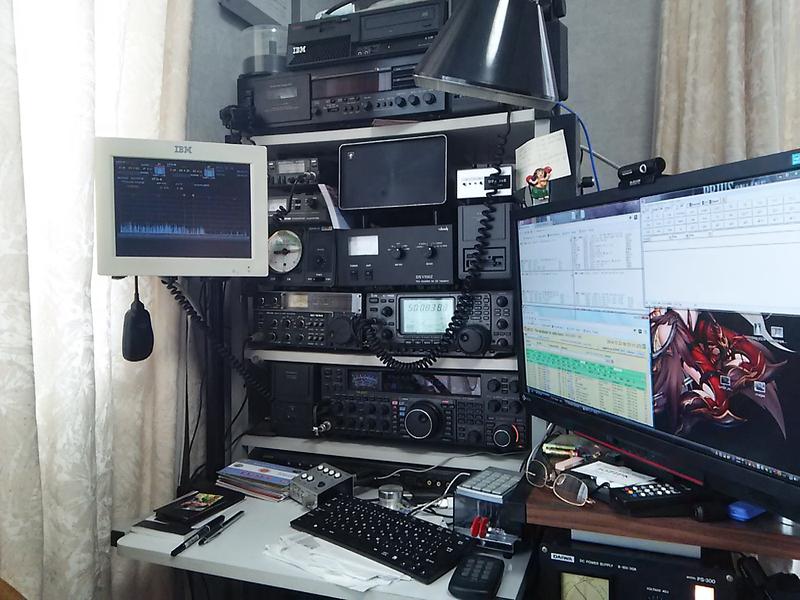
JA7DYN
JK1EXO
As mentioned earlier, this was an opening that would probably have been missed a few years ago, for several reasons. One factor is the growing use of the Internet to spot activity or stations that are actually on-the-air in real time. Another reason is the very short window of opportunity. Without stations looking, thanks to Han's QRV announcement, it is probable that nobody would have been pointing towards Japan at that time of the day ... but, more likely, the biggest reason is the exploitation of the SSSP path between NA and Asia that has become somewhat of a regular occurrence over the past several summers.
SSSP or Short-path Summer Solstice Propagation is the mechanism uncovered by JE1BMJ in 1999. In that year he discovered that his signals could be heard almost daily in many parts of Europe by transmitting on a regular evening schedule. He then turned his attention to North America, in the morning, and found much the same thing. Han continues to this day on a regular schedule each day and more often than not, works several stations in North America ... from both coasts and everything in between. He has even worked into Central America on SSSP.
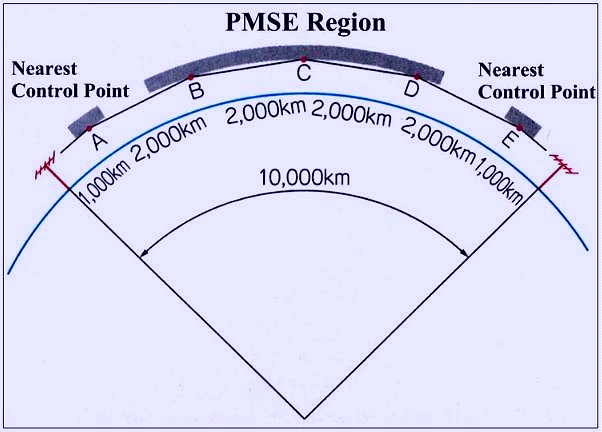
SSSP is a summertime-only event in the northern hemisphere and relies on the scattered ice crystals found in the Polar Mesospheric Summer Echo region (PMSE), located about 88km above the ground, very near the same height as the E-layer.
 |
| courtesy: JE1BMJ |
Signals travel through the polar region and never touch the ground until the far end of the path is reached. In all probability, this is the same mechanism that west coast stations are able to work transpolar-Es into Europe during the summer. The season is short-lived (June/July) and openings can have weak rapidly fading signals or, as in yesterday's case, strong steady signals during the course of the opening. Openings can last from just a few minutes to several hours. Thanks to the Internet and real-time chat, most of these openings are no longer being missed.
Stations being worked via SSSP seem to be, for the most part, running high-power and / or large antenna systems. It is rare to work many of the 100 watt stations, although under good conditions, it does happen.
 |
| JR2HCB's 6m Yagi Stack |
Steve McDonald, VE7SL, is a regular contributor to AmateurRadio.com and writes from British Columbia, Canada. Contact him at [email protected].
Amateur Radio Weekly – Issue 70

ARRL Board approves dues hike
The ARRL Board of Directors has approved a $10 increase in the League’s annual dues rate.
ARRL
My first SOTA Activation
It’s OK to screw up. After all, I’m sitting on a slab of granite, with a 5-watt radio, tapping out code on a straight key, on a fricking mountain!
KK4DSD
Working DL8DJM aeronautical mobile
Aeronautical Mobile contacts are pretty rare and the team in the gazebo fell silent as Johannes DL8DJM/AM told us that he was flying from Edinburgh to South Italy, about 100km from Amsterdam at 43,000ft.
Essex Ham
[PDF] The RF telecommunications system for New Horizons
This paper describes the design and development of the RF telecommunications system for the New Horizons mission, NASA’s mission to Pluto.
The Johns Hopkins University
USA Ham Radio License offered in UK
A group of ARRL certified Volunteer Examiners (VEs) will be hosting a USA ham radio exam night.
Southgate
Lunar Eavedropping
In 1969 Larry Baysinger independently detected signals from the Apollo 11 astronauts on the lunar surface.
Jefferson Community & Technical College
Ham fined $22,000 for malicious interference
Operator fined for causing intentional interference with other Amateur Radio communications and for failing to identify.
ARRL
PSAT PSK31 experimental software
Software allows your transmitted signal to drift exactly opposite to uplink Doppler effect.
DK3WN
Pentoo: Linux distro with GNU Radio and HackRF support
Pentoo is a Linux distribution with full support for the HackRF software defined radio and GNU Radio
Pentoo
NVIS
Near Vertical Incidence Skywave is an ionospheric skip operating technique that directs the strongest signals from a station vertically, or upward, rather than toward the horizon.
Ham Radio School
How to
EME on a budget
Moonbounce for the rest of us introduces EME and highlights operational basics and propagation.
hamradio.me
Video
Budget APRS mapping solution and portable battery box
This is one of several “homemade” APRS rigs that I cobbled together over the last year.
K7DCC
Getting started with the HackRF SDR
Shannon starts up the HackRF to show some of it’s capabilities. Follow along and learn about this new software defined radio peripheral capable of transmission or reception of radio signals!
Hak5
Amateur Radio Weekly is curated by Cale Mooth K4HCK. Sign up free to receive ham radio's most relevant news, projects, technology and events by e-mail each week at http://www.hamweekly.com.
Ham College Live Stream
Join us live on Saturday July 25th at 7:00 PM CDT, 0000 UTC on www.live.amateurlogic.tv for the next Ham College.
George Thomas, W5JDX, is co-host of AmateurLogic.TV, an original amateur radio video program hosted by George Thomas (W5JDX), Tommy Martin (N5ZNO), Peter Berrett (VK3PB), and Emile Diodene (KE5QKR). Contact him at [email protected].
Self-serving post…but not entirely
Yes, I am trying to sell books. I admit that right up front. That is how I feed my family and pay for Ham gear!
But I also have another purpose in the two new Amateur Radio books I have just published. I continually meet folks who either have considered joining the Ham Radio ranks but simply never followed through. And others who did all the work to get a license, maybe bought a two-meter HT, but never really went any farther in getting the most from our wonderful hobby.
OK, I realize what we all love so much is not everybody’s cup of tea. But I also believe that many who never develop into active Hams drop by the wayside because of four basic roadblocks…real or perceived. (And I am NOT including trepidation about passing the license exam. Anyone too timid to try the test probably wouldn’t take the next steps anyway.)
They are:
1) Putting together a station that would offer a complete and satisfying on-air experience.
2) Putting up an outside antenna.
3) Knowing what to say and do once on the air that would not get them ridiculed.
4) The jargon that has developed over the first century of Ham Radio’s existence.
In my new book, GET ON THE AIR…NOW!, I try to give practical, realistic advice on each of these stumbling blocks. I hope I have been successful because I want to see our hobby continue to grow and prosper.

One way I tackled obstacle #4–the one about jargon and gobbledygook–was to include in the book a complete Amateur Radio dictionary. As I compiled that section, I came up with far more terms than I expected–more than 1400 terms, 1600 definitions, and hundreds of web links–so I decided to not only make the dictionary a part of GET ON THE AIR…NOW! but publish it as a separate stand-alone book. It is cleverly titled THE AMATEUR RADIO DICTIONARY and is, I am confidently claiming, the most complete ham radio glossary ever compiled.

You can see info on both books at www.donkeith.com/hamradio/amateur-radio. The books are available wherever books are sold and in all e-book formats as well as in paperback.
But please consider my thoughts on those four hurdles that I believe keep many prospective Hams on the sidelines. If you agree, jump in and become a mentor, advise newcomers (or old-timers who never get on the air) on overcoming them, and help our wonderful hobby to continue to grow as we dive head-foremost into its second century.
73,
Don N4KC
www.n4kc.com
www.donkeith.com
Don Keith, N4KC, is a regular contributor to AmateurRadio.com and writes from Alabama, USA. Contact him at [email protected].
Control of Your Transmitter?
Are you really in control of your transmitter? I visited another radio club last night. It was interesting to hear the discussion about two new repeater projects the club is working on, including swapping the RF and control decks out with Yaesu’s Fusion offer. I could write a book on the pros and cons of the Fusion offer…today’s post isn’t about that.
What was interesting to me is that the club wasn’t concerned that they wouldn’t have remote control of their repeater transmitters the way that they do today. They are planning on running the repeaters in analog mode for output, and maybe dual mode for input. The comment that stuck with me is that they didn’t see any need for the repeater controllers they have today. The ability to make remote changes to the configuration, or to be able to shut the system down (and turn it back on) were not of interest to any of the members.
I’ve only run repeaters for a couple of years now. It has been quite the adventure. During that time, I had a cheap controller go belly up in such a way that it held the transmitter keyed down. The transmitter would overheat, shut off, cool off, then key down. Rinse and repeat. Over and over. The controller wouldn’t respond to any commands. It was a week before I could get to the site to replace the defective board. Since then, I’ve got a remote controlled power strip like we use in corporate data centers that allows me to power cycle equipment over the internet.
The thought of putting a repeater on the air without being in positive control is crazy. Sure, it’s very unlikely that the FCC is going to find you and fine you. That’s not the point…is it good practice to throw a system on the air that you can’t control? There are plenty of great solutions here that can be used. Put a second radio with a dtmf decoder on receive side of cans that controls the power. Use the internet and a $50 remote control power strip. Whatever solution you choose, please do something!
In this club’s case, the repeater guys are all retired and have easy walk-in access to the sites. In my case, the three repeaters I work on all required coordinated access, can’t be reached without taking man lifts or elevators, and two can only be accessed during my work day. Remote control – and positive control of the transmitters – is extremely important.
Michael Brown, KG9DW, is a regular contributor to AmateurRadio.com and writes from Illinois, USA. Contact him at [email protected].
Control of Your Transmitter?
Are you really in control of your transmitter? I visited another radio club last night. It was interesting to hear the discussion about two new repeater projects the club is working on, including swapping the RF and control decks out with Yaesu’s Fusion offer. I could write a book on the pros and cons of the Fusion offer…today’s post isn’t about that.
What was interesting to me is that the club wasn’t concerned that they wouldn’t have remote control of their repeater transmitters the way that they do today. They are planning on running the repeaters in analog mode for output, and maybe dual mode for input. The comment that stuck with me is that they didn’t see any need for the repeater controllers they have today. The ability to make remote changes to the configuration, or to be able to shut the system down (and turn it back on) were not of interest to any of the members.
I’ve only run repeaters for a couple of years now. It has been quite the adventure. During that time, I had a cheap controller go belly up in such a way that it held the transmitter keyed down. The transmitter would overheat, shut off, cool off, then key down. Rinse and repeat. Over and over. The controller wouldn’t respond to any commands. It was a week before I could get to the site to replace the defective board. Since then, I’ve got a remote controlled power strip like we use in corporate data centers that allows me to power cycle equipment over the internet.
The thought of putting a repeater on the air without being in positive control is crazy. Sure, it’s very unlikely that the FCC is going to find you and fine you. That’s not the point…is it good practice to throw a system on the air that you can’t control? There are plenty of great solutions here that can be used. Put a second radio with a dtmf decoder on receive side of cans that controls the power. Use the internet and a $50 remote control power strip. Whatever solution you choose, please do something!
In this club’s case, the repeater guys are all retired and have easy walk-in access to the sites. In my case, the three repeaters I work on all required coordinated access, can’t be reached without taking man lifts or elevators, and two can only be accessed during my work day. Remote control – and positive control of the transmitters – is extremely important.
Michael Brown, KG9DW, is a regular contributor to AmateurRadio.com and writes from Illinois, USA. Contact him at [email protected].
 Ham Radio Deluxe |
 W5SWL Electronics |
 Ham Radio Prep |
 KB3IFH QSL Cards  Hip Ham Shirts  HamRadioAuctions HamRadioAuctions Reliance Antennas Reliance Antennas Enigma Shop Enigma Shop |  morseDX  Ni4L Antennas  R&L Electronics R&L Electronics antennas.us antennas.us QRV QRV |
- Matt W1MST, Managing Editor
