 |
 The LM386 Pixie challenge
 11 August 2015 | by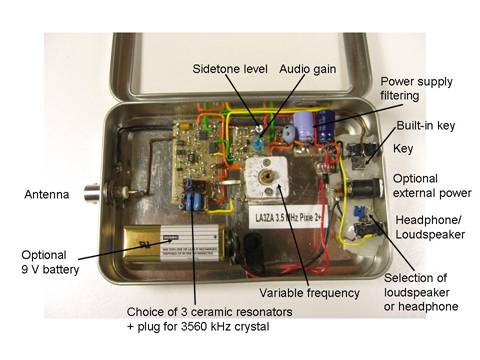
The Pixie 2 is this minimal transceiver which I and many others have played around with and had lots of fun with. My 80 m version is shown to the right, but right now it is very popular with some incredibly cheap Chinese ones on sale on Ebay and other places.
The Pixie 2 uses the versatile LM386 amplifier for its audio output. I have shown previously on this blog how its gain can be boosted and how it can implement a CW filter, and also how the muting can be improved. However, during transmission, the LM386 just sits there idle, although it can be used to amplify a sidetone from an external oscillator.
But I’m sure the old 70’s LM386 can do better than this. Despite its age, recently some pretty amazing uses of this chip have been demonstrated. It can be used as a regenerative receiver at least up to medium wave frequencies and it can also be used as an envelope detector/demodulator.
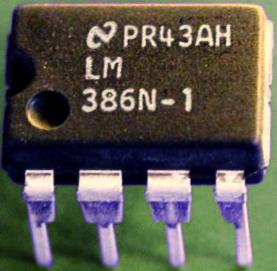
The LM386 challenge is this: Is is possible to implement a sidetone oscillator for the Pixie using only the LM386 with as few other components as possible? The output level needs to be controllable in order to make it comparable to that of the Pixie in the receiver mode.
The best data sheet for the LM386 seems to be the one for NJM386 from New Japan Radio Co. It is, as far as I know, the only one which shows the various muting circuits including the one using pin 7 which I have explored. It also shows the LM386 as an oscillator: both a sinusoidal and a square wave one.
In order for the LM386 to be useful as a sidetone oscillator, I believe that the oscillation must take place in the input circuitry. That seems to be the only way to ensure that the output doesn’t come out at a blasting full rail-to-rail swing as in the square wave oscillator example in the data sheet.
By the way, the data sheet referred to above is also the basis for the improved Spice model for the LM386 that just was developed. It came partly as a response to my complaint over how poor the present one was. Maybe the new Spice model, developed by EasyEDA, could help solve the LM386 challenge?
Sverre Holm, LA3ZA, is a regular contributor to AmateurRadio.com and writes from Norway. Contact him at [email protected].
Perseids Peaking
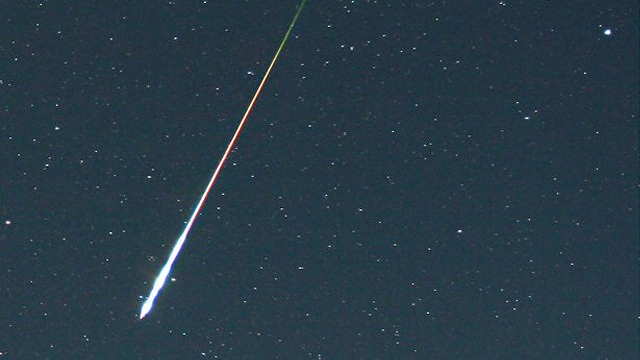
Nowadays, using FSK441 WSJT software, a lot of good fun can be had most non-shower mornings on meteor scatter, just using random meteors. My experience when using the same software during an actual shower has been disappointing, as often the signals are too strong or too long for the software which is looking for shorter, weaker signals. During a large shower such as the Perseids, where typical burns can be quite lengthy, my own experience has given better results with good old SSB or fast CW.
I clearly recall my first-ever meteor scatter QSO, made during the May Aquarids, back in the early 70's. I had arranged a sked with Ken, W7JRG, in Montana. I had grown up reading about Ken's VHF exploits in both QST and CQ as a teenager and was excited about the possibility of finally possibly working him. My station was homebuilt, using a 6360 transverter driven from my Heath HW-100, and feeding a homebrew 5894 amplifier with 1/4" copper tube plate lines. The amplifier produced just a shade over 100W output. My antenna, also homebrew, was a 24-foot 13 element Yagi ... probably not the best for meteor scatter although it worked well enough for me to ragchew every night with stations in Portland, Oregon on SSB.
A few minutes before our sked, I decided to make one final check of my system. Our sked was to be on SSB, using 15 second sequences. I keyed down at full-power and did a final tweaking of plate tuning and antenna loading, and unkeyed, back to receive mode after about 30 seconds of tuning up. My receiver immediately sprung to life with a very loud SSB signal, slightly off-tune. Thinking it was my local buddy, VE7BLF, calling me before the sked, I was surprised to hear a different voice ... it was Ken in Montana at S9++ ..."I've been holding my breath waiting for you to unkey there Steve ... thought you would never finish!"
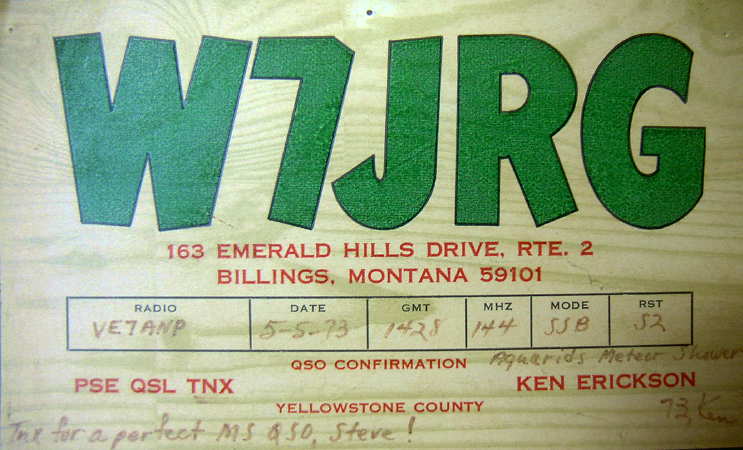
Needless to say I was just as surprised as he was. We talked back and forth for about another 60 seconds before the burn finally dissipated and signals were gone. What a great introduction to meteor scatter, with the QSO completed before the sked even started! Ken later told me that of all of the meteor contacts he had made, it was one of his best ... I guess we just hit it right.
Of all the showers, I always found that the December Geminids was the best, even better than the August Perseids, at least for the North-South path. Having said that, my longest meteor contact was made during the Perseids, with Arliss W7XU in South Dakota ... just a shade over 1300 miles while running just 40W SSB to a 9el Yagi.
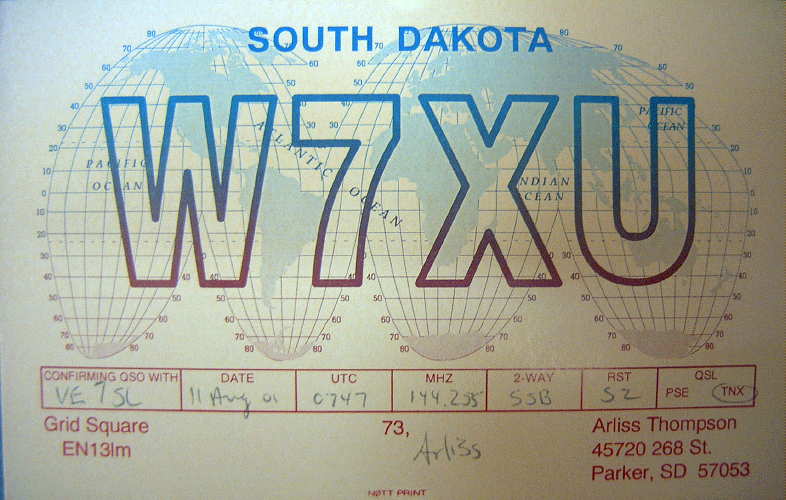
Good luck if you are doing some meteor scatter tomorrow or even if you are just watching the shower visually ... conditions should be ideal, if the skies are clear, as the very new moon's sliver does not rise until near dawn.
Steve McDonald, VE7SL, is a regular contributor to AmateurRadio.com and writes from British Columbia, Canada. Contact him at [email protected].
LHS Episode #152: Man Smart (Woman Smarter)
 Hello, ladies and gentlemen! It's time for another action filled episode of Linux in the Ham Shack. Topics for this episode include, women in technology, the Amateur Radio Parity Act of 2015, photo editors (of all things), databases for Linux hardware compatibility, ham radio-specific Linux distributions and much more. Thanks for spending an hour of your day with us. We appreciate all of our listeners. Also, don't forget to send us feedback. We'd love to hear from you.
73 de The LHS Guys
Russ Woodman, K5TUX, co-hosts the Linux in the Ham Shack podcast which is available for download in both MP3 and OGG audio format. Contact him at [email protected].
How I Worked VY0M From a Tent
I experimented with multiple antennas as I didn't know what I would be allowed to do at the camp. Would I be allowed to put up an antenna in camp? Would I have to find a remote location somewhere else? How long would my batteries last? So my plan was to try a Buddipole vertical first. It was relatively low profile and wouldn't attract a lot of attention. So I set up the station, in my tent, for a dry run.
As luck would have it, there was a 110v plug in my tent, the power intended to power a light and possibly a fan, so exit the batteries and in with the power supply. I set up the vertical and the antenna worked fine. I was using a Yaesu FT-857, which is a very capable radio, especially for portable use. With 70 watts I worked into Europe with good reports, so I was thinking that I might just get by with this set-up. However, the first day that VY0M came up, he was on SSB. I never heard a peep from him and decided it was time for plan B.
After erecting the vertical, a few around camp inquired about it and everyone thought the radio set-up was cool, so the next afternoon I decided to put up the bright orange Jacktite, 30 ft. collapsible pole with an end-fed long wire through a 9 to 1 balun. After I got everything connected, I turned on the radio and tuned the antenna with an LDG tuner. Everything looked good, so I checked the spots on my iPhone and Cezar had just moved to CW. I went to 14.040 and there he was with the fluttery signal common to stations in the far northern latitudes. After two or three calls I had him in the log, Victory dance. All the planning had paid off and I had another IOTA in the log.
What a blast ham radio is. Below is video of the set-up, right after I made the QSO. I didn't have the narrow CW filter on the FT-857, so the stations you hear are actually 1 KC up, but you can still hear Cezar's fluttery signal if you listen closely.
Mike Crownover, AD5A, is a regular contributor to AmateurRadio.com and writes from Texas, USA. Contact him at [email protected].
How I Worked VY0M From a Tent
I experimented with multiple antennas as I didn't know what I would be allowed to do at the camp. Would I be allowed to put up an antenna in camp? Would I have to find a remote location somewhere else? How long would my batteries last? So my plan was to try a Buddipole vertical first. It was relatively low profile and wouldn't attract a lot of attention. So I set up the station, in my tent, for a dry run.
As luck would have it, there was a 110v plug in my tent, the power intended to power a light and possibly a fan, so exit the batteries and in with the power supply. I set up the vertical and the antenna worked fine. I was using a Yaesu FT-857, which is a very capable radio, especially for portable use. With 70 watts I worked into Europe with good reports, so I was thinking that I might just get by with this set-up. However, the first day that VY0M came up, he was on SSB. I never heard a peep from him and decided it was time for plan B.
After erecting the vertical, a few around camp inquired about it and everyone thought the radio set-up was cool, so the next afternoon I decided to put up the bright orange Jacktite, 30 ft. collapsible pole with an end-fed long wire through a 9 to 1 balun. After I got everything connected, I turned on the radio and tuned the antenna with an LDG tuner. Everything looked good, so I checked the spots on my iPhone and Cezar had just moved to CW. I went to 14.040 and there he was with the fluttery signal common to stations in the far northern latitudes. After two or three calls I had him in the log, Victory dance. All the planning had paid off and I had another IOTA in the log.
What a blast ham radio is. Below is video of the set-up, right after I made the QSO. I didn't have the narrow CW filter on the FT-857, so the stations you hear are actually 1 KC up, but you can still hear Cezar's fluttery signal if you listen closely.
Mike Crownover, AD5A, is a regular contributor to AmateurRadio.com and writes from Texas, USA. Contact him at [email protected].
Coax losses
If you are like me, then you always want to know the loss of your coax at 6m,2m and 70cm, possibly higher I found this very useful table to compare various coax cables at different frequencies. You may have your own favorite table! If not, I hope you find this one useful.
See http://www.w4rp.com/ref/coax.html .

Roger Lapthorn, G3XBM, is a regular contributor to AmateurRadio.com and writes from Cambridge, England.
Yaesu FT991
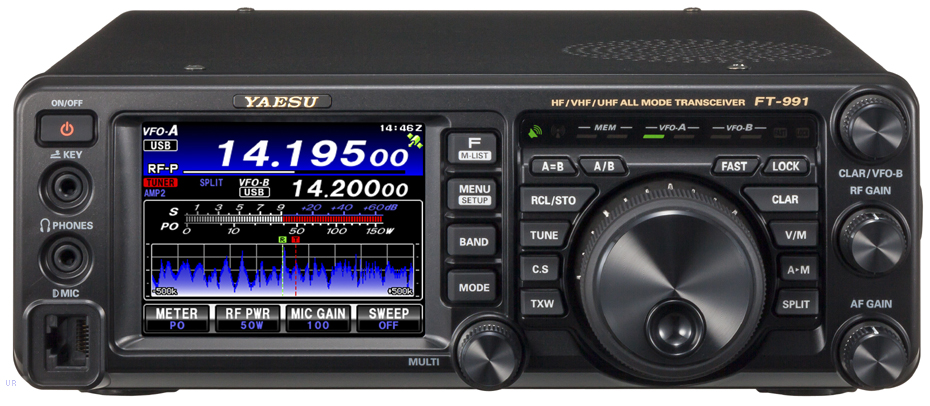
As I have said several times before, there is only one commercial rig that I fancy currently and that is the Yaesu FT991 that covers all of HF plus 6m, 2m and 70cm. However the UK price is still too high so I can wait and wait until the price drops. At £999 it will get serious consideration, but not at any higher price. The only other rig I fancy is an FT817 replacement, which may come later this year. Most of my operating is QRP and a 5-10W rig would suit my needs well.

Roger Lapthorn, G3XBM, is a regular contributor to AmateurRadio.com and writes from Cambridge, England.
 Ham Radio Deluxe |
 W5SWL Electronics |
 Ham Radio Prep |
 KB3IFH QSL Cards  Hip Ham Shirts  HamRadioAuctions HamRadioAuctions Reliance Antennas Reliance Antennas Enigma Shop Enigma Shop |  morseDX  Ni4L Antennas  R&L Electronics R&L Electronics antennas.us antennas.us QRV QRV |
- Matt W1MST, Managing Editor
