 |
 Amateur Radio Weekly – Issue 72
 9 August 2015 | by
FreeDV QSO Party Weekend
The Amateur Radio Experimenters Group would like to invite all amateurs interested in HF digital voice communications to join us on the weekend of September 12th and 13th in a FreeDV Codec2 digital HF voice QSO Party!
AREG
Do not Digipeat via PCSAT
Although this is the correct frequency for APRS operation in IARU Region 2, it is not compatible with our Region 1 bandplan.
AMSAT UK
My Amateur Radio bucket list. What’s yours?
There is just so many possible things you can do within the hobby that it could possibly take a lifetime to achieve.
NT1K
Chinese Amateur Radio Satellites set to launch in early September
The XW-2 series satellites are equipped with substantially identical Amateur Radio payloads — a U/V mode linear transponder, a CW telemetry beacon and an AX.25 19.2k/9.6k baud GMSK telemetry downlink.
ARRL
Simplex, Duplex, Offset and Split
Simplex is a term that applies on all of the ham bands, because it is the simplest way to communicate. However, it is not the “opposite” of using a repeater.
Ham Radio School
What happened when I added a counterpoise to my HT
By adding a 1/4-wave counterpoise, you, in effect, turn the antenna into an off-center-fed, vertically polarized 1/2-wave dipole.
KC4LMD
Facebook. What is it good for?
Notable Amateur Radio Facebook Groups.
W2LJ
DX from Bald Ledge
EA5GX Sergio in Spain was calling CQ and we made a quick contact. There was some QSB, but he gave me a 579. Finally, I heard LZ1GU in Bulgaria calling CQ. Harry was strong and he gave me a 569.
amateurradio.com
In Pacific islands, radio remains the most accessible news source
Newspapers are a luxury item. On average, each newspaper in the Pacific will be read by seven people, which helps explain why the daily paper’s print run is so low.
The Saturday Paper
How to
QRV from a new apartment
This mainly amounted to mounting and tuning my 20m hamstick and running cable to the radio. This doesn’t sound like much on paper but it was a lot more engineering than that.
W0EA
Video
Ham Radio fun with tropospheric ducting propagation
This is a sample of stations I worked or heard during a nice tropospheric ducting 2 meter band opening from my location in Albert Lea, Minnesota.
RadioHamGuy
Homemade yagi antenna field test
I demonstrate some local QRM that I have been receiving there, check access to 4 distant repeaters (GB3SC, GB3JB, GB3WH and GB3VA), and have a nice QSO with Andy (G6TRW).
YouTube
Amateur radio enthusiast contacts space station
We live in a world fascinated by space, but very rarely does the ordinary man reach up into the stars for a chat.
CNN
Amateur Radio Weekly is curated by Cale Mooth K4HCK. Sign up free to receive ham radio's most relevant news, projects, technology and events by e-mail each week at http://www.hamweekly.com.
Series Eight Episode Seventeen – Amateur Radio Ebay Reviews (9 August 2015)
In this episode, Martin M1MRB / W9ICQ is joined by Ed Durrant DD5LP ,Martin Rothwell M0SGL and Matthew Nassau 2E0MTT to discuss the latest Amateur / Ham Radio news. Colin M6BOY rounds up the news in brief, and this episodes feature is Ed’s Ebay purchases reviews and antennas.
- Proposed $1000 fine for Identifying Ham Radio Stations
- NoVs Changes for UK Intermediate Amateur Radio Operators
- Amateur Radio Vanity Call Sign Fee to Disappear in September
- Low Cost Device lets Hackers Hijack Satellite and Amateur Radio Satellite Communications
- Special Event Station Host for YOTA Required
- SignaLink and Other USB Digital Interfaces – Huge Bug + Fix for Amateur Radio Digital Modes
- Bogus Ofcom Email targets UK Amateur Radio Operators
- Amateur / Ham Radio Celebration and Promotion of Marine Beacons
- New Radio Initiative Website
- Radiomart.co.uk - New Classifieds Site
- Essex gets 2m D-STAR Amateur Radio Repeater
Colin Butler, M6BOY, is the host of the ICQ Podcast, a weekly radio show about Amateur Radio. Contact him at [email protected].
Series Eight Episode Seventeen – Amateur Radio Ebay Reviews (9 August 2015)
In this episode, Martin M1MRB / W9ICQ is joined by Ed Durrant DD5LP ,Martin Rothwell M0SGL and Matthew Nassau 2E0MTT to discuss the latest Amateur / Ham Radio news. Colin M6BOY rounds up the news in brief, and this episodes feature is Ed’s Ebay purchases reviews and antennas.
- Proposed $1000 fine for Identifying Ham Radio Stations
- NoVs Changes for UK Intermediate Amateur Radio Operators
- Amateur Radio Vanity Call Sign Fee to Disappear in September
- Low Cost Device lets Hackers Hijack Satellite and Amateur Radio Satellite Communications
- Special Event Station Host for YOTA Required
- SignaLink and Other USB Digital Interfaces – Huge Bug + Fix for Amateur Radio Digital Modes
- Bogus Ofcom Email targets UK Amateur Radio Operators
- Amateur / Ham Radio Celebration and Promotion of Marine Beacons
- New Radio Initiative Website
- Radiomart.co.uk - New Classifieds Site
- Essex gets 2m D-STAR Amateur Radio Repeater
Colin Butler, M6BOY, is the host of the ICQ Podcast, a weekly radio show about Amateur Radio. Contact him at [email protected].
New versions K1JT weak signal digital modes
Bob, G3WKW, has passed on this information from Joe Taylor K1JT:
“Date: Fri, 07 Aug 2015 16:28:19 -0400
Several people have asked for an update on development of the “Fast modes” in WSJT and WSJT-X. So here’s a brief summary.
First, a review of some relevant terms and motivations. It’s convenient to think of the various WSJT protocols (“modes”) in two groups:
*Slow modes* — JT4, JT9, JT65, and WSPR. These modes are designed for communication with extremely weak signals — often too weak to be heard. Target propagation modes include EME and long-distance troposcatter on HF-and-up bands, and QRP Dxing on the LF, MF, and HF bands. Relevant signal amplitudes are approximately constant over a minute and more, aside from so-called “libration fading” for EME. Transmit/receive sequences are 1 minute for JT4, JT9, and JT65, and 2 minutes for WSPR.
*Fast modes* — JTMS, FSK441, ISCAT, and JT6M — and now also *FSK315* (implemented in WSJT) and *JT9E* through *JT9H* (implemented in WSJT-X. These modes are made for communication with rapidly varying signals:for example, meteor scatter, ionospheric scatter, airplane scatter, and scatter off the International Space Station. The decoders are designed take advantage of short enhancements of signal strength. T/R sequences are 30 seconds (or sometimes even shorter).
Bill, ND0B, has implemented a trial version of FSK315 in WSJT. Think of this mode as FSK441 slowed down to 315 baud; the bandwidth is therefore narrow enough to make the mode legal in the “CW and data” portion of the 10 meter band. Bill and a few others have been experimenting with FSK315 and also ISCAT-A on 10 meters, under dead-band conditions, using meteors and ionospheric scatter propagation.
I have implemented experimental submodes of the JT9 protocol in the program branch WSJT-X v1.6.1. As with JT4 and JT65, letters following the “JT9” designator indicate increased spacings between the FSK tones. Traditional JT9 (now also called JT9A) has tone spacing 1.736 Hz, so the signals used at HF and below have total bandwidth 9*1.736 = 15.6 Hz. The widest of the new submodes, JT9H, has tone spacing 200 Hz and therefore bandwidth 9*200 = 1800 Hz.
When used with the standard 1-minute periods, the wide JT9 submodes should be useful for the same purposes as the wide JT4 submodes: microwave EME, for example, where libration fading can cause Doppler spreading of 100 Hz or more. Used in this way, all JT9 submodes are “slow” modes; they use 1-minute T/R periods and keying rate 1.736 baud, and they send the full 85-symbol message protocol in 85/1.736 = 48.96s.
Optionally, the wide JT9 submodes can now also use “fast” keying rates equal to their tone spacing. “Fast JT9H”, for example, uses keying rate 200 baud, so the full message protocol is transmitted in 85/200 = 0.425s. The message is sent repeatedly for the full Tx period, in the same way as done for the other fast modes.
The fast JT9 submodes should be very effective for meteors and ionoscatter propagation, especially on the 6 meter band. Sensitivity should be similar to ISCAT, or perhaps slightly better. Because JT9 includes strong forward error correction, decoding results are like those for all the slow modes: you should see messages exactly as they were transmitted, or nothing at all.
Tests of the fast JT9 submodes are currently under way, with excellent results.
— 73, Joe, K1JT”

Roger Lapthorn, G3XBM, is a regular contributor to AmateurRadio.com and writes from Cambridge, England.
So just how sporadic is sporadic E (Es)?
Time and again I have been struck by just how unsporadic Es is. OK, good days are random but there seems to be a pattern that more northerly and Scandinavian stations on 10m and 6m are better later in the day and later in the season. I actually wonder if these more northerly reports really are Es at all. There is every chance I am totally wrong, but I have noticed this over several summers and I question that Es is truly “sporadic”. I’d be interested to hear the views of others on this.
One thing is certain: we still have a great deal to learn about E-layer DX propagation. Es is certainly a fact on many summertime EU QSOs on the higher HF bands and 6m, but I am sure the multi-hop explanation for some very long distance QSOs is not right.

Roger Lapthorn, G3XBM, is a regular contributor to AmateurRadio.com and writes from Cambridge, England.
Summits On The Air at Central States VHF
Recently I had the opportunity to speak about portable, mountaintop VHF operating at the Central States VHF Society Conference in Denver. A key part of my presentation was the Summits On The Air program, portable VHF equipment, VHF contests and other operating events.
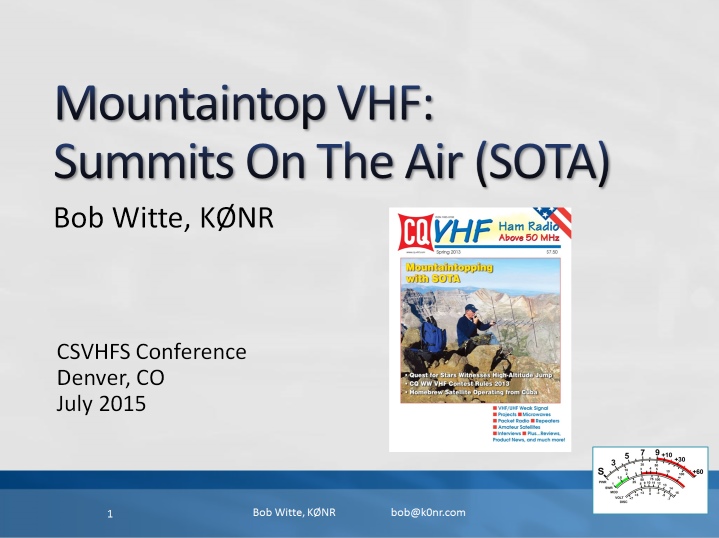 The presentation slides are available here in pdf format. I also submitted a paper on the same topic to the conference a paper on the same topic to the conference proceedings.
73, Bob K0NR
The post Summits On The Air at Central States VHF appeared first on The KØNR Radio Site.
Bob Witte, KØNR, is a regular contributor to AmateurRadio.com and writes from Colorado, USA. Contact him at [email protected].
Straight Key Century Club’s Weekend Sprintathon
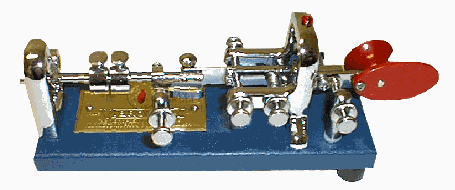
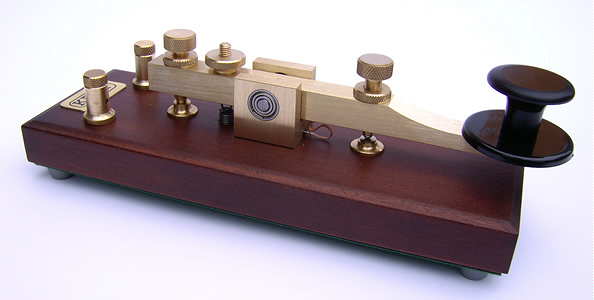 Can't wait 'til New Year's Eve's Straight Key Night? Enjoy CW as it has been sent since the earliest days of Amateur Radio in the SKCC Weekend Sprintathon! The SKCC regularly celebrates the joy of CW ... sent by either hand key or by bug:
The SKCC WES aims to bring together operators with different skill levels in a regularly scheduled, informal operating event lasting 36 hours. The event starts at 1200 UTC on the Saturday following the 6th of each month and ends at 2359 UTC on Sunday. Participants can operate for a total of no more than 24 hours. This event runs from 1200 UTC Aug. 8 to 23:59 UTC Aug. 9.
Non-members are encouraged to join in on the fun and, better yet, get an SKCC number by signing-up. Most of the action will congregate around the SKCC watering-hole frequencies:
Participants may sprint on 160-6 meters, excluding the WARC bands (60, 30, 17, and 12 meters). Suggested frequencies are on or around the SKCC calling frequencies: 1.820, 3.550, 7.055 and 7.114, 14.050, 21.050 and 21.114, 28.050 and 28.114, and 50.090 Mhz. K3UK's sked page or other spotting tools are permitted for this event.
I'll be on 20m for a few hours with my single 6L6 Tri-tet crystal oscillator running about 10 watts ... hopefully within a few KHz of 14.050, doubling from a 40m crystal along with my faithful Vibroplex, purchased as a teenager back in the early 60's.

For all of the details, visit the SKCC WES Rules page here ... so put away your keyers and have some real old fashioned radio fun.
Steve McDonald, VE7SL, is a regular contributor to AmateurRadio.com and writes from British Columbia, Canada. Contact him at [email protected].
 Ham Radio Deluxe |
 W5SWL Electronics |
 Ham Radio Prep |
 KB3IFH QSL Cards  Hip Ham Shirts  HamRadioAuctions HamRadioAuctions Reliance Antennas Reliance Antennas Enigma Shop Enigma Shop |  morseDX  Ni4L Antennas  R&L Electronics R&L Electronics antennas.us antennas.us QRV QRV |
- Matt W1MST, Managing Editor
