 |
 Frog Transceiver
 18 August 2015 | by
 You will have doubtlessly heard about the super cheap Pixie QRP TXRX. Well for those feeling a little flush there is a (and always has been) a real high powered alternative knocking about on eBay. The Frog Transceiver is around the £8 mark at the moment and will give you about 1.5w on 40m and an evenings worth of fun putting it together.
 I’m off work this week for my summer hols and in between kayaking on the sea, being eaten alive in Ennerdale by voracious midges (my own fault for going there when there was no wind and not taking any insect repellent) I’d planned on assembling this little friend to add to my growing collection (along with the Pixie).
The PCB is as one would expect, not bad but not brilliant, components are fit for purpose but the packaging was a little shabby with everything just thrown in a bag, not much protection for the IC’s. So I’m getting my excuses in early….this might not work!
Still £8 is less than an evening at the pub, less than a trip to the cinema (for one) but more than a Pixie 
Alex Hill, G7KSE, is a regular contributor to AmateurRadio.com and writes from Cumbria, UK. Contact him at [email protected].
The 10 Essentials for Hiking (and SOTA Activations)
 Most backcountry hikers are familiar with the Ten Essentials that you should take with you whenever you head into the wilderness. Over the past few years, I noticed that I was getting a bit sloppy with regard to what is actually in my pack when I head out on the trail. This hit home one day when my GPS battery went dead. I fumbled around to find my compass which was supposed to be in my pack. Well, it was in my pack, the other one that I left at home.
This caused me to review the list of ten essentials to make sure I had the right stuff in my kit. A search on the internet revealed that the classic list of ten has been modified and augmented by various people to make it better. (Innovation runs rampant on the interwebz, you know.) One of the better resources I found was this page on the REI web site, which explains how the Classic Ten Essentials have been updated to the Ten Essential Systems:
- Navigation (map and compass)
- Sun protection (sunglasses and sunscreen)
- Insulation (extra clothing)
- Illumination (headlamp/flashlight)
- First-aid supplies
- Fire (waterproof matches/lighter/candles)
- Repair kit and tools
- Nutrition (extra food)
- Hydration (extra water)
- Emergency shelter
Read through the REI web page to get the fine points of this system approach. I won’t repeat that information here. They also include a Beyond the Top Ten list which calls out the need for:
Communication device: Two-way radios, a cell phone or a satellite telephone can add a measure of safety in many situations.
Of course, what they really mean is an amateur radio transceiver and antenna but they probably can’t say that in print due to licensing issues. (Not everyone in the backcountry has an FCC ham license. I know, they all should have an amateur license but many don’t…very hard to understand.)
So how are you doing with your Ten Essentials list? Are you consistent in taking along the right stuff in your pack? Any tips to share with hiking hams?
73, Bob K0NR
The post The 10 Essentials for Hiking (and SOTA Activations) appeared first on The KØNR Radio Site.
Bob Witte, KØNR, is a regular contributor to AmateurRadio.com and writes from Colorado, USA. Contact him at [email protected].
On a scale of 1 to 10
The day started sunny and bright. As soon as I walked outside at 7:00 AM, it was easy to tell it was going to be a hot one. Summer! I love it!
I set out one of my 12 Volt SLA batteries on a patio chair in the backyard and hooked up one of my small solar panels to get it charged up. I had used the battery as a power source so I could program the Juentai VHF/UHF radio in the house, as well as to do some test transmissions. At 20 Watts out, I depleted the battery rather quickly, so I took the opportunity to use sunny days both yesterday and today to get it back up to full capacity.
I had gone to Mass on Saturday evening, so I used the quiet time (and "cool" morning) to install the Jeuntai into the Jeep. I mounted it "sideways" to the front console in the Patriot, where the transmission gear shift stick is. This is a really lousy photo, but it will show you what I mean:

I had to go to Home Depot to get some shorter sheet metal screws. The ones that came with the unit were about 3/4" long. I put my hand up and in behind the housing/fairing and could not feel anything vital behind my proposed mounting area, but I still wanted shorter screws. I got some 3/8" ones that did the job magnificently. The unit will sit a few inches from my right knee, but it is completely out of the way and non-interfering with the operation of the car. Not that I use it that much, bit it's great to have VHF/UHF in the car again.
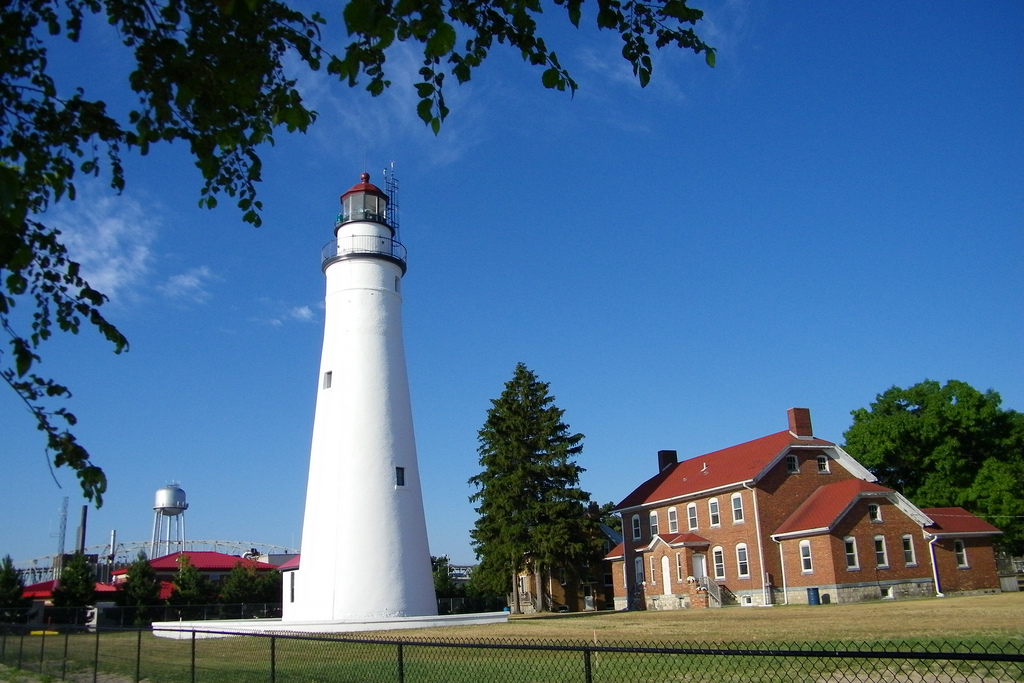
Shortly after, I went down the basement shack to see if I could work any lighthouses during International Lighthouse and Lightship Weekend. The bands were terrible! I managed to hear and work one - W8F, the Fort Gratiot lighthouse at Port Huron. Michigan. QSB was terrible, but I gave Stan a 579 and he gave me the same.
Then at 1:30 PM, I left to take a short drive over to Dave KD2FSI's house. Dave was hosting the South Plainfield Amateur Radio Club's Digital Rookie Roundup effort. He had his two Yaesu's hooked up and raring to go. He also had on display a Heathkit transciever that he recently bought at the Sussex County Amateur Radio Club Hamfest in July. Talk about pristine! Dave "lifted the hood" and let us take a look inside - it looked like it was built yesterday. It is immaculate, and looks like brand spanking new. And on the table next to it was an HW-8.
The bands were as terrible at Dave's house as they were at mine (surprise!). There wasn't a lot of Rookie RTTY activity, so Dave graced us with demos of PSK31 and the other digi modes and we had a great time shooting the breeze. Marv K2VHW and Drew W2OU were there in addition to a couple of Dave's neighborhood friends. I think between Dave, Marv, Drew and I, we gave his friends a good enough rundown on Amateur Radio that they could have passed the Tech test had we given it to them!
I had to leave at around 3:30 PM as I had promised my son Joey and my wife Marianne that I would accompany them to the community pool this afternoon. They've made use of the pool a lot this summer, and I haven't - so I promised I would go today. As I was leaving Dave's house and saying my good-byes, Dave says to me, "Make sure you don't leave without your radio." All I could do was shoot him a "?????" look. "The HW-8 ..... it's yours."
I was speechless. He had said that he had read somewhere (guess where?) that the HW-8 was my first QRP rig and that I had very much regretted parting with it years back. He had his son scour eBay for a good deal and acquired it for me. I was still speechless. I managed to croak out a "Thanks, Dave - you shouldn't have". But that is soooooooo inadequate. Dave has a heart of gold and as much as that HW-8 means to me, Dave's frienship means even more. I can't ever re-pay his generosity, but that sure doesn't mean that I'm not going to try - somehow, someway, someday.

As you can see, the rig is in pristine condition, besides the writing on the power supply, there's not a mark or scratch on it. Whoever had it made one modification that I can tell, they traded out the original RCA connector that was used for the antenna connection with an SO-239 - so that's perfect! This baby is going to get a lot of use. Yes, it's a HW-8, but I now have one back in my hands, and it's also a testament to the generosity of a great Ham and better yet, a great friend.
I did go to the pool with Marianne and Joey and even went in the water. I stayed at the shallow 3 foot end as I never learned how to swim as a kid. Even so, Marianne, Joey and I stayed there for about two hours, enjoying the cool water and we played a game of catch with this "Wubba" pool ball (small, soft, floats, unsinkable) that Joey had purchased when we were up at Lake George.
The evening was rounded out with a delicious dinner of grilled Teriyaki chicken, baked taters and corn, all consumed while leisurely sitting around the patio table in the back yard. We were able to enjoy the cooler evening air and each other's company.
So, yeah, on a scale of 1 to 10, today was about a 30 - heck, maybe even a 50!
72 de Larry W2LJ
QRP - When you care to send the very least!
Larry Makoski, W2LJ, is a regular contributor to AmateurRadio.com and writes from New Jersey, USA. Contact him at [email protected].
Failed 136kHz QRSS3 test
Well, I optimised my 136kHz QRSS3 beacon match into my earth electrode “antenna” used on 472kHz and tested it in the house and right outside. All looked promising, so I headed for my local car-park about 1.8km away. I was quite confident that with an E-field probe on the car I’d get a decent result. From the old QTH I got to the far side of Cambridge before I gave up as copy was so good!
Not a dicky bird – nothing at all, indeed I only got copy again when I entered our close at a range of a few hundred metres. As at VLF, the earth electrode “antenna” at this QTH is useless.
Not only that but at the end of the test I realise how poorly I still must be as I was totally exhausted. In my fitter days this test would have been totally trivial, but not any more. I think my trees and short baseline make this “antenna” totally out of the question at this QTH at LF. I need a better antenna for LF and MF use.
So, 136kHz was bad. A poor result and quite a lot worse than I was expecting. I was hoping for an encouraging result, but none was to be had.

Roger Lapthorn, G3XBM, is a regular contributor to AmateurRadio.com and writes from Cambridge, England.
The Best Laid Plans …
 |
| courtesy: www.kcj-cw.com/ |
Hoping to enjoy some further contest work and improve my ear-brain-keyboarding skills, I had prepared everything for this Saturday's 24-hour 'KCJ' Contest. The 'Keymen's Club of Japan' is an annual affair that seems to attract a lot of domestic JA activity, with bonus points when they work any DX stations. I checked my N1MM Logger software but it didn't seem to have the contest. I did find it in the program's UDC (User Defined Contests) section but had to download and install a unique 'Sections' file from a Japanese website, as the contest requires the Japanese to exchange their Prefecture abbreviations. I eventually had N1MM working perfectly for the KCJ contest and with the contest starting at 0500 locally, I tuned up everything for the normally excellent 40m path to Japan in the morning and went to bed.
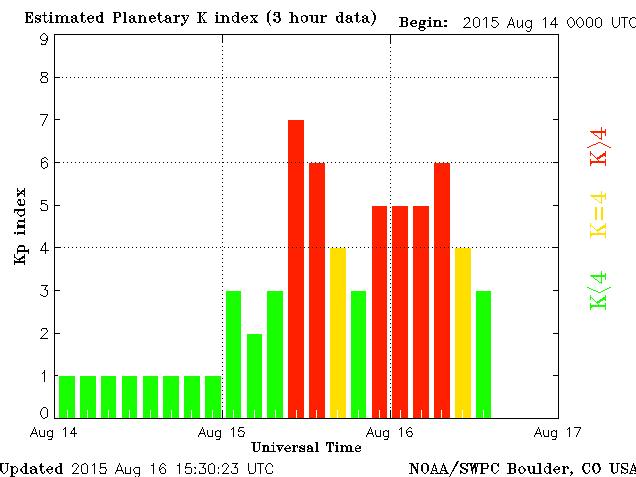 |
| courtesy: http://www.swpc.noaa.gov/ |
The afternoon path never really materialized either. Normally, propagation between the west coast and Japan is very good, with lots of strong signals being the norm ... but not today. Over the course of several hours, only four JA stations found their way into my log, and they were all a struggle.
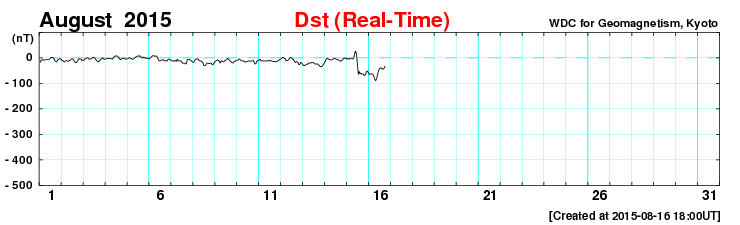 |
| courtesy: http://wdc.kugi.kyoto-u.ac.jp/dstdir/index.html |
The earth had been hit, rather unexpectedly, by another whopping 'coronal hole stream' and propagation was truly dismal. With only a smidgen of keyboarding practice, I had to admit defeat ... the Sun had messed things up once again, as it has been doing for the past year as Cycle 24 slowly slides downhill. Unfortunately there is always a lot more flaring and streaming on the way down than on the way up. Hopefully the Sun will soon get this out of its system and radio conditions will quiet down and stabilize for the upcoming fall and winter DX season.
There is one more chance left, this evening, to get in some more keyboarding practice. The 'Flying Pigs QRP Group' holds their monthly 'Run For The Bacon' CW QSO party, starting at 0100Z tonight. Non-members may also join in the fun by sending their 'power' level instead of a membership number ... so maybe I'll run into you tonight.

Steve McDonald, VE7SL, is a regular contributor to AmateurRadio.com and writes from British Columbia, Canada. Contact him at [email protected].
Amateur Radio Weekly – Issue 73

Getting started in Meteor Scatter
I write this during the peak of the Perseid meteor shower as it’s much more likely for a newcomer inspired by the article to decode meteor scatter bursts with a modest VHF station.
M1BXF
Perseids peaking
My receiver immediately sprung to life with a very loud SSB signal, slightly off-tune. We talked back and forth for about another 60 seconds before the burn finally dissipated.
VE7SL
Meteor Scatter experiments
Last weekend was very close to the peak meteor shower from Perseid. This gave us an ideal opportunity to try meteor scatter for the very first time.
Loughton & Epping Forest
J-Pole antenna grounding
A fully grounded antenna is certainly a very worthwhile goal so long as you don’t needlessly compromise the antenna’s functionality.
hamradio.me
Cross country HF APRS
The HF APRS network that resides in North America is on the high end of 30 meters. This band is open day and night.
VE6AB
$40 Arduino antenna analyzer
It is no surprise that hams will build an antenna analyzer from a DDS module and an Arduino instead of dropping a few hundred dollars on a commercial unit.
Hackaday
Skywave Linux
With global SDR access, shortwave listeners can access broadcast, utility, amateur radio, military, and other signals from almost anywhere in the world.
Skywave Linux
Tennessee QSO Party 2015
1800z Sunday, September 6 until 0300z Monday, September 7, 2015
Tennessee QSO Party
Noise canceling speaker hack
I have several Onkyo speakers from a retired surround sound system and a 100 watt 12 volt car audio amplifier and started to think on hacking this into something usable.
Prepared Ham
How to
Add OpenStreetMaps to Xastir
This tutorial will guide you how to install OSM maps into Xastir software.
S55MA Ham Blog
Video
Replace the meter light on a Kenwood TS-430s
KF4NOD
Portable radio operations
Using Morse Code to keep in touch with friends.
Wiltshire Man
Amateur Radio Weekly is curated by Cale Mooth K4HCK. Sign up free to receive ham radio's most relevant news, projects, technology and events by e-mail each week at http://www.hamweekly.com.
"Web price is best or call"
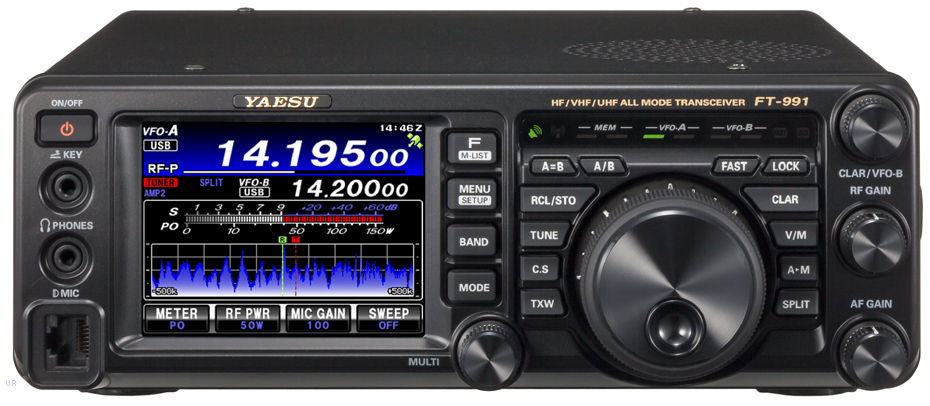 |
| FT991 from Yaesu |
The ongoing saga of the FT991 price fall continues. The phrase in the title is from the latest advert by MLS in Radcom. It looks like they know the price is too high but are looking to see who drops the price first – a kind of game of “chicken”. The best price advertised is £1139. Meanwhile the FT450D (HF and 6m) is just £499 from Waters and Stanton. I confidently predict the price of the FT991 from the major retailers will drop to £999, or even less, soon.

Roger Lapthorn, G3XBM, is a regular contributor to AmateurRadio.com and writes from Cambridge, England.
 Ham Radio Deluxe |
 W5SWL Electronics |
 Ham Radio Prep |
 KB3IFH QSL Cards  Hip Ham Shirts  HamRadioAuctions HamRadioAuctions Reliance Antennas Reliance Antennas Enigma Shop Enigma Shop |  morseDX  Ni4L Antennas  R&L Electronics R&L Electronics antennas.us antennas.us QRV QRV |
- Matt W1MST, Managing Editor
