 |
 The Best Laid Plans …
 16 August 2015 | by
  |
| courtesy: www.kcj-cw.com/ |
Hoping to enjoy some further contest work and improve my ear-brain-keyboarding skills, I had prepared everything for this Saturday's 24-hour 'KCJ' Contest. The 'Keymen's Club of Japan' is an annual affair that seems to attract a lot of domestic JA activity, with bonus points when they work any DX stations. I checked my N1MM Logger software but it didn't seem to have the contest. I did find it in the program's UDC (User Defined Contests) section but had to download and install a unique 'Sections' file from a Japanese website, as the contest requires the Japanese to exchange their Prefecture abbreviations. I eventually had N1MM working perfectly for the KCJ contest and with the contest starting at 0500 locally, I tuned up everything for the normally excellent 40m path to Japan in the morning and went to bed.
 |
| courtesy: http://www.swpc.noaa.gov/ |
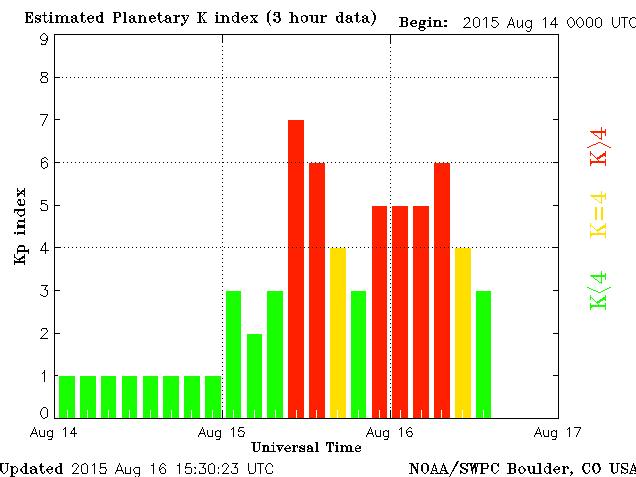
The afternoon path never really materialized either. Normally, propagation between the west coast and Japan is very good, with lots of strong signals being the norm ... but not today. Over the course of several hours, only four JA stations found their way into my log, and they were all a struggle.
 |
| courtesy: http://wdc.kugi.kyoto-u.ac.jp/dstdir/index.html |
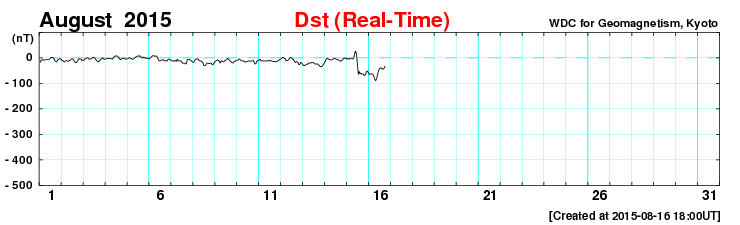
The earth had been hit, rather unexpectedly, by another whopping 'coronal hole stream' and propagation was truly dismal. With only a smidgen of keyboarding practice, I had to admit defeat ... the Sun had messed things up once again, as it has been doing for the past year as Cycle 24 slowly slides downhill. Unfortunately there is always a lot more flaring and streaming on the way down than on the way up. Hopefully the Sun will soon get this out of its system and radio conditions will quiet down and stabilize for the upcoming fall and winter DX season.
There is one more chance left, this evening, to get in some more keyboarding practice. The 'Flying Pigs QRP Group' holds their monthly 'Run For The Bacon' CW QSO party, starting at 0100Z tonight. Non-members may also join in the fun by sending their 'power' level instead of a membership number ... so maybe I'll run into you tonight.

Steve McDonald, VE7SL, is a regular contributor to AmateurRadio.com and writes from British Columbia, Canada. Contact him at [email protected].
Amateur Radio Weekly – Issue 73

Getting started in Meteor Scatter
I write this during the peak of the Perseid meteor shower as it’s much more likely for a newcomer inspired by the article to decode meteor scatter bursts with a modest VHF station.
M1BXF
Perseids peaking
My receiver immediately sprung to life with a very loud SSB signal, slightly off-tune. We talked back and forth for about another 60 seconds before the burn finally dissipated.
VE7SL
Meteor Scatter experiments
Last weekend was very close to the peak meteor shower from Perseid. This gave us an ideal opportunity to try meteor scatter for the very first time.
Loughton & Epping Forest
J-Pole antenna grounding
A fully grounded antenna is certainly a very worthwhile goal so long as you don’t needlessly compromise the antenna’s functionality.
hamradio.me
Cross country HF APRS
The HF APRS network that resides in North America is on the high end of 30 meters. This band is open day and night.
VE6AB
$40 Arduino antenna analyzer
It is no surprise that hams will build an antenna analyzer from a DDS module and an Arduino instead of dropping a few hundred dollars on a commercial unit.
Hackaday
Skywave Linux
With global SDR access, shortwave listeners can access broadcast, utility, amateur radio, military, and other signals from almost anywhere in the world.
Skywave Linux
Tennessee QSO Party 2015
1800z Sunday, September 6 until 0300z Monday, September 7, 2015
Tennessee QSO Party
Noise canceling speaker hack
I have several Onkyo speakers from a retired surround sound system and a 100 watt 12 volt car audio amplifier and started to think on hacking this into something usable.
Prepared Ham
How to
Add OpenStreetMaps to Xastir
This tutorial will guide you how to install OSM maps into Xastir software.
S55MA Ham Blog
Video
Replace the meter light on a Kenwood TS-430s
KF4NOD
Portable radio operations
Using Morse Code to keep in touch with friends.
Wiltshire Man
Amateur Radio Weekly is curated by Cale Mooth K4HCK. Sign up free to receive ham radio's most relevant news, projects, technology and events by e-mail each week at http://www.hamweekly.com.
"Web price is best or call"
 |
| FT991 from Yaesu |
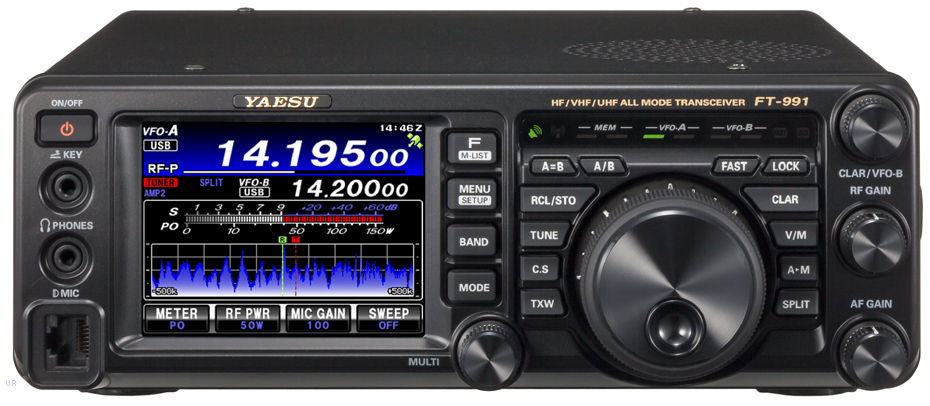
The ongoing saga of the FT991 price fall continues. The phrase in the title is from the latest advert by MLS in Radcom. It looks like they know the price is too high but are looking to see who drops the price first – a kind of game of “chicken”. The best price advertised is £1139. Meanwhile the FT450D (HF and 6m) is just £499 from Waters and Stanton. I confidently predict the price of the FT991 from the major retailers will drop to £999, or even less, soon.

Roger Lapthorn, G3XBM, is a regular contributor to AmateurRadio.com and writes from Cambridge, England.
Canadian 630m Ops Meet

 |
| Hakuna Matata under sail |
After a visit to the boat, a magnificent fractionally sloop-rigged 32' Beneteau, the Hakuna Matata, we all returned here to the house for refreshments, dinner and a station / antenna inspection. Part way through the visit I realized that our group contained 50% of Canada's active 630m operators, a rather sorry but true fact. In actuality, five out of the six Canadian 630m ops are VE7's! With such a special occurrence, a picture of the somewhat motley but enthusiastic crew was in order, with arms appropriately folded for the formal occasion.
 |
| Mark (VA7MM), myself and Toby (VE7CNF) |
Canadian amateurs have been fortunate enough to gain operating privileges in this very interesting part of the spectrum (472-479KHz) where surprisingly good results can be had with small backyard antenna systems. Hopefully with more activity from the west coast, amateurs in the prairie provinces and further east ... especially in highly-populated VE3, will take more interest in the band as two-way communications between the provinces can readily be done during the quiet winter nights.
With the USA well on its way to getting 630m operating privileges as well, it would be nice to see more Canadians on the band to take advantage of what is bound to be a flurry of activity from our southern neighbours ... there are already a dozen or more experimental stations there, just waiting to make the switch when the word comes.
More information on 630m operating and equipment see three related blogs:
630m Resources - Part 1
630m Resources - Part 2
630m Resources - Part 3
For a listing of all 630m-related blogs, click here.
Steve McDonald, VE7SL, is a regular contributor to AmateurRadio.com and writes from British Columbia, Canada. Contact him at [email protected].
Skeeter Hunt Videos
So far this year, two Skeeters have gone above and beyond the call of normal duty and have sent me a couple of short videos - so I will embed them here.
The first is from Nick WB5BKL, Skeeter # 84 from Texas:
and the second is from the fine Hams who make up the Burlington County Amateur Radio Club K2TD, Skeeter # 102 from Delanco, NJ. This one is from a bit of a different perspective and is way cool (not that Nick's isn't!):
Thanks guys, for sending these in! I think I'm going to have to ask Santa for a GoPro this Christmas so I can take videos of my QRP exploits, and share them, too. On second thought, maybe it's not such a good idea for you guys to see how I mess up - er, I mean operate. Hi!
72 de Larry W2LJ
QRP - When you care to send the very least!
Larry Makoski, W2LJ, is a regular contributor to AmateurRadio.com and writes from New Jersey, USA. Contact him at [email protected].
Arduino CW decoder – Conclusion
1. Line in or Microphone input
2. Easy to read display – all boxed neatly
3. An LED that shows the Zero beat
4. Easily accessible Reset Switch
5. Powered from a 12v supply.
I did want to create a usable PCB, something that could be used by a student or someone wanting to build the kit. So using the Fritzing application I set about laying out a circuit board.

This was my very first attempt at creating a PCB , so nerves were a wee bit on the tense side. I also wanted to box the project, so my rationale was to find a box first to work out the physical dimensions of the finished project.
As with the Vero Version – I created a layout that would fit on top of the UNO.
After submitting the design, and waiting a week I managed to get hold of 3 boards. They looked awesome. All white and exactly how I laid them out.
I did make 2 small errors on these boards. The first issue was sitting the capacitors a bit too close to the LM567 IC. That is an easy fix for the next version. But the 2nd and more serious issue is I forgot to ground 2 caps. They were floating and in parallel. I did fix this by attaching a wire to ground from one of the caps. That solved the issue, and I have already corrected the fault for the next batch of boards.
2 further observations of the boards & the project as a whole have highlighted 2 further improvements to the project. The location of the pins for the display / reset switch and audio OUT should be on the other side of the board. That would make a far better layout. Also adding in an audio oscillator / switch & plug to insert a key on the oscillator – then feed the output to the Arduino would immediately mean this kit could be used as a practice oscillator too. – that would show the letters as you transmit them out.
So here is a review of the project so far, and what I intend to do with the project going forward.
Dan Trudgian, MØTGN, is a regular contributor to AmateurRadio.com and writes from Wiltshire, England. He's a radio nut, IT guru, general good guy and an all round good egg. Contact him him here.
Arduino CW decoder – Conclusion
1. Line in or Microphone input
2. Easy to read display – all boxed neatly
3. An LED that shows the Zero beat
4. Easily accessible Reset Switch
5. Powered from a 12v supply.
I did want to create a usable PCB, something that could be used by a student or someone wanting to build the kit. So using the Fritzing application I set about laying out a circuit board.
This was my very first attempt at creating a PCB , so nerves were a wee bit on the tense side. I also wanted to box the project, so my rationale was to find a box first to work out the physical dimensions of the finished project.
As with the Vero Version – I created a layout that would fit on top of the UNO.
After submitting the design, and waiting a week I managed to get hold of 3 boards. They looked awesome. All white and exactly how I laid them out.
I did make 2 small errors on these boards. The first issue was sitting the capacitors a bit too close to the LM567 IC. That is an easy fix for the next version. But the 2nd and more serious issue is I forgot to ground 2 caps. They were floating and in parallel. I did fix this by attaching a wire to ground from one of the caps. That solved the issue, and I have already corrected the fault for the next batch of boards.
2 further observations of the boards & the project as a whole have highlighted 2 further improvements to the project. The location of the pins for the display / reset switch and audio OUT should be on the other side of the board. That would make a far better layout. Also adding in an audio oscillator / switch & plug to insert a key on the oscillator – then feed the output to the Arduino would immediately mean this kit could be used as a practice oscillator too. – that would show the letters as you transmit them out.
So here is a review of the project so far, and what I intend to do with the project going forward.
Dan Trudgian, MØTGN, is a regular contributor to AmateurRadio.com and writes from Wiltshire, England. He's a radio nut, IT guru, general good guy and an all round good egg. Contact him him here.
 Ham Radio Deluxe |
 W5SWL Electronics |
 Ham Radio Prep |
 KB3IFH QSL Cards  Hip Ham Shirts  HamRadioAuctions HamRadioAuctions Reliance Antennas Reliance Antennas Enigma Shop Enigma Shop |  morseDX  Ni4L Antennas  R&L Electronics R&L Electronics antennas.us antennas.us QRV QRV |
- Matt W1MST, Managing Editor
