 |
 Another VE3KCL Balloon Adventure
 23 August 2015 | by
 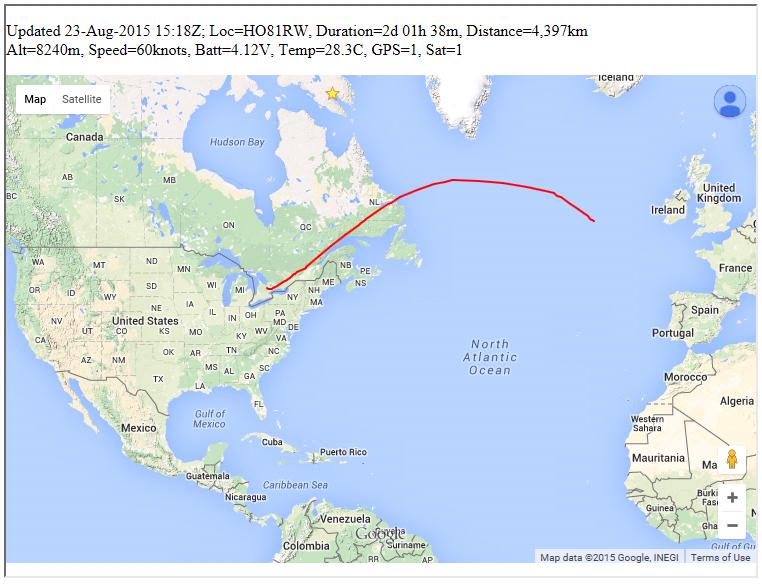 |
| courtesy: http://qrp-labs.com/ and https://www.google.ca/maps/ |
Like earlier flights, 'S-4' also uses a special U3 firmware version on an Arduino Nano board, with a QRP Labs Synthesiser, along with two hydrogen-filled party balloons with HF antennas hung between them. You can read all about Dave's previous flights here and keep up on the balloon's track here.
The balloon is transmitting data regularly on the following schedule:
0:00 CW ID, and 22wpm CW on 30m, 20m and 17m bands
0:01 JT9 on 10,140,450: "#CS#AT" (callsign, altitude)
0:02 JT9 on 10,140,450: "#LT#A0" (latitude, temperature on analogue A0)
0:03 JT9 on 10,140,450: "#LN#A3" (longitude, battery on analogue A3)
0:04 JT9 on 10,140,450: "#M6#GS" (6-char Maidenhead locator, groundspeed)
0:05 JT9 on 14,078,450: "#CS_#M6" (callsign, 6-char Maidenhead locator)
0:06 WSPR on 10,140,250 (standard WSPR transmission)
0:08 WSPR on 10,140,250 with special data telemetry encoding
0:10 22wpm CW on 15m, 10m and 6m bands
0:11 Calibration
0:12 Repeat...
Frequencies to listen on are:
Minute Mode Tag Frequency (Notes)
00:00 CWID. 10.140450 (GPS off)
00:12 CW 05 10.139150
00:27 CW 05 14.100550
00:42 CW 05 18.109150
01:00 JT9 00 10.140450
02:00 JT9 03 10.140450
03:00 JT9 04 10.140450
04:00 JT9 01 10.140450
05:00 JT9 02 14.078450
06:00 WSPR. 10.140250 (normal WSPR)
08:00 WSPR. 10.140250 (encoded WSPR)
09:50 CW 05 21.150150 (GPS on)
10:05 CW 05 28.205150
10:20 CW 05 50.070150
10:35 QRSS. 10.140450 (continuous 'space')
10:55 calibration
12:00 restart the sequence
Let's wish Dave luck and hope that this one makes a successful circumnavigation. It would be the first by a Canadian amateur I believe.
Steve McDonald, VE7SL, is a regular contributor to AmateurRadio.com and writes from British Columbia, Canada. Contact him at [email protected].
West Buffalo Peak (W0C/SP-018)
Buffalo Peaks are a pair of 13er summits that stick up quite prominently on the west side of South Park. West Buffalo peak is the taller of the pair (13,326 feet) and the SOTA summit (W0C/SP-018). I’ve had my eye on these peaks for a while, wanting to do a SOTA activation. Here’s a winter view of the summits from the south near Trout Creek Pass.
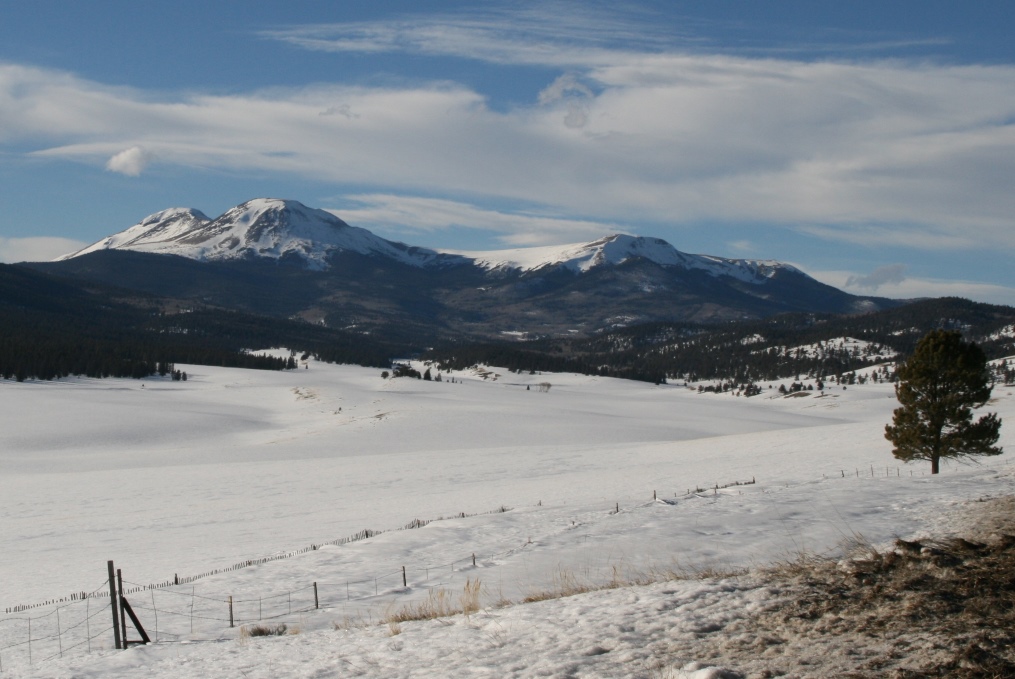
Buffalo Peaks in the Winter
There’s quite a bit of good information on the peaks at SummitPost.org.
Joyce K0JJW and I hiked in from the north, off of Buffalo Peaks Road (FS 431). The trailhead is not marked and is easy to miss but this trip report on the 13ers.com web site is very helpful. Pay special attention to the photo of the trailhead. This trip report describes doing both East and West Buffalo in a bit of a loop. We opted to focus on just West Buffalo, skipping East Buffalo.
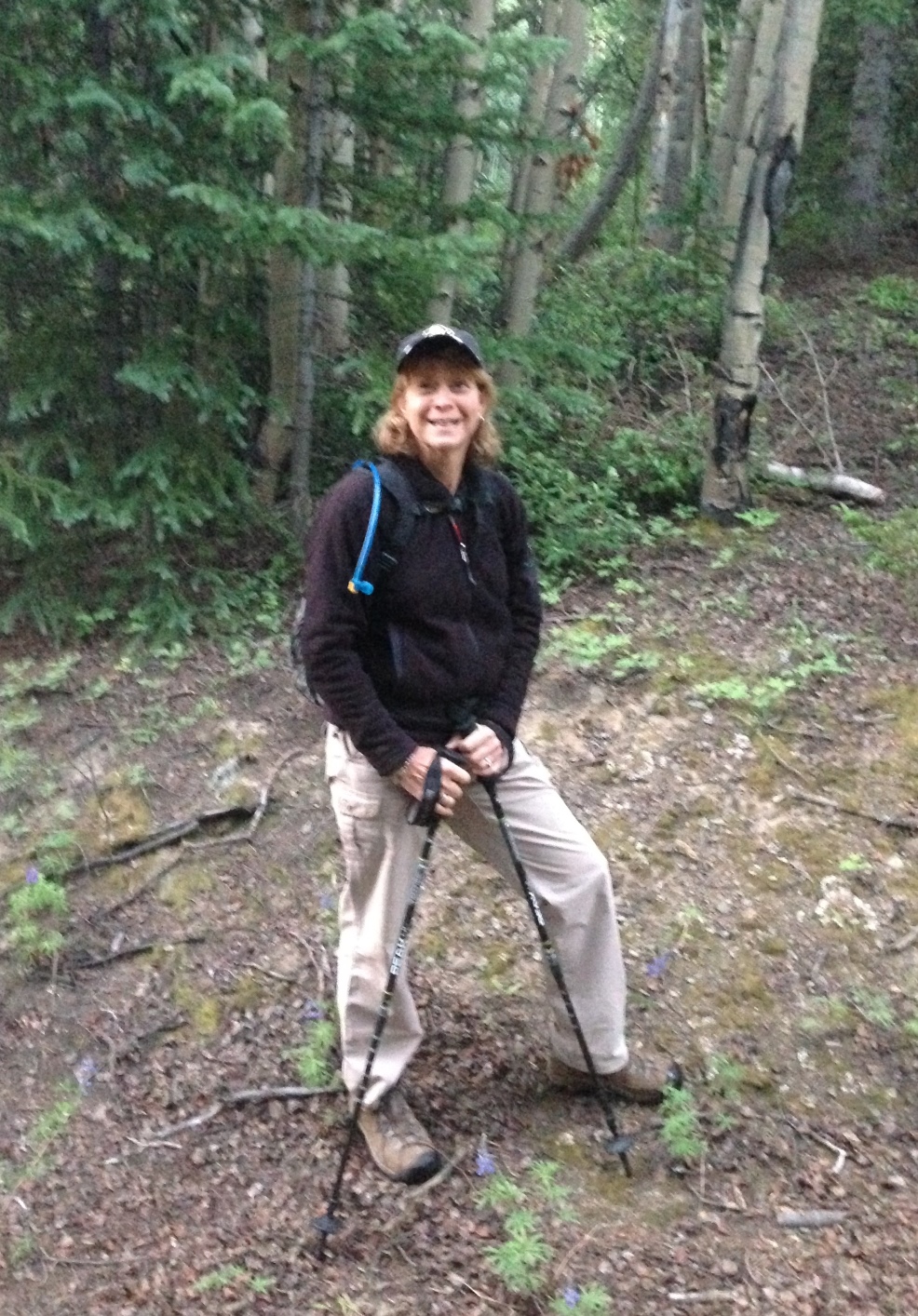
Joyce K0JJW on the trail.
Here’s my favorite hiking partner on the trail near the trailhead. The “trail” is not very well marked, following various old logging roads. We roughly followed the route indicate on 13ers.com. Once we cleared the trees we had a good view of both peaks and aimed for West Buffalo. We did make a critical error by going for the summit too early and got onto some very steep talus. Not fun. So the main route finding advice I am going to provide is make sure you approach the summit from the (more) gentle saddle on the northwest side. I marked this waypoint (N 38.99444, W 106.12866) as a good point to aim for on the way up so that you stay far enough west.
Once on the summit, I worked the following stations on 146.52 MHz: KD0MRC, KJ6NES, AF5KS, W9GYA, KE0DMT, W0BV and K5UK.
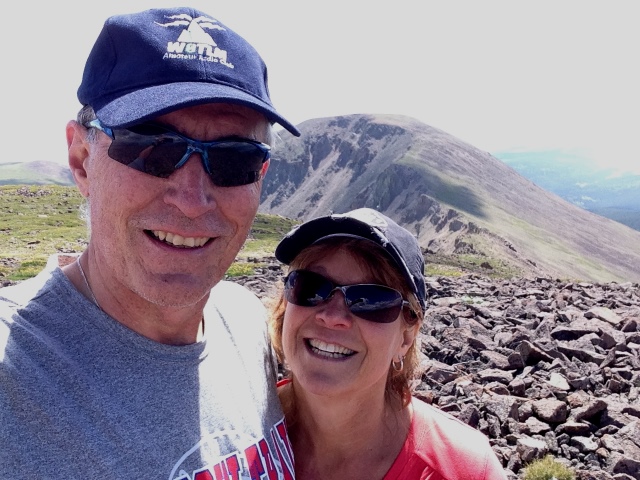
Bob K0NR and Joyce K0JJW on West Buffalo Peak, with East Buffalo Peak in the background.
On the descent we stayed west of the route marked on the 13ers.com trip report with the intent of having an easier route. However, mostly what we did was encounter additional off trail hiking, so that is probably not recommended. It would have been better to just retrace our ascent route. Eventually, we found a different trail that led back to FS 431, popping out about a quarter mile west of where we parked. I had the location of our Jeep marked in the GPS, so it was easy to backtrack to the vehicle.
This was the first SOTA activation for West Buffalo Peak, so it was great to get that in the log. Thanks to everyone that got on the air to work me.
73, Bob K0NR
The post West Buffalo Peak (W0C/SP-018) appeared first on The KØNR Radio Site.
Bob Witte, KØNR, is a regular contributor to AmateurRadio.com and writes from Colorado, USA. Contact him at [email protected].
Series Eight Episode Eighteen – Rigol 1050e Scope Review (23 August 2015)
In this episode, Martin M1MRB / W9ICQ is joined by Leslie Butterfield (G0CIB), Chris Howard (M0TCH / N4CTH) and Edmund Spicer (M0MNG) to discuss the latest Amateur / Ham Radio news. Colin (M6BOY) rounds up the news in brief, and this episodes feature is a review of a Rigol 1050e Scope .
- New Youth Amateur / Ham Radio Contesting Program
- Software Winner of Annual Construction Competition
- Ofcom - HF Broadcast Licensing Position
- Will There be an End to FM Radio Signal?
- The Longest Reign Amateur Radio Special Event Station
- Arduino CW Decoder Video
- VHF/UHF/Microwave SDR Transceivers
- £6bn Radio Replacement Emergency Staff May Put Lives at Risk
- Amateur Ham Radio Communications for Hospitals
- IRTS Amateur Radio Contests
- Do not Digipeat via PCSAT
Colin Butler, M6BOY, is the host of the ICQ Podcast, a weekly radio show about Amateur Radio. Contact him at [email protected].
Series Eight Episode Eighteen – Rigol 1050e Scope Review (23 August 2015)
In this episode, Martin M1MRB / W9ICQ is joined by Leslie Butterfield (G0CIB), Chris Howard (M0TCH / N4CTH) and Edmund Spicer (M0MNG) to discuss the latest Amateur / Ham Radio news. Colin (M6BOY) rounds up the news in brief, and this episodes feature is a review of a Rigol 1050e Scope .
- New Youth Amateur / Ham Radio Contesting Program
- Software Winner of Annual Construction Competition
- Ofcom - HF Broadcast Licensing Position
- Will There be an End to FM Radio Signal?
- The Longest Reign Amateur Radio Special Event Station
- Arduino CW Decoder Video
- VHF/UHF/Microwave SDR Transceivers
- £6bn Radio Replacement Emergency Staff May Put Lives at Risk
- Amateur Ham Radio Communications for Hospitals
- IRTS Amateur Radio Contests
- Do not Digipeat via PCSAT
Colin Butler, M6BOY, is the host of the ICQ Podcast, a weekly radio show about Amateur Radio. Contact him at [email protected].
The HF bands were dead today.
Mike Weir, VE9KK, is a regular contributor to AmateurRadio.com and writes from New Brunswick, Canada. Contact him at [email protected].
Regen Wrap-Up … What’s Next

I've also published a new page on my website which contains more pictures and details of all phases of the project. The page also has a recording of the 40m CW band, made a few evenings ago, which really best demonstrates how the receiver is working.
In the meantime, much consideration has been given to the next project work ... it will be a return to my earlier lightwave experiments. During the recent visit here by Toby (VE7CNF) and Mark (VA7MM), both expressed interest in building some lightwave equipment (in fact ... 'parts' have been ordered!) to try some direct LOS work as well as to try some QRSS clear-air scatter / cloudbounce work. It's really exciting to see some new interest in this fascinating mode as the field for experimentation in both transmitting and receiving systems is quite vast.
My first task will be to build a 4" optical tube receiver or another boxed Fresnel-lens type for portable operation, here on Mayne Island, to see if I can scatter a signal to the other side of the island and detect it while operating in the field. There are a couple of nearly 600' peaks on Mayne which should provide a good shielding effect for testing ... maybe too good. Time will tell.
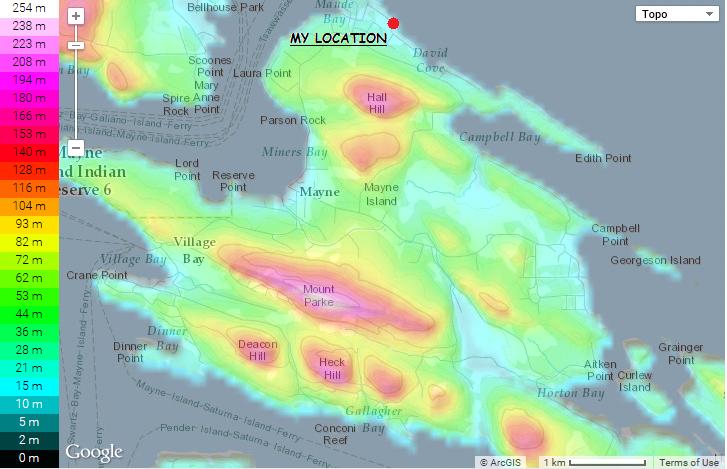 |
| courtesy: http://en-ph.topographic-map.com/ |
Steve McDonald, VE7SL, is a regular contributor to AmateurRadio.com and writes from British Columbia, Canada. Contact him at [email protected].
Amateur Radio Weekly – Issue 74

$8,000 fine proposed for Ham causing interference, failing to identify
Ham volunteered to track down the interference he was causing.
ARRL
Are Amateur Radio-based emergency communications still relevant?
From “we are the be all and end all of disaster communications planning” down to “hams who show up to emergency scenes should be arrested.” So what’s the answer?
VA3QR
Slim Jim vs. Traditional J-pole Antenna
Real measurements of a Slim Jim antenna and traditional j-pole antenna reveal the truth about their respective gain and pattern.
hamradio.me
New, fast JT9 Meteor Scatter modes
Joe Taylor K1JT has published some information about the new ‘Fast JT9’ submodes for Meteor Scatter communication on 28 and 50 MHz.
Southgate
Rufus Turner: Ham Radio’s first African American Operator
Rufus was an engineer who developed the 1N34A germanium diode in the 1946.
KC4LMD
First Tracksoar test flight
The Tracksoar APRS tracker is designed to be flown under anything capable of lifting 60 grams, including balloons, RC planes, quad copters, or anything else that flies.
Tracksoar
Danish CubeSats head for ISS
The IARU have coordinated 437.250 MHz for the 1k2-9k6 bps beacon and 437.425 MHz for the GMSK beacon.
AMSAT UK
SkookumLogger contest logger for OS X
Supporting CW and SSB events on the six HF contest bands plus 6m, 4m, 2m, and 70cm.
K1GQ
CJU satellite antenna for HTs
A minimalist satellite system.
VE6AB
How to
Setting up Ubuntu for Decoding NOAA and Meteor M2 Sats
In this guide, I will attempt to make it easy to set up Ubuntu with GQRX, GNU Radio Companion, WxtoIMG, and Tools for decoding Meteor M2 Sats.
voiceoverman
And finally…
One acorn too many
Woodpecker fills Antenna with Acorns.
YouTube
Amateur Radio Weekly is curated by Cale Mooth K4HCK. Sign up free to receive ham radio's most relevant news, projects, technology and events by e-mail each week at http://www.hamweekly.com.
 Ham Radio Deluxe |
 W5SWL Electronics |
 Ham Radio Prep |
 KB3IFH QSL Cards  Hip Ham Shirts  HamRadioAuctions HamRadioAuctions Reliance Antennas Reliance Antennas Enigma Shop Enigma Shop |  morseDX  Ni4L Antennas  R&L Electronics R&L Electronics antennas.us antennas.us QRV QRV |
- Matt W1MST, Managing Editor
