 |
 Web designers of the world
 7 September 2015 | by
 You have no competition from W2LJ - whatsoever. I have finished the 2015 Skeeter Hunt Soapbox and have posted it to the Web. A bona fide Web designer probably could have done in an hour what took me a lot longer to accomplish. And I bet it would look a lot better, too. Mr. Originality or Mr. Creativity, I am not!
In all their non-glory, they are there for your perusal. Just click and go!
2015 Scoreboard
2015 Soapbox
72 de Larry WLJ
QRP - When you care to send the very least!
Larry Makoski, W2LJ, is a regular contributor to AmateurRadio.com and writes from New Jersey, USA. Contact him at [email protected].
Satellite Operation @ WØLFA
I recently set up a satellite station at WØLFA to see how well the GØKSC-designed InnovAntennas LFA Yagis, which work so well on VHF and UHF terrestrial weak signal modes, would work with the amateur radio satellites. Up went a five element LFA for 2m (2 LFA 5) and a ten element LFA for 70cm (70 LFA 10). The 2m LFA was tuned for 146 MHz and the 70cm LFA was tuned for 436 MHz to put them near the center of the satellite subbands, simple adjustments of the LFA driven element loop in each case. The LFAs were mounted vertically so that the aluminum cross-arm would not disrupt their highly-optimized, low sidelobe designs.

Both Yagis are relatively compact and sit about eight feet above ground on a Glen Martin Engineering ‘Quadpod’ tower mounted just behind the WØLFA shack. SSB-Electronic LNA SP-200 & SP-70 preamps with VOX sensed T/R relays are mounted on the tower close to the antennas to optimize system performance. Since satellite operation is low power, I opted for the simplicity of the VOX capability built into the SSB LNAs; less wires is always a good thing!
Positioning is provided by an AlfaSpid RAS rotator controlled by a rack-mounted AlfaSpid MD-01 controller. Rig is a Yaesu FT-847, the only non-SDR radio @ WØLFA, which I kept around solely for satellite use as our SDR rigs, as much as I love them, don’t (yet) have the full-duplex features needed for serious satellite operation. Satellite tracking is handled by SatPC32 software running on a Windows 7 64 PC. SatPC32 communicates with the FT-847 via a serial port null modem cable and with the MD-01 via a standard straight-through serial cable on a second serial port.
Here is what the XW-1 (Xi Wang 1 aka Hope OSCAR or HO-68) ham satellite sounded like at WØLFA on Aug 10, 2015 at around 03:30 UTC. XW-1 was launched in 2009 from the Taiyuan Satellite Launch Center in Shanxi province, China. After about a year, the transponder failed, however, the little ‘bird’ (68 x 48cm) continues to orbit and its 200 mW (2/10th of one Watt!) Morse code beacon continues to transmit. Note the manual Doppler correction! (I have since enabled the automatic Doppler correction feature in SatPC32.)
All of the antenna system items used here, from InnovAntennas, AlfaSpid, and SSB-Electronic, are available from the Force 12 Superstore.
Bill Hein, AA7XT, is a regular contributor to AmateurRadio.com and writes from Colorado, USA. He is co-owner of Force 12 and InnovAntennas. Contact him at [email protected].
TX Factor Episode 9 is Ready to Watch
The popular UK TV show dedicated to amateur radio is back on the air with episode 9 featuring ham radio Essex-style!
We visit the south east of England to report on the work of Chelmsford ARS, Essex Repeater Group and Essex Ham.
And we’re giving away a CG-PK4 Pocket Memory Keyer in our free-to-enter draw.
Hope you enjoy the show!
Nick Bennett 2EØFGQ co-hosts TX Factor with Bob McCreadie GØFGX and Mike Marsh G1IAR. Contact the team at [email protected]
Series Eight Episode Nineteen – Microphones in Amateur / Ham Radio (06 September 2015)
In this episode, Martin M1MRB / W9ICQ is joined by Ed Durrant DD5LP and Matthew Nassau M0NJX to discuss the latest Amateur / Ham Radio news. Colin M6BOY rounds up the news in brief, and this episodes feature is a review of a Microphones in ham radio
- Secondary School Students Decode ISS Images
- South African 40 MHz (8m) ham radio contact
- FreeDV digital HF Voice Mode QSO Party
- Senator Thanks Radio Amateurs
- FCC Considering Proposal to End Modification of IT devices
- Expected September Release of 5 MHz in Netherlands
- Outcome for 5 MHz at WRC-15 Remains in Limbo
- Improving Amateur / Ham Radio Club Websites
Colin Butler, M6BOY, is the host of the ICQ Podcast, a weekly radio show about Amateur Radio. Contact him at [email protected].
Series Eight Episode Nineteen – Microphones in Amateur / Ham Radio (06 September 2015)
In this episode, Martin M1MRB / W9ICQ is joined by Ed Durrant DD5LP and Matthew Nassau M0NJX to discuss the latest Amateur / Ham Radio news. Colin M6BOY rounds up the news in brief, and this episodes feature is a review of a Microphones in ham radio
- Secondary School Students Decode ISS Images
- South African 40 MHz (8m) ham radio contact
- FreeDV digital HF Voice Mode QSO Party
- Senator Thanks Radio Amateurs
- FCC Considering Proposal to End Modification of IT devices
- Expected September Release of 5 MHz in Netherlands
- Outcome for 5 MHz at WRC-15 Remains in Limbo
- Improving Amateur / Ham Radio Club Websites
Colin Butler, M6BOY, is the host of the ICQ Podcast, a weekly radio show about Amateur Radio. Contact him at [email protected].
Amateur Radio Weekly – Issue 76

Pi-Go 12v power adapter for Raspberry Pi
The Pi-Go connects to the GPIO header and supplies a solid 5V at up to 3A for the Pi and its connected peripherals.
Kickstarter
$50SAT falls silent
The $50SAT amateur radio spacecraft has ceased transmitting after nearly 20 months in space.
AMSAT UK
Labor Day weekend: a great time for pirate radio action
Monday, September 7, is Labor Day throughout most of North America; shortwave pirates love to operate on long holiday weekends.
The SWLing Post
New versions K1JT weak signal digital modes
Think of this mode as FSK441 slowed down to 315 baud; the bandwidth is therefore narrow enough to make the mode legal in the “CW and data” portion of the 10 meter band.
amateurradio.com
HI HI: LOL of the 19th century
LOL in the age of the telegraph.
The Conversation
Sound of a sinking ship
Listen to the Morse code interchange between a sinking cruise ship and fellow ships.
hamradio.me
Open letter to Ham Radio manufacturers
Once upon a time, companies like yours developed equipment for hams entering the hobby as Novice licensees.
KC4LMD
Liquid metal changes shape to tune antenna
Liquid at room temperature, these alloys have the useful property of oxidizing on contact with air and forming a skin.
Hack A Day
Solar storm of 1859
Telegraph systems all over Europe and North America failed, in some cases giving telegraph operators electric shocks. Telegraph pylons threw sparks. Some telegraph operators could continue to send and receive messages despite having disconnected their power supplies.
Wikipedia
Video
Video of ICOM IC-7300 in action
IZØKBA
Digital voice and SSB comparison
You can really notice the reduced audio bandwidth and ever present noise of SSB compared to FreeDV. This is just the start – we are gradually improving the low SNR robustness and speech quality of FreeDV.
Rowetel
and finally…
RTTY decoder for Commodore 64
Decodes RTTY audio to readable text on the screen of your Commodore 64.
ebay
Amateur Radio Weekly is curated by Cale Mooth K4HCK. Sign up free to receive ham radio's most relevant news, projects, technology and events by e-mail each week at http://www.hamweekly.com.
The Wouxun KG-UV8D arrival.
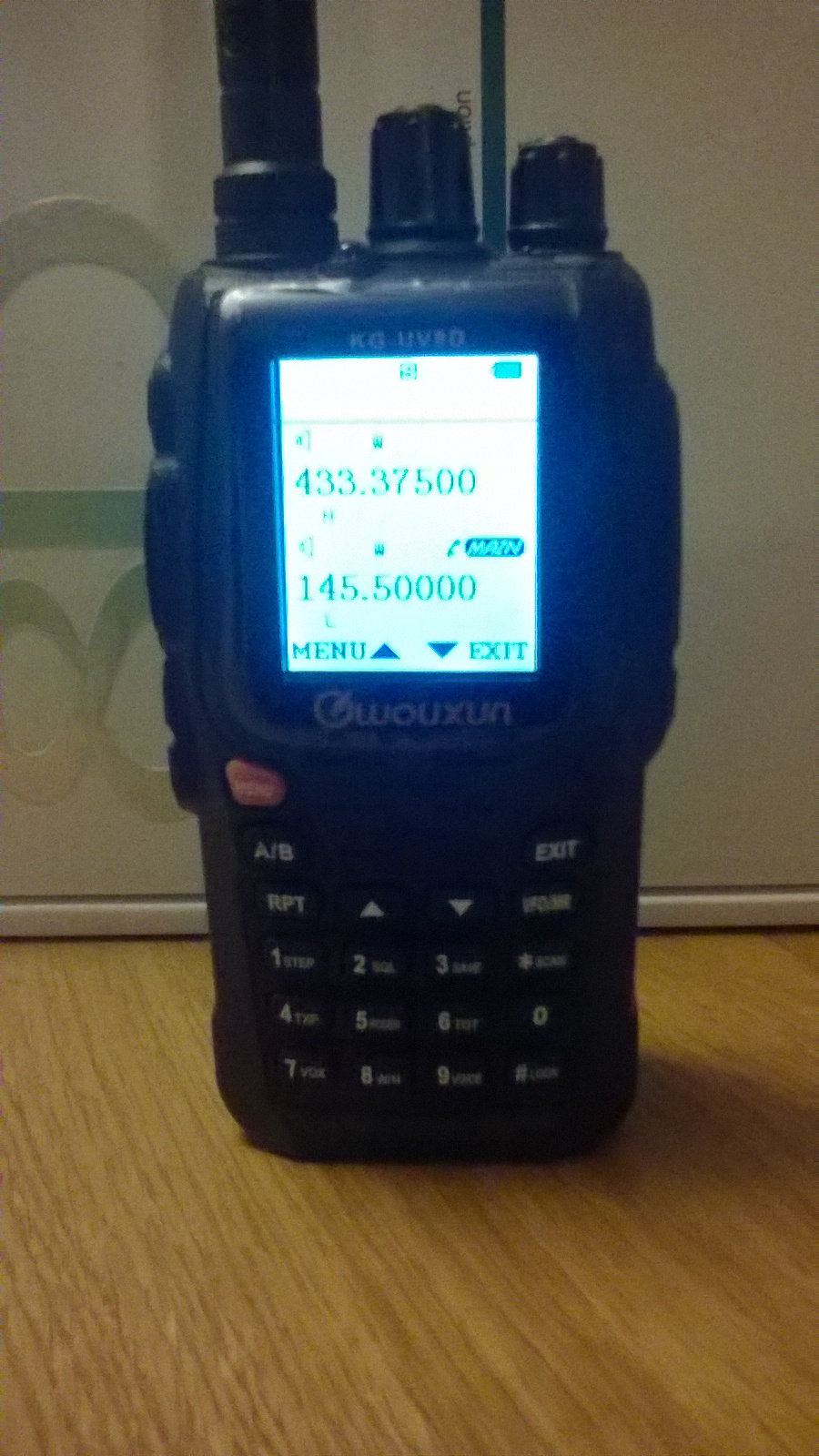
There is a lot of technical info out on there about this radio, the best, if you want a fair and unbiased review, get down to Hans PD0AC who has tested many Chinese radios with the proper test gear to a professional standard.
What do I have to say about it so far:
Like all new toys one is always eager to have a play. The radio came complete with external charger, wrist strap, belt clip, dual band antenna etc. A quick read of the well detailed manual might put your head in a spin, plenty of stuff to note. But like most of these Chinese radios once you understand the menu system it is easy to get to grips with. I slided the 2600mAh battery on the back of the main chassis case, it snapped and locked into place with a firm click. This made the radio feel quite weighty and rugged, I only have small hands and they only just made it around the body while holding it firm.
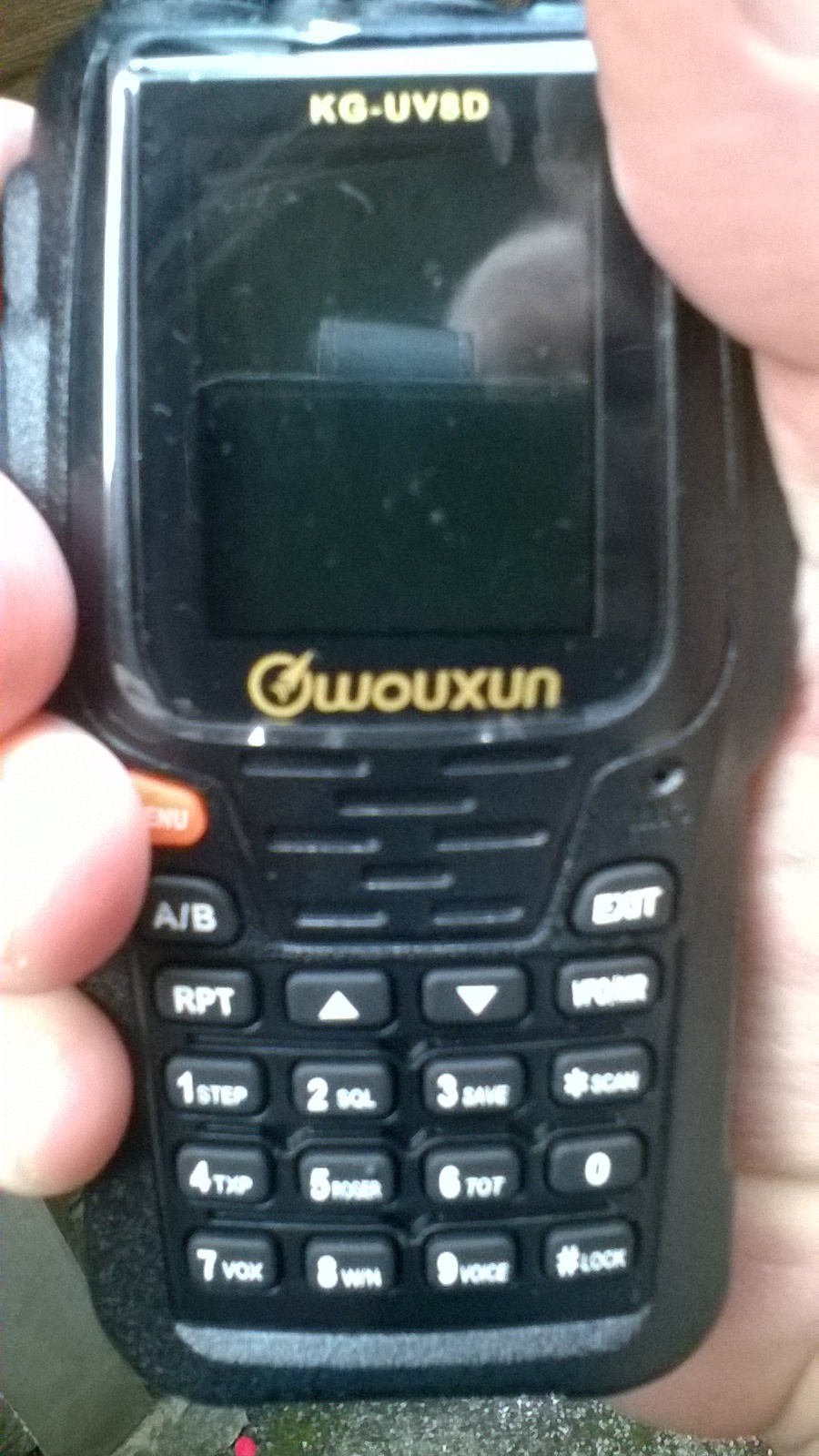
Switching on, we were in business, a clear bright display made a change from the simple plain two line LCD HT's I have.
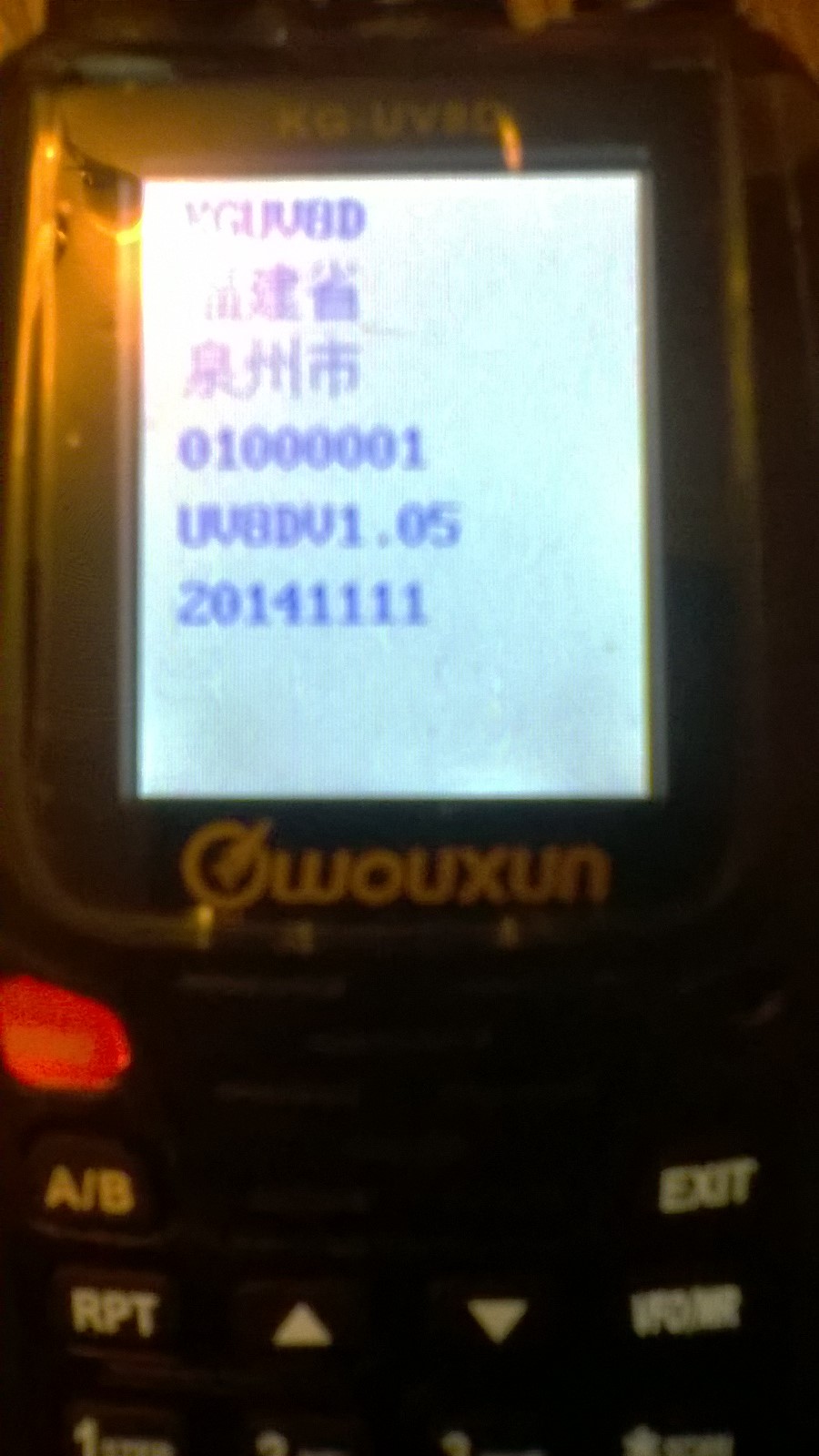
A quick test to check the internal firmware version, is achieved by holding down the 3 key while turning on the radio. Mine showed Version V1.05, which I understand is the latest which is shipped with the radio during production. *Note there is no user way of upgrading the firmware from an external PC..
2m and 70cm are always very quiet around here, but I was lucky my friend Gary M0TTO was just signing with someone on the 2m band over at Lichfield QTH. I pushed the PTT and gave him a shout, he came straight back to me, he reported the audio sounded really nice and crisp! I said what was the signal strength like? He said end stop! But of course it would be, he only lives about 6 streets away, I turned the power down to Low, still end stop. The received audio sounded good, and plenty of volume still left in the wick should I have required a bit more. In the middle of the QSO it suddenly stopped TX, I was still pressing the PTT, I released the PTT and then pressed it again, it started Transmitting again, but shortly after the same thing happened. I was a bit curious at first, but I remember these radios have a Time Out Timer "TOT" Menu 06 this was only set at 60 secs, I increased the time out period and it stopped the annoyance.
Conclusion: I have always rated Wouxun as being the better of the quality end of production from China, I feel this radio brings them into a new era and still keeps them at the top! Certainly they have had problems in production like any other, but I am sure the Japanese big three feel the threat. So far I am pleased with what I have bought at the price of £69 inc UK delivery makes it an excellent buy. I still have to program it up for repeaters etc with the free software. Which can be downloaded from Wouxun or you can use the free Chirp multi radio programming software, which also supports this radio in a basic format at the moment.
Steve, G1KQH, is a regular contributor to AmateurRadio.com and writes from England. Contact him at [email protected].
 Ham Radio Deluxe |
 W5SWL Electronics |
 Ham Radio Prep |
 KB3IFH QSL Cards  Hip Ham Shirts  HamRadioAuctions HamRadioAuctions Reliance Antennas Reliance Antennas Enigma Shop Enigma Shop |  morseDX  Ni4L Antennas  R&L Electronics R&L Electronics antennas.us antennas.us QRV QRV |
- Matt W1MST, Managing Editor
