 |
 Arduino Morse Tutor
 20 September 2015 | by
In a recent conversation with my good friend Lewis, we started discussing Morse code, training and the old equipment that was used to educate and teach the code to newcomers. In particular we discussed the old Datong D70 practice oscillators. Lewis carried on the tell me that his Datong like so many others started sending odd illegal characters and essentially rendered the kit useless. Of course you could whip of the lid and replace the logic chips, but I thought of recreating the Datong functionality in a new Arduino sketch.
So here is a breakdown of what the Datong offered:
- Either Mixed, letter or number combinations
- Groups of 5 characters
- Variable speed ( up to 37.5 word per minute)
- Variable character spacing (up to 4 seconds)
The Datong also allowed you to connect a telegraph key, and your headphones. But for now I will focus on the code generation element of the project.
The finished project has just a handful of components and can easily be created on a breadboard, or indeed if you have an old broken Datong you can reuse the box and panel to really replicate the old kit. The complete project includes 3 variable resistors (1K LIN) for Character speed, gap and volume. It also needs a 3 way switch to select the mode.
The Arduino I’m using is the UNO. Arguably the most popular Arduino on the market, but I have also tried the sketch on a Nano and it works fine – just some customisation of pin assignments is all that is needed.
On start up the Arduino checks to see which switch is LOW – it also saves the current mode and checks if the saved mode is the same as the current selected switch. If this is different, then the Arduino has had a change in the mode selection and resets.
When generating the tones, the Arduino randomly selects a character from an array. With that chosen letter – it calls a function and plays the corresponding tone functions. 2 functions exist as a DIT and a DAH.
The rest of the functions are dedicated to allowing the speed and gap to alter and also displaying the results on the LCD panel (completely optional).
Here is a short video of the kit working, and a link to the source code.
Dan Trudgian, MØTGN, is a regular contributor to AmateurRadio.com and writes from Wiltshire, England. He's a radio nut, IT guru, general good guy and an all round good egg. Contact him him here.
Series Eight Episode Twenty – Software Defined Radio Dongles (20 September 2015)
In this episode, Martin M1MRB / W9ICQ is joined by Leslie Butterfield (G0CIB), Chris Howard (M0TCH) and Edmund Spicer (M0MNG) to discuss the latest Amateur / Ham Radio news. Colin (M6BOY) rounds up the news in brief, and this episodes feature is Software Defined Radio Dongles.
- Bermuda Closes AM / Medium Wave Radio Transmitters
- Acorn II 40m SDR Construction
- Indian Government Employees to learn Amateur / Ham Radio
- Chess Controversy and Morse Code
- Ofcom Suggest 70.5 MHz for Internet of Things
- Reflectorless Yagi Radio Antennas Designs
- Councillors Vote in Favour of Ham Radio Mast
- Malta Digital Repeater
Colin Butler, M6BOY, is the host of the ICQ Podcast, a weekly radio show about Amateur Radio. Contact him at [email protected].
Series Eight Episode Twenty – Software Defined Radio Dongles (20 September 2015)
In this episode, Martin M1MRB / W9ICQ is joined by Leslie Butterfield (G0CIB), Chris Howard (M0TCH) and Edmund Spicer (M0MNG) to discuss the latest Amateur / Ham Radio news. Colin (M6BOY) rounds up the news in brief, and this episodes feature is Software Defined Radio Dongles.
- Bermuda Closes AM / Medium Wave Radio Transmitters
- Acorn II 40m SDR Construction
- Indian Government Employees to learn Amateur / Ham Radio
- Chess Controversy and Morse Code
- Ofcom Suggest 70.5 MHz for Internet of Things
- Reflectorless Yagi Radio Antennas Designs
- Councillors Vote in Favour of Ham Radio Mast
- Malta Digital Repeater
Colin Butler, M6BOY, is the host of the ICQ Podcast, a weekly radio show about Amateur Radio. Contact him at [email protected].
The Gray Line Report
Ham club newsletters exist in abundance. Most to inform members about upcoming events or to celebrate recently concluded activities with words and pictures. But there are those that serve a much larger audience — with timely advice and stories that cover the broader spectrum of amateur radio.

One of my favorites is The Gray Line Report — a quarterly publication of the Twin City DX Association.
The September edition is another good one. I’m reading ‘Adding an Amplifier to a Low Power Contest Station’ by Al Dewey, K0AD.
An there’s plenty more where that came from. Don’t miss it.
Tagged: dx, newsletter, tcdxa 

Jeff Davis, KE9V, is a regular contributor to AmateurRadio.com and writes from Indiana, USA.
Drawing PCBs With ‘MS Paint’
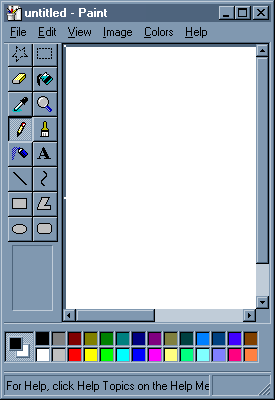
I recently had an inquiry about using 'MS Paint' for drawing PC board layouts. Although there are several freeware programs available for designing and drawing PC layouts, the ones I have tried had onerous learning curves. I also found that unless I was designing boards fairly regularly, I would have to go back and re-learn many of the functions each time I used the program. If you are regularly making a lot of boards, then these programs are certainly the way to go as they are packed with every feature you might need.
On the other hand, MS Paint meets all of my requirements and is simple to use ... I like simple. Although some might turn up their noses at MS Paint, I have found it to be a powerful and underestimated software tool. Here are some of the things that you might want to remember if drawing a PC layout with 'Paint'.
1. Take the time to read the built-in HELP and USING files. It doesn't take long to learn all of the functions along with some of the shortcuts.
2. Always draw with the IMAGE ... DRAW OPAQUE function turned off (unchecked). Do this first. This way, lines can go as close as you want without any blocking or overlapping. Try it the other way and you can see what happens.
3. If you are working with IC's, take the time to make a 'master' pattern that can be saved and copied anytime that you need it. A 16-pin layout can by used for 14 and 8 pin IC's by copying and pasting it and then erasing the unwanted pins. I can send you one via email if you contact me.
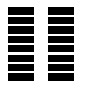
4. Similarly, once you have established the correct pad spacing for certain capacitors or resistor sizes, copy and save them for future use. Finding the correct spacing will require a few trial printouts so you can measure the exact gap.
5. For detailed work, use the VIEW ... ZOOM...CUSTOM function to magnify the layout. This also allows you to use a grid if you find this helpful.
6. Never SAVE your layout while in ZOOM mode as you can't go back to the original size when you re-load your plan. I learned this the hard way.
7. For drawing perfectly straight lines, squares or round circles, hold the SHIFT key down when drawing the element.
8. For large areas of copper (groundplanes), outline the area then choose the FILL symbol to create the area.
9. With a little planning, you can almost always avoid jumpers to make a crossover connection, unless your circuit is very complex.
10. When you make a mistake, just use the EDIT ...UNDO command. You can go back several steps with this helpful function.
11. I will often draw a thin line between to pads to see if they are on the same level ... and then UNDO the line once I have checked.
12. Always SAVE your layout as a Monochrome Bitmap with the FILE ... SAVE AS function. Using some of the other modes will create less than solid blacks and some random pixels that can lead to etching problems.
13. If using the 'toner iron-on' method of etching, set your printer options to the highest resolution (mine is 1200 dpi) and then choose the darkest 'print' option. You want as much toner thickness as possible. Note that this method works only with laser / toner printers and not the ink-jet / bubble types.
14. For the iron-on transfer paper, I have had good success with the shiny yellow transfer paper widely available on E-Bay, usually with free shipping. I get the best results when pre-heating the PCB in the toaster oven before ironing-on the pattern ... not too hot to touch however.
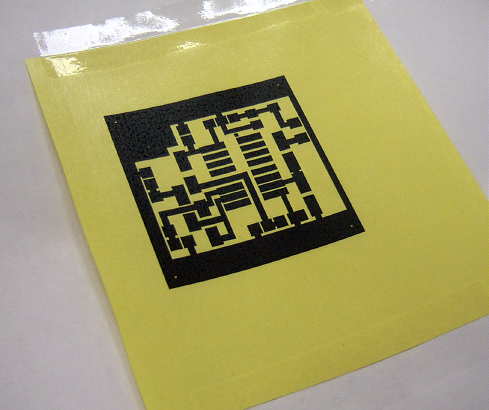
If you just build the occasional PC board, you might find using MS Paint worthy of a try. It has been meeting my needs for many many years and once you have done a few, unlike some PC software, it doesn't take long to build a new board without having to learn how to use it all over again.
Steve McDonald, VE7SL, is a regular contributor to AmateurRadio.com and writes from British Columbia, Canada. Contact him at [email protected].
Amateur Radio Weekly – Issue 78

Why public service-oriented Hams should participate in contests
Radio contests are training that improves our abilities elsewhere in Amateur Radio.
Social Contest Club
FreeDV voice keyer and spotting demo
FreeDV has a low bit rate text message stream that allows you to send information such as your call-sign and location.
Rowetel
Wire antennas in trees
Choosing a wire antenna system is one thing. Finding somewhere to put it up is another. Particularly if you’re short on supporting structures around the home environment.
Delta Alfa
Russian military in 7 and 14 MHz Ham Radio bands
The latest IARU Monitoring System newsletter reports Russian Military traffic in the amateur radio 7 and 14 MHz bands has increased.
Southgate
Meet the preppers who are ready for the next massive solar storm
Another source emphasized the value of hunting down older, “tube type” communications gear. “Modern amateur radio gear is hugely susceptible to EMP.”
Gizmodo
FM/VHF operating guide
This guide is intended to assist new amateur radio operators in figuring out what VHF FM and repeater operation is all about.
K0NR
Signal Identification Guide
This wiki is intended to help identify radio signals through example sounds and waterfall images.
Signal Identification Guide
1090 MHz bandpass filter from FlightAware
FlightAware.com is a website that aggregates ADS-B aircraft location data from various contributors.
RTL-SDR.COM
Turn your current transceiver into an SDR
The MDSR software performs all of the demodulation, filtering (both radio frequency and audio frequency), signal enhancement (equalization and binaural presentation).
MDSR
We need a better UHF connector
The venerable UHF connector was developed in the 1930’s. The UHF connector suffers from two problems.
amateurradio.com
Video
DMR TYT MD-380 programming tutorial
A guide aimed at people new to DMR, showing how to program an amateur repeater and a simplex channel.
YouTube
Solar powered HF Ham Radio portable system
Zamp 40 watt Portable Solar Charging System ZS-40-P, 80-6 Meter-Alpha EZ-Military Antenna, ICOM-IC-718 HF-Ham Radio, LDG-IT-100-AutoTuner, and a 18AH-Werker-AGM Battery.
YouTube
Amateur Radio Weekly is curated by Cale Mooth K4HCK. Sign up free to receive ham radio's most relevant news, projects, technology and events by e-mail each week at http://www.hamweekly.com.
We Need a Better UHF Connector
The venerable UHF connector was developed in the 1930’s. It has withstood the test of time and for the most part is a good connector for HF and VHF applications in amateur radio. It’s fairly inexpensive, has somewhat intuitive assembly, and is mechanically robust. From an RF perspective it’s not bad at HF and VHF, but despite the UHF name it exhibits an impedance bump at UHF frequencies and is usually avoided for UHF applications.
The UHF connector suffers from two problems, in my opinion. One is that it’s not weatherproof. You absolutely, positively should not have a UHF connector outdoors without weatherproofing. If you do not weatherproof it, you will have water intrusion into the connector and probably into the braid of the coaxial cable. Weather. Proof. It. Connectors like the N connector (a very common connector in commercial RF applications) which sports rubber gaskets on the mating surface and within the body of the connector are weatherproof, although it’s still advisable to use weatherproofing with the N connector.
The second issue is the difficulty in soldering the braid. The holes in the body of the UHF connector expose the ground braid and you’re supposed to solder through these holes to make a positive connection between the braid and the connector body, and provide mechanical strength and stability. Some folks pre-tin the ground braid before inserting it into the body, others do not. You need a high wattage iron to do this properly and the heat required can melt the dielectric in the process. I think many people don’t solder this well and some avoid doing it at all.
K3LR demonstrated an alternative method of soldering the braid to the PL-259 in this video:
I’ve tried this technique and for the most part it works. (I prefer to use heat-shrink tubing around the exposed soldered braid.) However, as you can see from the video it’s not pretty as it requires increasing the diameter of the dielectric with electrical tape, and there is not a snug fit between the connector body and the soldered braid and the coax jacket. This technique in my opinion does provide a better braid electrical connection than most mere mortals can accomplish using the proper solder hole method, as the connector is intended to be used.
I think a PL-259 connector needs to be designed for this technique. The body of the connector should have a smaller inner diameter in order to fit the diameter of the RG-213 dielectric. The outer part of the connector body where the braid is soldered to it could be of a smaller diameter as well and perhaps have a gnarled surface in order to promote better adhesion of the solder. I would like to see some sort of rubber gasket employed with the threaded sleeve for some weatherproofing, however I can’t think of a good way to implement this without affecting the electrical connectivity to the body.
Unfortunately I’m more a software guy and not very good at fabricating metal parts. Someone with manufacturing experience could probably design this connector and perhaps make a small fortune. It’s problem waiting to be solved.

Anthony, K3NG, is a regular contributor to AmateurRadio.com.
 Ham Radio Deluxe |
 W5SWL Electronics |
 Ham Radio Prep |
 KB3IFH QSL Cards  Hip Ham Shirts  HamRadioAuctions HamRadioAuctions Reliance Antennas Reliance Antennas Enigma Shop Enigma Shop |  morseDX  Ni4L Antennas  R&L Electronics R&L Electronics antennas.us antennas.us QRV QRV |
- Matt W1MST, Managing Editor
