 |
 Hamfest Balloon – Some analysis
 1 October 2015 | by
 I contacted some local and national newspapers about the flight but with little response. The Register IT news website did put an article on http://www.theregister.co.uk/2015/09/28/pigs_in_spaaaace
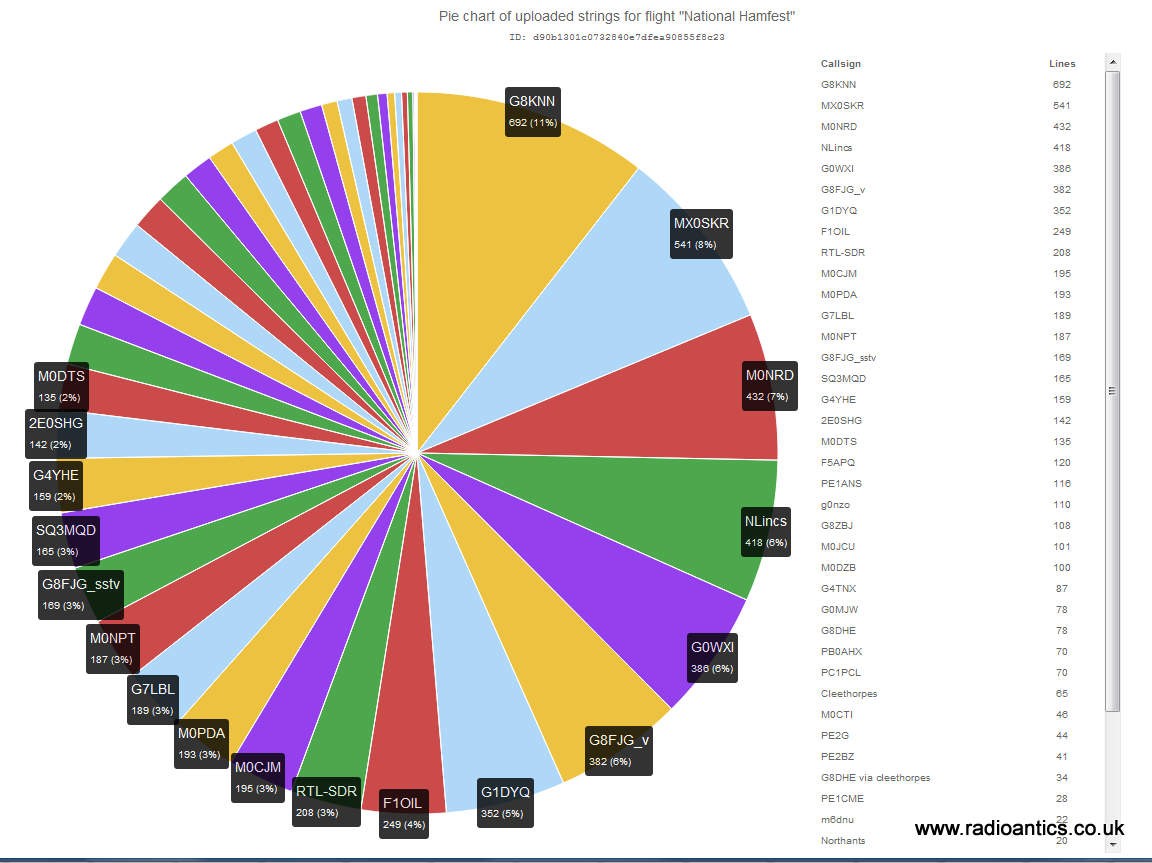
I checked out the telemetry statistics on http://habitat.habhub.org/stats/ and was impressed with the number of people who tracked (as can be seen in the pie chart below) I know that several interested parties have since visited the UKHAS wiki and have been asking questions on the IRC channel on how to do a flight and/or develop their own trackers. Naturally I have also been thinking about some possible future flights.
While the novelty of flying something into space, be it a toy pig or an egg is satisfying I would like to make any future flight serve some purpose, whether collecting more data or ideally doing some experiment with radio even if it within the constraints of the UK draconian regulations when operating in the air!
One set of data I did extract was the temperature profile during the flight. PINKY had two sensors, one internal to the Styrofoam box, the other external. PIGLET also had a temperature/pressure sensor but it was giving odd readings during the flight so have ignored that.
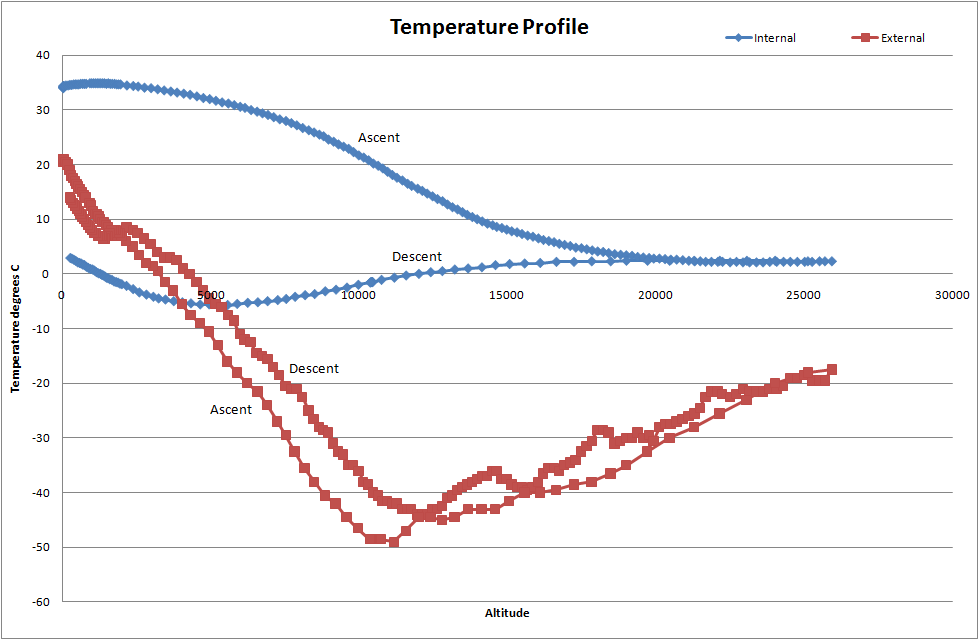
The graph shows internal/external temperature recorded by PINKY against altitude, there are two plots for each showing the ascent profile and the decent. The lowest temperature recorded by the external temperature was -49.5°C (-57.1°F) and the foam did a good job of insulating the internal electronics, though it drop below 0°C during the decent.
One thing I will do on the next flight (if it happens) is take a lot more photographs, using a 32GB memory card I could have held a lot more images. Also I will look at embedding the GPS coordinates (geotagging) into the image files.
I will also put on board a video camera, I did purchase a cheap dash cam type for £20 one off eBay for the Eggsplorer-1 but didn't use it because of sea-landing, I need to sort out powering it as the internal battery wouldn't last for the duration of the flight.
I have still to investigate the issues with the LoRa as to why it failed. This weekend Dave Akerman is flying three balloons in succession with LoRa tracker modules. They will be set up to work in a mesh, receiving and repeat each others telemetry. Sounds an interesting experiment, I will have to set my LoRa gateway back up and attempt to receive them.
Andrew Garratt, MØNRD, is a regular contributor to AmateurRadio.com and writes from East Midlands, England. Contact him at [email protected].
Recent Activations Out West
California
I was in Northern California, of all tough places to be, Napa. While having a look at the nearby summits I discovered that all the nearby summits were 1 or 2 pointers. Should be easy right. Well not so much. One of the inequities of SOTA, albeit well understood, is that elevation is the major determinant of point value, not length of climb or difficulty. Although all of that tends to even out over time if you do enough summits. I used my MTR II configured for 17M, 20M and 30M. I brought my LNR Trail friendly 40/20m antenna and a T1 Elecraft Tuner. The tuner failed, so I could only operate on 20m exclusively.
Mt. Diablo
 |
| View from Scott Hill |
 |
| Scott Hill in the Distance |
Quarry Mountain
This summit, W7U/NU-067, is not the most scenic and the trail winds through a lot of scrub brush. There is a little more cover on top and so some shade to set up the station. It is a 2 mile round trip and is a 6 pointer. It was my second activation on a day that netted 14 points. Below is a short video from the summit.
Mike Crownover, AD5A, is a regular contributor to AmateurRadio.com and writes from Texas, USA. Contact him at [email protected].
Recent Activations Out West
California
I was in Northern California, of all tough places to be, Napa. While having a look at the nearby summits I discovered that all the nearby summits were 1 or 2 pointers. Should be easy right. Well not so much. One of the inequities of SOTA, albeit well understood, is that elevation is the major determinant of point value, not length of climb or difficulty. Although all of that tends to even out over time if you do enough summits. I used my MTR II configured for 17M, 20M and 30M. I brought my LNR Trail friendly 40/20m antenna and a T1 Elecraft Tuner. The tuner failed, so I could only operate on 20m exclusively.
Mt. Diablo
|
| View from Scott Hill |
|
| Scott Hill in the Distance |
Quarry Mountain
This summit, W7U/NU-067, is not the most scenic and the trail winds through a lot of scrub brush. There is a little more cover on top and so some shade to set up the station. It is a 2 mile round trip and is a 6 pointer. It was my second activation on a day that netted 14 points. Below is a short video from the summit.
Mike Crownover, AD5A, is a regular contributor to AmateurRadio.com and writes from Texas, USA. Contact him at [email protected].
Conditions Rising
In the afternoon hours I started watching for Europe1 on 183kHz, transmitting from western Germany, and was able to see its weak carrier on the Perseus SDR's waterfall display several hours before sunset. Twilight here brought a dramatic improvement in signal strength as shown below.
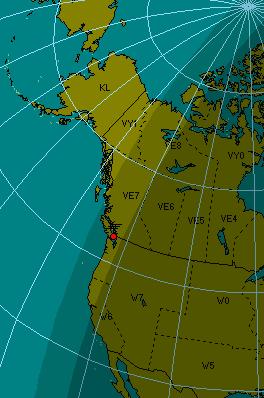

As daylight approached the transmitter site in Germany, the 183kHz signal provided a good visual example of 'dawn-enhancement', with the signal showing a dramatic flare on the waterfall indicating its build-up in strength.

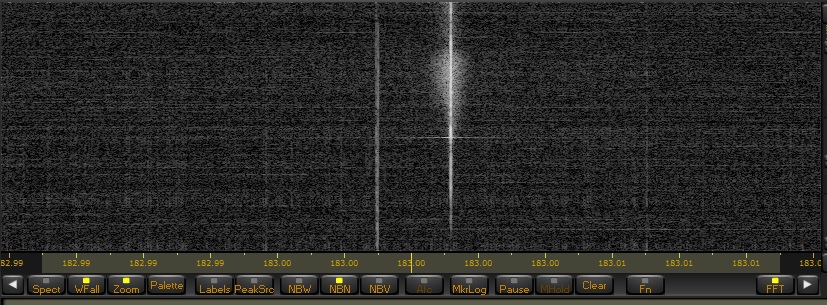
Once dawn arrived, it was interesting to see that the signal was able to hang-on for over an hour with reasonable strength before fading out rather quickly. Even though the transmitter site was in full daylight, the dark skies to the west were able to sustain propagation for some time before it all came crashing down.
Of late, the pre-dawn hours here have also been providing some exceptionally strong signals from Asia on the BCB. These are often enhanced at sunrise as well, as the strength often takes a short fast peak, before fading out for the day.
One of the loudest this week was from JOAK (NHK1) in Tokyo on 594 kHz ... listen ...
This was heard on the Perseus SDR and inverted-L antenna. The LF polar signals shown above, were recorded with the 10' X 20' loop and Wellbrook preamp while looping towards Europe at 030 degrees.
With the DST going positive, hopefully these good conditions will continue to build over the next few weeks. October is often one of the best months of the year for LF/MF DX.
 |
| courtesy: http://wdc.kugi.kyoto-u.ac.jp/dst_realtime/presentmonth/index.html |
Steve McDonald, VE7SL, is a regular contributor to AmateurRadio.com and writes from British Columbia, Canada. Contact him at [email protected].
The builder bug
It looks like I’m coming down with another case of the “builder bug”. That’s what I call it when I get the urge to make stuff. For the last couple of years, I’ve been content playing with digital repeaters I’ve cobbled together, or wiring up a TNC for a Raspberry pi in recent months. But now, I’m looking at Arduinos. These boards are a little lower level than the full-blown Linux system I’ve come to love with the pi. The Arduinos have incredible potential because of their simplicity. With very lower power consumption, and nearly instant power up, I can see many uses for these wonders of the 21st century. My youngest daughter is working on a project to provide weather data from the high school’s crop test plot 4 miles away. That led us to looking at building a weather station from scratch, which led to Arduinos, which then led to…well you get the point. I’ve now found at least four other projects that I could accomplish with these little microcontrollers. I placed an order for an $4 UNO last night. Let the fun begin!
Michael Brown, KG9DW, is a regular contributor to AmateurRadio.com and writes from Illinois, USA. Contact him at [email protected].
The builder bug
It looks like I’m coming down with another case of the “builder bug”. That’s what I call it when I get the urge to make stuff. For the last couple of years, I’ve been content playing with digital repeaters I’ve cobbled together, or wiring up a TNC for a Raspberry pi in recent months. But now, I’m looking at Arduinos. These boards are a little lower level than the full-blown Linux system I’ve come to love with the pi. The Arduinos have incredible potential because of their simplicity. With very lower power consumption, and nearly instant power up, I can see many uses for these wonders of the 21st century. My youngest daughter is working on a project to provide weather data from the high school’s crop test plot 4 miles away. That led us to looking at building a weather station from scratch, which led to Arduinos, which then led to…well you get the point. I’ve now found at least four other projects that I could accomplish with these little microcontrollers. I placed an order for an $4 UNO last night. Let the fun begin!
Michael Brown, KG9DW, is a regular contributor to AmateurRadio.com and writes from Illinois, USA. Contact him at [email protected].
The Spectrum Monitor — October, 2015

Stories you’ll find in our October, 2015 issue:
It Can Still Be Done! Kit Building is Alive and Well
By Kevin O’Hern Carey WB2QMY
Kit building is as old as amateur radio and as popular as ever. The attraction to kit building comes from the learning experience of building an electronic project, the pride of knowing how components work and the money saved by doing it yourself. A longtime kit builder himself, Kevin shows us that kits for all kinds of radio projects are readily available today, but that it’s also a fun experience to do with your children or grandchildren.
Digitally Speaking: The Original Digital Conversation
By Cory GB Sickles WA3UVV
This month our digital guru goes old school as he examines the original digital conversation: Morse code. The attraction of CW is multilevel: it’s a mode available to all license classes, an efficient use of bandwidth, and a natural for low power DIY ham stations. Furthermore, savvy CW operators can put together a small, capable station at a fraction of the cost of voice mode stations. Despite the fact that the Morse requirement for amateur licenses was dropped in early 2007, CW operating is a popular as ever.
Build a Rugged, Copper Pipe J-Antenna for VHF-UHF
By Richard Fisher KI6SN
Explore the myths and magic of the J-antenna and get yourself “de-polarized.” Richard explains that some of the things you thought you knew about the J-antenna just aren’t right. And, that with a quick trip to your nearest home-improvement store, you can find all the parts and all the tools you need to build one of the most popular VHF-UHF antennas for scanning or amateur radio applications. You’ll even find out how to put this antenna on your bike for some on-road and off-road bicycle/mobile fun.
TSM Reviews: Manhattan DJ-1997 FTA Satellite Receiver
By Ken Reitz KS4ZR
The new Manhattan DJ-1997 receiver is smaller and less expensive than its predecessor and yet more capable. It goes a long way toward blurring the lines between traditional cable and satellite TV services and the new direction consumers are inevitably migrating toward: Over the Top TV. We’ve seen similar activity with services offered by new TV sets: direct access through apps to Netflix, Hulu, Pandora and a host of other non-cable/satellite video and audio services, including direct access to Web content. This is disruptive technology in the best sense of the word.
The Norden Broadcasts: America’s Ace in the Hole
By J. Wandres
While British forces in WWII had mounted successful radio-based propaganda campaigns, the US had no such program until 1942 when the US Office of Naval Intelligence put together an unlikely trio, which included a doctor, a lawyer and a Hungarian émigré. They created a fictitious character named Commander Norden and broadcast what they said was the truth in German aimed at German warships. But, how successful was the program?
Scanning America By Dan Veenaman
Counties Weigh a Combination of Radio System Options
Federal Wavelengths By Chris Parris
Programming Federal Interoperability Channels
Utility Planet By Hugh Stegman NV6H
US Coast Guard Consolidates HF Services
Digital HF: Intercept and Analyze
By Mike Chace-Ortiz AB1TZ/G6DHU
A Few Easy Digital Catches for the Beginner
HF Utility Logs
By Mike Chace-Ortiz and Hugh Stegman
Amateur Radio Insights By Kirk Kleinschmidt NT0Z
Are You Up for the Challenge of 60 Meters?
Radio 101 By Ken Reitz KS4ZR
Ramsey AM Broadcast Transmitter Kit: $45 of Pure Radio Fun
Radio Propagation By Tomas Hood NW7US
The Chromosphere (Continuing our Look at the Sun)
The World of Shortwave Listening By Andrew Yoder
Tales of Pirate Radio Woe and Intrigue
The Shortwave Listener By Fred Waterer
Spy Stations, Canadian Elections, Central European Crisis and More
Maritime Monitoring By Ron Walsh VE3GO
Marine Radio Technology Sails On
The Longwave Zone By Kevin O’Hern Carey WB2QMY
Adventures in Through-Ground Radio
Adventures in Radio Restoration By Rich Post KB8TAD
From Aristocrat to Royalty: First Look at a Zenith Trans-Oceanic G-500
The Broadcast Tower By Doug Smith W9WI
Go West, Young Man!
Antenna Connections By Dan Farber AC0LW
The Modern Underground: Stealth
The Spectrum Monitor is available in PDF format which can be read on any desktop, laptop, iPad®, Kindle® Fire, or other device capable of opening a PDF file. Annual subscription (12 issues, beginning with the January 2015 issue) is $24. Individual monthly issues are available for $3 each.
Ken Reitz, KS4ZR, is publisher and managing editor of The Spectrum Monitor. Contact him at [email protected].
 Ham Radio Deluxe |
 W5SWL Electronics |
 Ham Radio Prep |
 KB3IFH QSL Cards  Hip Ham Shirts  HamRadioAuctions HamRadioAuctions Reliance Antennas Reliance Antennas Enigma Shop Enigma Shop |  morseDX  Ni4L Antennas  R&L Electronics R&L Electronics antennas.us antennas.us QRV QRV |
- Matt W1MST, Managing Editor
