 |
 Alaskan NDBs Awaken
 2 October 2015 | by
Good geomagnetically-quiet conditions continued into Tuesday morning, with the 'K' index hitting '0' just before dawn here on the west coast. A two-minute Perseus recording of the NDB band revealed good propagation towards Alaska, the first of the season.
The first good opening of the new DX season always provides an opportunity to see which NDB's have survived the summer and have not been closed down by the FAA bean counters. Every year, a few more of the Alaskan NDBs go quiet, with no new ones being added to the list.
The situation is certainly not confined to Alaska. The growing reliance on GPS and RNAV procedures is gradually making the reliance on NDBs a thing of the past. Frankly I'm astounded, yet grateful, that there are many hundreds of NDBs still in use and I'll really miss chasing the low-powered DX targets when they are all eventually decommissioned.
The following Alaskans were heard on Tuesday morning at 1300Z, about one hour before my local sunrise:
9/30/15 1300 529 SQM Level Island AK CO36
9/30/15 1300 396 CMJ Ketchikan AK CO45
9/30/15 1300 391 EEF Sisters Island AK CO28
9/30/15 1300 372 FPN Fredericks Point AK CO36
9/30/15 1300 266 ICK Annette Island AK CO45
9/30/15 1300 414 IME Mt. Edgecumbe AK CO27
9/30/15 1300 394 RWO Kodiak AK BO37
9/30/15 1300 209 CYT Yakataga AK BP80
9/30/15 1300 390 HBT Sand Point AK AO95
9/30/15 1300 358 SIT Sitka AK CO26
9/30/15 1300 350 VTR McGrath AK BP22
9/30/15 1300 338 CMQ Campbell Lake AK BP41
9/30/15 1300 429 BTS Dillingham AK BO08
9/30/15 1300 233 ALJ Johnstone Point AK BP60
9/30/15 1300 212 CGL Coghlan Island AK CO28
9/30/15 1300 223 AFE Kake AK CO36
9/30/15 1300 229 AKW Klawock AK CO35
9/30/15 1300 283 DUT Dutch Harbor AK AO63
9/30/15 1300 245 HNS Haines AK CO29
9/30/15 1300 347 DJN Delta Junction AK BP74
9/30/15 1300 411 ILI Iliama AK BO29
9/30/15 1300 277 ACE Homer AK BO49
9/30/15 1300 355 AUB King Salmon AK BO18
9/30/15 1300 524 MNL Valdez AK BP61
9/30/15 1300 382 JNR Unalakleet AK AP93
9/30/15 1300 281 CRN Cairn Mountain AK BP21
9/30/15 1300 385 EHM Cape Newenham AK AO88
9/30/15 1300 385 OCC Yakutat AK CO09
9/30/15 1300 263 OAY Norton Bay AK AP84
9/30/15 1300 390 AES Northway AK BP29
9/30/15 1300 404 GCR Cordova AK BP70
9/30/15 1300 525 ICW Nenana AK BP54
9/30/15 1300 251 OSE Bethel AK AP90
9/30/15 1300 341 ELF Cold Bay AK AO85
9/30/15 1300 248 GLA Gulkana AK BP72
9/30/15 1300 376 PVQ Deadhorse AK BQ50
9/30/15 1300 379 IWW Kenai AK BP40
9/30/15 1300 399 SRI St. George AK AO56
9/30/15 1300 359 ANI Aniak AK BP01
9/30/15 1300 272 UTO Utopia Creek AK BP35
9/30/15 1300 275 CZF Cape Romanzof AK AP61
9/30/15 1300 529 FDV Nome AK AP74
9/30/15 1300 391 EAV Bettles AK BP46
9/30/15 1300 346 OLT Soldotna AK BP40
9/30/15 1300 347 TNC Tin City AK AP65
There were several missing from the list ... but I classify them as 'third-tier' beacons since propagation needs to be even better than it was on Tuesday to hear them. These are beacons that are either suffering from terrible locations, small inefficient antenna / ground systems or in need of maintenance. I also have a list of Alaskans that have never been heard at all outside of Alaska but are known to be on the air according to recent FAA online information. It is these last two groups that keep me watching and waiting ... for those magic mornings that happen only once or twice per year.
From what I can surmise by scouring the FAA information, there are presently 77 active NDBs in Alaska, including the ones not heard down here. If you live in Alaska, and can take a listen on the NDB band, I'll send you the ones I'm not sure about. If anyone else wants a list of all of the beacons up there, with detailed frequency information, drop me an e-mail and I will send you a three-page pdf.
Here are some signal samples, recorded on Tuesday morning, of some of the 'second-tier' (not heard every morning) signals from Alaska.
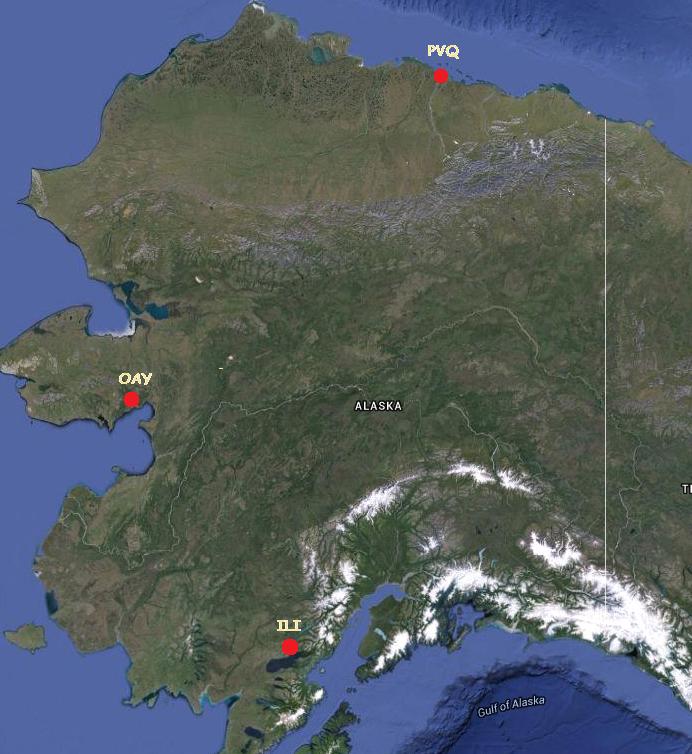 |
| courtesy: https://www.google.ca/maps |

PVQ - 376 kHz Put River (Deadhorse), Alaska

OAY - 263 kHz Norton Bay (Moses Point), Alaska
ILI - 411 kHz Iliamna, Alaska
With the sun getting quieter and quieter, conditions on the NDB band should continue to get better and better over the next several years ... let's just hope that the NDBs are still around long enough to enjoy the solar-quiet benefits.
Steve McDonald, VE7SL, is a regular contributor to AmateurRadio.com and writes from British Columbia, Canada. Contact him at [email protected].
Made my first satellite QSO
Last month Abdel Mesbah M0NPT chairman of the Hucknall Rolls-Royce ARC came to South Kesteven ARS to give an informative talk on operating amateur radio satellites. Abdel was the first UK operator to receive the AMSAT-UK 73 on 73 award for making 73 confirmed contacts via the FUNCube satellite AO-73. http://amsat-uk.org/2015/01/28/abdel-m0npt-73-on-73-award/
Abdel explained all the current active satellites, how to work through them and gave hints and described techniques for achieving success on this more challenging mode of operation.
Spurred on I opted to target the SO-50 satellite which until very recently this was the only satellite carrying a FM transponder. The satellite receives on 145.850 MHz and retransmits them on 436.800 MHz (+/- 10 kHz Doppler shift). Operation requires the use of CTCSS (PL) tones of 74.4 Hz which starts a 10 minute timer and then a 67 Hz tone used for the contact. More details of how to operate and a video are on the AMSAT-UK website
I initially tried using just a suitably programmed Baofeng UV-5R with a NA771 whip and could clearly hear the downlink on higher passes, I called a few times with no luck.
I hadn't monitored SO-50 much before and sadly it seems to suffer from very poor operating, with stations calling over contacts in progress, or stations continually calling CQ CQ seemingly oblivious to any reply and those that just keep calling "hola hola hola" for whatever bizarre reason! I would be lucky to get through the QRM with just the whip so I needed a better antenna.
Despite being extremely busy at the National Hamfest last weekend I did manage to get hold of a dual band Yagi that was reasonably lightweight for hand held use and capable of being easily dismantled for transporting. (The Moonraker YG27-35 Dual Band) it has a single feed point and two adjustable gamma match sliders and was easy to adjust using my analyser.
It has a single feed and I tried it with the Baofeng and reception of the downlink was excellent, again on a couple of passes I tried answering calls with no success.
Last night I decided to try again but with the FT-857D set at 10W output. I put it on a small workbench in the garden and powered it from my portable SLA battery. I ran split operation with the 2m Tx VFO set at 145.850MHz with 67Hz CTCSS, the 70cm Rx VFO set at 436.800Mhz I was able to adjusted it down in 5kHz steps during the pass. I got the wife to take a picture while I was operating.

As I started to hear the downlink I heard Abdel M0NPT calling and answered him, I was shocked when he came back and we exchanging details - that was it I had made my first QSO via an amateur radio satellite! Then amazingly other stations started calling me and I was able to also work DO2SYD.
I did manage to record it on a small dictaphone (did have a bit of a brain fade with my callsign at one point!)
I could get hooked on this... There is also the new LilacSat-2 (CAS-3H) satellite with a FM transponder to try to work!So much to do, so little time...
Andrew Garratt, MØNRD, is a regular contributor to AmateurRadio.com and writes from East Midlands, England. Contact him at [email protected].
Made my first satellite QSO
Last month Abdel Mesbah M0NPT chairman of the Hucknall Rolls-Royce ARC came to South Kesteven ARS to give an informative talk on operating amateur radio satellites. Abdel was the first UK operator to receive the AMSAT-UK 73 on 73 award for making 73 confirmed contacts via the FUNCube satellite AO-73. http://amsat-uk.org/2015/01/28/abdel-m0npt-73-on-73-award/
Abdel explained all the current active satellites, how to work through them and gave hints and described techniques for achieving success on this more challenging mode of operation.
Spurred on I opted to target the SO-50 satellite which until very recently this was the only satellite carrying a FM transponder. The satellite receives on 145.850 MHz and retransmits them on 436.800 MHz (+/- 10 kHz Doppler shift). Operation requires the use of CTCSS (PL) tones of 74.4 Hz which starts a 10 minute timer and then a 67 Hz tone used for the contact. More details of how to operate and a video are on the AMSAT-UK website
I initially tried using just a suitably programmed Baofeng UV-5R with a NA771 whip and could clearly hear the downlink on higher passes, I called a few times with no luck.
I hadn't monitored SO-50 much before and sadly it seems to suffer from very poor operating, with stations calling over contacts in progress, or stations continually calling CQ CQ seemingly oblivious to any reply and those that just keep calling "hola hola hola" for whatever bizarre reason! I would be lucky to get through the QRM with just the whip so I needed a better antenna.
Despite being extremely busy at the National Hamfest last weekend I did manage to get hold of a dual band Yagi that was reasonably lightweight for hand held use and capable of being easily dismantled for transporting. (The Moonraker YG27-35 Dual Band) it has a single feed point and two adjustable gamma match sliders and was easy to adjust using my analyser.
It has a single feed and I tried it with the Baofeng and reception of the downlink was excellent, again on a couple of passes I tried answering calls with no success.
Last night I decided to try again but with the FT-857D set at 10W output. I put it on a small workbench in the garden and powered it from my portable SLA battery. I ran split operation with the 2m Tx VFO set at 145.850MHz with 67Hz CTCSS, the 70cm Rx VFO set at 436.800Mhz I was able to adjusted it down in 5kHz steps during the pass. I got the wife to take a picture while I was operating.
As I started to hear the downlink I heard Abdel M0NPT calling and answered him, I was shocked when he came back and we exchanging details - that was it I had made my first QSO via an amateur radio satellite! Then amazingly other stations started calling me and I was able to also work DO2SYD.
I did manage to record it on a small dictaphone (did have a bit of a brain fade with my callsign at one point!)
I could get hooked on this... There is also the new LilacSat-2 (CAS-3H) satellite with a FM transponder to try to work!So much to do, so little time...
Andrew Garratt, MØNRD, is a regular contributor to AmateurRadio.com and writes from East Midlands, England. Contact him at [email protected].
Xiegu X108G Outdoor Version First Test
X108G Review October 2015
By: Fred Lesnick VE3FAL
Note: All firmware updates are done at your own risk and caution should be used when installing or updating any firmware into this radio. The removal of any covers or mods will void your warranty. Never hit the RST button while in the engineering menu. All settings should be written down and stored in a safe place in the event that RST is hit or if a firmware update makes any changes as all radios are aligned individually. To find these setting do the following then take a picture or write them down:

| “Hold the F1 button while powering up the radio, a list of 14 items will appear. If any changes are made you hit the SAV button, if no changes are made you can power the radio off and then back on without any changes made.” Sometimes Menu 11 will set itself to 1, it needs to be at 0 or you will not hear anything on the radio. |
I placed an order for the Xiegu X108G and it was shipped from China via D.H.L. on Sept 25 and arrived here on Sept 29 2015 at 12:30 PM. The unit was well packaged and no damage to the box at all after the trip from China. Inside the box was the X108G, Xiegu sticker, power cable (much longer then first models, but still no in-line fuse), microphone and microphone cable, as well as USB cable for firmware updates. Manual for radio was in the box and a warranty card with serial number of radio attached. The radio is equipped with front and back handles.
Unboxing the unit after its arrival:


Powering The Radio Up
An inline fuse should be installed on either one or both of the power cables before the radio is powered up to avoid any damage to the radio. I finally got the chance to power the radio up and see how this unit plays after all the updates and fixes that Xiegu made to make this radio a seller. First thing I did was to put my call-sign into the radio, this is undocumented but was found by a fellow X108G owner while playing with the radio.
This is how it is done:
Press F3 on powering up. Use the VFO to select letters/numbers then to move onto the next letter press INS button for each letter or number, when finished hit save. The radio will power back up. Switch it off and on again and you will see your call sign where the word Xiegu used to be.
Powering the radio up (continued)
After going through the supplied Operating Manual and getting familiar with what each button does (many changes to these buttons since versions 1 and 2) I was ready to hook my windom antenna to the SO239 connector and listen on 20 meters SSB for a bit. Tuning across the band with the 2.3k filter on signals were clear and clean, I was in AGC-S and pre-amp was in off position. Signals on 14.300 were an S5 with the pre-amp off and came up to a solid S8-9 with the PRE on, no distortion or overmod was heard or encountered nor was any splatter from adjacent signals heard. A move to 40 meters and LSB I was able to pick up a station on 7.188, and just like USB signals were right on where they should be, I was listening on my VX1700 with windom as well and noted the similarities in signal and quality. Once I was happy there I went to 20 meters and tuned to CW and went to 14.020 and monitored a station in the UK working an N3 station stateside, both signals were S5 and I had .5k filter on and no stations nearby were heard breaking through. A quick tune by the PSK frequency on 14.070 yielded a bunch of PSK signals. Next will be to hook up a key and attempt some contacts using a straight key and testing the waters that way. I will also hook the microphone up and try make a few SSB contact and get reports on both USB and LSB to compare. Videos of the radio in use and contact’s will be recorded so others can see and hear how well this unit works.


So what are some of the features this radio offers? First off is the display on the outdoor version, this display is bigger and brighter and designed for use outside where it is brighter, of course a video and pictures to show this will follow. Next is low current operation, with my power supply set at 13.1v on receive my meter shows 600ma of current draw, the stated current draw on transmit at 20 watts is rated at 7.5A, but again I will test this later. 2.3k and .5k filters for SSB and CW choices. The radio offers SSB,CW and AM modes and can be tuned from .5-30mHz and includes all shortwave bands in between the filtered amateur bands. Multi-function microphone. Variable power output from .5 to 20 watts. Adjustable microphone compression, Dual VFO’s, Split feature, accessory port for digital modes as well as jack for morse code key and external speaker. Many other options to list but will talk about those in a later review.
So this is a start and looking forward to playing with this radio and putting it to the test. I should add there is a 1 Year Warranty on this unit from date of purchase.
Communication‘s with Xiegu as well are fast. Xiegu also monitors the X108G Yahoo Group which can be found here if you are looking for more information as well about this radio and what other radio owners think of it, the group can be found here:
https://groups.yahoo.com/neo/groups/X108-Transceiver/info
I look forward to taking this radio out portable and testing it and bringing more information out there for potential radio buyers.
73
Fred
VE3FAL
Thunder Bay, Ontario Canada
Fred Lesnick, VE3FAL, is a regular contributor to AmateurRadio.com and writes from Thunder Bay Ontario, Canada. Contact him at [email protected].
Amateur Radio Newsline Report 1979 October 2, 2015
- WES SCHUM DEATH/TRIBUTE
- PERRY WILLIAMS, SILENT KEY
- PHISHING
- UPSET OVER THE UPGRADE
- RETIRING AT 88
- DON’T KEEP YOUR OPINION TO YOURSELF
- ELMERS FOR ETHIOPIA
- DIFFERENT KIND OF CONTEST
- CALIFORNIA HERE WE COME
- PA QSO PARTY
- PIG REVISITED
- HE DIDN’T NEED ANY JUMPER WIRES
- RUSSIAN DIGITAL CHALLENGE
- THE WORLD OF DX
- YOU THINK YOU HAD A BAD DAY?
VE3WDM's QRPower BLOG 2015-10-01 23:00:00
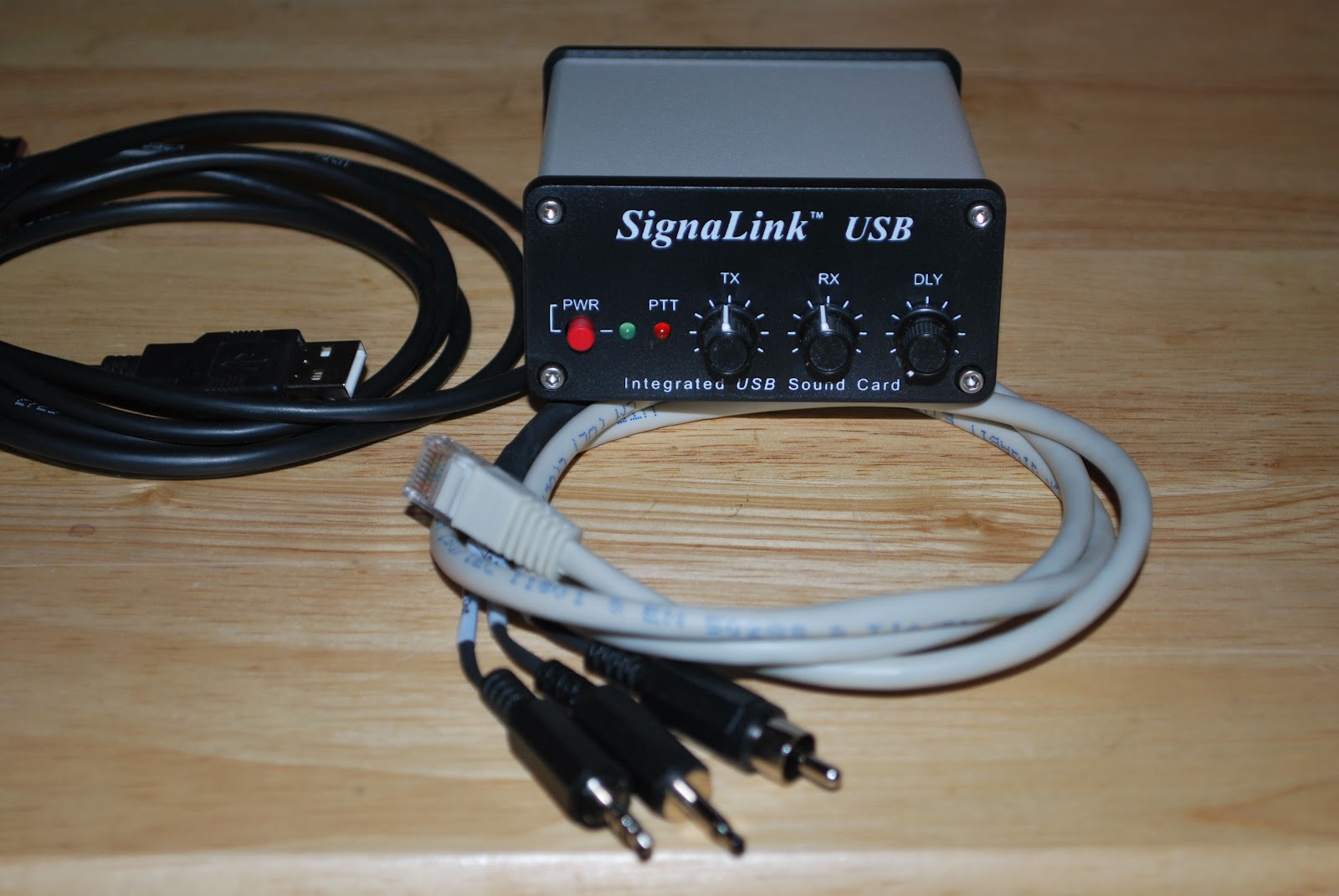 |
| On to the next step. |
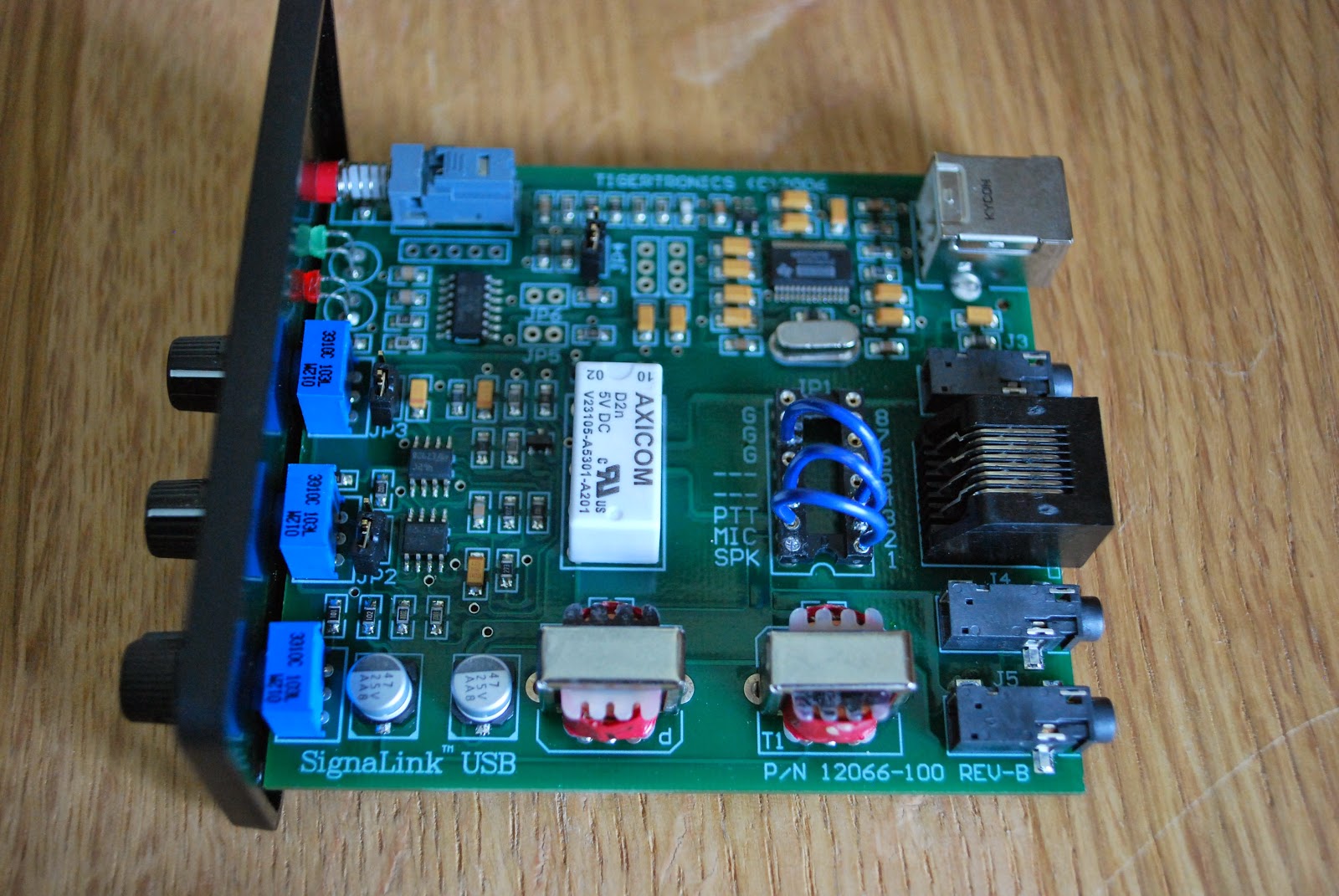 |
| Setting up internal jumpers |
Mike Weir, VE9KK, is a regular contributor to AmateurRadio.com and writes from New Brunswick, Canada. Contact him at [email protected].
Hamfest Balloon – Some analysis
I contacted some local and national newspapers about the flight but with little response. The Register IT news website did put an article on http://www.theregister.co.uk/2015/09/28/pigs_in_spaaaace
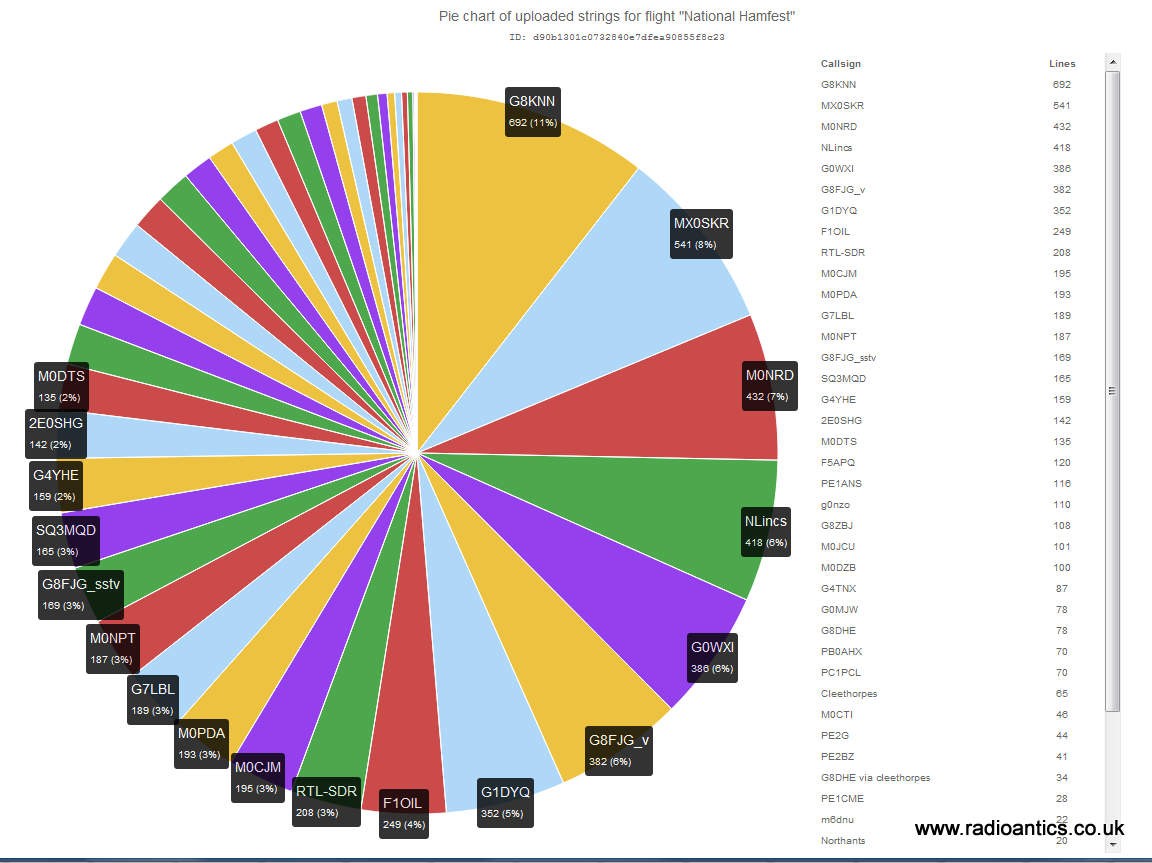
I checked out the telemetry statistics on http://habitat.habhub.org/stats/ and was impressed with the number of people who tracked (as can be seen in the pie chart below) I know that several interested parties have since visited the UKHAS wiki and have been asking questions on the IRC channel on how to do a flight and/or develop their own trackers. Naturally I have also been thinking about some possible future flights.
While the novelty of flying something into space, be it a toy pig or an egg is satisfying I would like to make any future flight serve some purpose, whether collecting more data or ideally doing some experiment with radio even if it within the constraints of the UK draconian regulations when operating in the air!
One set of data I did extract was the temperature profile during the flight. PINKY had two sensors, one internal to the Styrofoam box, the other external. PIGLET also had a temperature/pressure sensor but it was giving odd readings during the flight so have ignored that.
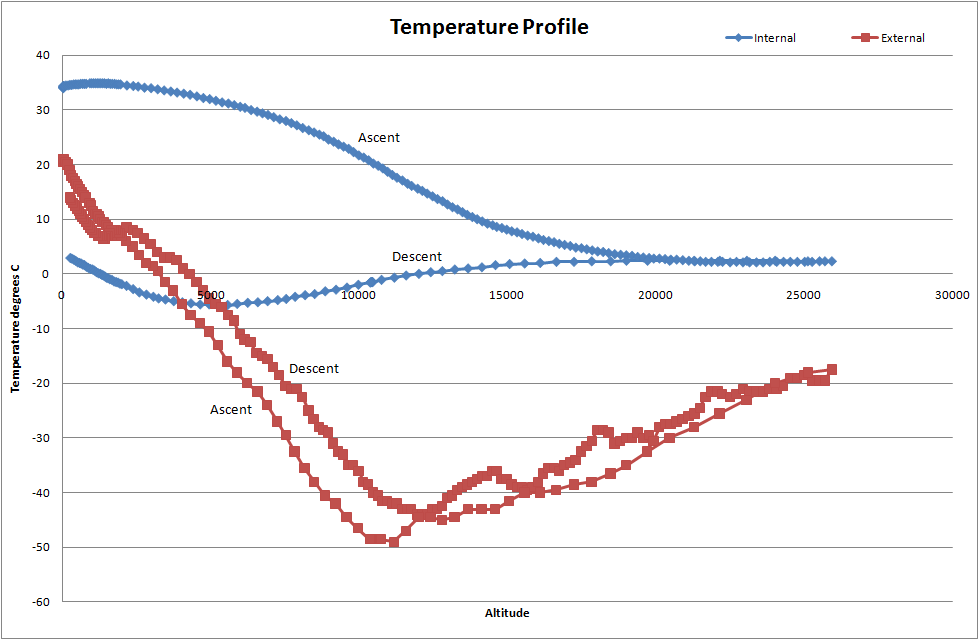
The graph shows internal/external temperature recorded by PINKY against altitude, there are two plots for each showing the ascent profile and the decent. The lowest temperature recorded by the external temperature was -49.5°C (-57.1°F) and the foam did a good job of insulating the internal electronics, though it drop below 0°C during the decent.
One thing I will do on the next flight (if it happens) is take a lot more photographs, using a 32GB memory card I could have held a lot more images. Also I will look at embedding the GPS coordinates (geotagging) into the image files.
I will also put on board a video camera, I did purchase a cheap dash cam type for £20 one off eBay for the Eggsplorer-1 but didn't use it because of sea-landing, I need to sort out powering it as the internal battery wouldn't last for the duration of the flight.
I have still to investigate the issues with the LoRa as to why it failed. This weekend Dave Akerman is flying three balloons in succession with LoRa tracker modules. They will be set up to work in a mesh, receiving and repeat each others telemetry. Sounds an interesting experiment, I will have to set my LoRa gateway back up and attempt to receive them.

Andrew Garratt, MØNRD, is a regular contributor to AmateurRadio.com and writes from East Midlands, England. Contact him at [email protected].
 Ham Radio Deluxe |
 W5SWL Electronics |
 Ham Radio Prep |
 KB3IFH QSL Cards  Hip Ham Shirts  HamRadioAuctions HamRadioAuctions Reliance Antennas Reliance Antennas Enigma Shop Enigma Shop |  morseDX  Ni4L Antennas  R&L Electronics R&L Electronics antennas.us antennas.us QRV QRV |
- Matt W1MST, Managing Editor
