 |
 More Manhattan Building Tips
 6 October 2015 | by
  |
| 2200m kW Transmitter |
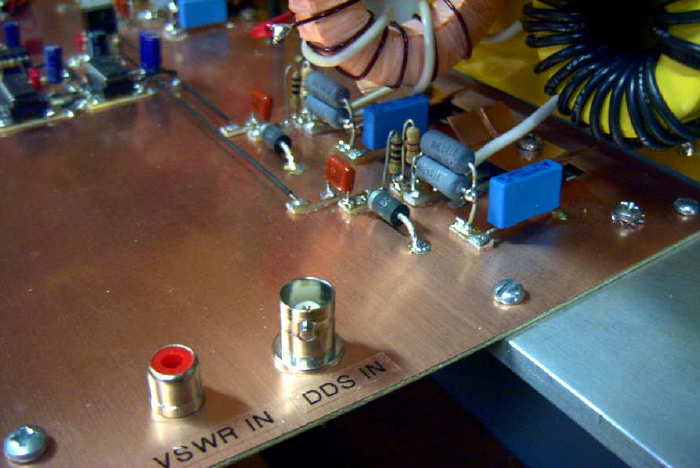
One of my early blogs described how I make the pads needed for Manhattan style. It can pretty much be used for any modern project and has been used here for countless circuits ... from a 1W LF tranmsitter to my 2200m/630m kilowatt.
 |
| 1W LF Transmitter |
I found these hints from Bob about pads and soldering components particularly helpful for anyone making a start in Manhattan style building:
Round pads require only placing in proper X and Y coordinates. A rectangular or square pad also requires proper rotation. A rectangular pad placed cockeyed doesn't look good.
I've had good luck with pads made from .032 double sided board. Solder surface tension prevents shorts with this pad thickness. My experiments making pads from thinner .010 thick flexible board often resulted in shorts.
A clean surface is needed for good pad adhesion to the board. I polish the pad board on both sides to a shine and then punch out the pads.
Pads can take up a lot of solder so I prefer to use 1/8th inch (.125) diameter pads.
Some of my Manhattan projects have failed because pads have loosened from the board. Cheap, discount super glue was my mistake. I now use Loctite Super Glue Gel. Of the hundreds of pads I've applied, I've never had one loosen.
If a punch is used to make pads each pad will have a rounded side and concave side. My pads are applied rounded side up. Using tweezers, I pick up a pad, place a small dab of glue on the punch mark and drop the pad in place. Light tweezer pressure is used to set the pad. Too much pressure squeezes out the glue leaving a weak joint. I Use enough glue so it squeezes out around the bottom edge of the pad.
Disaster occurs if glue gets on the tweezers. Pads stick to tweezers and won't stick to the board. If this happens, I stop and wipe off the tweezers with a cloth. I also use an Exacto knife to remove any hardened glue on the tweezer tips.
I try not to put too many leads to a pad. For example, its common for a transistor base lead to connect to two resistors and two capacitors. If this happens I extend the transistor base lead across two adjacent pads ans share the connections between the two pads.
I take time to shape my component leads. I make certain I don't have to flex a lead, like a spring, to solder it in place. Improper technique means the next component soldered to the pad may spring loose the earlier lead.
I put a bend in the component lead so the lead sets level on the pad. But the bend doesn't need to be long. A bend a 1/16th inch long, or half the diameter of the pad works well. This also means multiple leads can attach to a pad, each pointing toward the pad center.
My Hakko 936 soldering station is rated for 50 watts. I use a wide tip to get that power to the pads. I'm surprised how much power is required to do Manhattan construction. This is especially true when soldering component ground leads to the project board.
It is very easy to come away with cold solder joints. After all the leads are attached to a pad I Heat all the solder on the pad to liquid state. My ground connections take 1-2 seconds and pad connections take about 1 second. I've had no damage to components due to the heat I apply.
I prefer to use .032 leaded solder for my pad connections. But I use .062 solder for ground connections or to fill in a heavily populated pad.
I offer these ideas for what they are worth to you.
bob-N7SUR
Bob also mentioned that he prefers to tape down a full size plan of his component layout as an aid in placing his pads ... a light punch mark through the paper layout, marking the pad's location. I haven't gone this far with any of mine, preferring to place pads as I build, giving flexibility to component placement.
There are lots of good online references for Manhattan-style building but be warned ... some of them, particularly the pages of Dave, AA7EE, will have you making plans and reaching for the soldering iron before you know what's happened!
Steve McDonald, VE7SL, is a regular contributor to AmateurRadio.com and writes from British Columbia, Canada. Contact him at [email protected].
Competition time

An amazing thing happened this week. I reached 250 subscribers on YouTube. Its amazing how quickly my subscriber count has skyrocketed in recent weeks.
I watch many videos on YouTube and I have found some excellent examples of contributors that have a fresh and informative way of delivering content to their audiences. Ive also seen terrible examples too. Adding fresh content that people find informative, fun and want to watch more of is something I have been wanting to achieve for quite some time. but I just couldn’t find the topics or style of videos that I thought people would find interesting.
It turns out that what I thought might interest people and what might bore people to sleep are in fact complete opposites. So it shows what I know !!
While I struggle with thinking of new videos and fresh “relevant” content – I thought it would only be fair to celebrate this milestone with a giveaway.
I’m giving away an Acorn II SDR kit (as seen in this video). It’s a excellent Kit, easy to build and a brilliant introduction to software defined radio. Its able to receive on the 40m band straight away – but can easily be a multiband SDR with the addition of an external VFO. This kit has been kindly supplied by Dennis at Kanga Products and requires no licence to operate.
This prize is open to all subscribers of my channel (if you haven’t already subscribed – now would be a good time to) who answer the question correctly.
Simply fill in the form, answer the question correctly and press submit. Its as easy as that. The winner will be chosen and announced at random on the 10th November and the kit will be posted once I have made contact with the winner.
Good luck.

Dan Trudgian, MØTGN, is a regular contributor to AmateurRadio.com and writes from Wiltshire, England. He's a radio nut, IT guru, general good guy and an all round good egg. Contact him him here.
Competition time
An amazing thing happened this week. I reached 250 subscribers on YouTube. Its amazing how quickly my subscriber count has skyrocketed in recent weeks.
I watch many videos on YouTube and I have found some excellent examples of contributors that have a fresh and informative way of delivering content to their audiences. Ive also seen terrible examples too. Adding fresh content that people find informative, fun and want to watch more of is something I have been wanting to achieve for quite some time. but I just couldn’t find the topics or style of videos that I thought people would find interesting.
It turns out that what I thought might interest people and what might bore people to sleep are in fact complete opposites. So it shows what I know !!
While I struggle with thinking of new videos and fresh “relevant” content – I thought it would only be fair to celebrate this milestone with a giveaway.
I’m giving away an Acorn II SDR kit (as seen in this video). It’s a excellent Kit, easy to build and a brilliant introduction to software defined radio. Its able to receive on the 40m band straight away – but can easily be a multiband SDR with the addition of an external VFO. This kit has been kindly supplied by Dennis at Kanga Products and requires no licence to operate.
This prize is open to all subscribers of my channel (if you haven’t already subscribed – now would be a good time to) who answer the question correctly.
Simply fill in the form, answer the question correctly and press submit. Its as easy as that. The winner will be chosen and announced at random on the 10th November and the kit will be posted once I have made contact with the winner.
Good luck.
Dan Trudgian, MØTGN, is a regular contributor to AmateurRadio.com and writes from Wiltshire, England. He's a radio nut, IT guru, general good guy and an all round good egg. Contact him him here.
LHS Episode #155: Interview with Frank Howell
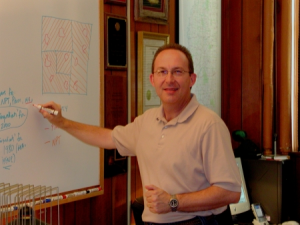 Today we have a change of pace for you. Thanks to a blog post from Frank Howell, K4FMH, we managed to land an interview. He's a former professor who now works on myriad projects in science, technology, computers and amateur radio. He's also very involved in his community and philanthropic endeavors. Frank discusses Broadband HamNet, HamWAN, the Magnolia Intertie and gives us a treasure of information on networking with amateur radio. This one is a double episode, but you're not going to want to miss a minute of it.
73 de The LHS Guys
Russ Woodman, K5TUX, co-hosts the Linux in the Ham Shack podcast which is available for download in both MP3 and OGG audio format. Contact him at [email protected].
Plans At VY1JA
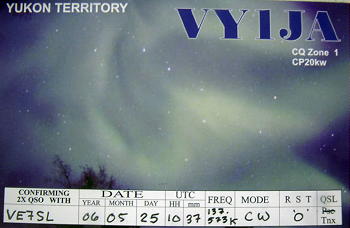 In the midst of this weekend's California QSO Party, I heard VY1JA calling CQ, looking for the Californians. It had been several years since I last heard VY1JA and the last time that we worked was on 137kHz on the 2200m band.
 The CQs continued without much luck as the Californians just didn't appear to be hearing (or looking) to the north ... missing one of the rarest multipliers in North American contests.
Now, I had recently read that the VY1 station had been experimenting with remote operation, so that hard core, experienced contesters, could have the opportunity to hand out the rare 'NT' (Northern Territories) multiplier in future contests ... especially in the popular November ARRL Sweepstakes. I assumed that the station was likely being remotely operated.
After listening to a lot of CQ's going unanswered, I swung the beam towards Whitehorse and sent, "ur 599 down in VE7 land" and sent my call. Much to my surprise, it was my dear old friend 'J' himself, operating the station. What followed was a 10-minute catch-up on what he had been doing over the past few years and his plans for the future.
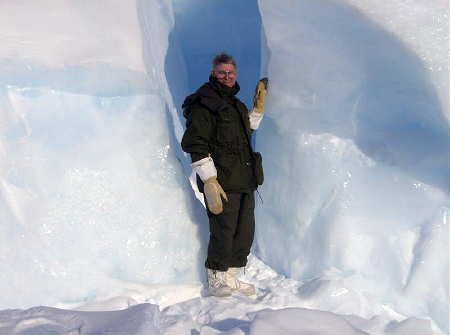 |
| J in Nunavut as VYØJA |
Future plans, now well underway, call for multiband V-beams (520' legs) at 70' aligned to the SE and NW and some high metal on a pair of 100' towers for the HF bands. As well, a new K-3 will drive an Alpha 9500 amplifier on all bands.
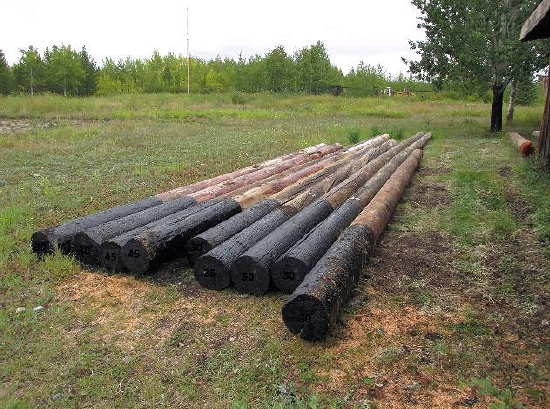
A few of the 20 poles, ranging from 70' to 30', that will be used to support V-beam legs and elevated groundplanes for the low bands.
I've saved the best news for last. J told me that he really wants to get going on 630m as well! His signal will be a wonderful addition to the band as he should be workable by most of the western provinces on nights of normal propagation. I am very much looking forward to working J again on the LF bands, recalling how strong his 100W signal could get during several of our early-morning 2200m CW ragchews.
Welcome back J!
Steve McDonald, VE7SL, is a regular contributor to AmateurRadio.com and writes from British Columbia, Canada. Contact him at [email protected].
Series Eight Episode Twenty-One – The Humble Capacitor (4 October 2015)
In this episode, Martin M1MRB / W9ICQ is joined by Ed Durrant DD5LP ,Martin Rothwell M0SGL and Matthew Nassau M0NJX to discuss the latest Amateur / Ham Radio news. Colin M6BOY rounds up the news in brief, and this episodes feature is The Humble Capacitor
- RSGB Takes Over Radio Exam Management
- LilacSat-2 – Linux Live CD for Telemetry Decoding
- Amateur Radio Society and CB
- UK Shipping Forecast on LW to End?
- Proposed German SDR Network
- QRO Club - Free DXpedition Travel Amps
- Fox Telemetry Decoder Software Version 1.0
- FreeDV Fortnightly Europe-wide Net / Test Session
- Lundy DX Group 2015
Colin Butler, M6BOY, is the host of the ICQ Podcast, a weekly radio show about Amateur Radio. Contact him at [email protected].
Series Eight Episode Twenty-One – The Humble Capacitor (4 October 2015)
In this episode, Martin M1MRB / W9ICQ is joined by Ed Durrant DD5LP ,Martin Rothwell M0SGL and Matthew Nassau M0NJX to discuss the latest Amateur / Ham Radio news. Colin M6BOY rounds up the news in brief, and this episodes feature is The Humble Capacitor
- RSGB Takes Over Radio Exam Management
- LilacSat-2 – Linux Live CD for Telemetry Decoding
- Amateur Radio Society and CB
- UK Shipping Forecast on LW to End?
- Proposed German SDR Network
- QRO Club - Free DXpedition Travel Amps
- Fox Telemetry Decoder Software Version 1.0
- FreeDV Fortnightly Europe-wide Net / Test Session
- Lundy DX Group 2015
Colin Butler, M6BOY, is the host of the ICQ Podcast, a weekly radio show about Amateur Radio. Contact him at [email protected].
 Ham Radio Deluxe |
 W5SWL Electronics |
 Ham Radio Prep |
 KB3IFH QSL Cards  Hip Ham Shirts  HamRadioAuctions HamRadioAuctions Reliance Antennas Reliance Antennas Enigma Shop Enigma Shop |  morseDX  Ni4L Antennas  R&L Electronics R&L Electronics antennas.us antennas.us QRV QRV |
- Matt W1MST, Managing Editor
