 |
 The Spectrum Monitor — November, 2015
 3 November 2015 | by
Stories you’ll find in our November, 2015 issue:
TSM Reviews: Electraft K3s—Another Step Forward
By Mark Haverstock K8MSH
If you already have a K3, you know you have one of the best, full-featured rigs around. It will serve you well for years to come. But many of us have the urge to keep up with the latest and greatest. Is it time to upgrade? A longtime kit builder and ham, Mark tells us why an Elecraft K3s should be in our future.
Current and Future Trends in Scanning Radio
By Chris Parris
The current models of digital scanners are now starting to resemble – no, they actually are small, self-contained computer systems, complete with networking, USB ports, removable media, built-in audio recording and updatable operating firmware. Some even offer the ability to remotely access and control these scanners over the Internet. Chris tells us which scanners are best for your local scanning situation.
TSM Reviews: EZ-Scan WS1095—Whistler’s Digital Scanning Receiver
By Chris Parris
With the introduction of the WS-1095, we get a look at a scanner design that was apparently conceived at GRE, but did not see the light of day until Whistler made it so. Now, Chris puts this multi-talented scanner through real-world paces. He notes, “Performance of the WS-1095 scanner in most respects matches the other radios in the GRE/Whistler line.”
TSM Reviews: Airspy SDR Receiver System
By Bob Grove W8JHD
In electronic communications, software defined radio (SDR) is becoming dominant. For radio hobbyists, a niche product is gaining momentum: the SDR dongle. Only slightly larger than a memory stick, when plugged into a USB port, it converts your computer into a flexible, wide-frequency-coverage receiver. Is this just another SDR dongle? Bob, tells us what really sets this diminutive receiver apart from the rest.
Digital Amateur Radio Roundup
By Cory Sickles WA3UVV
In the spirit of this month’s Radio Buyers’ Guide, Cory reviews the growing list of transceivers available for the digitally inclined ham. If you haven’t already transitioned into the digital domain, or you are looking for an additional model or methodology to try out, you will find this overview of use to you.
Toward a Glorious and Uncertain Future!
By Kirk Kleinschmidt NT0Z
With all evidence to date, the phenomenon we call amateur radio will have been born, matured, evolved and “died,” in a 150-250 year period. Period! Kirk shows us that there’s still hope for the future.
FTA Satellite-TV: The Heir to Shortwave Radio
By Ken Reitz KS4ZR
Originally, countries turned to shortwave to serve two specific purposes: promote their own cultural and political ideas worldwide and serve the expatriate community abroad. As shortwave declined throughout the 1980s to the present, many of those same broadcasters began appearing on geostationary satellites doing exactly the same thing, only this time with pictures (and now in HDTV format) as well as words and sound.
Scanning America
By Dan Veenaman
Tennessee Advanced Communications Network
Federal Wavelengths By Chris Parris
CBP OAM Changes
Utility Planet By Hugh Stegman NV6H
Goodbye HF911, Hello UrgentLink
Digital HF: Intercept and Analyze By Mike Chace-Ortiz AB1TZ/G6DHU
All About NAVTEX
HF Utility Logs By Mike Chace-Ortiz and Hugh Stegman
Amateur Radio Insights By Kirk Kleinschmidt NT0Z
Ham Radio on the Big Screen(s)
Radio 101 By Ken Reitz KS4ZR
License-Free Two-Way Radio: CB/FRS/GMRS/MURS
Radio Propagation By Tomas Hood NW7UST
The Sun Part 2: Coronas, Sunspots and SIDs
The World of Shortwave Listening By Thomas Witherspoon W4SWL
Buyer’s Guide to Shortwave Radios
The Shortwave Listener By Fred Waterer
Shortwave Listening via Internet Archives
Amateur Radio Astronomy By Stan Nelson KB5VL
Continuum Monitoring Using an SDR R820T Dongle
The Longwave Zone By Kevin O’Hern Carey WB2QMY
Miscou DXpedition and LF Resources
Adventures in Radio Restoration By Rich Post KB8TAD
Powering and Testing the Zenith Trans-oceanic G-500
The Broadcast Tower By Doug Smith W9WI
Why is that Tower where it is?
Antenna Connections By Dan Farber AC0LW
MFJ: Our Friend in the Radio Business
Radio Horizons
DXtreme Reception Log (V. 10,0); Klingenfuss 2016 Shortwave Frequency Guide
The Spectrum Monitor is available in PDF format which can be read on any desktop, laptop, iPad®, Kindle® Fire, or other device capable of opening a PDF file. Annual subscription (12 issues, beginning with the January 2015 issue) is $24. Individual monthly issues are available for $3 each.
Ken Reitz, KS4ZR, is publisher and managing editor of The Spectrum Monitor. Contact him at [email protected].
DX’ing The ‘Utilities’ – Pt. 2
A huge percentage of commercial aircraft are delegated to moving freight and many of them can be heard on HF radio. Many of the planes in use are retired passenger planes that have been reconfigured for moving cargo. Back when I did this type of listening, older DC-8s seemed to be particularly popular, especially on the nightly South / Central America to Florida routes. I suspect that nowadays, these have been replaced with older DC-10's and 747's.
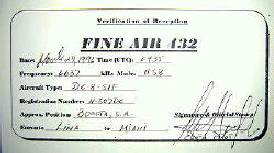
'FINE AIR 432' was logged on March 24,1996 at 0435Z while working Miami Radio on 6637kHz. The DC8-51F (Freighter) was over Bogota while enroute from Lima to Miami.
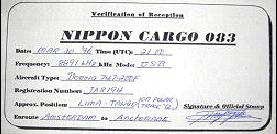 'NIPPON CARGO 083', a 747-200F, was logged
on 8891kHz working Baffin Radio. They were reporting position "LT", a waypoint above Alert, at 82-31N / 62-12W, westbound on Polar Track "Quebec".
The freighter was enroute Amsterdam to Anchorage.
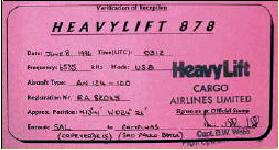
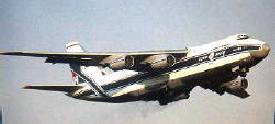
The Antonov 124-100 is a gigantic Russian built freighter - capable of transporting in excess of
120 tons. This is aircraft "RA-82045" which was logged as 'HEAVYLIFT 878' in June, 1996.
Operated by Volga-Dnepr, 'HEAVYLIFT 878' was working Dakar (Senegal) Aeradio on 6535kHz reporting FL240 and position 13-14N / 24-26W enroute Cape Verde Islands to Sao Paulo, Brazil.
'AFM 01' was a DC8-55F logged while working Brazzaville Radio (Congo) on 8903kHz. It was at FL350, enroute Harare, Zimbabwe to Kano, Nigeria at the "MPK" waypoint, 250 miles east of Kinshasha, Zaire. Brazzavile was advising of 'crossing traffic, same level...please say intentions'... Yikes!
On another evening I heard the Dakar (Senegal) controller advise a British Speedbird 747 to 'go to flight level 330 ... please go now ... go very very fast'. I don't think I'll be flying in Africa anytime soon.
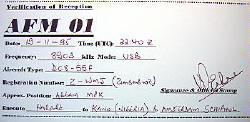
'AFM01' (Affretair) was Z-WMJ, shown here on final approach to Gatwick.

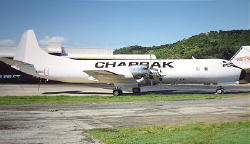 'PACIFIC AIR EXPRESS 3517' was heard on 8867kHz working Brisbane Radio while over the Coral Sea. The Lockheed L-188C four-engine turbo prop was enroute Honiara to Brisbane with a load of fresh tuna destined for the Japanese market. N360Q, shown on the ground at Honiara, was leased from the states and operated by Charrak Air.
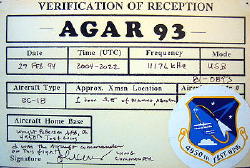 The U.S. military is still active on HF radio and some interesting catches can be had. During the testing phase of the 'cruise' missile, the missile navigation systems were tested over the Northern Territories and Alberta. Once dropped from their B-52 launch platforms, the missiles were tracked across Alberta by Advanced Range Instrumentation Aircraft (ARIA). 'AGAR 93' was heard on one such mission on 11176kHz. 'AGAR 93' was # 81-0893, an EC-18 (modified Boeing 707) out of Wright Patterson' 4950th Test Wing. According to the aircraft commander who signed my verification, the aircraft was approximately 1 hour S.E. of Namao, Alberta. One can easily see why # 81-0893, shown here, was affectionately known as "The Beast".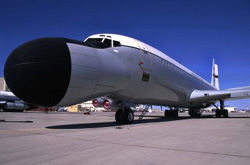
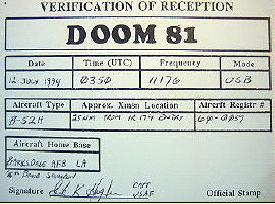
'DOOM 81' was a gigantic B-52H from the 96th Bomb Squadron, stationed at Barksdale AFB, LA. The appropriately named big bomber was heard on 11176kHz while working Ascension Radio and was just about to rendezvous with their mid-air refueler when the mission was aborted. This was the first and only B-52 that I was ever able to confirm.
 'ROMA 99' was logged on 17975kHz while working Thule Radio. They were taxiing for takeoff at Dulles International in Washington D.C. and reporting a minor fuel-pump problem. 'ROMA 99' was a KC-135R Stratotanker, # 62-003512, from the 509th Air Refueling Squadron at Griffis AFB, NY.
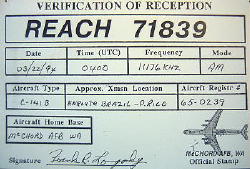
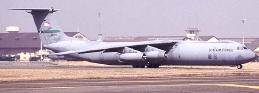
'REACH 71839' was heard on 11176kHz while working Albrook AFB, Alaska. Tail # 65-0239, this 'REACH' flight was an aging C-141B Starlifter, at one point, the Air Force's major transporter. 'REACH 71839', out of McChord AFB, was enroute Brazil to Puerto Rico.
There's still plenty to be heard on HF, outside of the amateur bands and a quick internet search on 'Utility DX' will turn up several interesting and informative sites ... each one having an abundance of related links to follow. Here are some that will be helpful:
**************************************
A freshly updated list of all active HF aero frequencies. Also check their list of active aero 'callsigns'
http://monitor-post.blogspot.ca/p/this-international-hf-aero-frequency.html
If you can catch an aircraft's four-letter SELCAL code, often given during waypoint checks, you can search here for more info on the actual aircraft itself:
http://www.airframes.org/reg/b18305
The Milcom Blogspot:
http://mt-milcom.blogspot.ca/
Steve McDonald, VE7SL, is a regular contributor to AmateurRadio.com and writes from British Columbia, Canada. Contact him at [email protected].
QSO with W0RW from Knox Mountain
Wow… what a day. Judy and I hiked to Knox Mountain. I worked Paul W0RW who was walking on Pike’s Peak. I also worked KM0U/P/QRP, Canary Islands and Mexico. The color was amazing.

Every day is a surprise. We expect November weather to set in, but it’s sunny and warm. It was a bit over 50F today, so we headed to the Knox Mountain cabins. We took an old logging road. This is not the charming trail we usually take along the brook. Loggers have changed that landscape and so we’ll avoid that route. Actually this was beautiful.

We hiked in about a mile and a half and came to the pond and the cabins. The loggers have not been anywhere near here.

I tossed my 30 foot wire over a cherry tree between the cabins and set up the KX3. I was a half hour late for Paul’s starting time on Pike’s Peak, but I tuned up on 14.342.5 anyway. What a thrill to hear him… I had no microphone so I set up cross-mode with a split… VFO B in CW mode up 600 Hz. Paul came right back to me and it was a real thrill. Just imagine working Paul who had a backpack PRC319 military radio walking on the north side of Pike’s Peak at 13,000 feet. It’s plain magic! Anyway Paul copied everything I sent and gave me a 599. His SSB signal was 55. He said the cold was “bone chilling.”

After I signed and tuned down the band. KM0U Terry was calling CQ. Little did I know that he was operating QRP portable with a KX3. We had a long chat. It was pretty cool to work QRP /P between New Hampshire and Minnesota. He was 589 and gave me a 569.
Next I worked XE2HOE in Mexico. Mode gave me a 449 and he was 599. It was a quick exchange and then I tuned down a bit and answered EC8AUZ Pedro in the Canary Islands. We gave each other 599s and signed. I packed up to leave. What a day… a perfect hike, great radio and fall scenery at its best.

Jim Cluett, W1PID, is a regular contributor to AmateurRadio.com and writes from New Hampshire, USA. Contact him at [email protected].
Weekly Propagation Summary – 2015 Nov 02 16:10 UTC

Here is this week’s space weather and geophysical report, issued 2015 Nov 02 0132 UTC.
Highlights of Solar and Geomagnetic Activity 26 October – 01 November 2015
Solar activity was at low levels on 26-30 October and 01 November with numerous C-class events, primarily observed from Region 2443 (N07, L=316, class/area Fkc/650 on 01 Nov). An isolated M1/Sf (R1-Minor) flare was observed on 31 October at 1752 UTC from Region 2443. On 29 October, Type II (estimated 972 km/s shock velocity) and Type IV radio emissions were detected at 0219 UTC and 0230 UTC, respectively. SOHO/LASCO C2 imagery observed a non Earth-directed CME off the SW limb at 29/0236 UTC, believed to be associated with the Type II and Type IV radio activity.
A short-lived greater than 10 MeV at greater than or equal to 10 pfu proton event was observed on 29 October. The event began at 29/0550 UTC, reached a maximum of 23 pfu at 29/1000 UTC and ended at 29/1700 UTC. Coincident with this event was a short-lived greater than 100 MeV at greater than or equal to 1 pfu event. This event began at 29/0435 UTC, reached a maximum of 2 pfu at 29/0610 UTC and ended at 29/0930 UTC. Both of these events were most likely associated with activity just beyond the SW limb described above.
The greater than 2 MeV electron flux at geosynchronous orbit was at normal levels on 26, 30-31 October and 01 November with moderate levels obsered on 27-29 October.
Geomagnetic field activity was predominately at quiet levels with some unsettled periods observed on 30-31 October and 01 November. Solar wind parameters reflected a mostly nominal environment with wind speeds ranging from a high of 483 km/s at 26/1145 UTC to a low of 287 km/s at 29/0746 UTC. Total field strength ranged from 1-10 nT while the Bz component did not vary much beyond +/- 7 nT. Phi angle was in a positive (away) orientation from the beginning of the period through early on 28 October when a switch to a negative (towards) sector was observed. Phi switched back to a positive sector at about 29/1915 UTC and remained so through the balance of the summary period.
Forecast of Solar and Geomagnetic Activity 02 November – 28 November 2015
Solar activity is expected to be at predominately low levels with moderate levels (R1-R2.Minor-Moderate) likely through the outlook period. Region 2443, through 10 November, and the return of old Regions 2434 (S09, L=165) on 07 November and 2437 (S18, L=098) on 12 November are likely to produce M-class activity through the outlook period.
No proton events are expected at geosynchronous orbit in the absence of any siginifcant flare activity.
The greater than 2 MeV electron flux at geosynchronous orbit is expected to be at high to very high levels on 02-13 November due to an enhanced solar wind environment as a recurrent, trans-equatorial coronal hole high speed stream (CH HSS) becomes geoeffective. Normal to moderate levels are expected from 14-28 November.
Geomagnetic field activity is expected to began the period at G1 (Minor), G2 (Moderate) and G3 (Strong) levels on 02 November followed by G1 to G2 levels on 03 November as a recurrent, trans-equatorial CH HSS impacts Earth. Unsettled to active levels are expected on 04-06 November as CH HSS effects wane. Unsettled to active levels are expected on 13-14 November and 16-17 November due to periods of southward Bz and a weak positive polarity CH HSS. Quiet to unsettled levels are expected for the remainder of the outlook period.
Don’t forget to visit our live space weather and radio propagation web site, at: http://SunSpotWatch.com/
Live Aurora mapping is at http://aurora.sunspotwatch.com/
If you are on Twitter, please follow these two users: + https://Twitter.com/NW7US + https://Twitter.com/hfradiospacewx
Get the space weather and radio propagation self-study course, today. visit http://SunSpotWatch.com/swc for the latest sale and for more information!
Check out the stunning view of our Sun in action, as seen during the last five years with the Solar Dynamics Observatory (SDO): https://www.youtube.com/watch?v=zXN-MdoGM9g
We’re on Facebook: http://NW7US.us/swhfr
Visit, subscribe: NW7US Radio Communications and Propagation YouTube Channel
Is time about to be called on cheap Chinese imports?

Ticking the CN22 as a gift, or marking down the value of items, is in effect deceiving the import rules. It appears that this activity has not gone unnoticed by the UK VAT man, and some traders are complaining about this practice too, saying that they cannot fairly compete. Could the door be about to close!
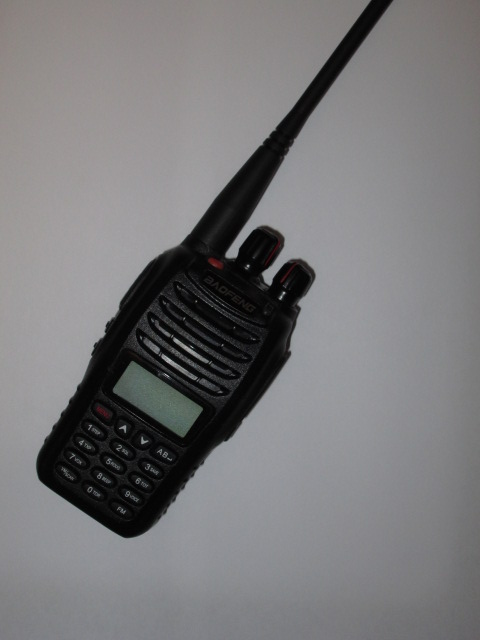
There are quite a few articles on this doing the rounds today, this is the best one I have found that sums it all up: http://www.pressexaminer.com/uk-troubled-by-chinese-sellers-on-ebay-and-amazon-as-christmas-approaches/77476
Steve, G1KQH, is a regular contributor to AmateurRadio.com and writes from England. Contact him at [email protected].
Is time about to be called on cheap Chinese imports?
It appears this activity has not gone unnoticed by the UK VAT man, and some traders are complaining about this practice too that they can't fairly compete, could the door be about to close!
There are quite a few articles on this doing the rounds today, this is the best one I have found that sums it all up: http://www.pressexaminer.com/uk-troubled-by-chinese-sellers-on-ebay-and-amazon-as-christmas-approaches/77476
Steve, G1KQH, is a regular contributor to AmateurRadio.com and writes from England. Contact him at [email protected].
WSPRing on 30M
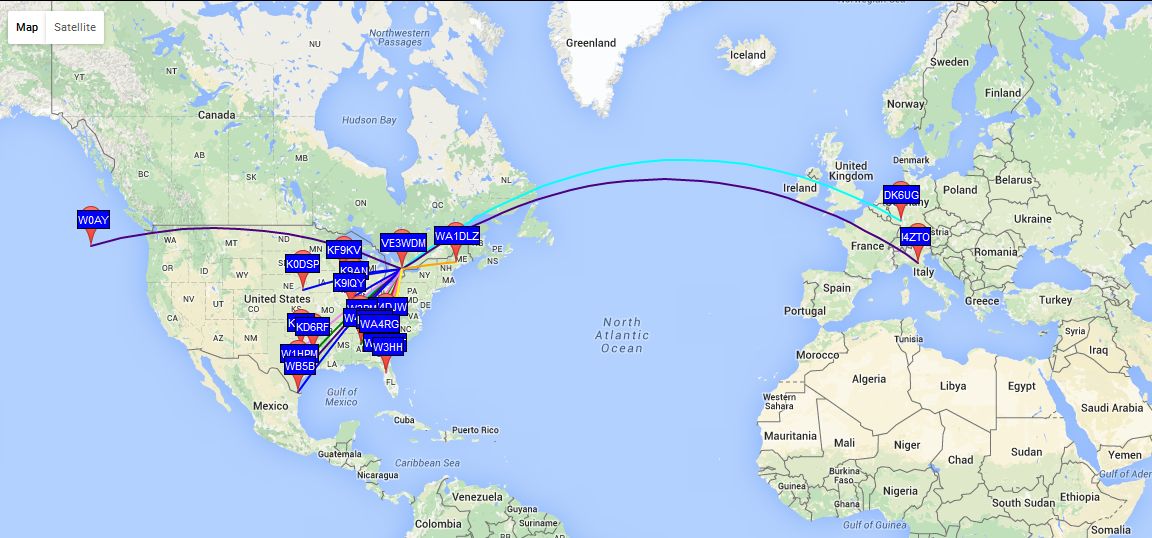 |
| 30m WSPRing |
Mike Weir, VE9KK, is a regular contributor to AmateurRadio.com and writes from New Brunswick, Canada. Contact him at [email protected].
 Ham Radio Deluxe |
 W5SWL Electronics |
 Ham Radio Prep |
 KB3IFH QSL Cards  Hip Ham Shirts  HamRadioAuctions HamRadioAuctions Reliance Antennas Reliance Antennas Enigma Shop Enigma Shop |  morseDX  Ni4L Antennas  R&L Electronics R&L Electronics antennas.us antennas.us QRV QRV |
- Matt W1MST, Managing Editor
