 |
 DX and Fall Colors from Livermore Falls
 27 October 2015 | by
 Tim W3ATB and I went up to Livermore Falls in Plymouth this morning. I worked England, Spain, Israel, Denmark and Latvia. To make it even better, the fall colors were stunning.

The Plymouth and Lincoln railroad tracks run just to the west of the falls. I set up on some rocks in the sunshine. It was nearly 55F in the sun.

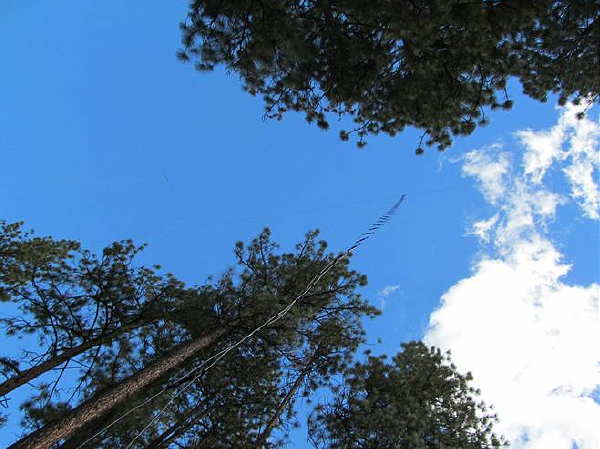
I tossed a 33 foot wire into an oak tree so my wire was sloping to the east. It was perfect on 15, 12 and 10 meters. I used the KX3 with a 9:1 unun.

As I tuned across 15 meters I felt like I was in radio heaven. FS/K9NU Paul in
St. Martin answered on my first call. Here’s my log for the morning:
27 Oct-15 1455 21.028 FS/K9NU CW 599 599 St. Martin
27 Oct-15 1458 21.024 OZ5RM CW 569 599 Denmark
27 Oct-15 1503 21.022 YL2TQ CW 589 599 Latvia
27 Oct-15 1508 21.007 LZ1IN CW 559 579 Bulgaria
27 Oct-15 1512 24.900 4Z5AD CW 599 599 Israel
27 Oct-15 1523 24.900 UR5WA CW 599 599 Ukraine
27 Oct-15 1525 28.028 G0EFO CW 579 599 England
27 Oct-15 1530 28.009 EA3AR CW 579 599 Spain

I tried 12 meters and worked Ukraine and Israel, so I moved up to 10 meters. I was amazed to find it also open. I worked England and Spain.
With that I packed up and headed home. I’m so glad I was able to get out. It’s supposed to rain the next two days.
Jim Cluett, W1PID, is a regular contributor to AmateurRadio.com and writes from New Hampshire, USA. Contact him at [email protected].
A Few More Days… DX from the land of Gold
It was such a glorious day. We walked through a tunnel of gold and into a wide open field to bask in the warm sunshine. I worked California, Arizona, Hungary and Russia.

Many of the maple trees with their bright colors are bare now. The oaks are showing their subdued reddish browns and the beeches their brilliant yellows. And it’s much cooler… 45F. Fortunately, in the sun it was nearly 70F. I tossed a line over an large oak on the edge of the field and pulled up a 33 foot wire.

I used the KX3 and fed the vertical wire through a 9:1 unun. I started out on 15 meters. The first station I worked was NI6BB, the Battleship Iowa, now on display in Los Angeles. My signal was pretty awful… a 229, but the operator was eventually able to copy the full exchange. Then I worked W7GVE in Arizona. Ed gave me a 549 and we chatted for nearly 20 minutes.

I switched to 17 meters for a quick QSO with Hungary. Joska, HA0EX gave me a 339 but we completed the exchange without trouble. I went to 20 meters. UE25R, a special event station in Russia, gave me a 599. He was strong to me, so I think my signal there was credible.

The warm days are passed. Back home, I carried the hammock and the summer table to the basement. Winter is near.
Jim Cluett, W1PID, is a regular contributor to AmateurRadio.com and writes from New Hampshire, USA. Contact him at [email protected].
HF Slacker Operation for CQ WW SSB
The CQ Worldwide DX SSB contest was last weekend and I applied my signature HF Slacker™ operating methodology to this event. Most of the HF gear I have is kept at our cabin in the mountains but I had to be at the house this weekend due to some commitments. I decided to apply Field Day principles and rig up whatever I could with equipment on hand.
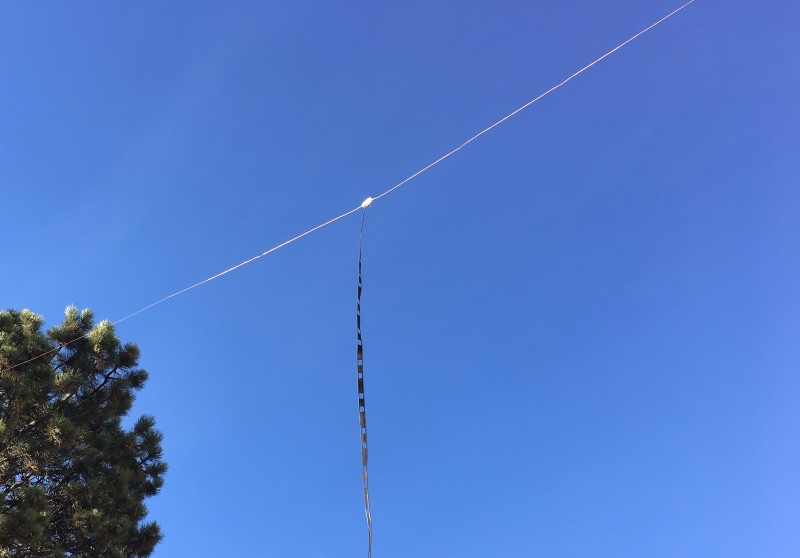
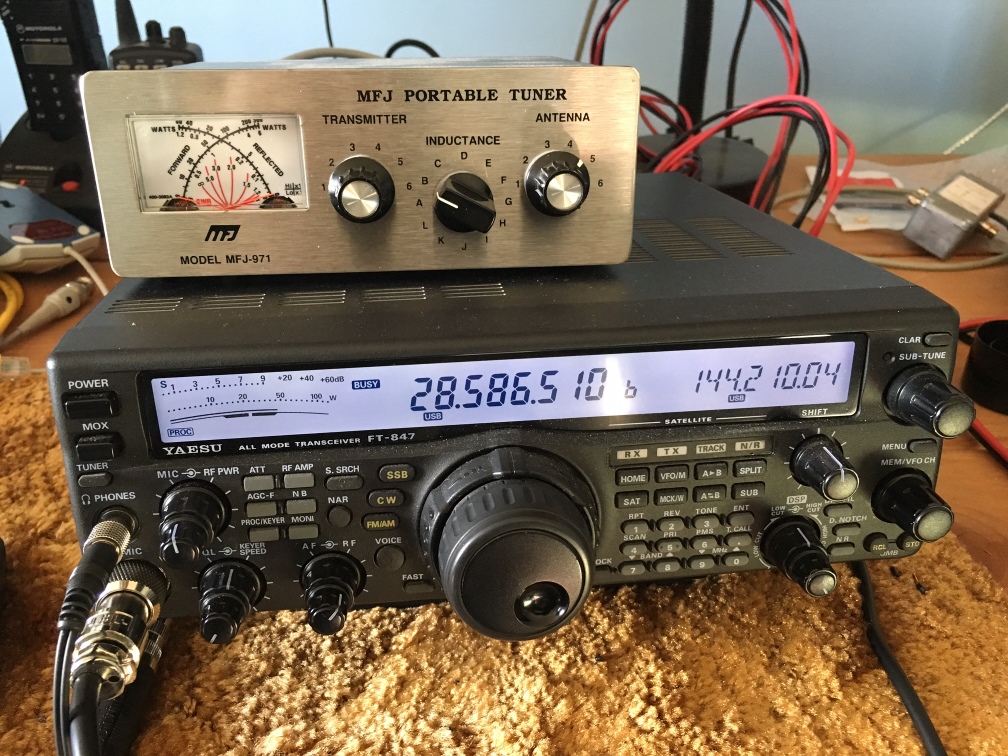 I dug out the Yaesu FT-847 transceiver, an MFJ antenna tuner and a half-size G5RV antenna to configure a basic HF station. Using a fishing pole to cast a steel washer over a tall tree in the back yard, I rigged up the antenna between the tree and the house. The G5RV is a compromise antenna…I’d much rather have something like a trap or fan dipole. But it’s what I had on hand, so I made it work. The impedance presented by this antenna is all over the map, so a decent antenna tuner is a must.
 I started out on 15m with a few contacts to Europe and Central America. Later I moved up to 10m and made even more contacts there. I was mostly searching around for the best DX but still working a few stateside stations. Later in the afternoon, the bands swung towards the west and I managed to work KH7CW and JR3NZC before going QRT for the day.
Sunday morning brought more propagation, first to Europe, then the Caribbean and South America. The high point was working AHØBT in the Mariana Islands and VK2GGC in Australia. AHØBT was not real strong, maybe S5 at my location so I thought I’d struggle to punch through the noise and QRM on the band. However, it only took a couple of calls to make the contact. That’s what I like about the 10m band!
I used the N1MM logging program during the contest. A snapshot of the log is shown below.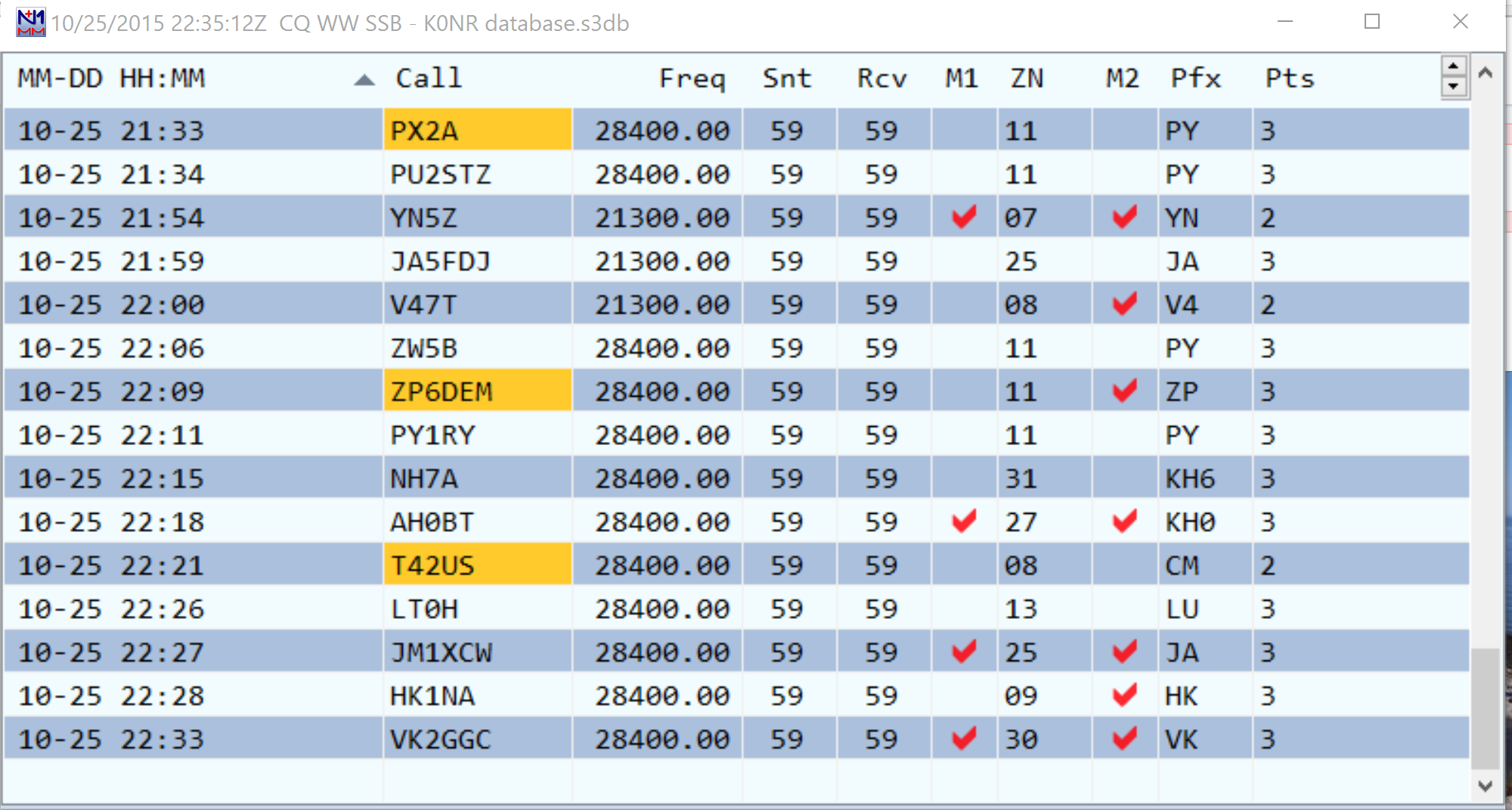 I only worked the contest intermittently on Saturday and Sunday, maybe 5 or 6 hours total operating time. Still, I managed to work 49 countries and 30 CQ Zones. That’s half way to DXCC on one weekend with a very basic HF station. Radio contests stimulate activity and DX contests bring out the DX. I point this out to encourage others to give it a try, even if they don’t have huge antennas on a tower and a linear amplifier. Almost all of my contacts were on 15m and 10m, which tend to be more productive when conditions cooperate. Twenty meters gets jammed with high power stations so it is often tough going for the little pistols.
 Band     QSOs     Pts  Zone  Country
    14       2       3    2    2
    21      30      70   13   21
    28      52     136   15   26
 Total      84     209   30   49
Score: 16,511
Another weekend of having fun messing around with radios. Even if I’m an HF Slacker™. 
73, Bob K0NR
The post HF Slacker Operation for CQ WW SSB appeared first on The KØNR Radio Site.
Bob Witte, KØNR, is a regular contributor to AmateurRadio.com and writes from Colorado, USA. Contact him at [email protected].
AUXCOMM
All I can say is, "Wow!". This course was fantastic and re-awakened a lot of the training that I received when I was a Communications Officer with Middlesex County OEM back in the 80s and 90s. And a lot of things have changed since then, of course, and hopefully, I absorbed them like a sponge.
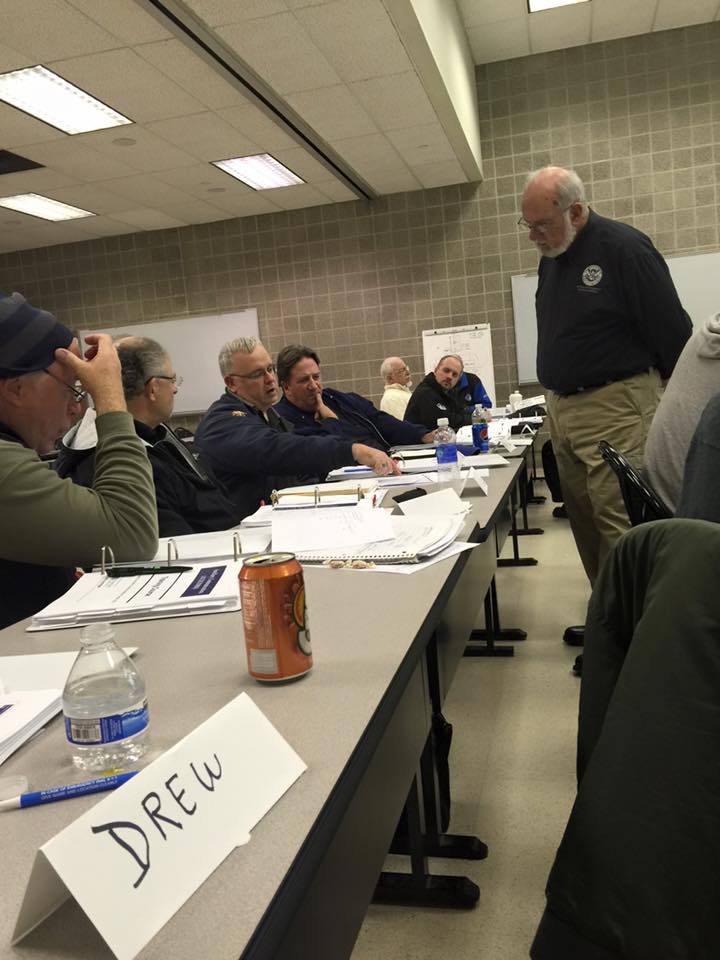
The course, which spanned some 20 hours, was expertly taught by Hank Koebler N3ORX and Jim Millsap WB4NWS. If I were to go into the experience which make these two fine gentlemen qualified to teach this course, it would probably occupy the next 5-10 blog posts. Suffice it to say that we were very fortunate enough to be taught by two experts with regard to Amateur Radio and EMCOMM.
The class went by quickly, and was never boring. Jim and Hank kept it interesting and, if I may dare say, fun. The pace was quick, but with enough time given to take in all the key and necessary aspects of what was being taught. There were ten units (I hate to call them "lectures") that were broken up by plenty of exercises where we had to identify resources, come up with communications plans, and then submit them for approval. This was followed by one last "Final Exam" or final planning session which brought together everything that we had learned up to that point, In addition, throughout the class, we learned the correct procedures for filling out the necessary ICS paperwork that accompanies all these kind of events.
I must admit that after the first day, my head felt like it does after the first day of Dayton Hamvention, busting to the seams with sensory overload. But it was all good, and by the second day, I think everyone returned in the morning feeling a bit better and just a tad more comfortable with their EMCOMM skills.
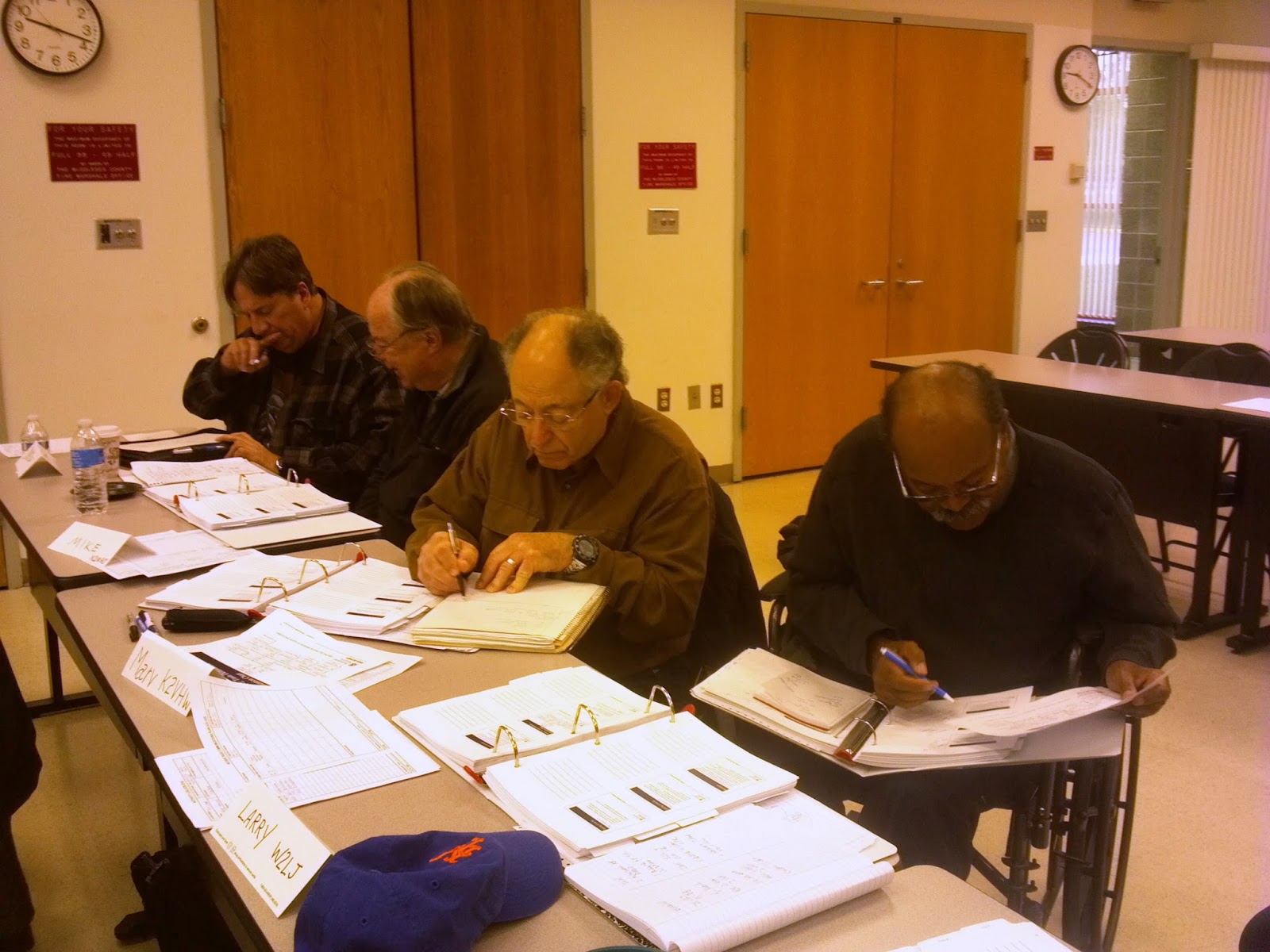
The course built upon the education we received from those online FEMA courses that we all took on the Incident Command System, the National Incident Management System and the National Response Framework. It expanded upon that and throughout the class, decorum, attitude and etiquette were accented.
It does not do any good for the name and face of Amateur Radio, for uninvited, untrained, undisciplined "know-it-all cowboys" to show up to an emergency with an attitude that Amateur Radio is there "to save the day". That attitude, along with "Hey, lookie here at all my latest and greatest gear" is most assuredly going to get you escorted off the scene with a firm admonition to never return.
The keys to a successful blend of Amateur Radio and Disaster Response are training, decorum, the willingness to help with ANY situation (not just communications), and above all, professionalism. The willingness to blend in, get the job done with a minimal mount of attention or hoopla to yourself or the Amateur Radio Service, are what is needed. In fact, if you follow those guidelines, the Amateur Radio Service and Amateur Radio operators WILL come out smelling like a rose, and will be asked to come back on a continual basis.
To all Amateur Radio ops who read this blog that are interested in Public Service and Amateur Radio EMCOMM - I heartily urge you to go to your Town/City, County and State RACES/ARES leadership team to request them to have this AUXCOMM class brought to your state. Regardless of your level of experience, you are going to enjoy this class and will learn things that you never knew before.
72 de Larry W2LJ
QRP - When you care to send the very least!
Larry Makoski, W2LJ, is a regular contributor to AmateurRadio.com and writes from New Jersey, USA. Contact him at [email protected].
West Coast 630m Growth

The Canadian west coast contingent of stations on 630m continues to slowly expand, with Mark, VA7MM and Toby, VE7CNF now operational at 'DX capable' power levels.
Both Mark and Toby have been refining their antenna systems with an eye towards the upcoming winter season as well as the November 'crossband' activity weekend ... both stations were heard testing this week and are sounding very strong at my Mayne Island location.
Toby has sent a picture of his antenna loading coil and variometer scheme, shown below.
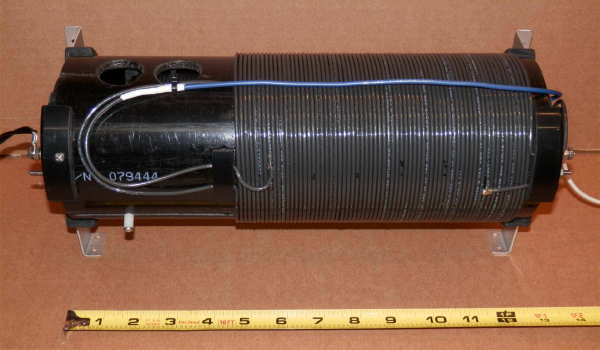
"You can see the white slider knob at the lower left, which goes through a slot in the outer pipe and screws into the end of the inner pipe. The white wire at the right goes to the matching transformer, and the black high-voltage wire at the left goes to the antenna. The coil is wound with #14 so it can handle some power. There are ventilation holes around the pipe and at the ends, but at 200W I did not notice any warming. A regular rotating variometer may have slightly lower losses, but it would be larger and I wanted to make my tuner box small so I can hide it near the trees."
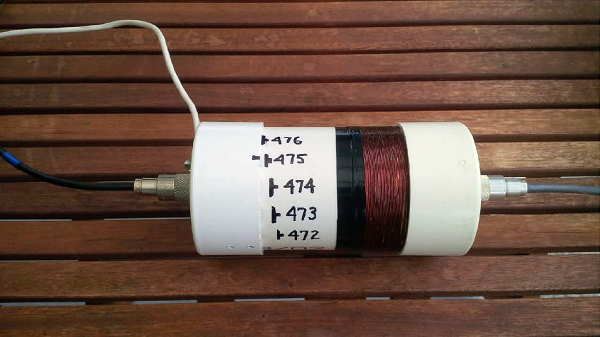 Mark also sent some pictures of his recent handiwork, showing the simple loading coil and tuning system presently in use at his station. His present plans call for something capable of handling power in the 100 watt range and, although using smaller gauge wire, the loading coil seems to handle it just fine. Like Toby, he is using a 'sliding variometer' and a toroidal autotransformer for impedance matching to 50 ohms. Mark will be running ~ 100 watts into a 100' vertical wire with top-loading.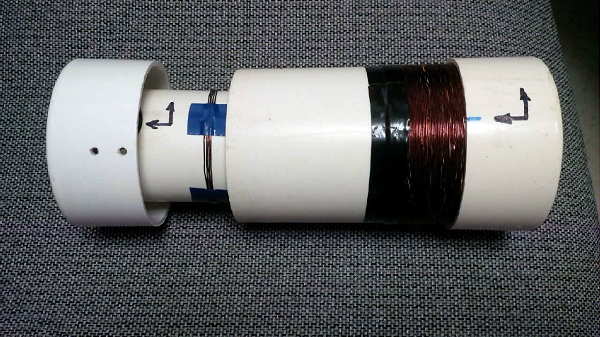
It is wonderful to see more new stations arriving on the band but the new activity seems to be coming from VE7 only ... how interesting it would be to have stations in VE6, the prairies and especially from Ontario, which has many more hams than any of the other provinces. The opportunities presented to Canadian amateurs by the new band are both boundless and challenging and there is so much that can be learned by 'jumping in'!
Another western amateur has caught the 630m bug, this one from the U.S.A. Steve, KK7UV, in Montana, has been busy building new antennas as well as a new GW3UEP transmitter. Operating with an experimental licence, WH2XNV, Steve has been putting a nice CW signal up this way during the evenings and is all set for the winter and, hopefully, for the fast-approaching day when the boys on the other side of the border get full access to 630m as a ham band. All of us up here very much look forward to working our U.S. counterparts very soon.
Steve's new antenna consists of an 81' vertical wire, top-loaded with a 3-wire 68' x 8' tophat. His ground system now has over 4,000' of radials, ranging in size from 40'-130'.

Steve also reports modifying his dual-FET (parallelled) GW3UEP transmitter from the original solenoid-wound coils to toroidal cores, increasing efficiency from 74% to 77%.

As well, he also went to a single-FET (per the original design) and garnered a further increase in efficiency, now at 86% and 82 watts out ... plenty of power to do some useful work on the band. It's wonderful to see how 630 meters brings out the 'experimenter' in all of us. He also reports that he's "having a bunch of fun at this ... "!
If homebrewing is your main interest, all of the 630m stations that I'm familiar with are using home-built transmitters. Maybe you like tinkering with antennas? This band is perfect for the design and development of small, yet effective, backyard antennas ... most will be surprised at how little is needed to radiate a usable signal on 630m. Perhaps propagation is your main interest? There is still much to be learned about the capabilities of our stations, operating at amateur radio power levels, in the MF band.
As mentioned before, we are really very fortunate here in Canada, to have this amazingly interesting part of the radio spectrum made available to us ... let's try and use it, from coast to coast and everywhere in between.
VE6, VE5, VE4, VE3, VE2 and VE1 ... the band needs you!
Steve McDonald, VE7SL, is a regular contributor to AmateurRadio.com and writes from British Columbia, Canada. Contact him at [email protected].
Amateur Radio Weekly – Issue 82

The Yellow Box of Power
The Yellow Box of Power is a very yellow Pelican box (size 1550) loaded up with 36 amp-hours of 12-volt battery capacity that can be charged by way of normal 120V household power or through one or more solar panels.
GAD.net
Use of 146.52 MHz FM simplex frequency cleared for ARRL contests
The committee felt that permitting the use of 146.52 MHz would allow new/curious contesters possessing only FM-mode radios to stumble upon more contacts.
ARRL
How do lacquered boards stand up over time?
A query I hear from time to time about using copper-plated boards for construction is what they look like after a few months or years.
AA7EE
Unscientific spectral analysis of two Baofeng radios
This transmitter is all over the place. Tons of spurious emissions, some as little as 30dB down from the fundamental. This transmitter is definitely misbehaving or not properly filtered.
KD8TWG
Digital Voice Balkanization
Wouldn’t it be cool if we had one digital communications format for the VHF/UHF amateur bands?
AmateurRadio.com
All your modem are belong to us
Closed source and proprietary chipsets are nasty, a glaring problem in a cool geeky field that is otherwise open source. It’s got to be fixed.
ROWETEL
Spoken command injection on Siri, Google
It is possible to trigger Siri remotely by emitting an AM-modulated signal containing voice commands at 103 MHz.
University of Pennsylvania
Try FSQ for fast, simple QSOs
FSQ is a Fast Simple QSO mode designed specifically for HF. It works well under NVIS and sunrise/sunset conditions on the lower bands, and also works well for short skip and grey-line on higher bands.
KB6NU
Scripting Fldigi on OS X
With excellent support for executing external scripts, it is easy to set up Fldigi to log all recorded QSOs directly to one of the three major OS X logbook programs.
Mac Ham Radio
Good SWR and antenna resonance
Standing Wave Ratio (SWR) is an important concept that describes how good of a match exists between a transceiver and antenna system.
Ham Radio School
Video
VHF propagation timelapse
This is a timelapse of NG0E’s APRS VHF Propagation monitor.
YouTube
Fox 1A satellite beacon
“Hi, this is amateur radio satellite Fox 1.”
YouTube
Amateur Radio Weekly is curated by Cale Mooth K4HCK. Sign up free to receive ham radio's most relevant news, projects, technology and events by e-mail each week at http://www.hamweekly.com.
Amateur Radio Newsline Report 1982 October 23, 2015
- HAMS MOBILIZE IN STORM-STRUCK PHILIPPINES
- IARU: KEEPING AMATEUR RADIO YOUNG AND GROWING
- CELEBRATING ARTHUR COLLINS
- DEADLINE FOR ARISS CONTACTS IS NOV. 1
- UK HAM LICENSES,, GOING, GOING, GONE
- HAMS ARE BIG WHEELS AT BICYCLE FEST
- UN CELEBRATING 70
- UNPLUGGING THE HOTELS IN CALIFORNIA'S SAFETY NET
- A 'FIRST' FOR NEPAL
- INDIA: ELECTION HISTORY REPEATS ITSELF
- THE WORLD OF DX
- SCOUTING FOR ANSWERS
 Ham Radio Deluxe |
 W5SWL Electronics |
 Ham Radio Prep |
 KB3IFH QSL Cards  Hip Ham Shirts  HamRadioAuctions HamRadioAuctions Reliance Antennas Reliance Antennas Enigma Shop Enigma Shop |  morseDX  Ni4L Antennas  R&L Electronics R&L Electronics antennas.us antennas.us QRV QRV |
- Matt W1MST, Managing Editor
