 |
 I found a fox!
 4 December 2015 | by
I found a fox! No, not a real fox…a QRP fox! I took a break from watching the Packers get whooped by the Lions, and ran up to the shack for a bit of relaxing. I turned on the KX3, and it was still tuned to 3.550 CW. Right away came N0UR calling CQ FOX. I haven’t participated in the fox hunts before, but hey, this had to be destiny! Jim in MN picked me up right away…first call! He did have to ask for my power (5W) as in the excitement I forgot to send it!
Thanks Jim for the hunt! If you’re interested in giving QRP a try, and you like a bit of a challenge, check out the QRP Fox Hunt page.
Michael Brown, KG9DW, is a regular contributor to AmateurRadio.com and writes from Illinois, USA. Contact him at [email protected].
FT991 issues?
It looks like Yaesu have had some quality control issues with some FT991 transceivers, although I am unsure what percentage of units sold are effected. It does not look good though. It is always wise to wait a while so these initial issues are ironed out. In Yaesu’s defence, I have had an FT817 (original version with the old PA) for about 15 years and it still works as well as ever. I love it.

Roger Lapthorn, G3XBM, is a regular contributor to AmateurRadio.com and writes from Cambridge, England.
Ten-Tec Sold to Mystery Owner

A post from John Henry KI4JPL (reprinted with his permission):
Thu, 3 Dec 2015 06:12:00
I wanted to bring people up to date on what is happening right now.
I had a discussion with the new owner last night, and I wanted to relay some information.
He is now officially the new owner of TEN-TEC.
He is planning the rigs and amplifiers and other accessory products to engineer and to manufacture for the coming year to cover the purchase and expenses for the year, working on the details of the various plans for service, sales, and marketing, etc.
Don’t underestimate the amount of time and planning and effort that this business strategy planning maintaining overhead etc stuff takes.
Learning lessons from the past to help the future of the company be more viable.
What will you see? and when?
Planning on having the OMNI-VII back in production in 1st quarter 2016, hoping to ship in 2nd quarter 2016.
Dayton, He will be there, going to try to get the same TEN-TEC booth/booths as possible. Showcasing the existing products, and possibly something new based on the existing products, time will tell.
He did say that he will either bring back the Orion II or have an Orion III. Time frame is tbd. could be as early as end of 2016 or Dayton 2017????
There might be improvements/changes to certain rigs, e.g. maybe there will be an OMNI-VII+ maybe an OMNI-VIII in a year???
The Eagle will go back into production some time after the 1st OMNI-VII run.
Prices will return to the original pre liquidation sale prices when the new website is up so that each will be at a point that will make enough profit to make the company viable. Other features will get added where possible.
TEN-TEC was actually shipping a $200 bill with every one of a specific model that it sold this last year.
There were so many ways that TEN-TEC has been hemorrhaging over the last couple of years, and even back a bit further, that changes will have to be made. Some the public won’t like, but then the alternative is that TEN-TEC would close forever.
Also remember, it was made public that the two owners of RKR were looking for a new owner, and how many stood up to say “I’ll buy it/fund it/save it”. This gentleman did and will do what he has to do to keep the brands alive.
There are plans to bring back some VERY good products, items that have been big sellers for TEN-TEC just a few years ago, and were profitable and have been requested for quite some time.
Also, there are still commercial orders coming in that will be there for maybe another year or two using the same RX331/RX340 platforms that will help him maintain a cash flow that will help realize amateur market production runs. There might be a need in the future to try to raise some more capital if certain plans come to fruition with commercial and FEMA customers, if those work out, may need to raise some cash to buy the parts, so there might be a gofundme funding campaign set up, where amateur customers can help donate to purchase the parts, and then part of or all of or x times the amount of the donation is taken off of their next order of a TEN-TEC product > a certain dollar amount.
No, don’t look for exchanging your $100 donation to cover 1/2 of a Rebel, that won’t happen, Talking a major product, e.g. an OMNI-VII, or a high powered amp….. To do this first class, we need a 200K capital infusion for a new factory building and some new equipment to replace what was liquidated if anyone cares to step up and accelerate our success. 400K would give us the facility, equipment and capitol to put everything back in production to a stocking basis and allow us to complete the Orion III. If 400 people will give us 1K each, we will commit to the Orion III of your dreams in 18-24 months and give you 2K off the target price of 5K as well as engrave your name and call on a plaque on the new building that says you helped build it and save TEN TEC.
Where do I fit in?
No, I’m not the owner, but I am going to do whatever I can in the evenings to ensure that TEN-TEC is a success. I want to see it be a success, and maintain what can be maintained of the people, and improve it’s image/products/etc back to where they were years ago. The owner is quite insistent that I remain intimately involved with TEN-TEC even if it is on a part time basis. It is my choice of how much or little I spend on TEN-TEC and the door is assuredly left open for me to come and go as I please. He wants me to be the VP of Engineering, but, well, time will tell how all of
this plays out.
I am also working on digital modes for HRD, so, my evenings are quite interesting.
In the future, who knows?
Where do you fit in?
Be patient, this is a total reboot of a company, ripping away the excess that bleeds it dry (e.g. high rent, using an MRP system that costs $$$$ monthly when something is already in place to take care of it, changing to a cost effective internet/phone system, so many “luxuries” will be removed and put in their place the necessities to get business going profitably), and building the business and products with the key employees to make it strong again. You build the employees, the employees build the company. But it will take time.
The products are there, the technology is also there for the future (some things that were in the works that no one in the public knows about) that the new owner has a plan to finish soon.
Actually, TEN-TEC does need to take the time it will take to make it a success. Otherwise if he runs headlong into this as was done in the past, he will fail. If people buy rigs and amps and tuners and other accessories elsewhere in the meantime, well, that is their decision. The market continually has new and continued customers. existing customers periodically look for something new, enough of a continual market that should sustain itself for years.
The new products coming out that are planned include continuances of good known technology, and of course some are a step ahead of what is in the market today, and you will see those in 1-2-3 years.
I will not divulge nor answer speculation on anything further than what I have stated above as to what products, when, etc. I can also tell you is that the owner has emphatically stated to me that this the last time Ten Tec will change hands for the next 15-20 years or so as he is my age and plans for us both to operate it until we are in our 70s or physically unable to continue, so Ten Tech could not be in the hands of anyone more SERIOUSLY long term goal oriented. He has wanted Ten Tec for a long time for the excellent DSP AGC technology built in to our transceivers so I
think it is safe to say that there will be future generations of the Omni, and Orion style units as finances permit. But again in order for this to happen it is critical that YOU support TEN TEC by purchasing existing TEN TEC products. Look for the Omni 7+ next year.
So, whereas he still wants to remain anonymous until his formal announcement in the first quarter, I myself am convinced that this will work, enough so to help him wherever I can, and so are the key core employees at TEN-TEC. If anything, our message at this time is please be patient with the negativity. There are other things happening behind the scenes which can not yet be publicly discussed before they are finished.
If this sounds like cheerleading, well, then so be it, I care about TEN-TEC, the people, the legacy, and will do what I can to make it a success, and, if this fails, well, we will give it a valiant effort.
Please understand that I have other commitments from now until Monday next week that I may not be able to respond/answer questions until then. But do realize, that I have disclosed about as much as I can for now. This statement came from a draft I created, and the new owner gave me inputs on, which items he felt like disclosing now, etc. So, there may be some he/I/our’s mixed up, but I hope the message from him is clear. TEN-TEC is something he is passionate about, and is committed to making it a success. Yes, there are trials and tribulations, but, he is convinced he
can do it, and I will do whatever I can to assist, and so will various core TEN-TEC individuals.
73, KI4JPL
John Henry
Matt Thomas, W1MST, is the managing editor of AmateurRadio.com. Contact him at [email protected].
The Spectrum Monitor — December, 2015

Stories you’ll find in our December, 2015 issue:
A Virtual Tour of WEAF in 1927
By John F. Schneider W9FGH
The iconic radio station WEAF in New York City began in 1922 as a grand experiment by the Western Electric Company, a subsidiary of AT&T. Western Electric was interested in exploiting its collection of radio patents, which it believed would allow it to corner the market in the exploding field of radio broadcasting. The station went on the air August 16 of that year from an antenna atop the eleven-story Western Electric Building at 463 West Street. WEAF was initially conceived by AT&T as a “toll broadcaster,” a radio-station-for-hire, with blocks of program time that would be leased to anyone that wanted to broadcast. Later, WEAF began broadcasting from a new transmitter site located in more rural surroundings on Maple Avenue in Bellmore, Long Island, 28 miles East of New York. John gives us a tour of this historic radio station.
Variacs 101: Answering those Questions
By Rich Post KB8TAD
One of the most useful tools for vintage radio repair and restoration is the Variac. All it does is vary the line voltage from zero to full and, depending on its connections, beyond full line voltage. It can be found in the chemistry lab, in older hotels and theaters for varying the lighting levels, as noise-free dimmers in recording studios, and as a way to gently warm up guitar amps from a cold start. It has been used to control the heating of soldering irons, to carefully adjust coffee roasters, and to increase the life of older incandescent Christmas lighting. And, of course, for radio restoration, it allows an older radio to be powered-up gently and at reduced voltage.
Retro Radio: Antique Radio Classics and the People Who Love Them
By Richard Fisher KI6SN
The dulcet tones of Dinah Washington, Frank Sinatra, Nat King Cole, The Andrews Sisters and Etta James no longer float through the air from the more than 2,500 radios consuming Barry Dagestino’s three-car garage and a nearby 1,000 square foot storage unit. The singers may be gone, but many of the radios that brought their voices to bygone generations are very much alive today—dusted off, rewired, restored and glowing from side tables and mantel pieces around the world. This first of the two-part TSM “Retro” series on Antique and Vintage Radio opens a window on broadcast band and shortwave receiver collectors, calling on the advice of experts to tell us how to get started in this fascinating niche of hobbyist communications.
Cutting the Cord: Part 1
By Mike Kohl
Much has been written in the mainstream press during the past several years about the subject of cord-cutting, which is the act of dropping cable-TV and other subscription services for less costly and sometimes totally free alternatives. This article is a primer on the options now available to most consumers, with future articles going into how-to details that will attempt to compare those options so that one can form an opinion about how to save money on home entertainment delivery.
Digitally Speaking By Cory GB Sickles WA3UVV
P-25 Networking: Staying Digital
Scanning America By Dan Veenaman
Scanning the Mall of America and DFW Airport
Federal Wavelengths By Chris Parris
Year End Wrap Up; Reader’s Submissions
Utility Planet By Hugh Stegman NV6H
Big Month for Russian Military Monitoring
Radio Intrigue By Don Schimmel
Old FAPSI Intercepts
Digital HF: Intercept and Analyze By Mike Chace-Ortiz AB1TZ/G6DHU
More on US Government 5-Letter Network
HF Utility Logs By Mike Chace-Ortiz and Hugh Stegman
Amateur Radio Insights By Kirk Kleinschmidt NT0Z
Forgotten Antenna Fundamentals and other Curious Tidbits: Part 1
Radio 101 By Ken Reitz KS4ZR
Timely News with a Global Perspective and some Great Music
Radio Propagation By Tomas Hood NW7US
NASA’s Solar Fleet Peers Into Coronal Cavities
The World of Shortwave Listening By Rob Wagner VK3BVW
Preparing for your next DXpedition
The Shortwave Listener By Fred Waterer
Christmas Radio Around the World
Amateur Radio Satellites By Keith Baker KB1SF/VA3KSF
A Whole Host of New Satellites
The Longwave Zone By Kevin O’Hern Carey WB2QMY
Miscou 2015 Recap
Adventures in Radio Restoration By Rich Post KB8TAD
In Command again, a pair of ARC-5 and SCR-274N aircraft transmitters: Part 1
The Broadcast Tower By Doug Smith W9WI
Going out with a Bang!
Antenna Connections By Dan Farber AC0LW
Year-End Quiz: Test Your Antenna Knowledge!
The Spectrum Monitor is available in PDF format which can be read on any desktop, laptop, iPad®, Kindle® Fire, or other device capable of opening a PDF file. Annual subscription is $24. Individual monthly issues are available for $3 each.
Ken Reitz, KS4ZR, is publisher and managing editor of The Spectrum Monitor. Contact him at [email protected].
CLE 200 Results
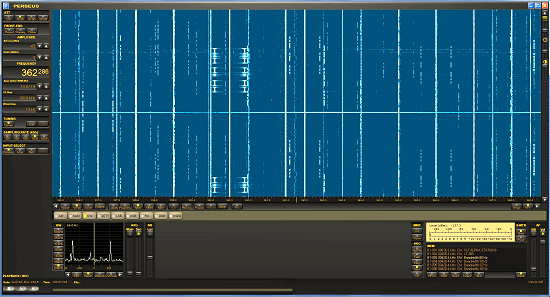
The CLE 200 event this past weekend once again delivered mediocre propagation on all three evenings. In spite of Sunday night's G1-class geomagnetic storm and high K values, Sunday's overnight period proved to be the best of the weekend's generally 'below average' conditions ... this is the time of the year that LF propagation is usually at its best. Thankfully, there are still several months ahead that could offer some really great mid-winter prop.
The following NDBs were logged using the Perseus SDR along with my LF inverted L, resonated at 300kHz:
28 09:00 335 CC Concord, CA, USA
28 09:00 335 CVP Helena, MT, USA
28 08:00 335 YUT Repulse Bay, NU, CAN
28 06:00 335 YLD Chapleau, ON, CAN
28 09:00 336 LF La Salle, MB, CAN
28 13:00 337 FF Fergus Falls, MN, USA
28 09:00 337 7D Hudson Bay, SK, CAN
28 12:00 338 CMQ Campbell Lake, ALS
28 09:00 338 ZU Whitecourt, AB, CAN
28 12:00 338 RYN Tucson, AZ, USA
30 08:00 338 SHL Sheldon, IA, USA
28 07:00 338 TU Tulsa, OK, USA
28 12:00 338 YPX Puvirnituq, QC, CAN
28 12:00 338 K Port Angeles, WA, USA
28 10:00 339 6X York Landing, MB, CAN
28 10:00 339 MKR Glasgow, MT, USA
29 06:00 340 YY Mont Joli, QC, CAN
28 13:00 341 ELF Cold Bay, ALS
28 10:00 341 OIN Oberlin, KS, USA
29 06:00 341 YYU Kapuskasing, ON, CAN
28 09:00 341 DB Burwash, YT, CAN
28 09:00 342 PFT Pinecreek, MN, USA
28 09:00 343 YZH Slave Lake, AB, CAN
28 09:00 344 YOP Rainbow Lake, AB, CAN
28 09:00 344 XX Abbotsford, BC, CAN
28 09:00 344 FCH Fresno, CA, USA
28 09:00 344 BKU Baker, MT, USA
28 09:00 344 POY Powell, WY, USA
30 08:00 345 GF Grand Forks, ND, USA
30 08:00 346 OLT Soldotna, ALS
28 09:00 346 YXL Sioux Lookout, ON, CAN
28 15:00 347 TNC Tin City, ALS
28 13:30 347 DJN Delta Junction, ALS
28 06:00 347 LEN Leeny, ID, USA
28 15:00 347 SBX Shelby, MT, USA
30 08:00 347 YK Yankton, SD, USA
28 09:00 347 PA Prince Albert, SK, CAN
30 08:00 348 MC Mason City, IA, USA
28 07:00 348 MNC Shelton, WA, USA
Steve McDonald, VE7SL, is a regular contributor to AmateurRadio.com and writes from British Columbia, Canada. Contact him at [email protected].
Can anybody hear me
Calling QRP CQ - Inconceivable
Amazingly my 80m Windom / OCF Dipole has 4.5:1 SWR native around 1.8 mHz and it matches easily with a tuner across the entire 160m band. That was a surprise.
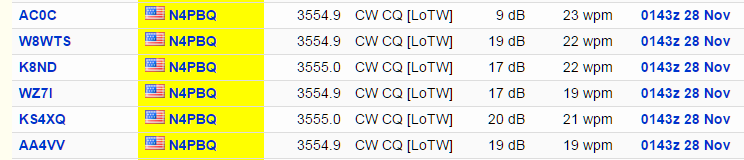
I tossed my mighty 5 watts call out at 1810 kHz not expecting much...
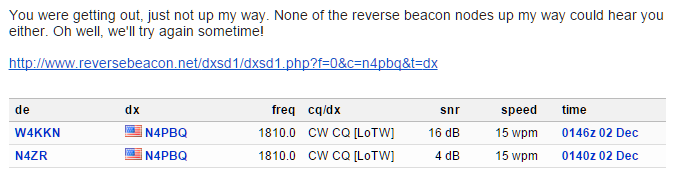
So how do you know if and where your signal is getting out ?
The Reverse Beacon Network
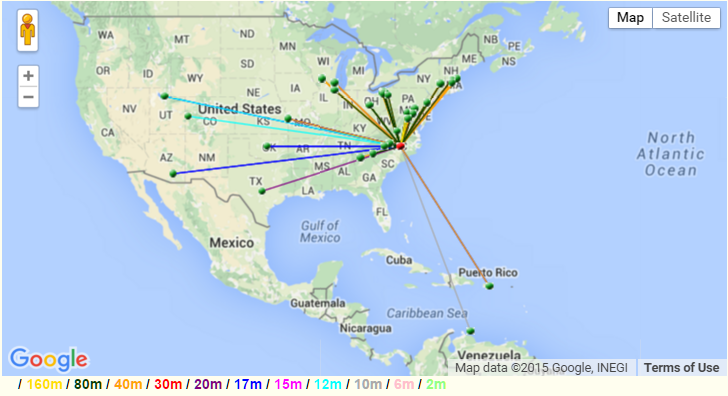 |
| Map of the last 100 reports from Reverse Beacon stations of my call sign Color coded by band |
It even includes a speedometer
 |
| My brief speed key session with N4HAY |
Summary
Richard Carpenter, AA4OO, is a regular contributor to AmateurRadio.com and writes from North Carolina, USA. Contact him at [email protected].
More Low Noise Vertical (LNV) Construction
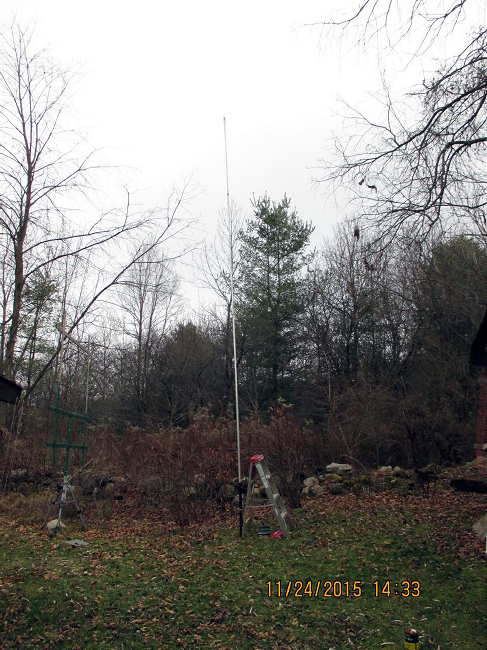 |
| New LNV At WG2XKA |
The low-noise vertical discussed here previously, has recently been implemented by at least three of the 630m experimental stations. John, WG2XKA / WA3ETD, along with Ken, WG2XXM / K5DNL and John, WG2XIQ / KB5NJD, have all constructed versions of this receiving antenna after reading about the details here.
John's antenna, pictured above, is described in more detail here, along with some nice pictures of his matching transformer.
All stations report good results with the antenna so it may be something you might want to consider if your present receiving antenna is a noise-collector.
For those interested in getting started on 630m, John (WG2XIQ), has a ton of inspiring information available on his website here as does John (WG2XKA) on his site here.
Steve McDonald, VE7SL, is a regular contributor to AmateurRadio.com and writes from British Columbia, Canada. Contact him at [email protected].
 Ham Radio Deluxe |
 W5SWL Electronics |
 Ham Radio Prep |
 KB3IFH QSL Cards  Hip Ham Shirts  HamRadioAuctions HamRadioAuctions Reliance Antennas Reliance Antennas Enigma Shop Enigma Shop |  morseDX  Ni4L Antennas  R&L Electronics R&L Electronics antennas.us antennas.us QRV QRV |
- Matt W1MST, Managing Editor
