 |
 Cold enough for antenna work
 29 November 2015 | by
 My last big project before winter was getting a wire antenna up for 160m. My HF antenna has been a Carolina Windom up 40′ or so, hung below the trees. It has been a fabulous antenna for me, allowing contacts all around the world. But lo, it does not work well down at 160m. The HF gurus in my area continued to remind me that I needed to get down on 160…so that project finally bubbled to the top of the list. I would have a two HF antenna QTH!
My first try was an end-fed zepp. After some reading and encouragement from others, up went the wire. I placed 500′ of 12AWG up in the trees. This time instead of hanging it below the trees, I used the bow to shoot it right over the tops. My youngest daughter and I had a blast over the week doing the project, including making some homebrew ladder line to feed it. After about two weeks of working on and off on it, the time to test had come. The results were awful. Although it tuned up ok, I swear it generated noise. I heard birdies I’ve never heard before, but the signals I wanted to hear were 3 S units or lower than the same signals on my Windom. I tried different grounding solutions, and even tried re-orienting the end of the wire to make more of a loop. I added a 1:1 balun (based on some other reading) but that solved nothing.
Not every experiment results in success, so down came the wire. Funny, it took about 10 minutes to pull it all down compared to the week to get it up. Anyway, Fred KC9REG had given me a commercially made 160m double bazooka that I had stashed away in my barn. I pulled it out, laid it on the ground, and determined which tree limbs I could hang it from. No more laying wire in the trees – this one was going up in the clear. After about 3 hours of work (I must be getting better) the antenna was in the rainy 37F air.
I took the KX3 outside under a tree and hooked up the coax (no ladder line this time). While it tuned ok, there seemed to be no signals anywhere. A check of the KX3 on the Windom revealed that the Apocalypse had not occurred. Ugh. Will I ever get a working 160m antenna?
I texted Fred (I was so sick of ham radio by this point that I reverted to the phone). He assured me the antenna had worked the last time he had it up. We texted back and forth a few times, and then he called. He offered to bring up his analyzer to see what was going on. About an hour later Fred shows up and sees something very interesting…the antenna isn’t resonant on any frequency. We checked the PL259 at the ground and it was fine. We let down the apex and plugged his analyzer right into the antenna. It looked good, but the PL259 at that end of the coax was loose. Not just loose, it spun. It was held on by shrink wrap. This was a commercially made coax I had never used before. I won’t name names, but don’t trust fly by night ham radio stores that have nothing more than a website and a guy named Bruno making stuff in the back of a warehouse.
I drug the ends of the coax into the porch, and Fred pulled out his soldering gun(yep, he brought everything with him.) Fred had me back in business in about 5 minutes. Back out to the antenna, pulled it up, hooked up the analyzer and wow…it worked! Pulled out the KX3 and I had signals all over the place.
Finally, after an expensive long wire antenna building experience (just under $100 in raw supplies) an elmer named Fred came through with both an antenna, soldering gun, and knowledge to make it all work. Watch out 160m…here I come!
Michael Brown, KG9DW, is a regular contributor to AmateurRadio.com and writes from Illinois, USA. Contact him at [email protected].
Ham College 11
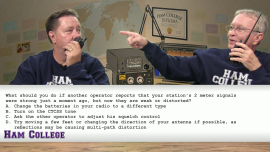
Ham College episode 11 is now available for download.
Tommy and George discuss ‘Your First Radio’. More questions and answers from the Technician class question pool. Learn how you can win an Icom T-shirt and cap.
01:06:14
George Thomas, W5JDX, is co-host of AmateurLogic.TV, an original amateur radio video program hosted by George Thomas (W5JDX), Tommy Martin (N5ZNO), Peter Berrett (VK3PB), and Emile Diodene (KE5QKR). Contact him at [email protected].
Amateur Radio Weekly – Issue 87

Raspberry Pi Zero: $5 computer
Of all the things we do at Raspberry Pi, driving down the cost of computer hardware remains one of the most important.
Raspberry Pi
3916 Santa Net 2015
Every year on 3916, we give good little boys and girls a chance to talk to Santa Claus at the North Pole!
The 3916 Nets
Kids are not the future of Ham Radio
You’ve heard it a million times: our kids are the future. But I am starting to think it is incorrect.
K0NR
rtl_433: 433.92MHz generic data receiver
rtl_433 turns your Realtek RTL2832 based DVB dongle into a 433.92MHz generic data receiver.
GitHub
5 things good Elmers do
Sending a newcomer a QSL card is a good way to encourage them to get on CW again, and I included the message, “I hope to hear you on again sometime.”
KB6NU
RTTY contest soapbox
I honestly thought I was going to be making blazing fast contacts since it’s a “Digital” mode. Nope… RTTY contacts are much longer than CW or SSB.
NT1K
DIY kit for aircraft band monitoring
There is an interesting kit being sold on eBay designed specifically for aircraft monitoring of 118-136 MHz.
The SWLing Post
SatSat iOS satellite tracker
Satellite tracking software displays current and next passes for any satellite. It also provides beacon frequencies to listen to.
SatSat
APRS Paths explained
“Why is WIDE1-1,WIDE2-1 better than WIDE2-2?” The answer has to do with the use of neighborhood “fill-in” digis.
wsanders.net
HF Automatic Link Establishment (ALE)
Automatic Link Establishment, or ALE for short, has become a worldwide standard for initiating HF communications between two or more points.
VA3QR
Samuel Morse’s other masterpiece
The famous inventor’s painting of Gallery of the Louvre is as much a fascinating work of art as a 19th century history lesson.
Smithsonian.com
Video
The changing face of hobby electronics
The internet offers cheap components from global suppliers to anywhere in Australia but may also herald the downfall of local brick and mortar stores.
State of Electronics
Amateur Radio Weekly is curated by Cale Mooth K4HCK. Sign up free to receive ham radio's most relevant news, projects, technology and events by e-mail each week at http://www.hamweekly.com.
Don’t Bug OUT when hearing a Vibroplex semi-automatic key
Vibroplex Bug Morse Keys
 |
| Vibroplex Original Semi-automatic Bug |
The Vibroplex semi-automatic Bug is considered a manual key by the SKCC (Straight Key Century Club) so it counts in SKCC contacts.

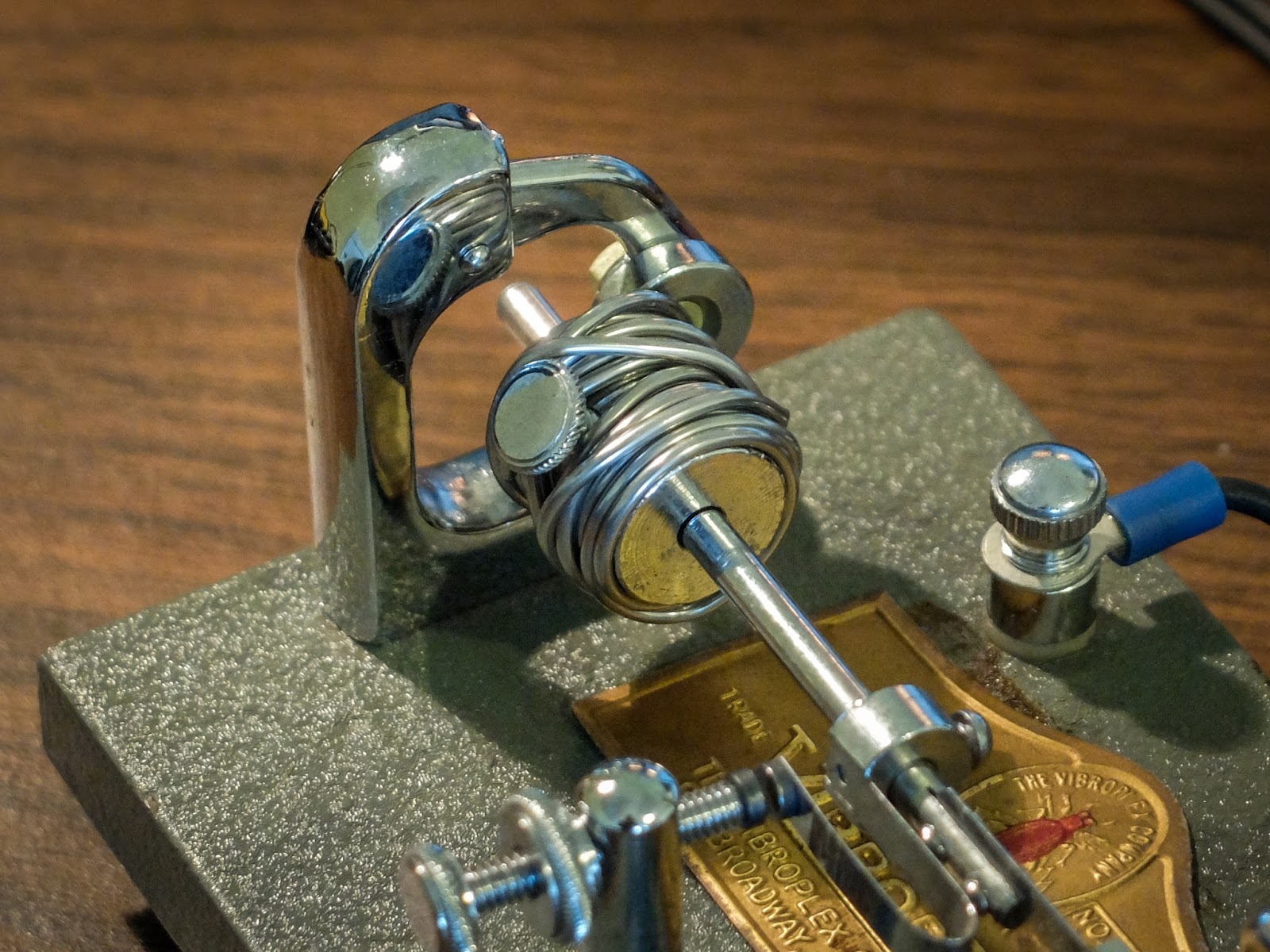 |
| Wrap the pendulum weight with solder to slow it a bit |
Here is a video running through the keys to see if learning a Vibroplex messes up my ability to use a paddle with an electronic keyer The Vibroplex Bug next to a Kent Hand Key. 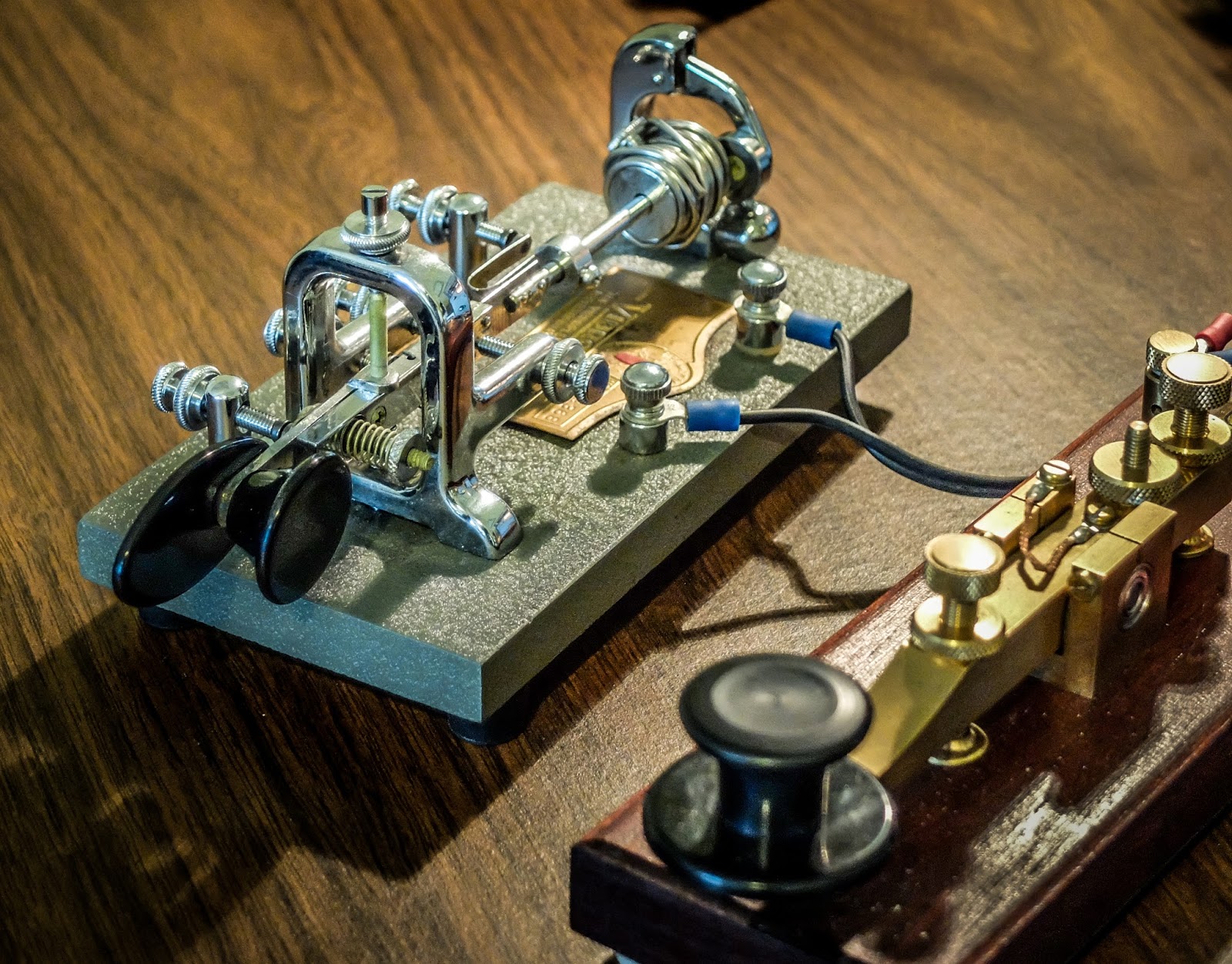 |
| Manual Morse Code Keys |
Richard Carpenter, AA4OO, is a regular contributor to AmateurRadio.com and writes from North Carolina, USA. Contact him at [email protected].
Kay Everett Calls CQ

All aboard for ADVENTURE! I purchased this book a while back and I finally dug it off the shelf. Kay Everett Calls CQ, by Amelia Lobsenz, is about a young college girl who takes a summer road trip from North Carolina out to the West with three friends, a travel trailer, and ham radio. For me, this book has several things going for it: (1) strong female protagonist (I have two daughters), (2) HF mobile (I need to get my rig installed in my new vehicle), and (3) a travel trailer trip to Yellowstone National Park, Idaho, and the Colorado Rocky Mountains. The plot centers around a jewel thief, who is also roaming the West, and Kay learning about the amateur radio hobby. Ham radio plays a critical role in several places and the author has the main characters explore several aspects of the hobby (… they even go to a hamfest).
The author, Amelia Lobsenz, was an experienced ham, licensed in 1941. After a stent in publishing, she ran her own public relations firm. She based some of the characters on her actual friends, to include Theresa Korn, K7JGU. In the story, Terry, a YL and pilot, takes two of the girls flying over Idaho (aeronautical mobile, where they end up directing smokejumpers into a wildfire). The protagonist, Kay, is named after Ms. Lobsenz’s own daughter.
Ms. Lobsenz used a 1940’s trip out West to serve as inspiration for Kay’s trip. Among the many places the girls go include:
– National Elk Refuge National Wildlife Refuge
– Grand Teton National Park
– Yellowstone National Park
– Craters of the Moon National Monument
– The Great Salt Lake in Utah
– Rocky Mountain National Park
Amelia became a Silent Key in 1992, but I think her written work will live on.
Scott Hedberg, NØZB, is a regular contributor to AmateurRadio.com and writes from Kansas, USA. Contact him at [email protected].
CQ contest this weekend.
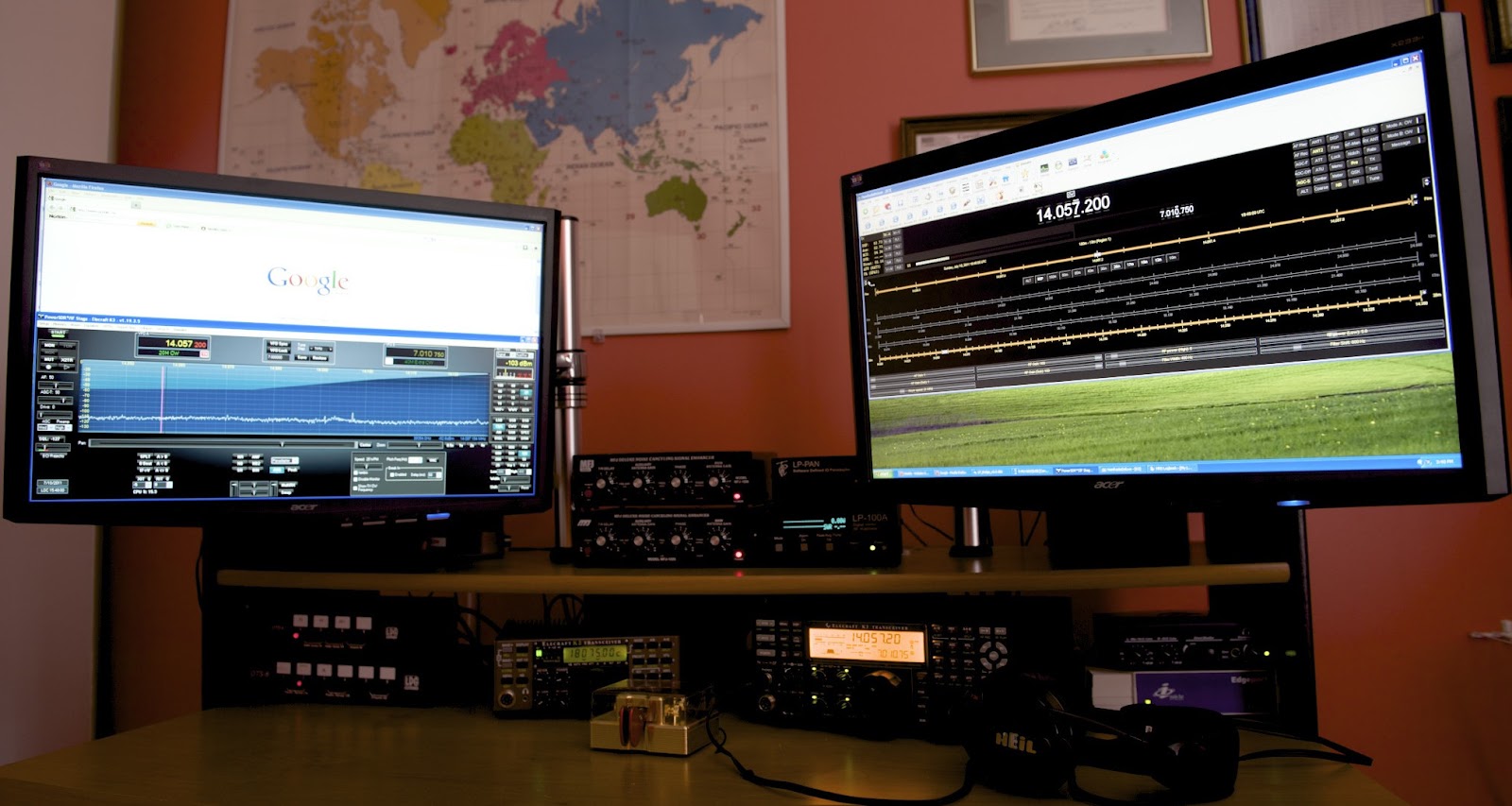 |
| Ahhh the old setup along with a great antenna............ |
1. Stay with the contest and not to get frustrated.
2. Try not to use the morse code reader and do most by ear....see how that works out.
3. Have fun and not worry about the score as with my setup placing anywhere for anything is most likely out of the question.
I will keep you posted as to how things go in the contest.....oh and the new setup as well....maybe I will hang some garlic close to the shack to keep Murphy away....:)
Mike Weir, VE9KK, is a regular contributor to AmateurRadio.com and writes from New Brunswick, Canada. Contact him at [email protected].
630m WSPR
 |
| courtesy: http://wsprnet.org/ |
Happy Thanksgiving to those of you in the U.S.A.
It seems that the 630m WSPR digital crowd is growing quickly, with more new stations showing up every evening on the web's WSPRnet activity page. Most nights see activity from 80 or more stations, either transmitting or listening in WSPR mode on 630m!
WSPR is the 'Weak Signal Propagation Reporter' beacon-only mode being used by many of the stations presently transmitting on 630m, especially the U.S. experimental stations.
Those with the WSPR software (freeware and easily installed) usually have the program automatically upload their spots (stations being heard) to the WSPRnet page so that the transmitting stations are able to see where their signals are being heard. It also becomes quickly apparent, when examining the various spots, just how good or bad propagation might be at any given time.
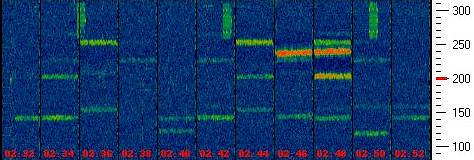 |
| WSPR Waterfall Displaying Detected Signals |
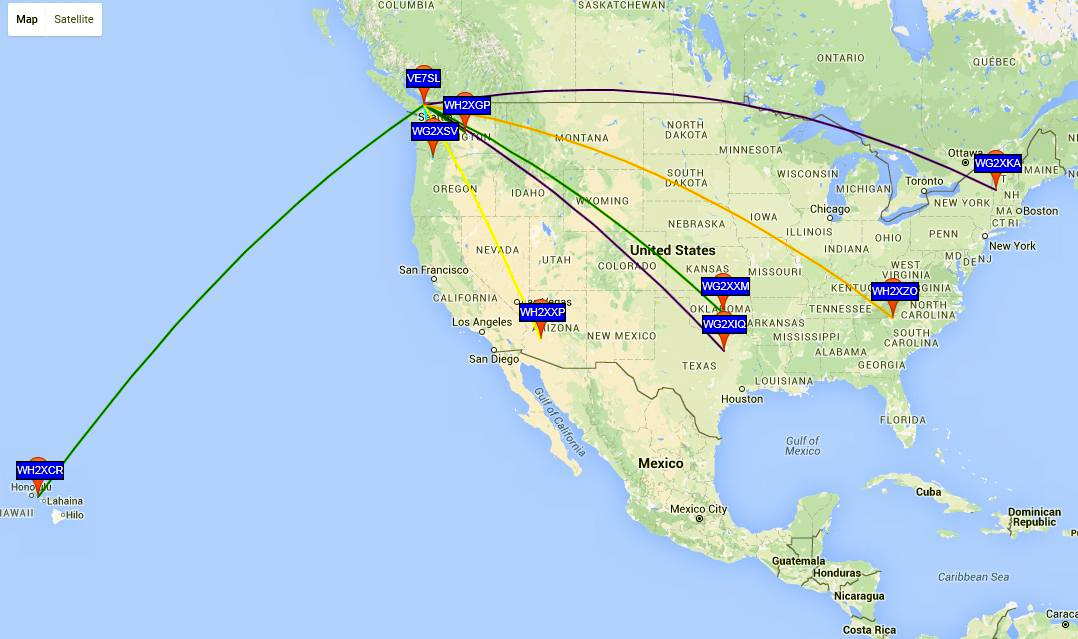
If you choose, you can also see your spotted stations in a Map mode, as shown at the top. This map shows the stations that I was hearing last night on 630m.
Along with the call and grid locator of the station being heard, the WSPR software also indicates several other bits of information, including the signal-to-noise ratio as heard at your location. Shown below is the decoded output from several stations following the two-minute transmission period.
| 06:58 | WH2XXP | 0.475662 | -13 | 0 | DM33 | 5 | VE7SL | CN88iu | 1909 | |
| 06:58 | WG2XXM | 0.475709 | -6 | 0 | EM15lj | 5 | VE7SL | CN88iu | 2610 | |
| 06:58 | WG2XKA | 0.475723 | -9 | 0 | FN33lq | 1 | VE7SL | CN88iu | 3833 |
Note the SNR reports ... usually, signals stronger than around -14dB will be just detectable by ear with anything in the + range being pretty strong.
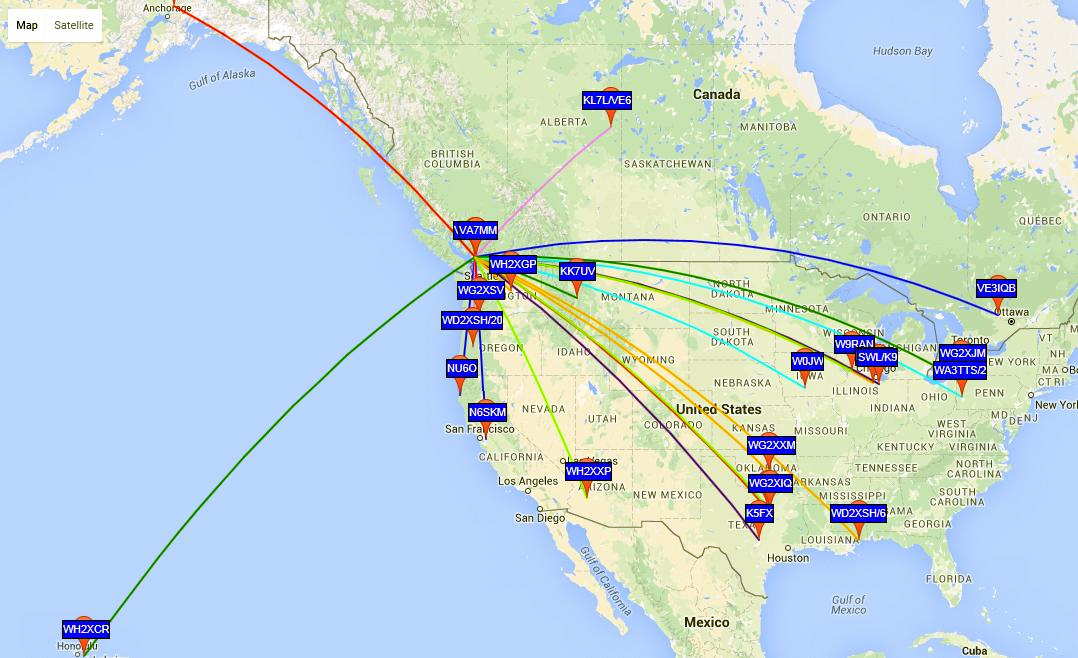
Shown below are the Tuesday night reports of local station, VE7CNF, and indicates the extensive area over which his WSPR beacon was reported. Toby is running a modest 5W eirp station from a suburban-sized lot. Analyzing the reports, it is apparent that many of these stations rose to audible signal levels at various times throughout the evening and would have probably been workable on normal CW mode ... even from the 'burbs!
 |
| courtesy: http://wsprnet.org/ |
There are probably many of you already listening to WSPR signals on HF and have yet to venture down to 630m to see what can be heard. The improved propagation conditions of late make this an ideal time to have a peek at 630m and see what you can spot.
Your low-band wire antennas can often hear surprisingly well below the broadcast band and you may be surprised at what WSPR can detect. Use the USB mode with your receiver set to 474.200 kHz and, if possible, upload your 630m MF spots to the WSPRnet. You can also follow up-to-the-minute activity on the 2200m/630m ON4KST Chat page which is always interesting.
Steve McDonald, VE7SL, is a regular contributor to AmateurRadio.com and writes from British Columbia, Canada. Contact him at [email protected].
 Ham Radio Deluxe |
 W5SWL Electronics |
 Ham Radio Prep |
 KB3IFH QSL Cards  Hip Ham Shirts  HamRadioAuctions HamRadioAuctions Reliance Antennas Reliance Antennas Enigma Shop Enigma Shop |  morseDX  Ni4L Antennas  R&L Electronics R&L Electronics antennas.us antennas.us QRV QRV |
- Matt W1MST, Managing Editor
