 |
 DMR – Joining the Dark Side!
 22 December 2015 | by
As a birthday present to myself I have just ordered a Retevis RT3 DMR hand-held off eBay which should be delivered just after Christmas.
South Kesteven ARS had a talk in October by Sean Burton 2E0ENN about amateur DMR where he demonstrated some handsets and the new DV4Mini which allows gateway and internet linking for the various networks, DSTAR, DMR and System Fusion. This piqued my interest in the DMR scene.
As I posted last time I dabbled a few years ago with decoding PMR DMR using software and a sound card but they were very hit and miss at the time. I reacquainted myself with the various projects and using the FUNCube Dongle Pro+ and the latest version of DSDPlus (support forum at RadioReference.com) monitored the nearby GB7RR DMRPlus repeater managing to get some reasonably clear decodes of some amateur transmissions.
I decided to dig out my Realistic PRO-2022 scanner and using a discriminator tap fed into the sound card got slightly better quality decodes.
Doing some research and reading a couple of reviews had decided I was going to get a Tytera TYT MD-380 when funds allowed but spotted the Retevis RT3 which appears to be identical and slightly cheaper.
I know some people wince at the thought of DMR and issues with proprietary technology used in some of the systems but I think the genie is out the bottle and it isn't going away soon. Adoption of DMR appears to be growing with talk of restructuring of talk groups needed to deal with the growth (whatever that means!) so I should at least get my feet wet and understand the technology.
I registered for an ID, now off to decode the jingo and understand all this talk of codeplugs, talk groups and time slots.
Andrew Garratt, MØNRD, is a regular contributor to AmateurRadio.com and writes from East Midlands, England. Contact him at [email protected].
DMR – Joining the Dark Side!
As a birthday present to myself I have just ordered a Retevis RT3 DMR hand-held off eBay which should be delivered just after Christmas.
South Kesteven ARS had a talk in October by Sean Burton 2E0ENN about amateur DMR where he demonstrated some handsets and the new DV4Mini which allows gateway and internet linking for the various networks, DSTAR, DMR and System Fusion. This piqued my interest in the DMR scene.
As I posted last time I dabbled a few years ago with decoding PMR DMR using software and a sound card but they were very hit and miss at the time. I reacquainted myself with the various projects and using the FUNCube Dongle Pro+ and the latest version of DSDPlus (support forum at RadioReference.com) monitored the nearby GB7RR DMRPlus repeater managing to get some reasonably clear decodes of some amateur transmissions.
I decided to dig out my Realistic PRO-2022 scanner and using a discriminator tap fed into the sound card got slightly better quality decodes.
Doing some research and reading a couple of reviews had decided I was going to get a Tytera TYT MD-380 when funds allowed but spotted the Retevis RT3 which appears to be identical and slightly cheaper.
I know some people wince at the thought of DMR and issues with proprietary technology used in some of the systems but I think the genie is out the bottle and it isn't going away soon. Adoption of DMR appears to be growing with talk of restructuring of talk groups needed to deal with the growth (whatever that means!) so I should at least get my feet wet and understand the technology.
I registered for an ID, now off to decode the jingo and understand all this talk of codeplugs, talk groups and time slots.
Andrew Garratt, MØNRD, is a regular contributor to AmateurRadio.com and writes from East Midlands, England. Contact him at [email protected].
Weekly Propagation Summary – 2015 Dec 21 16:10 UTC
Here is this week’s space weather and geophysical report, issued 2015 Dec 21 0423 UTC.
Highlights of Solar and Geomagnetic Activity 14 – 20 December 2015
Solar activity was at low levels. The period was dominated by low to mid-level C-class flare activity from a number of active regions, the largest of which was a C6/1f flare at 16/0903 UTC from Region 2468 (S15, L=128, class/area=Dao/120 on 10 Dec). Region 2468 was the most productive region on the visible disk throughout the summary period, however, an unnumbered region behind the northeast limb produced multiple mid-level C-class flares within quick succession and caused a slow increase in the background GOES-15 x-ray flux late in the period.
Two asymmetrical full-halo coronal mass ejections (CMEs) were observed in SOHO/LASCO C2 coronagraph imagery on 16 Dec. The first CME was observed in C2 imagery beginning at 16/0924 UTC and was associated with the C6/1F flare mentioned above. The second CME, associated with a filament eruption, was first observed in coronagraph imagery at 16/1436 UTC. Both CMEs were determined to be Earth-directed and arrived at Earth late on 19 Dec. See the geomagnetic summary below for further information on this event.
No proton events were observed at geosynchronous orbit.
The greater than 2 MeV electron flux at geosynchronous orbit reached high levels on 14 Dec and 19 Dec with moderate levels observed throughout the remainder of the period.
Geomagnetic field activity reached active to G1 (Minor) geomagnetic storm levels late on 14 Dec and early on 15 Dec due to the influence of a corotating interaction region followed by the onset of a negative polarity coronal hole high speed stream (CH HSS). Isolated active field conditions were observed early on 16 Dec and again late on 17 Dec due to weak substorming. The CMEs from 16 Dec presumably merged in the interplanetary medium and impacted the Earth at 19/1528 UTC. During the passage of the interplanetary shock, solar wind parameters aboard the ACE spacecraft became suddenly enhanced. Total field strength values initially increased from 5 nT to 17 nT and the Bz component went strongly southward shortly after the initial shock passage. The prolonged period of southward magnetic field (-Bz) associated with the passage of the 16 Dec CMEs caused periods of active conditions late on 19 Dec and active to G2 (Moderate) geomagnetic storm levels on 20 Dec. G2 storm conditions were observed between 20/0300-0600 UTC and 20/1500-2359 UTC.
Forecast of Solar and Geomagnetic Activity 21 December – 16 January 2016
Solar activity is expected to be low throughout the period with a chance for M-class flares (R1-R2 (Minor-Moderate) Radio Blackouts) on 21 Dec through 03 Jan to the increased flare activity from an unnumbered region behind the east limb.
No proton events are expected at geosynchronous orbit.
The greater than 2 MeV electron flux at geosynchronous orbit is expected to be at normal levels on 21-27 Dec, moderate levels on 31 Dec-02 Jan, and 14-16 Jan. High flux levels are expected on 28-30 Dec and 03-13 Jan.
Geomagnetic field activity is expected to be at active to G2 (Moderate) geomagnetic storm levels early on 21 Dec due to the waning effects of the 16 Dec coronal mass ejections. G1 (Minor) geomagnetic storms are likely on 02, 06, and 10 Jan due to the influence of recurrent coronal hole high speed streams.
Don’t forget to visit our live space weather and radio propagation web site, at: http://SunSpotWatch.com/
Live Aurora mapping is at http://aurora.sunspotwatch.com/
If you are on Twitter, please follow these two users: + https://Twitter.com/NW7US + https://Twitter.com/hfradiospacewx
Get the space weather and radio propagation self-study course, today. Visit http://nw7us.us/swc for the latest sale and for more information!
Check out the stunning view of our Sun in action, as seen during the last five years with the Solar Dynamics Observatory (SDO): https://www.youtube.com/watch?v=zXN-MdoGM9g
We’re on Facebook: http://NW7US.us/swhfr
Visit, subscribe: NW7US Radio Communications and Propagation YouTube Channel
LHS Episode #158: Tipping the SCaLE
 Today we have a special episode of Linux in the Ham Shack in which your hosts interview two of the volunteer coordinators for the Southern California Linux Expo, Hriday "Bala" Balachandran and Stewart Sheldon. Both of them are amateur radio operators and play key roles in making SCaLE one of the largest and most successful Open Source conferences in the world. We talk with them about their new amateur radio focus for 2016, the conference program, technology and many other topics. It's a lot of fun and highly educational, so don't miss this one.
73 de The LHS Crew
Russ Woodman, K5TUX, co-hosts the Linux in the Ham Shack podcast which is available for download in both MP3 and OGG audio format. Contact him at [email protected].
Time to get in Line
 Excitement in the shack! We’ve had a new addition. I have had my Elecraft K3 for quite a while. Nothing but positive words about it. It has never let me down.
We’ve all heard about the K-Line. I am assuming that the term K-Line is an omage to the Collins S-Line.

Through my research of MARS, I know that the Collins S-Line was the choice of MARS stations. Collins even had a repair shop located at the major air base outside of Saigon.

Although I have never operated any Collins gear, from what I’ve read it was built like a tank but clearly was designed to have aesthetic appeal. Elecraft is aiming to achieve the same.

I’ve started my attempt at building my K-line with the addition of the Elecraft amp and tuner. Both easily interface with each other and the K3. This allows for seamless band switching and tuning.
While only a 500 watt amplifier, I have already noticed an notable increase in my ability to make contacts and get to the top of the pileup. Band conditions helped, I’m sure – but it was still enjoyable making contacts with South Africa, Findland, the Canary Islands, and Aruba. Stateside contacts have also seemed to be easier to make with a little extra punch.
Scott Hedberg, NØZB, is a regular contributor to AmateurRadio.com and writes from Kansas, USA. Contact him at [email protected].
Tri-Tet Fun
 |
| courtesy: VK5TR http://www.users.on.net/~endsodds/ |
I spent a few hours yesterday, operating in the 'RAC Winter Contest'.
Originally, this contest began back in 1932, when QST excitedly announced a 'Canada-U.S.A. Contact Contest' to run in mid-January of that year.

The contest turned out to be extremely popular and has been run, in one form or another, ever since ... gradually becoming known as the 'VE-W Contest', sponsored by the Montreal Amateur Radio Club, and eventually by its modern name, with one version in July and a second in December.
As a teen-aged ham, the 'VE-W Contest' was always the highlight of the year as the contest format, much as it is today, made anyone with a 'VE' call as sought-after as AC4YN ... not the one in North Carolina!
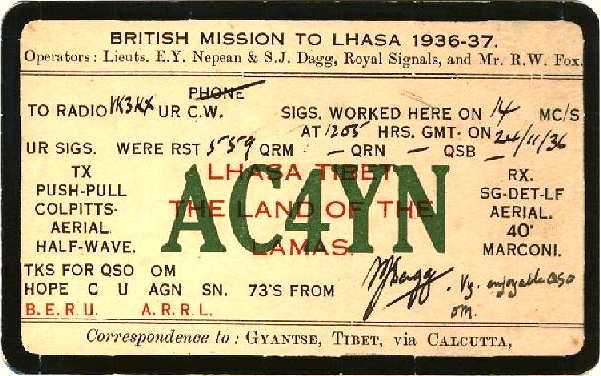
Old-timers and DXers will remember the call, as it represented the rarest of all possible contacts at the time and only a very lucky few made contact with the low-powered station, high in the Himalayan mountains at the British mission encampment in Lhasa, Tibet, in the late 30's. Having an 'AC4' QSL on the wall anointed you bragging rights for life.
Another great aspect about the contest back then, as in most, was that stations exchanged real RST's and not the meaningless '599' of today's contest operation. It was always interesting to learn how my little station, nestled in the upstairs attic, was really sounding at the other end.
I decided to set up my homebrew 'Tri-Tet-Ten', 6L6 crystal oscillator, and give the contest a short try. Being unable to conveniently move around the band meant that I would be reliant on stations answering my CQs ... not something that normally happens with the little transmitter in typical contest QRM ... but the magical 'VE' factor would change all of that, I hoped.
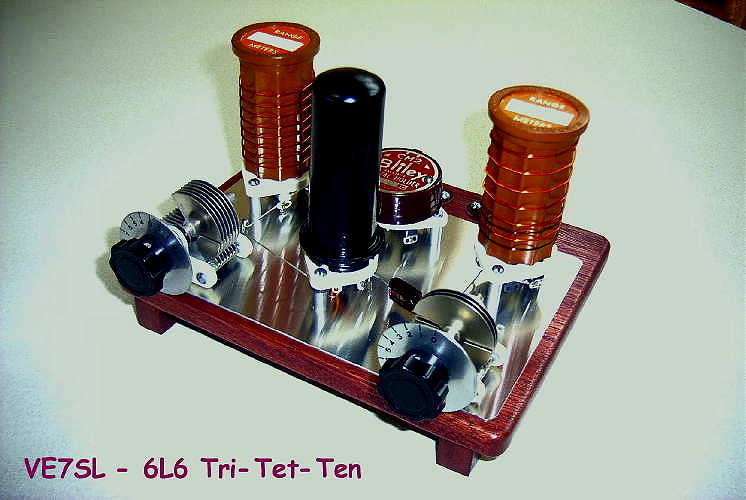
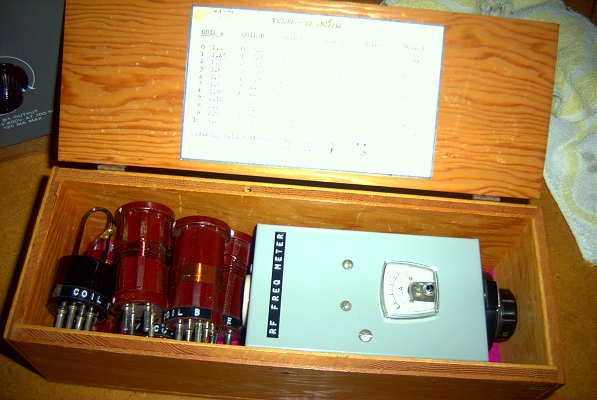
I plugged-in the 15/20m plate coil and got out my old homebrew RF-sniffer / wavemeter. It was the first piece of gear that I built, as a new 15 year-old ham, and the poor man's spectrum analyzer has been in constant use ever since. Using the 40m crystal's third harmonic, I have found the wavemeter is the easiest way to avoid mistuning and quickly found myself with just over 5 watts of RF ready to go. A tune-up for 20m later, found the second harmonic producing about 10 watts of pile-up generating madness.
Nowadays, the rules have changed a bit, and 'VE-to-VE' contacts are worth more than 'VE-to-W' QSO's but for 'W's, the goal is still to work as many 'VE's as possible ... and call they did.
Over the period of a few hours, the Tri-tet did not disappoint, generating 206 callers, including PY, PJ and HP ... frequently generating pileups 4 and 5 deep. I didn't try 10m as by the time I got started, it was falling off and the 6L6's 4 1/2 watts of fourth harmonic output on 10m requires really good conditions to be heard very well.
Due to conflicts with other activities, this was the first RAC VE-W Party that I have operated in many years ... it's nice to see that apparently not much has changed since 1932!
Steve McDonald, VE7SL, is a regular contributor to AmateurRadio.com and writes from British Columbia, Canada. Contact him at [email protected].
Christmas project
What’s the use of holidays if you just do nowt? It’s never going to happen in our house. So I decided to do something with one of he old netbooks I have. Remember them? Mine is an Advent 4211 that my lad decided to pull the keys off and eat them whilst our backs were turned and he was a less mobile menace 
Anyway. A media server is something we’ve been missing since our NAS decided to go on a ‘go slow’. After 20 mins Googling I ended up with OpenMediaVault. Impressed eh?

An all in one server is almost on us. I did the usual and downloaded the iso, burnt it to a USB stick with Rufus and installed it on the machine. As expected the installation was simple and I used this tutorial to help. Needless to say the 20 mins Googling the right software was the quick bit.
The MiniDLNA bit was what I was after and after a few ‘Uh’s’ and a quick trip round the internet and back and it looks like its going to serve me nicely. Did you see what I did there? serve? server? Oh well never mind. Here’s to you internet and your ability to give me ideas for stuff to do in the holidays whilst I’m waiting for stuff to arrive from China……Now what’s next on eBay?
Alex Hill, G7KSE, is a regular contributor to AmateurRadio.com and writes from Cumbria, UK. Contact him at [email protected].
 Ham Radio Deluxe |
 W5SWL Electronics |
 Ham Radio Prep |
 KB3IFH QSL Cards  Hip Ham Shirts  HamRadioAuctions HamRadioAuctions Reliance Antennas Reliance Antennas Enigma Shop Enigma Shop |  morseDX  Ni4L Antennas  R&L Electronics R&L Electronics antennas.us antennas.us QRV QRV |
- Matt W1MST, Managing Editor
