 |
 The 1st Annual Midwinter 630m Activity Weekend
 11 January 2016 | by
Following late fall's very successful 630m Activity / CW Crossband Weekend in November, several enquiries were soon received asking "when's the next one?" I'm happy to announce that the 'next one' will be held on the first weekend of February and will follow a similar format.
Here is the formal press release describing the event published in the ARRL News:
*****************************************
US and Canadian radio amateurs and experimenters will join forces in February for the first Midwinter 630 Meter Activity Weekend. The event will get under way on February 6 at 0000 UTC (Friday, February 5, in US time zones) and run through 2359 UTC on February 7.
“This event is being undertaken because of the new and quickly growing interest in present 630 meter activities, both in the US and Canada,” said ARRL 600 Meter Experimental Group (WD2XSH) Experiment Coordinator Fritz Raab, W1FR. “Much of the interest is in response to the strong likelihood of US amateurs receiving access to the band in the near future, while Canadian hams are eager to learn more about the present level of Amateur Radio activity on their newest ham band.” The activity weekend comes on the heels of a special event operation over the November 13-14 weekend that included participation by US and Canadian radio amateurs.and the Maritime Radio Historical Society (MRHS).
Raab said the two activity nights will offer interested amateurs in both countries an opportunity to experience the 630 meter band and, through cross-band activity with Canadian amateurs, to take part in activity in the MF spectrum. “Our hope is to see this activity become an annual operating event, to be held very winter on the 630 meter band,” Raab said. “For those who may be building for future 630 meter operation, this event will provide an opportunity to test your ‘receive’ capabilities on MF.”
Operation will be from 472 kHz to 479kHz in various modes. The two-way crossband work will be undertaken by several Canadian stations, all on CW. Canadians will operate on a schedule and listen for callers on specific QSX frequencies in the US ham allocations.
Time: 2130Z - 0130Z both Friday night (Feb 5 - 6Z) / Saturday night (Feb 6 - 7Z) plus QRSS3 / 12 WPM Beacon from 0130 – 1000Z
TX Frequency: 477.7 kHz
RX (QSX) Frequency: 3562 kHz
Station: VE7SL (Steve) CN88 Mayne Island, B.C.
Time: 0200Z - 0700Z both Friday night (Feb 6Z) / Saturday night (Feb 7Z)
TX Frequency: 473.0 kHz
RX (QSX) Frequency: 3566 / 7066 kHz
Station: VE7BDQ (John) CN89 Delta, B.C.
Time: 0330Z - 0700Z both Friday night (Feb 6Z) / Saturday night (Feb 7Z)
TX Frequency: 474.0 kHz
RX (QSX) Frequency: 3555 kHz
Station: VA7MM (Mark) CN89 Coquitlam, B.C.
Time: 0500Z - 0700Z Friday night (Feb 6Z)
0400Z - 0800Z Saturday night (Feb 7Z)
TX Frequency: 475.0 kHz
RX (QSX) Frequency: 1801 kHz / 3574 kHz / 7062 kHz
Time: 0300Z - 0700Z both Friday night (Feb 6Z) / Saturday night (Feb 7Z)
TX Frequency: 476.5 kHz
RX (QSX) Frequency: 1836 kHz / 3558 kHz / 7031 kHz
Time: 0000Z - 0400Z both Friday night (Feb 6Z) / Saturday night (Feb 7Z)
TX Frequency: 477.0 kHz
RX (QSX) Frequency: 3563 kHz / 7058 kHz
“The success of this event largely depends upon the participation of as many amateurs as possible,” Raab said. “We hope that you can find a few hours to participate in this unique midwinter event.” Submit reception reports via e-mail to the respective operators or via the ARRL 600 Meter Experiment website.
*************************************
Hopefully you will be able to participate in the crossband activity by being able to listen on 630m and then able to switch over to HF to transmit. This could involve the use of a separate receiver / transmitter or can often be easily implemented via your transceiver's 'A/B' switch.
No antenna for receiving on 630m? Surprisingly good results can often be had by using a low band wire antenna such as a dipole or inverted-L for listening on 630m ... the antenna does not necessarily need to be resonant. In fact, often times, a non-resonant receiving antenna can provide a better overall S/N ratio than one which is resonant, as these often gather more noise along with signals.
You may want to experiment before hand by listening to many of the numerous U.S. experimental stations operating nightly, mostly in the WSPR mode, between 475.6 and 475.8kHz. Most operators provide a CW identifier following their WSPR transmission but a better way to decode these signals is by installing the latest WSPR software, WSJT-X (freeware), at K1JT's website here. The software works extremely well and is easy to install and get working. If you set the software to 'upload spots', you can share your nightly catches with dozens of other listeners throughout the continent on the WSPRnet website.
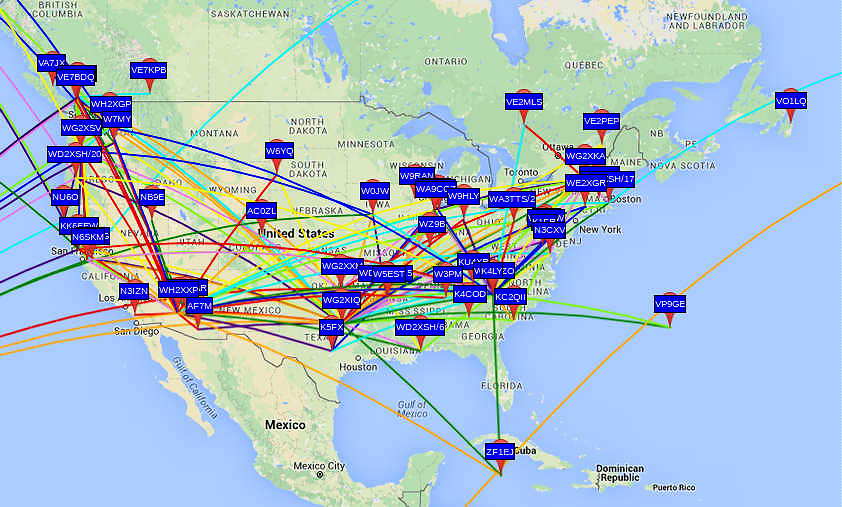 |
| courtesy: KB5NJD's 630m Daily Blog |
Steve McDonald, VE7SL, is a regular contributor to AmateurRadio.com and writes from British Columbia, Canada. Contact him at [email protected].
Weekly Propagation Summary – 2016 Jan 11 16:10 UTC
Here is this week’s space weather and geophysical report, issued 2016 Jan 11 0123 UTC.
Highlights of Solar and Geomagnetic Activity 04 – 10 January 2016
Solar activity was at very low to low levels. Very low activity was observed on 04-05 January and 08-10 January while isolated low activity occured on 06-07 January. A pair of C1 x-ray events were observed from Region 2480 (N02, L=125, class/area Eso/190 on 10 Jan) on 06/1137 UTC and 07/0617 UTC, respectively. No Earth-directed coronal mass ejections were observed during the summary period.
No proton events were observed at geosynchronous orbit.
The greater than 2 MeV electron flux at geosynchronous orbit was at high levels throughout the period.
Geomagnetic field activity was at predominately quiet levels on 04-05 January and 08-10 January. On 06 January, activity increased to unsettled to active levels with an isolated period of minor storming (G1-Minor) observed early on the 6th. Unsettled to active conditions persisted through late on the 7th. This increase in activity was due to the presence of a recurrent, positive polarity coronal hole high speed stream (CH HSS). Solar wind parameters, measured at the ACE satellite, indicated an increase in wind speeds early on 06 Jan from about 475 km/s to a peak of 643 km/s at 06/1025 UTC. Wind speeds remained elevated between 575 – 625 km/s through about 07/2000 UTC when a gradual decline to about 430 km/s were observed through the end of the summary period. Total field (Bt) averaged about 5 nT for a majority of the period, but ranged from 7-16 nT from 05/0820 UTC – 06/0131 UTC. The Bz component varied between +/- 4 nT with increased variability recorded between +12 nT to -10 nT from 05/0935 UTC to 06/0022 UTC. The phi angle was in a predominately positive (away for the Sun) orientation throughout the summary period.
Forecast of Solar and Geomagnetic Activity 11 January – 06 February 2016
Solar activity is expected to be at very low to low levels from 11-14 January and from 29 January – 06 February. From 15-28 January, activity levels are expected to increase to low to moderate levels (R1-Minor) due to the return of old active Region 2473 (S21, L=334).
No proton events are expected at geosynchronous orbit.
The greater than 2 MeV electron flux at geosynchronous orbit is expected to be at normal to moderate levels on 11-12, 17-22, 26-28 January and 31 January – 02 February. High levels are expected on 13-16, 23-25, 29-30 January and 03-06 February due to enhanced winds from a series of geoeffective CH HSSs.
Geomagnetic field activity is expected to be at unsettled to active conditions on 12-13, 22-23, 28-29 January and 02-03 February with isolated minor storm levels (G1-Minor) likely on 12 and 18 January, all due to a series of recurrent CH HSSs. Quiet to unsettled conditions are expected for the remaining days of the outlook period.
Don’t forget to visit our live space weather and radio propagation web site, at: http://SunSpotWatch.com/
Live Aurora mapping is at http://aurora.sunspotwatch.com/
If you are on Twitter, please follow these two users: + https://Twitter.com/NW7US + https://Twitter.com/hfradiospacewx
Get the space weather and radio propagation self-study course, today. Visit http://nw7us.us/swc for the latest sale and for more information!
Check out the stunning view of our Sun in action, as seen during the last five years with the Solar Dynamics Observatory (SDO): https://www.youtube.com/watch?v=zXN-MdoGM9g
We’re on Facebook: http://NW7US.us/swhfr
Visit, subscribe: NW7US Radio Communications and Propagation YouTube Channel
AmateurLogic 86: We’re Back
AmateurLogic.TV Episode 86 is now available for download.
Peter introduces Satellite TV. Tommy explores FLRig with his Icom IC-7100 and Mac computer. Emile makes a cheap APRS Tracker. George visits a transmitter site in the wilderness and more.
1:15:21
George Thomas, W5JDX, is co-host of AmateurLogic.TV, an original amateur radio video program hosted by George Thomas (W5JDX), Tommy Martin (N5ZNO), Peter Berrett (VK3PB), and Emile Diodene (KE5QKR). Contact him at [email protected].
LHS Episode #159: Digital Mode Interfaces
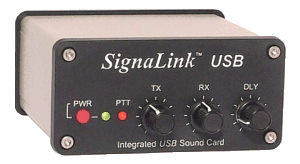 Hello, dear listeners! Thank you for tuning into another episode of Linux in the Ham Shack. In this week's episode, your hosts discuss a variety of topics from 600-meter operation to Linux in cars to Star Wars. Our featured segment tonight is a look at PC-to-radio interfaces for digital mode communication. Thanks for tuning into, and hope to see you next time.
73 de The LHS Team
Russ Woodman, K5TUX, co-hosts the Linux in the Ham Shack podcast which is available for download in both MP3 and OGG audio format. Contact him at [email protected].
Retirement and Ham Radio
Basically my last day in the office was mid-December, so I've had a nice taste of freedom from employment already. My schedule, or lack thereof, is starting to gel although I'm sure I will go through numerous "phases", I think the pattern is set. So below are few things that I've already experienced on how retirement will effect my ham radio pursuits.
- I've had time actually read the owner's manual for my radios.
- I've learned to set-up and use the frequency/band memory functions available on the K3
- I now understand more of the menu options for the radio
- I can now operate my HT.
- I'm reading books about antennas
- I love CW and have found that rag-chewing is a very enjoyable aspect of ham radio. I have met some very interesting people and I've started to make a lot of new friends since I've taken time to just call CQ and not append DX to it
- I joined the local 2 meter weak signal group and I actually check in to their weekly net.. When I'm home I monitor 144.200 on SSB/CW. VHF/UHF can provide a lot of excitement for a DX minded ham. The DX isn't as far, but it's just as satisfying.
- I've acquired a lot of new equipment over the years, but I haven't gotten rid of much. There are many avenues to sell gear, EBay, QRZ.com, eHam, etc.... Now that I'm retired I will have a more modest ham radio budget and getting rid of the old stuff provides a little cash for even more toys.
- I haven't finished this yet, but I've started
- I love SOTA and can now plan extended SOTA activation trips with no time lines.
- I've activated 10+ IOTA islands and can now consider planning more trips.
Mike Crownover, AD5A, is a regular contributor to AmateurRadio.com and writes from Texas, USA. Contact him at [email protected].
Retirement and Ham Radio
Basically my last day in the office was mid-December, so I've had a nice taste of freedom from employment already. My schedule, or lack thereof, is starting to gel although I'm sure I will go through numerous "phases", I think the pattern is set. So below are few things that I've already experienced on how retirement will effect my ham radio pursuits.
- I've had time actually read the owner's manual for my radios.
- I've learned to set-up and use the frequency/band memory functions available on the K3
- I now understand more of the menu options for the radio
- I can now operate my HT.
- I'm reading books about antennas
- I love CW and have found that rag-chewing is a very enjoyable aspect of ham radio. I have met some very interesting people and I've started to make a lot of new friends since I've taken time to just call CQ and not append DX to it
- I joined the local 2 meter weak signal group and I actually check in to their weekly net.. When I'm home I monitor 144.200 on SSB/CW. VHF/UHF can provide a lot of excitement for a DX minded ham. The DX isn't as far, but it's just as satisfying.
- I've acquired a lot of new equipment over the years, but I haven't gotten rid of much. There are many avenues to sell gear, EBay, QRZ.com, eHam, etc.... Now that I'm retired I will have a more modest ham radio budget and getting rid of the old stuff provides a little cash for even more toys.
- I haven't finished this yet, but I've started
- I love SOTA and can now plan extended SOTA activation trips with no time lines.
- I've activated 10+ IOTA islands and can now consider planning more trips.
Mike Crownover, AD5A, is a regular contributor to AmateurRadio.com and writes from Texas, USA. Contact him at [email protected].
Thanks everyone for your help!!
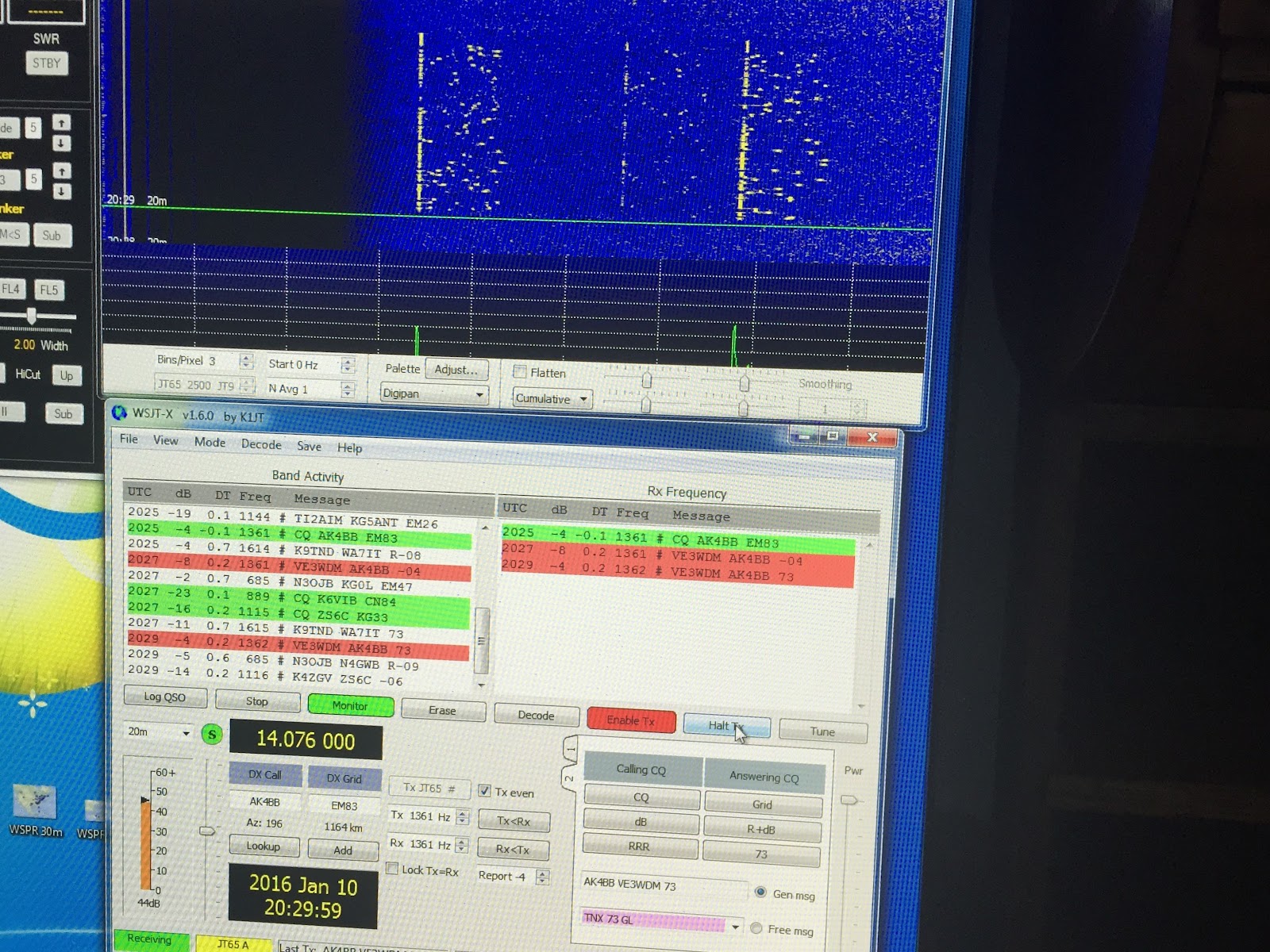 |
| My contact on 20m |
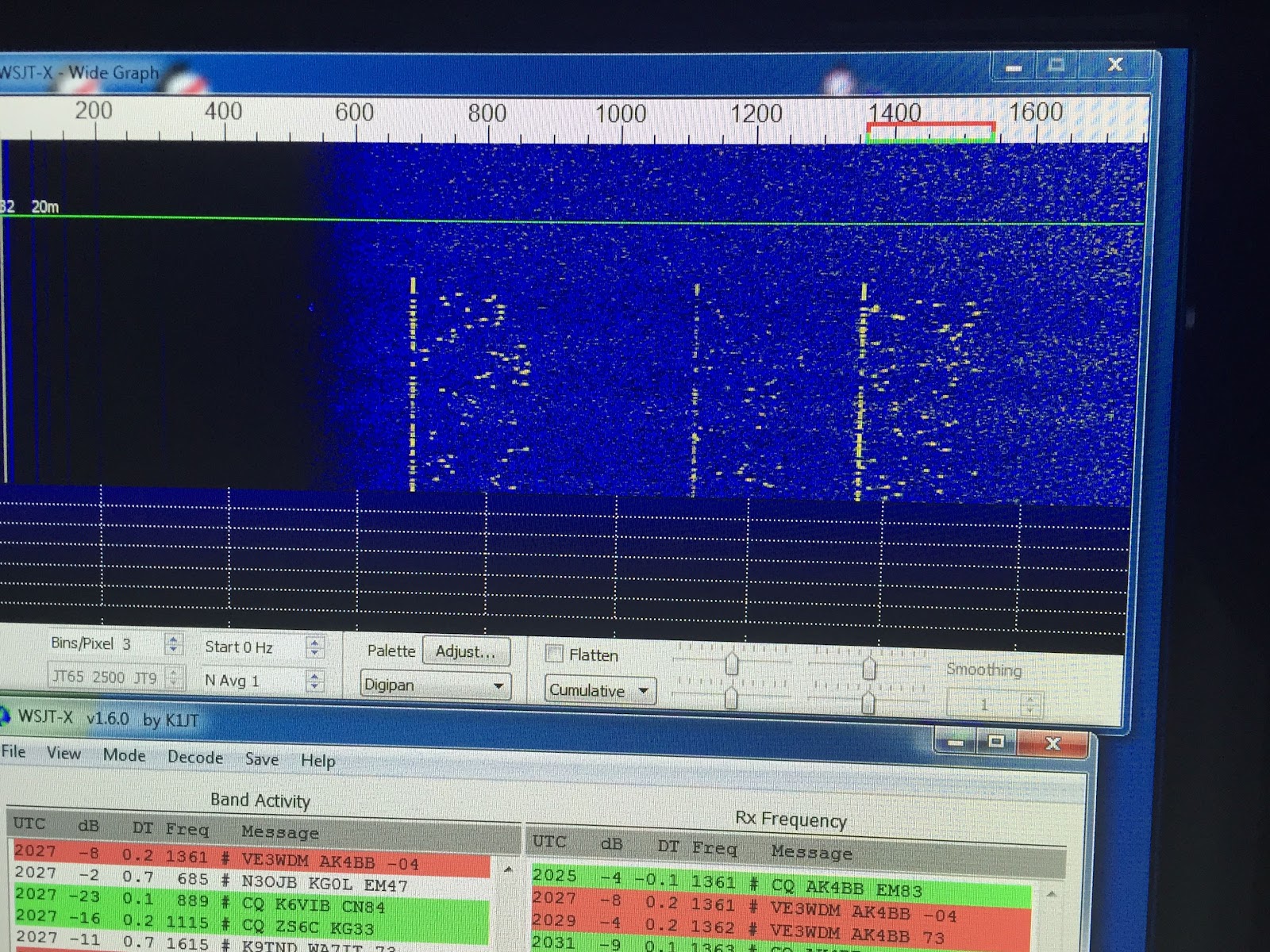 |
| New and improved waterfall |
Mike Weir, VE9KK, is a regular contributor to AmateurRadio.com and writes from New Brunswick, Canada. Contact him at [email protected].
 Ham Radio Deluxe |
 W5SWL Electronics |
 Ham Radio Prep |
 KB3IFH QSL Cards  Hip Ham Shirts  HamRadioAuctions HamRadioAuctions Reliance Antennas Reliance Antennas Enigma Shop Enigma Shop |  morseDX  Ni4L Antennas  R&L Electronics R&L Electronics antennas.us antennas.us QRV QRV |
- Matt W1MST, Managing Editor
