 |
 You can’t work ’em if you can’t hear ’em.
 26 January 2016 | by
 So this morning, after moving my car for her, I made some coffee and headed down into the shack. I had about a half hour before I had to shower, shave and get dressed for work. I figured that maybe, just maybe, I'd hear K5P, as this is their last day on the island, I believe. And sure enough, there they were on 80 Meters, calling CQ! And from the rate they were answering stations, you could tell they were listening for ATNOs - stations they had never worked before (which would have been me!).
They were decently loud - about 559 with QSB on 3.530 MHz with QSB. Even so, this was the best I've heard them throughout the entire DXpedition. I put the KX3 into "Dual Watch" mode, so I could figure out where they were listening, and then I fired up the KXPA100 to 90 Watts and jumped into the fray.
Then some idiot proceeded to come onto their QRG (the frequency they were transmitting on) and began to send an non-ending string of S9 dits, totally obliterating them.
"You can't work 'em if you can't hear 'em."
Sigh.
72 de Larry W2LJ
QRP - When you care to send the very least!
Larry Makoski, W2LJ, is a regular contributor to AmateurRadio.com and writes from New Jersey, USA. Contact him at [email protected].
CLE 203 Results
As has been the case for much of this winter's DX season, LF conditions were very erratic during this past weekend's CLE NDB-listening event.
Geomagnetic activity fluctuated wildly from hour to hour, gradually settling down for Sunday night's last opportunity, with K-indices dropping to 1's or Ø's.
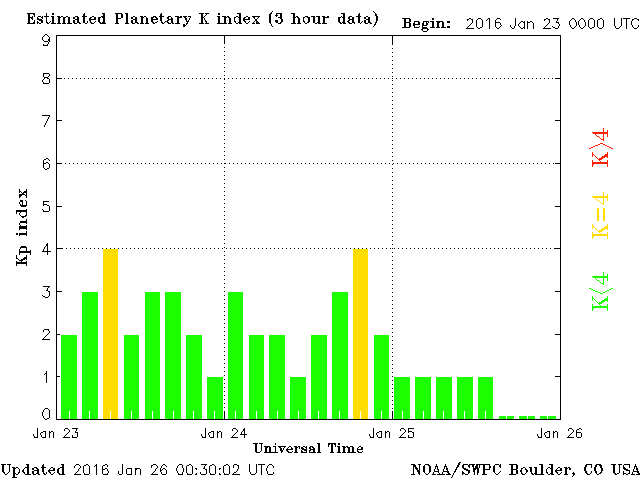 |
| courtesy: http://www.solarham.net/planetk.htm |
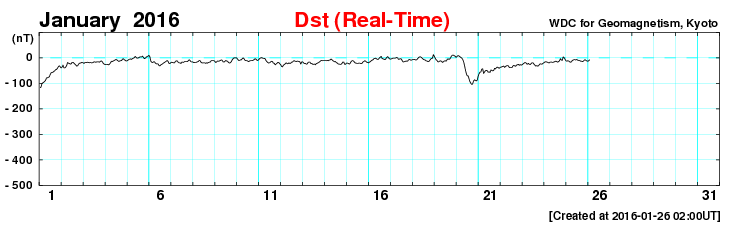 |
| courtesy: http://wdc.kugi.kyoto-u.ac.jp/dst_realtime/presentmonth/index.html |
Participants in the central and southern states noted excellent conditions and were not as badly affected as listeners to the north, where the effects of any auroral activity are sudden and much more severe ... I'm always surprised at just how much difference one or two hundred miles further to the south can make.
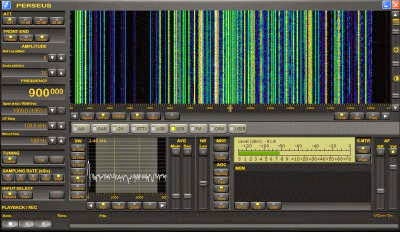
The following NDB's were heard over the course of the weekend, all using the Perseus SDR to record two-minute grabs, every hour, from dusk through dawn. Going over the recordings takes some time but being able to, in effect, listen all night, readilly illustrates how much the band conditions on LF can change so drastically from hour-to-hour ... sometimes for better and sometimes for worse.
25 11:00 350 VTR McGrath, ALS
23 05:00 350 SWU Id Falls, ID, USA
23 05:00 350 RG Oklahoma City, OK, USA
25 10:00 350 RB Resolute Bay, NU, CAN
23 05:00 350 ON Agate, OR, USA
23 05:00 350 NY Enderby, BC, CAN
24 13:00 350 DNS Denison, IA, USA
24 10:00 351 YKQ Waskaganish, QC, CAN
23 05:00 351 AE Paradise Hills, NM, USA
23 09:00 352 RG Rarotonga, CKS
25 10:00 353 ZXY Whitehorse, YT, CAN
23 05:00 353 RNT Renton, WA, USA
23 04:00 353 PG Portage La Prairie, MB, CAN
23 08:00 353 LLD Lanai, HWA
24 09:00 353 IN Ericsburg, MN, USA
23 08:00 353 DI Dickinson, ND, USA
23 05:00 353 CY Cheyenne, WY, USA
23 05:00 353 AL Dixie, WA, USA
23 08:00 353 5F Chevron, AB, CAN
24 07:00 355 YWP Webequie, ON, CAN
25 14:30 355 AUB King Salmon, ALS
23 08:00 356 ZXE Saskatoon, SK, CAN
23 08:00 356 ZF Yellowknife, NT, CAN
23 11:00 356 PND Portland, OR, USA
23 08:00 356 ON Penticton, BC, CAN
25 11:00 356 ODX Ord, NE, USA
23 08:00 356 MEF Medford, OR, USA
24 11:00 358 YKG Kangiqsujuaq, QC, CAN
23 05:00 359 YQZ Quesnel, BC, CAN
23 05:00 359 YAZ Tofino, BC, CAN
23 05:00 359 SDY Sidney, MT, USA
24 13:00 359 GGF Grant, NE, USA
23 05:00 359 BO Ustick, ID, USA
24 11:00 360 SW Warroad, MN, USA
25 13:00 361 HI Holman, NT, CAN
23 08:00 361 E3 Wabasca, AB, CAN
25 10:30 362 YZS Coral Harbour, NU, CAN
23 08:00 362 RPX Roundup, MT, USA
23 09:00 362 OWP Sand Springs, OK, USA
23 08:00 362 BF Seattle, WA, USA
23 08:00 362 6T Foremost, AB, CAN
23 10:00 364 4D Helmet, BC, CAN
25 07:00 365 PAL Palma, EQA
23 05:00 365 MA Mayo, YT, CAN
23 05:00 365 HQG Hugoton, KS, USA
23 05:00 365 DPY Deer Park, WA, USA
23 06:00 365 AA Harwood, MN, USA
25 10:00 366 YMW Maniwaki, QC, CAN
25 11:00 366 PNI Pohnpei, FSM
25 10:00 366 EOK Keokuk, IA, USA
25 11:30 367 R5 Pukatawagan, MB, CAN
23 08:00 368 ZP Sandspit, BC, CAN
23 08:00 368 VX Dafoe, SK, CAN
23 08:00 368 SX Cranbrook, BC, CAN
25 11:00 368 SOY Sioux, IA, USA
It will be nice to see a 'quiet sun' once again, hopefully sooner than later. For such a wimpy solar cycle, this one is not going down without a valiant fight, as it continues to mess-up LF and MF propagation, with an almost non-stop bombardment of coronal hole streams.
Steve McDonald, VE7SL, is a regular contributor to AmateurRadio.com and writes from British Columbia, Canada. Contact him at [email protected].
Internet access into ham radio mesh network
In my continuing work with the ham radio AREDN (amateur radio emergency data network) mesh software, I’ve come across the need to provide access from the internet to a host located across the mesh. Unfortunately, the AREDN graphical interface doesn’t provide a way to do this.
But don’t despair! If you’re capable of editing a file on a linux based platform, you can add your own firewall rules on the AREDN node that is connected to the internet to provide this access. On the AREDN mesh gateway you edit the /etc/firewall file and put in either a routing rule or a SNAT/DNAT rule. The difference is whether or not the gateway node will just pass the traffic through or if it will proxy (NAT) the traffic onto the mesh.
I’m working with the AREDN developers to add this functionality to the gui, and I’d expect that to come out later in 2016. In the meantime, if you’re interested in making this work drop me an email and I’ll send you some instructions! My callsign is KG9DW and I’ve got an arrl.net address.
Michael Brown, KG9DW, is a regular contributor to AmateurRadio.com and writes from Illinois, USA. Contact him at [email protected].
Internet access into ham radio mesh network
In my continuing work with the ham radio AREDN (amateur radio emergency data network) mesh software, I’ve come across the need to provide access from the internet to a host located across the mesh. Unfortunately, the AREDN graphical interface doesn’t provide a way to do this.
But don’t despair! If you’re capable of editing a file on a linux based platform, you can add your own firewall rules on the AREDN node that is connected to the internet to provide this access. On the AREDN mesh gateway you edit the /etc/firewall file and put in either a routing rule or a SNAT/DNAT rule. The difference is whether or not the gateway node will just pass the traffic through or if it will proxy (NAT) the traffic onto the mesh.
I’m working with the AREDN developers to add this functionality to the gui, and I’d expect that to come out later in 2016. In the meantime, if you’re interested in making this work drop me an email and I’ll send you some instructions! My callsign is KG9DW and I’ve got an arrl.net address.
Michael Brown, KG9DW, is a regular contributor to AmateurRadio.com and writes from Illinois, USA. Contact him at [email protected].
Virtual ham radio…sounds interesting!

Mike Weir, VE9KK, is a regular contributor to AmateurRadio.com and writes from New Brunswick, Canada. Contact him at [email protected].
Weekly Propagation Summary – 2016 Jan 25 16:10 UTC
Here is this week’s space weather and geophysical report, issued 2016 Jan 25 0701 UTC.
Highlights of Solar and Geomagnetic Activity 18 – 24 January 2016
Solar activity was at very low to low levels during the period. Only weak C-class flares (<C3) were observed on 20-21 January and 24 January from Regions 2484 (N08, L=094, class/area Dro/030 on 20 January), 2487 (S13, L=336, class/area Dai/100 on 21 January), and 2488 (N04, L=319, class/area Dai/200 on 24 January). Region 2487 was in a growth phase since its emergence on 18 January, but entered into a decay phase after 22 January and was only responsible for three weak C-class flares. Region 2488 continued to exhibit growth since its emergence on the disk on 18 January and was responsible for two weak C-class flares. No Earth-directed coronal mass ejections (CMEs) were observed during the summary period.
No proton events were observed at geosynchronous orbit.
The greater than 2 MeV electron flux at geosynchronous orbit was at normal levels on 19-20 January, moderate levels on 21 January and high levels on 18 January and again on 22-24 January. The maximum flux of the period was 12,881 pfu observed at 24/1550 UTC.
Geomagnetic field activity ranged from quiet to major storm (G2-Moderate) levels. The period began under quiet conditions for the majority of 18 January. At approximately 18/2056 UTC, a small shock was observed in ACE data indicating the arrival of a CME from a filament eruption on 14 January. Total field (Bt) initially increased from 6 nT to 12 nT with solar wind speed increasing from 300 km/s to near 380 km/s while the Bz component fluctuated between +6 nT and -9 nT. By 19/0935 UTC, the Bz component deflected north and total field increased to 14 nT. A subsequent rotation of the Bz component occurred after 20/0325 UTC to a maximum of -13 nT followed by another increase in the total field to a maximum of 21 nT at 21/0545 UTC. By this time, the Bz component was fluctuating between +/-18 nT. By 21/1006 UTC, Bt decreased to around 8 nT, while the solar wind speed increased to around 530 km/s as the solar wind began to transition into a negative polarity coronal hole high speed stream (CH HSS). The geomagnetic field responded with an unsettled period late on 18 January, quiet to active levels on 19 January, quiet to minor storm levels (G1-Minor) on 20 January, and unsettled to major storm levels (G2-Moderate) on 21 January. Solar wind speeds continued around 500-550 km/s under CH HSS influence until late on 23 January. Solar wind speeds continued to be elevated in the 450-500 km/s range through the end of the period. As a result, the geomagnetic field was at quiet to active periods from 22-24 January.
Forecast of Solar and Geomagnetic Activity 25 January – 20 February 2016
Solar activity is expected to be at very low to low levels with a slight chance for an M-class flare (R1-R2, Minor-Moderate) from 25-31 January as Region 2488 continues to develop.
No proton events are expected at geosynchronous orbit.
The greater than 2 MeV electron flux at geosynchronous orbit is expected to be at mostly high levels due to recurrent CH HSS activity. A return to moderate levels is expected on 25-26 January, 07-08 February, and 14-18 February.
Geomagnetic field activity is expected to be at unsettled to active levels from 25-30 January, 02-03 February, 07-10 February, and 17-20 February due to recurrent CH HSS activity.
Don’t forget to visit our live space weather and radio propagation web site, at: http://SunSpotWatch.com/
Live Aurora mapping is at http://aurora.sunspotwatch.com/
If you are on Twitter, please follow these two users: + https://Twitter.com/NW7US + https://Twitter.com/hfradiospacewx
Get the space weather and radio propagation self-study course, today. Visit http://nw7us.us/swc for the latest sale and for more information!
Check out the stunning view of our Sun in action, as seen during the last five years with the Solar Dynamics Observatory (SDO): https://www.youtube.com/watch?v=zXN-MdoGM9g
We’re on Facebook: http://NW7US.us/swhfr
Visit, subscribe: NW7US Radio Communications and Propagation YouTube Channel
Latest firmware for AP510 APRS tracker is superb
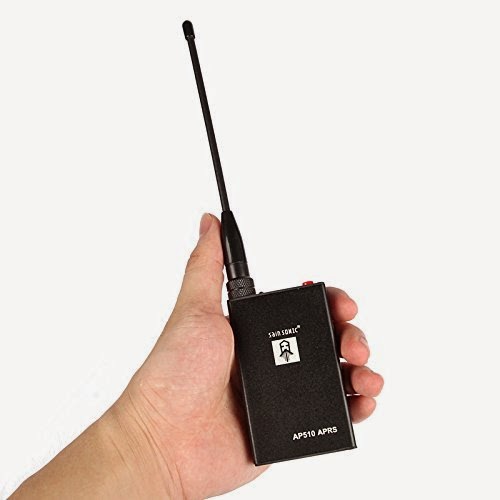
I got my AP510 APRS tracker a little more than a year ago. It kind of worked, but not very well in my car. But after the tracker got a new firmware dated 3 Nov 2015, it has become so much better. Now I can say that it is really useful.
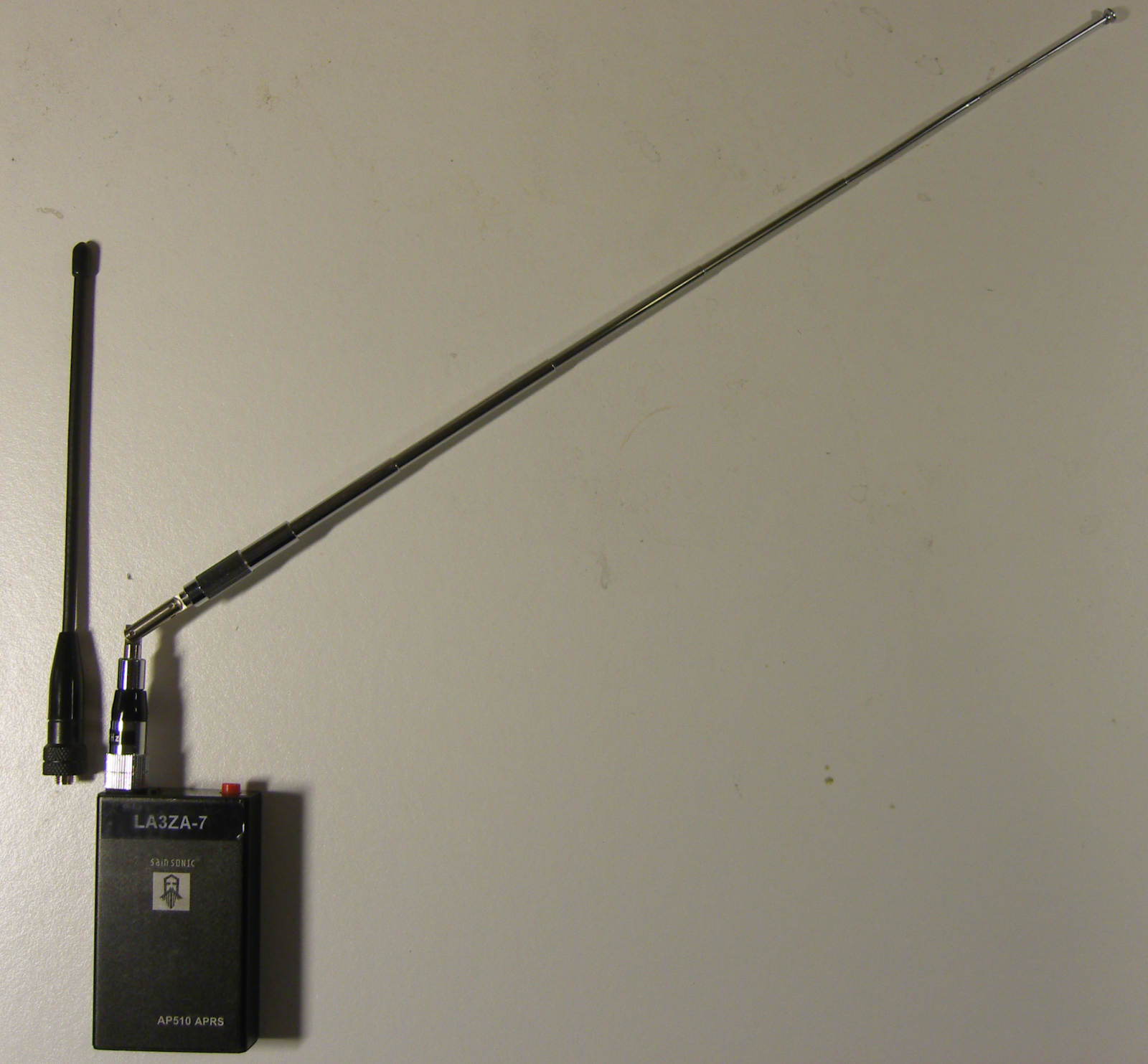 |
| AP510 with original short antenna and telescopic antenna |
Apparently, the Smartbeacon function didn’t work properly in earlier versions of the firmware. With some good debugging and error reporting by KC5EVE, Mark, working with the software developer for the AP510, BG6QBV, the annoying errors now seem to be gone. This is all documented in the Yahoo AP510 group.
I have fitted mine with a 16-45 cm telescopic antenna and even when attached to one of the rear headrests in my sedan, the 1 Watt of output power tracks very well.
The map below shows a drive from Telemark, about 100 km west of Oslo, to Oslo with as good coverage as one can expect given the valleys and the availability of APRS digipeaters especially in the western part.
 |
| Note the missing tracks east of LA5PPA-1 which are due to a 3.5 km long tunnel, Strømsåstunnelen, between Drammen and Mjøndalen. |
Sverre Holm, LA3ZA, is a regular contributor to AmateurRadio.com and writes from Norway. Contact him at [email protected].
 Ham Radio Deluxe |
 W5SWL Electronics |
 Ham Radio Prep |
 KB3IFH QSL Cards  Hip Ham Shirts  HamRadioAuctions HamRadioAuctions Reliance Antennas Reliance Antennas Enigma Shop Enigma Shop |  morseDX  Ni4L Antennas  R&L Electronics R&L Electronics antennas.us antennas.us QRV QRV |
- Matt W1MST, Managing Editor
