 |
 Amateur Radio Weekly – Issue 99
 21 February 2016 | by
Why modern Makers are bringing back Ham Radio
Some Maker spaces now offer ham radio activities. A few, like HacDC, have their own radio shacks and experimental equipment and offer ham radio license classes.
Yahoo! Tech
First impressions of the Icom IC-7300 HF + 6M transceiver
We did not use the transmit functions on the radio, but were able to test out the receiver at my campsite with a Buddipole antenna on 40 meters.
AB4BJ
Vanderbilt CubeSat data collected by ham radio operators worldwide
Building a program of reliable CubeSats; doing real science at a fraction of the cost.
Vanderbilt University
Listening to 10 meter radio beacons
Radio beacons can be found across the RF spectrum from the LF (low frequency) band all the way up to bands inhabited by satellite signals.
The SWLing Post
New distance record on AO-7
We both agreed to simply repeat your call / my call / grid / report rapidly, much in the same way a digital or contest contact is made. At 2009UTC, both stations cleanly heard the others call and grid.
AMSAT
Amateur Radio Parity Act… Amendments?
There was one Committee member, Rep. Anna Eschoo from California, who has been wary of, if not opposed to the bill, based on lobbying she’s received from an association of HOAs.
AmateurRadio.com
Review – BTech UV2501+220 (Tri-Band)
BTech has introduced a low profile Tri-Band Mobile Transceiver to the ham radio marketplace.
Ham Radio Blog PD0AC
HamSphere: Virtual Ham Radio
Talk to Amateur Radio operators all over the world. No extra hardware needed.
HamSphere
Tiny USB Morse Code Beacon
The design for the board is available with single-sided artwork suitable for production using simple methods like toner transfer.
Hack A Day
Video
Getting started with digital modes
This comprehensive video explains the concept behind amateur radio digital modes and describes the hardware and cabling required to get started.
QRP School
UHF RICK Repeater with Auto ID and Teardown
I had previously mentioned that the RICK doesn’t meet FCC requirements on its own due to its lack of automatic identification. What it does have is an accessory port where you can plug in some other device which can generate the ID for you.
The Life of Kenneth
Radio Free Europe (1964)
This film gives an overview of Radio Free Europe’s news-gathering and audience research, its production center in Munich, and its transmission operations in Germany and Portugal.
YouTube
Amateur Radio Weekly is curated by Cale Mooth K4HCK. Sign up free to receive ham radio's most relevant news, projects, technology and events by e-mail each week at http://www.hamweekly.com.
Episode 205 – Resistors
In this episode, Martin M1MRB / W9ICQ is joined by Chris M0TCH, Martin M0SGL, Dan KB6NU, and Colin M6BOY to discuss the latest Amateur / Ham Radio news. Colin M6BOY rounds up the news in brief, and this episodes feature is Resistors
- Google use 71-76 and 81-86 GHz Amateur Bands
- ARRL Partnership Added to RFinder
- Alex Discovers Amateur Radio
- Amateur Ham Radio on BBC Radio Norfolk
- Trinidad and Tobago Lighthouse Joins Ham Radio Event
- ZS1MM Beacon Now Operational
- Emergency Ham Radio Equipment for Indiana Hospital
Colin Butler, M6BOY, is the host of the ICQ Podcast, a weekly radio show about Amateur Radio. Contact him at [email protected].
Episode 205 – Resistors
In this episode, Martin M1MRB / W9ICQ is joined by Chris M0TCH, Martin M0SGL, Dan KB6NU, and Colin M6BOY to discuss the latest Amateur / Ham Radio news. Colin M6BOY rounds up the news in brief, and this episodes feature is Resistors
- Google use 71-76 and 81-86 GHz Amateur Bands
- ARRL Partnership Added to RFinder
- Alex Discovers Amateur Radio
- Amateur Ham Radio on BBC Radio Norfolk
- Trinidad and Tobago Lighthouse Joins Ham Radio Event
- ZS1MM Beacon Now Operational
- Emergency Ham Radio Equipment for Indiana Hospital
Colin Butler, M6BOY, is the host of the ICQ Podcast, a weekly radio show about Amateur Radio. Contact him at [email protected].
Series capacitors that failed according to the book
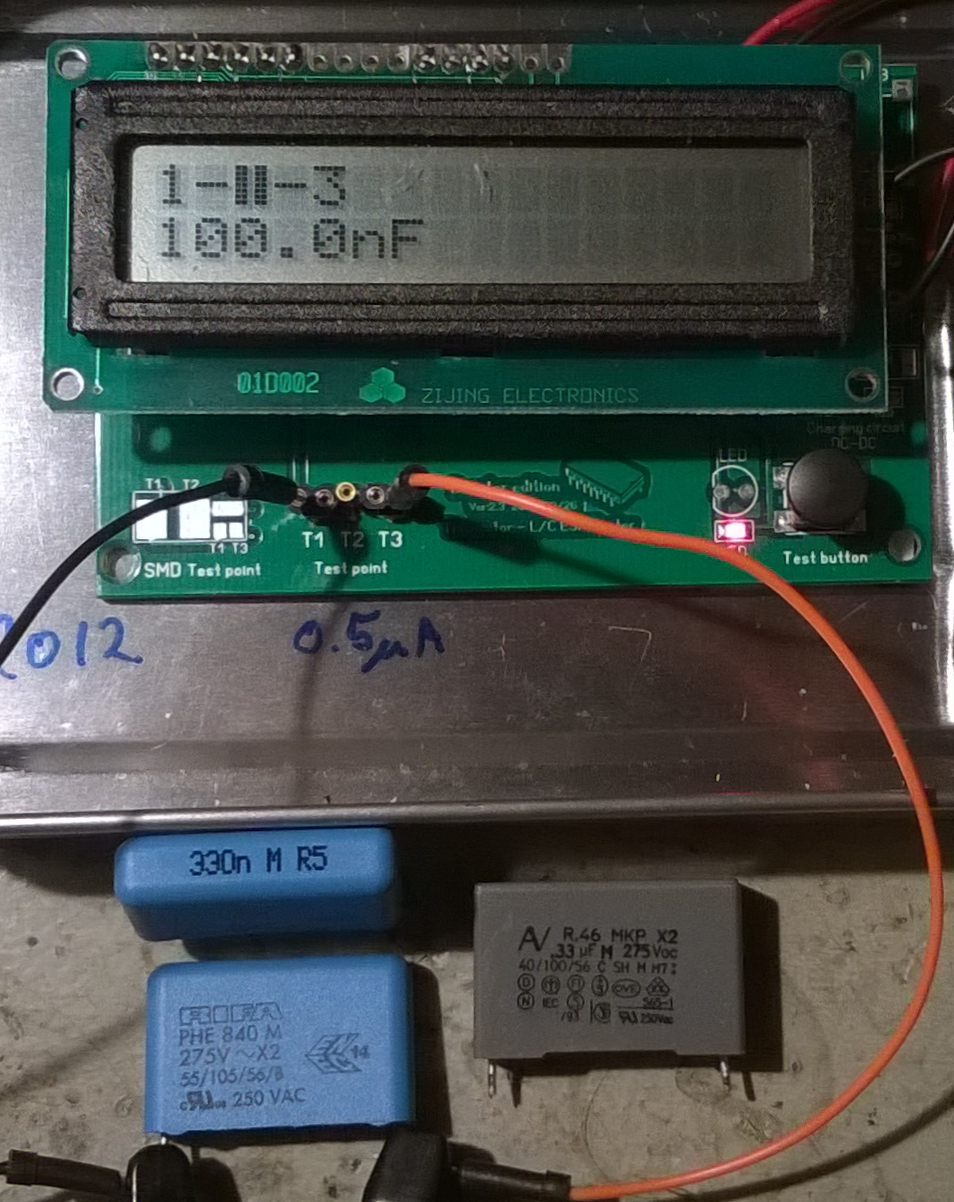 |
| 0.33 uF X2 capacitors which measured only 0.097, 0.1, and 0.118 uF. |
Many devices now use a capacitor power supply thus saving the space that a mains transformer occupies. The principle is that a series capacitor from the mains supply is used to drop the voltage and reduce the current. Provided that the circuit is completely isolated from human touch, this is an economical way to provide DC power.
The image shows three such capacitors as I were measuring them. They came from three malfunctioning devices in my home: two wall-mounted thermostats for floor heating and a remote controlled mains switch.
Their power supplies were designed with a capacitor of 330 nF in series with a bridge rectifier which supplies the low voltage DC. This value is typical, it seems, for 230 Vac, 50 Hz circuits that are designed for about 20 mA. The value will be higher for an equivalent 115 Vac, 60 Hz circuit.
The malfunctioning happened because the value of the capacitor in my cases was reduced to 1/3 and less of the nominal value. These capacitors are all marked X2 and a voltage of 275 Vac.
The X2 means that they are safety capacitors which will not fail by short-circuiting as this would be a fire hazard in this circuit. They have self-healing properties and that means that they fail by “burning away” on their own foil, leading to a reduction in capacitance and eventually failure of the circuit as the power supply cannot supply the required current any more. They should never be replaced by anything but X2 capacitors with the same or higher voltage rating.
Go to the Wikipedia page Capacitive power supply for more description of this circuit.
By the way, the devices which these capacitor came from were 15 year old Microtemp MTN-1991 thermostats and a 20 years old Nobø System 500 RCE 512 remote receiver. They now all work again thanks to the fitting of new 0.33 uF capacitors. And all of them are safety capacitors of type X2 of course – no gambling with safety here.
Sverre Holm, LA3ZA, is a regular contributor to AmateurRadio.com and writes from Norway. Contact him at [email protected].
Series capacitors that failed according to the book
|
| 0.33 uF X2 capacitors which measured only 0.097, 0.1, and 0.118 uF. |
Many devices now use a capacitor power supply saving the space that a mains transformer occupies. The principle is that a series capacitor from the mains supply is used to drop the voltage and reduce the current. Provided that the circuit is completely isolated from human touch, this is an economical way to provide DC power.
The image shows three such capacitors as I were measuring them. They came from three malfunctioning devices in my home: two wall-mounted thermostats for floor heating and a remote controlled mains switch.
Their power supplies were designed with a capacitor of 330 nF in series with a bridge rectifier which supplies the low voltage DC. This value is typical, it seems for 230 Vac, 50 Hz circuits that are designed for about 20 mA. The value will be higher for an equivalent 115 Vac, 60 Hz circuit.
The malfunctioning happened because the value of the capacitor in my cases was reduced to 1/3 and less of the nominal value. These capacitors are all marked X2 and a voltage of 275 Vac.
The X2 means that they are safety capacitors which will not fail by short-circuiting as this would be a fire hazard in this circuit. They have self-healing properties and that means that they fail by “burning away” on their own foil, leading to a reduction in capacitance and eventually failure of the circuit as the power supply cannot supply the required current any more. They should never be replaced by anything but X2 capacitors with the same or higher voltage rating.
Go to the Wikipedia page Capacitive power supply for more description of this circuit.
By the way, the devices which these capacitor came from were 15 year old Microtemp MTN-1991 thermostats and a 20 years old Nobø System 500 RCE512 remote receiver.
Sverre Holm, LA3ZA, is a regular contributor to AmateurRadio.com and writes from Norway. Contact him at [email protected].
I got to be the Flea on the Hound last night
This time, Conventional Wisdom did not disappoint.
I worked Dave pretty quickly. According to my log, I nabbed him at 0203 UTC. And as I suspected, Brian was nowhere to be heard. Actually, Brian and his pack of Hounds were nowhere to be heard, except for an occasional "Woof" and "Arf" from a Hound here and there.
I ended up spending the evening listening to Dave handle his pileup. It was a treat as N1IX is an accomplished Amateur Radio Op, to say the least. He handled all calls rapidly and without error. He also QRS'ed (slowed his code speed for those of you not familiar with the Q Code) from time to time when it was warranted. Dave is a member of the A-1 Operators Club, which is no surprise, and his inclusion is well deserved.
Towards the end of the hunt, Dave had fewer and fewer Hounds baying at him, and as a result, he was calling "CQ FOX" quite a lot. QUITE a lot. And, at the same time, his signal strength to me was actually increasing.
So at 0311 UTC, I decided to do something that I've never done before. I dialed the KX3's power output down to the flea power neighborhood - 100 milliWatts (that's 1/10th of 1 Watt for those of you, who like me, sometimes scratch your head when it comes to scientific notation), and gave Dave another call. In the past, I've only called a Fox a second time if I wasn't positive about being in the log, and I've certainly have never done it QRPp.
Thanks to Dave's excellent ears and superb station, I made it into "Official" log at 0311 at 100 milliWatts of power. According to QRZ, Dave lives 233 miles from me as the proverbial crow flies. So that means the QSO was accomplished last night as a rate of 2330 Miles per Watt.
Not too shabby, and you just GOTTA love this QRP stuff!
72 de Larry W2LJ
QRP - When you care to send the very least!
Larry Makoski, W2LJ, is a regular contributor to AmateurRadio.com and writes from New Jersey, USA. Contact him at [email protected].
I got to be the Flea on the Hound last night
This time, Conventional Wisdom did not disappoint.
I worked Dave pretty quickly. According to my log, I nabbed him at 0203 UTC. And as I suspected, Brian was nowhere to be heard. Actually, Brian and his pack of Hounds were nowhere to be heard, except for an occasional "Woof" and "Arf" from a Hound here and there.
I ended up spending the evening listening to Dave handle his pileup. It was a treat as N1IX is an accomplished Amateur Radio Op, to say the least. He handled all calls rapidly and without error. He also QRS'ed (slowed his code speed for those of you not familiar with the Q Code) from time to time when it was warranted. Dave is a member of the A-1 Operators Club, which is no surprise, and his inclusion is well deserved.
Towards the end of the hunt, Dave had fewer and fewer Hounds baying at him, and as a result, he was calling "CQ FOX" quite a lot. QUITE a lot. And, at the same time, his signal strength to me was actually increasing.
So at 0311 UTC, I decided to do something that I've never done before. I dialed the KX3's power output down to the flea power neighborhood - 100 milliWatts (that's 1/10th of 1 Watt for those of you, who like me, sometimes scratch your head when it comes to scientific notation), and gave Dave another call. In the past, I've only called a Fox a second time if I wasn't positive about being in the log, and I've certainly have never done it QRPp.
Thanks to Dave's excellent ears and superb station, I made it into "Official" log at 0311 at 100 milliWatts of power. According to QRZ, Dave lives 233 miles from me as the proverbial crow flies. So that means the QSO was accomplished last night as a rate of 2330 Miles per Watt.
Not too shabby, and you just GOTTA love this QRP stuff!
72 de Larry W2LJ
QRP - When you care to send the very least!
Larry Makoski, W2LJ, is a regular contributor to AmateurRadio.com and writes from New Jersey, USA. Contact him at [email protected].
 Ham Radio Deluxe |
 W5SWL Electronics |
 Ham Radio Prep |
 KB3IFH QSL Cards  Hip Ham Shirts  HamRadioAuctions HamRadioAuctions Reliance Antennas Reliance Antennas Enigma Shop Enigma Shop |  morseDX  Ni4L Antennas  R&L Electronics R&L Electronics antennas.us antennas.us QRV QRV |
- Matt W1MST, Managing Editor
