 |
 HamRadioNow: 60 Meters… Let’s Go Dutch
 2 February 2016 | by
 I’ll coin a phrase for a program like this: Wonkie-Talkie.
The WRC (World Radio Conference) last November ended up with a worldwide Amateur Radio 60 Meter allocation of 15 kHz. You’ll be forgiven if you thought there already was a 60 meter allocation, as many countries have authorized 60 Meter Amateur operation. But it’s never been a formal ITU deal.
But 15 kHz, with a power restriction of about 10 watts into a dipole? (Or 15 watts EIRP – an ‘isotropic radiator’ – a dipole has 2 dB gain over an isotropic radiator?) Compared to the 5 discrete SSB/CW/digital channels we have now with a 100 watt/dipole power limit…. is that a win, lose or draw?
In this Episode of HamRadioNow, ARRL Chief Technology Officer Brennan Price N4QX explains how the WRC ended up with this meager offering, and how hams in the US and other countries with maybe more spectrum and certainly more power may continue to enjoy those privileges. Or not… At the very least, the FCC won’t act on the WRC changes for some time… maybe years.
Well, it’s years if we’re gaining something, like the 137 kHz spectrum that was authorized in WRC 07, that we’re just getting rules opening it up to US hams now. But if we’re losing something?
Brennan is happier to talk about some of the defensive successes at WRC 15. If half the battle is gaining spectrum, the other half is avoiding losing it. And there were many eyes on some of our microwave allocations, but the attacks were fended off.
So, Wonkie-Talkie? You’ll also be forgiven if you drift off to work some DX on 20…. while we still have 20….
Oh, and ‘Let’s Go Dutch’? The contingent from the Netherlands strongly supported a wider allocation and 100 watt limit. They compromised down to 100 kHz, but were out-shouted (apparently there is no voting) by the “almost nothing” faction. So their government immediately authorized Dutch hams that 100 kHz/100 watts anyway.
Brennan says it’s not going to happen here in the US.
73, Gary KN4AQ
And if you don’t have time to watch, maybe you have time to listen while you commute or work out (work out? Hams? Who am I kidding?). Paste this into your podcast app: http://HamRadioNow.tv/hrn/hrnrss.xml. You’ll be subscribed to our audio download.
Gary Pearce, KN4AQ, is the host of HamRadioNow.tv. If you enjoy this and other HamRadioNow programs, help keep them 'on the air' with a contribution. Contact him at [email protected].
Weekly Propagation Summary – 2016 Feb 01 16:10 UTC
Here is this week’s space weather and geophysical report, issued 2016 Feb 01 0641 UTC.
Highlights of Solar and Geomagnetic Activity 25 – 31 January 2016
Solar activity was at very low to low levels during the period. Low levels were observed from 25-29 January with Regions 2488 (N02, L=320, class/area Dai/240 on 25 January) and 2489 (N10, L=253, class/area Eko/300 on 29 January) producing the majority of the C-class flaring. The largest flare of the period was a C9/1f at 28/1202 UTC from Region 2488. Region 2488 was in slow decay over the period. Region 2489 continued to exhibit growth through 28 January and slowly decayed thereafter. Several filament eruptions, and subsequent coronal mass ejections (CMEs), were observed during the period, but none had an Earth-directed component.
No proton events were observed at geosynchronous orbit.
The greater than 2 MeV electron flux at geosynchronous orbit was at high levels from 25-27 January, moderate levels on 28 January, and normal levels from 29-31 January. The maximum flux of the period was 2,117 pfu observed at 26/1500 UTC.
Geomagnetic field activity was at mostly quiet levels throughout the period with isolated unsettled periods on 27-28 and 31 January and an isolated active period observed late on 31 January. Solar wind parameters were in decline as the period began under the waning influence of a negative polarity coronal hole high speed stream (CH HSS). Solar wind speed gradually decreased from approximately 480 km/s early in the period to around 260 km/s by 30 January before increasing slightly to 300 km/s by the end-of-the-period. A solar sector boundary crossing into a positive (away) orientation occurred at approximately 27/0834 UTC, accompanied by a slight increase in total field (Bt) measurements to 9 nT on 27 and 28 January. On 31 January, another increase in Bt to 10 nT was observed along with a prolonged period of southward Bz. The geomagnetic field responded with isolated active levels to end the period.
Forecast of Solar and Geomagnetic Activity 01 February – 27 February 2016
Solar activity is expected to be at very low to low levels with a chance for M-class flares (R1-R2, Minor-Moderate) from 03-25 February with the return of old Regions 2484 (N08, L=094) and 2488 (N02, L=320).
No proton events are expected at geosynchronous orbit.
The greater than 2 MeV electron flux at geosynchronous orbit is expected to be at normal to moderate levels with high levels likely on 04-07, 09-15, and 18-23 February as a result of CH HSS influence.
Geomagnetic field activity is expected to be at unsettled to active levels on 01 February due to continued effects from a prolonged period of southward Bz. Unsettled to active levels are likely from 02-04, 08-09, and 17-20 February due to recurrent CH HSS activity.
Don’t forget to visit our live space weather and radio propagation web site, at: http://SunSpotWatch.com/
Live Aurora mapping is at http://aurora.sunspotwatch.com/
If you are on Twitter, please follow these two users: + https://Twitter.com/NW7US + https://Twitter.com/hfradiospacewx
Get the space weather and radio propagation self-study course, today. Visit http://nw7us.us/swc for the latest sale and for more information!
Check out the stunning view of our Sun in action, as seen during the last five years with the Solar Dynamics Observatory (SDO): https://www.youtube.com/watch?v=zXN-MdoGM9g
We’re on Facebook: http://NW7US.us/swhfr
Visit, subscribe: NW7US Radio Communications and Propagation YouTube Channel
Winner announcement: 2016 NooElec Giveaway

First of all, thank you to the 2,015 people from all over the world who entered the giveaway. That’s a record number of entries for us!
Now for the moment you’ve been waiting for… the winners! OK, here they are:

We will contact the winners by e-mail with further instructions today. If you are one of the 41 winners, please reply quickly so that we can get your prize on the way to you! If you don’t receive your e-mail today, please double-check your spam folder to make sure it didn’t end up there.
Here are the prizes:
 One (1)
HackRF One SDR transceiver bundle
Estimated retail value $500 each
Contains everything you need to listen to, and transmit, HF, VHF & UHF (1 MHz to 6 GHz) with the HackRF One from Great Scott Gadgets, down to 100kHz or lower! Standard bundle includes HackRF, Ham It Up, Antenna Balun, 2 SMA interconnect cables and an SMA to BNC adapter. Pre-installed in a black aluminum enclosure and with the RF shield.
 Three (3)
NESDR XTR+ HF bundles
Estimated retail value $140 each
Each kit will contain an SDR, an upconverter to enable HF reception, and a cable to connect the two units.
 Two (2)
NESDR Mini 2+ HF bundles
Estimated retail value $125 each
Each kit will contain an NESDR Mini 2+ SDR with 0.5PPM TCXO, MCX-connected antenna for VHF, an upconverter to enable HF reception, and a cable to connect the two units.
 Ten (10)
NESDR XTR+ sets
Estimated retail value $60 each
NooElec NESDR XTR+ SDR & DVB-T USB set, including GPS-rated +/- 0.5PPM TCXO, quality telescopic antenna and remote control. Genuine Elonics E4000 tuner is guaranteed.
 Ten (10)
NESDR Nano 2+ sets
Estimated retail value $30 each
Same form factor as the Nano 2 but with a TCXO!
 Fifteen (15)
NESDR Nano 2 sets
Estimated retail value $25 each
The NESDR Nano 2 is based on the R820T2 tuner IC made by Rafael Micro, which means an approximate tuning range of 25MHz-1700MHz and improved selectivity and sensitivity in most frequency ranges versus R820T-based SDRs. There is also an RTL2832 (RTL2832U) IC on board of course, to provide basic demodulation and USB interface functionality
a special BIG thank you to NooElec!
Matt Thomas, W1MST, is the managing editor of AmateurRadio.com. Contact him at [email protected].
Arduino DTMF Decoder and Relay Controller
Another Arduino project I’ve been working on is a DTMF decoder used to control a relay board. Using a ham radio receiver, I can switch lights, radios, computers…anything…on or off from miles away. Here’s the video:
Here’s the wiring diagram. And here’s the Arduino code.
I’m using a Sainsmart 4 relay board, although pretty much any relay board would work. You’ll also need a MT8870 DTMF decoder – these run about $2 on ebay. And of course, you’ll need an Arduino Uno. Again, check out ebay for these as well. The total cost here should be less than $12 and you’ve got a fully functioning radio controlled DTMF relay controller!
Michael Brown, KG9DW, is a regular contributor to AmateurRadio.com and writes from Illinois, USA. Contact him at [email protected].
Arduino DTMF Decoder and Relay Controller
Another Arduino project I’ve been working on is a DTMF decoder used to control a relay board. Using a ham radio receiver, I can switch lights, radios, computers…anything…on or off from miles away. Here’s the video:
Here’s the wiring diagram. And here’s the Arduino code.
I’m using a Sainsmart 4 relay board, although pretty much any relay board would work. You’ll also need a MT8870 DTMF decoder – these run about $2 on ebay. And of course, you’ll need an Arduino Uno. Again, check out ebay for these as well. The total cost here should be less than $12 and you’ve got a fully functioning radio controlled DTMF relay controller!
Michael Brown, KG9DW, is a regular contributor to AmateurRadio.com and writes from Illinois, USA. Contact him at [email protected].
PAØRDT Miniwhip Shakedown

A recent posting to Yahoo's 'NDB List Group' by Mike, an ardent NDB DXer in the UK (Sussex), announced the recent completion of his four-part video series describing the installation and testing of a new PAØRDT active antenna.
If you may be contemplating the installation of an active antenna such as this, or perhaps making a start at DXing the NDB band or listening on 630m, then you might enjoy following Mike's journey as he demonstrates that living in the noisy suburbs need not keep you from enjoying the LF/MF bands. Mike includes some interesting tests involving his grounding system versus noise ingress and the results of keeping the electrical main's ground isolated (or not) from the antenna cable's ground.
The PAØRDT active whip is available from PAØRDT himself or if you are handy with a soldering iron, you might choose to build the same antenna in your workshop. These simple yet highly effective receiving antennas are being used successfully by hundreds of listeners all over the world and for their size provide some pretty amazing performance.
Much more information on the PAØRDT e-probe antenna may be found here in a previous blog posting. To see more of Mike's videos, you can visit his interesting Youtube Channel here.
Steve McDonald, VE7SL, is a regular contributor to AmateurRadio.com and writes from British Columbia, Canada. Contact him at [email protected].
January VHF Contest Plus SOTA
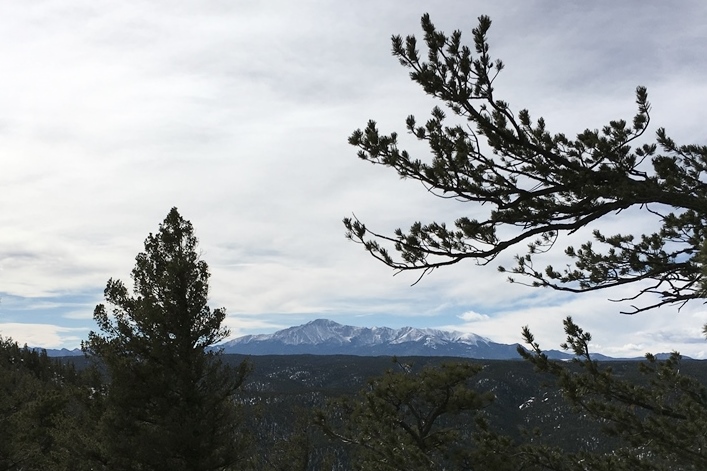
A view of Pikes Peak from Mt Herman.
It’s been a while since I’ve done a January VHF contest from a mountaintop so I decided to give it a try from Mount Herman this year. The ARRL recently changed the contest rules to allow the use of the national 2m fm calling frequency for contests. See Coming Soon: 146.52 MHz in ARRL VHF Contests. I wanted to see how this change would play out in practice when doing a combination VHF Contest plus SOTA activation. In previous attempts, I had to vector the SOTA activity to another 2m fm frequency for it to be a legal contact for the contest. The SOTA + Contest operation is attractive because it has all the elements of a fun SOTA hike coupled with the increased activity of a VHF contest. The contest brings out the weak-signal folks with very capable stations, increasing the probability of making some good DX contacts.
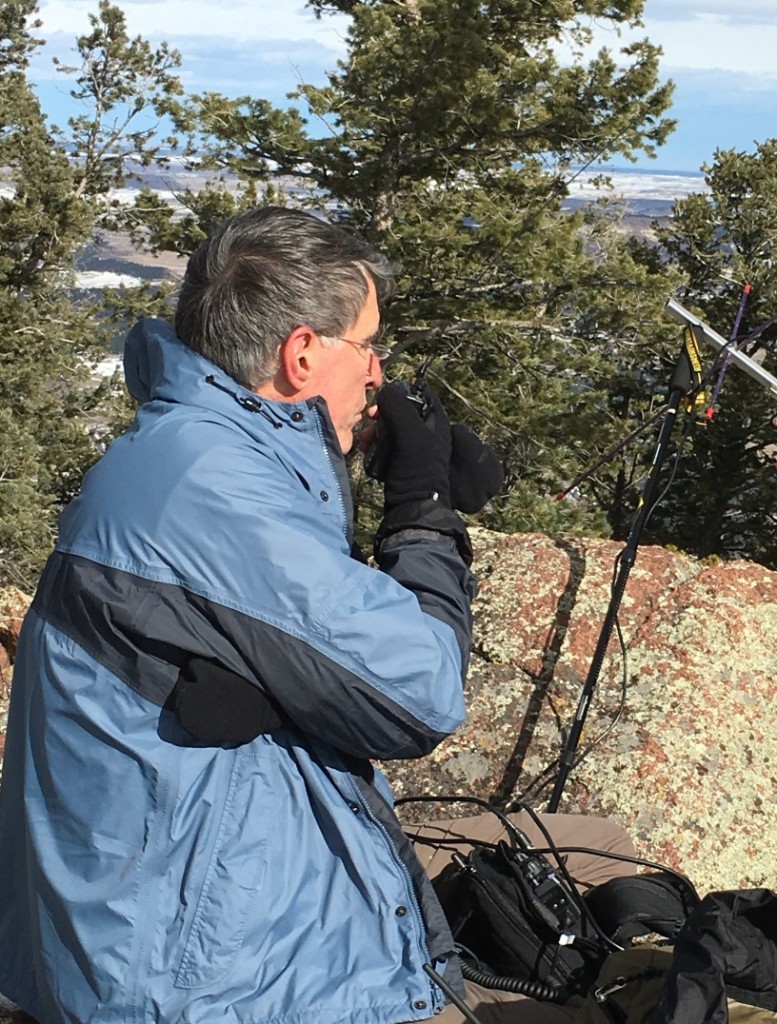
Bob K0NR using an HT to make contacts on 446.0 MHz FM.
Joyce KØJJW and I hit the trail at 10:30 AM local with the goal of being at the summit around noon (1900 UTC) for the start of the ARRL contest. The trail was icy, but manageable with the gripping devices on our boots. The weather was chilly but not bad for January. At the summit, I configured my FT-60 handheld radio for 146.52 MHz using a 2m half-wave vertical. My first call netted a QSO with Tim, KAØMWA in Castle Rock. I worked a few other stations on 2m fm and then set up the 2m ssb station (FT-817 plus Arrow II antenna). On 144.200 MHz SSB, I contacted two Wyoming stations in grid DN71, about 140 miles away. I also gave a call on 446.0 MHz fm and worked W3DHJ and KE0HBW mobile.
Freq    Mode    UTC     Call     Grid
146.52    FM    1900    KA0MWA   DM79
146.52    FM    1902    N0AXK    DM79
146.52    FM    1905    N0LP     DM79
146.52    FM    1905    K0GPA    DM79
146.52    FM    1905    WG0AT    DM79
146.52    FM    1920    N0ISB    DM78
146.52    FM    1923    N0LEA    DN70
144.2    SSB    1932    WY7KY    DN71
144.2    SSB    1935    K0ALE    DM79
144.2    SSB    1938    AB0YM/R  DM79
144.2    SSB    1939    KG0RP    DN70
144.2    SSB    1940    WA7KYM   DN71
144.2    SSB    1942    KC4YLV   DM79
446.0    FM     1948    W3DHJ    DM78
144.2    SSB    1949    WE7L     DM79
144.2    SSB    1951    N0SP     DM79
446.0    FM     2000    KE0HBW   DM79
The wind was strong at the summit and kept blowing everything around, making it difficult to operate the radio and manage the antennas. After an hour of operating, I decided to QRT and head on down. I know I missed a bunch of potential contacts, especially having not gotten on 70 cm and 6m ssb.
Except for the short operating time, the operation played out as expected. I was able to work the SOTA folks and 2m fm enthusiasts on 146.52 MHz. I made it a point to not hog the calling frequency, as there are quite a few folks that monitor there. Switching over to 2m ssb, I worked the contest crowd, typically with more capable vhf stations. My score is a whopping 114 points, in the single-op portable category.
Thanks to everyone that got on the air to play radio that day!
73, Bob KØNR
The post January VHF Contest Plus SOTA appeared first on The KØNR Radio Site.
Bob Witte, KØNR, is a regular contributor to AmateurRadio.com and writes from Colorado, USA. Contact him at [email protected].
 Ham Radio Deluxe |
 W5SWL Electronics |
 Ham Radio Prep |
 KB3IFH QSL Cards  Hip Ham Shirts  HamRadioAuctions HamRadioAuctions Reliance Antennas Reliance Antennas Enigma Shop Enigma Shop |  morseDX  Ni4L Antennas  R&L Electronics R&L Electronics antennas.us antennas.us QRV QRV |
- Matt W1MST, Managing Editor
