 |
 Ham College 15
 27 March 2016 | by
 Satellite communications.
45:13
George Thomas, W5JDX, is co-host of AmateurLogic.TV, an original amateur radio video program hosted by George Thomas (W5JDX), Tommy Martin (N5ZNO), Peter Berrett (VK3PB), and Emile Diodene (KE5QKR). Contact him at [email protected].
RPiGate again
For a few weeks I have been attempting to use an RTL-SDR and a raspberry Pi 2 as an APRS iGate. Dutifully following a number of tutorials I failed to ‘Kalibrate’ the dongle several times and so put it to one side. Today however I have managed to get the thing running. Not with the original tutorial but with a different application called ‘Direwolf’.
There are quite a few clever sods kicking about and the guy who pulled this together is no exception. John Langer,WB2OSZ has not only produced a cracking application but also one of the most straightforward and detailed installation documents as well. What I particularly liked was the way that there was a step followed by an explanation of what the step was meant to achieve. I’m no great linux fan, partly because I don’t understand what the hell is going on and more importantly for me, why its not doing what I thought it should do and why. This small success may point me more in that direction though.
More to the point see. I told you it was working!

Alex Hill, G7KSE, is a regular contributor to AmateurRadio.com and writes from Cumbria, UK. Contact him at [email protected].
QSO Today interview with VK3YE
This is well worth a listen, when having your midnight cocoa:
http://www.qsotoday.com/podcasts/vk3ye
I can only reflect some of the similar things of visiting the dump, or being given old televisons & radios to pull apart that got myself interested in the hobby many years ago..
Steve, G1KQH, is a regular contributor to AmateurRadio.com and writes from England. Contact him at [email protected].
QSO Today interview with VK3YE
This is well worth a listen, when having your midnight cocoa:
http://www.qsotoday.com/podcasts/vk3ye
I can only relect some of the similar things of visiting the dump, or being given old televisons & radios to pull apart that got myself interested in the hobby many years ago..
Steve, G1KQH, is a regular contributor to AmateurRadio.com and writes from England. Contact him at [email protected].
Amateur Radio Weekly – Issue 104

Realtime QSO information from Heard Island
Dashboard shows QSO counts, recently logged callsigns, and QSO search.
DXA3.org
Multimode Digital Voice Modem
A project describing an adapter for D-Star, DMR and other digital modes based on an Arduino Due and a little PCB to put on top.
Notizbl0g.
Radio attack lets hackers steal 24 different car models
Thieves are amplifying near-by key fob signals.
Wired
The Radio Amateur’s Code
Radio sport that involves chasing that elusive country, county, SOTA peak, NPOTA entity or whatever should never become the focus of our lives, or our reason for being.
W2LJ
Why I changed my call sign after 28 years
Up until last month, I’ve used my original Novice-class call sign since it came in the mail in 1988.
N4AE
Ham Radio and Photography
It goes without saying that I always have my emergency preparedness kit with me that is stored in the cargo bay of my mobile, as you never know when you might need to draw from it.
VE6AB
Man in trouble for cellphone jammer on public train
A 63 year old financial analyst is facing serious charges, because he used a cellphone jammer on a public train.
Southgate
The technology working behind the scenes of Heard Island
Here is a pictorial list of the technology we are using to support VK0EK. Every thing we use is in the “Cloud” – and everything is automatically maintained and backed up.
VK0EK
Rash believed to be caused by radiation from mobile phone mast
Resident said she suffers from electrosensitivity- a condition suffered by people who in varying degrees are made ill by connection to electricity.
Ledbury Reporter
North Korea intensifies shortwave jamming
North Korea has been from the beginning of March continually signal jamming radio broadcasts on the shortwave frequency used by the South Korean non-profit broadcaster Unification Media Group.
The SWLing Post
Video
NOAA WX Sat umbrella antenna
Using an umbrella in place of a quadrifilar helix antenna.
YouTube
Amateur Radio Weekly is curated by Cale Mooth K4HCK. Sign up free to receive ham radio's most relevant news, projects, technology and events by e-mail each week at http://www.hamweekly.com.
BLT+ Balanced line tuner at Excalibur
Another portable test of the BLT+ tuner
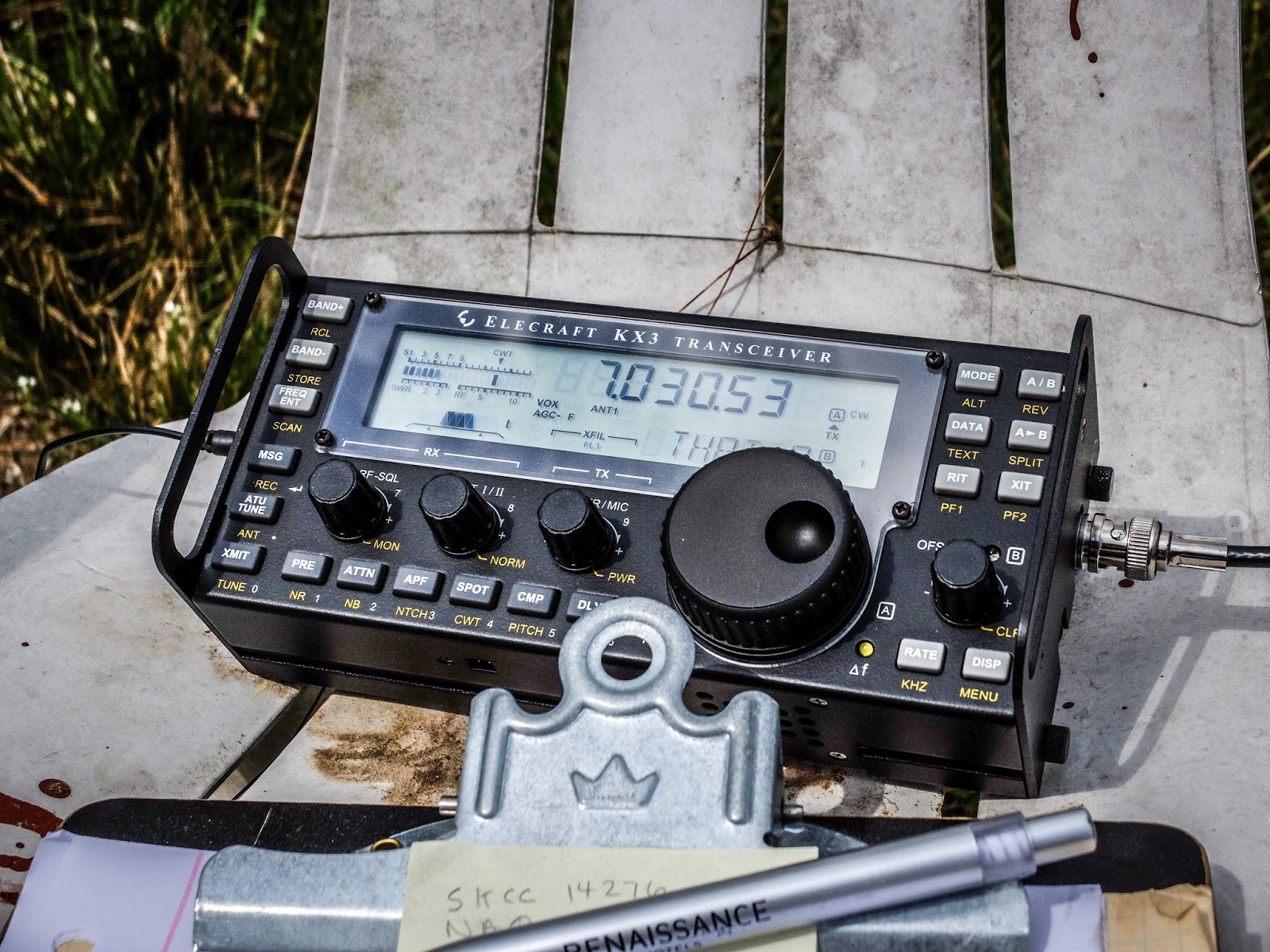 |
| KX3 operating on internal battery. What a fantastic portable rig. |
I took the BLT+ balanced line tuner out to the Excalibur antenna site to try it out on the doublet antenna that we put up last Saturday. This was the first test of that antenna (40m and 80m using a common feedpoint).
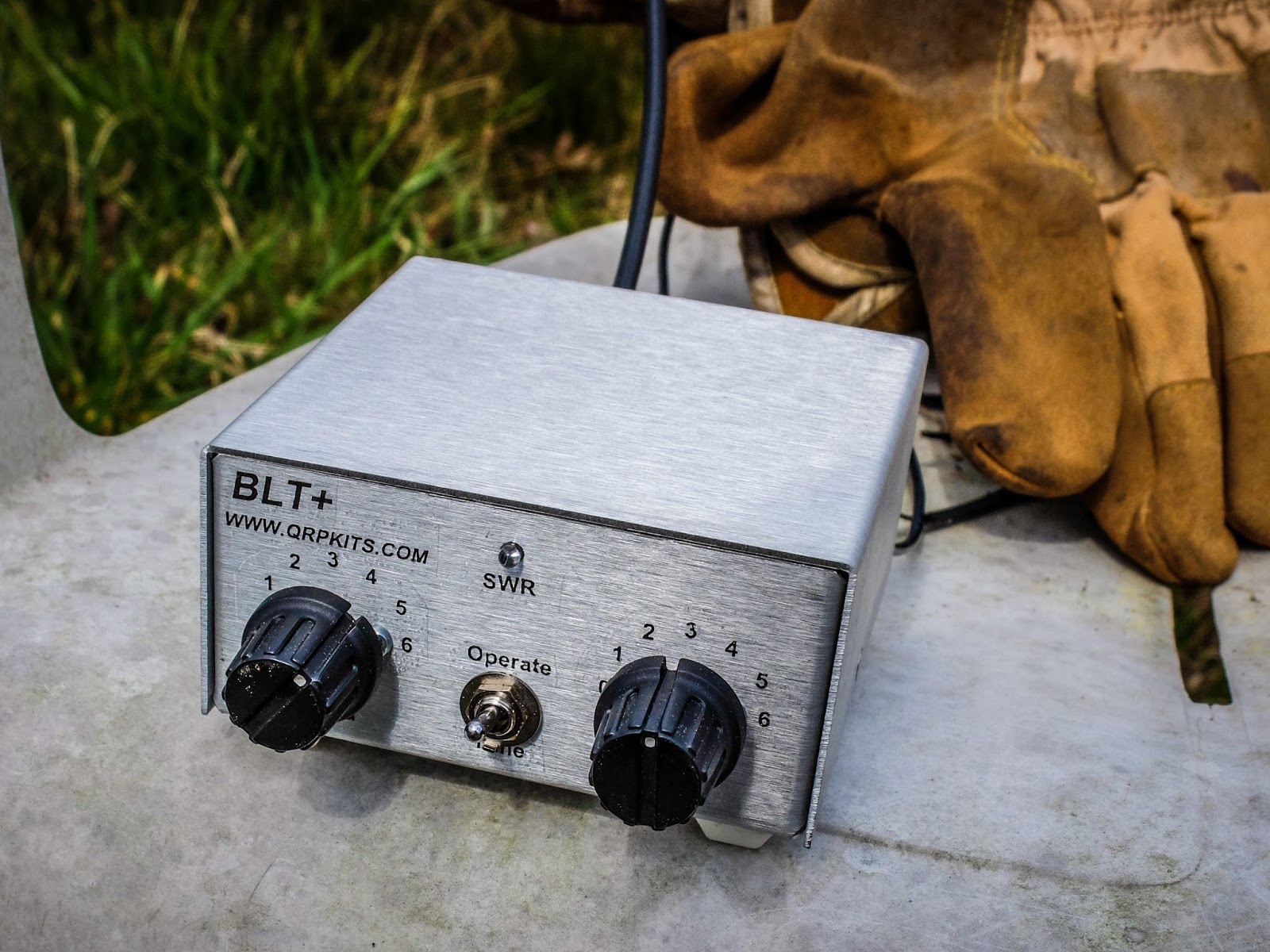 |
| BLT+ connected to open wire line (under the gloves) going to ta 40m Doublet at 65ft |
I used the BLT+ to tune the 40m/80m doublet. Balanced line antennas perform better with a tuner designed for balanced line and this was a good test for both the tuner and the new antenna.
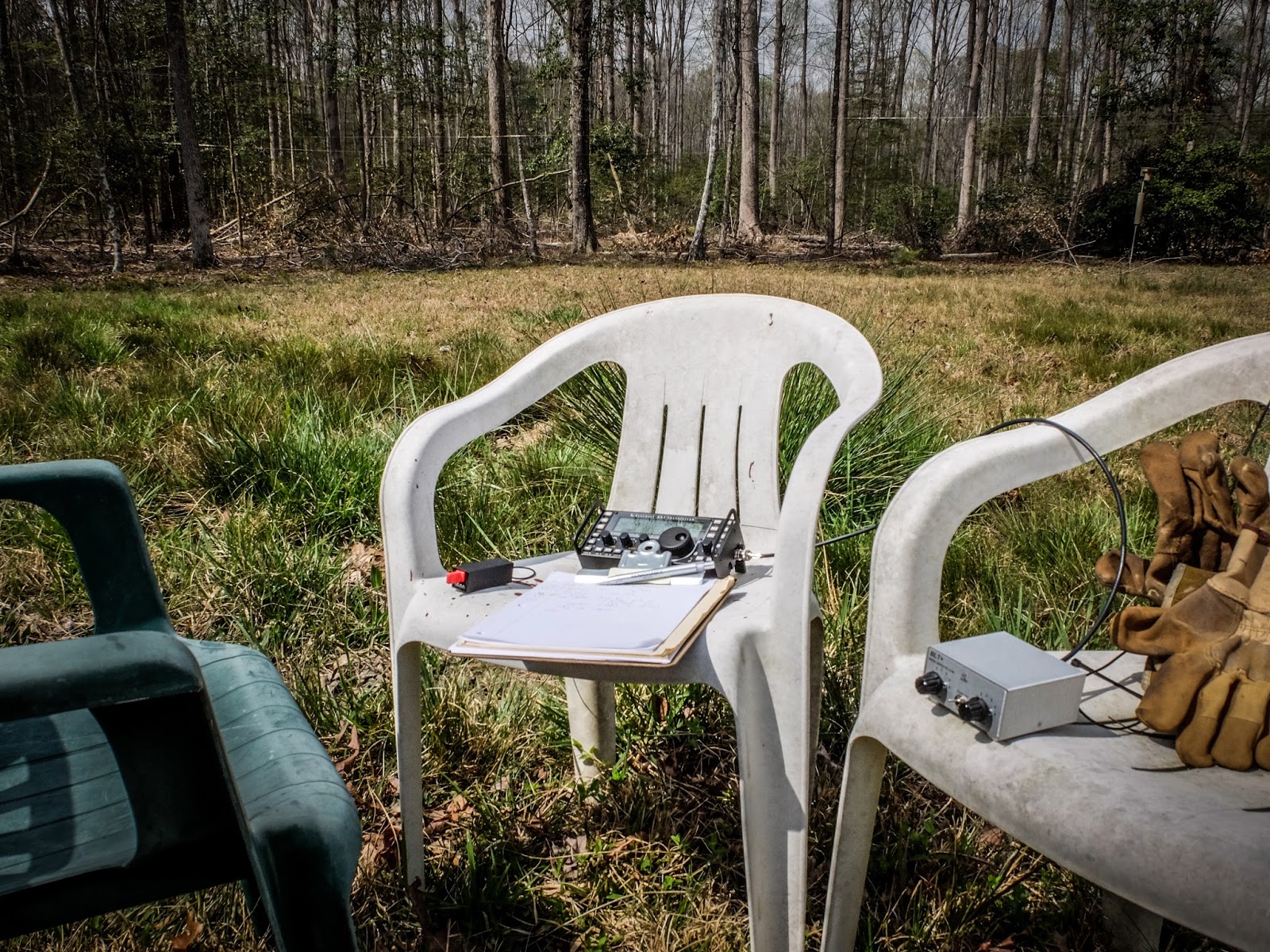 |
| Portable shack, courtesy of three plastic chairs |
I quickly matched the doublet using the BLT+ using the lowest impedance setting which is also the most efficient. I was glad to see that the BLT SWR LED indicator is bright enough to be seen in direct sunlight. I was wondering about that but you can definitely tell when it dims even in direct sunlight.
Performance
AA4OO sitting back and listening to the QSO
The Doublet's feed line has not been brought to the shack yet so I was just sitting under the antenna. The open feed line is running along the ground for a bit which certainly didn't help the signal but we haven't installed the posts to carry the feed line over to the shack and I was too lazy to move the chairs far enough away to keep the feed line in the air.
In the foreground is some saw-grass common on the NC coast. I'm not sure why it's growing this far inland.
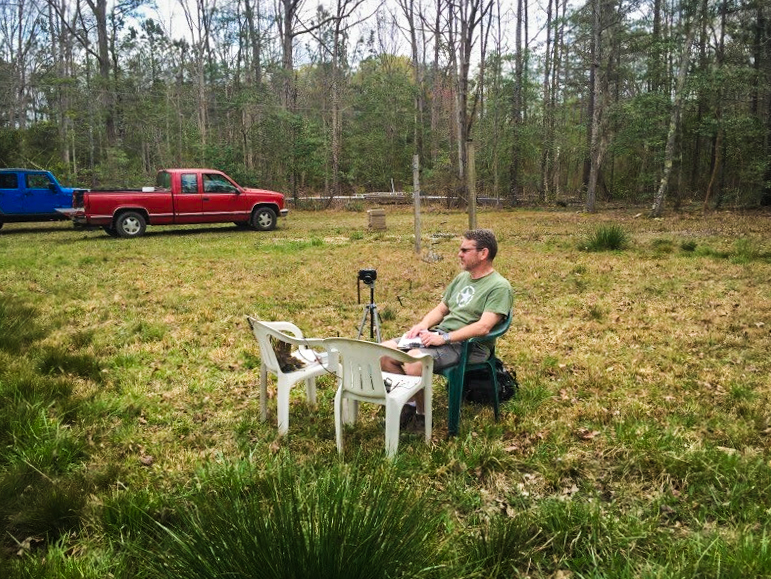 |
| Portable shack at the Excalibur antenna site... The Doublet is 65 feet above my head |
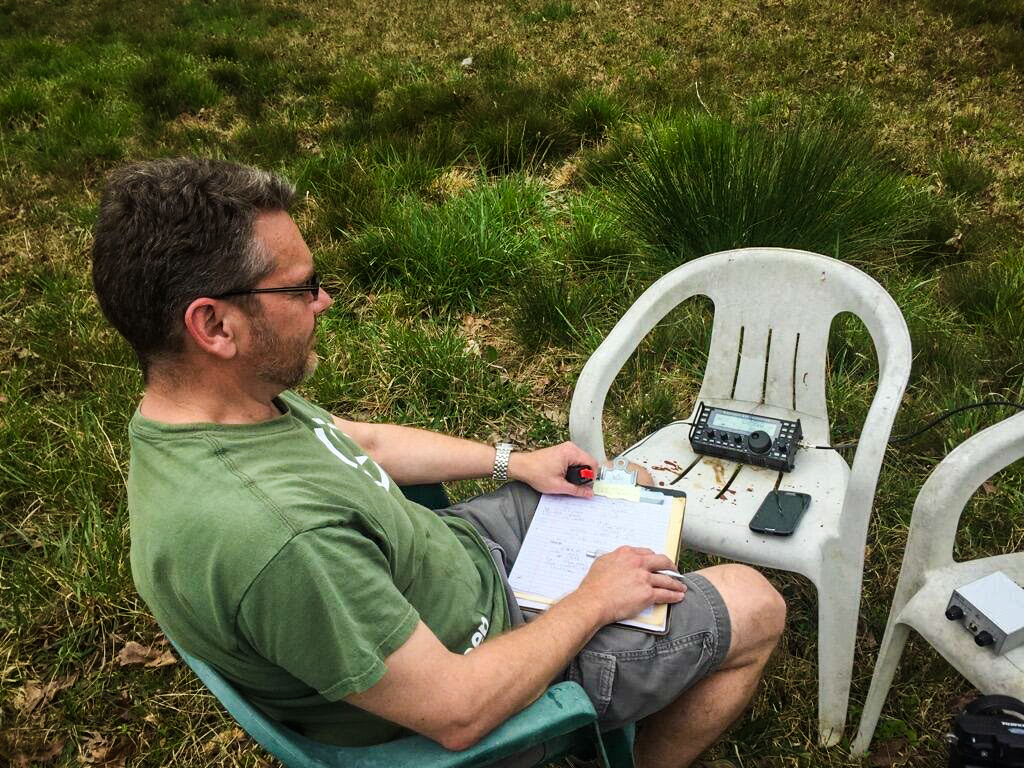 |
| Waiting my turn in the QSO... holding the Palm Single Paddle. BLT+ tuner in the chair to the right |
Video
Summary
Richard Carpenter, AA4OO, is a regular contributor to AmateurRadio.com and writes from North Carolina, USA. Contact him at [email protected].
ARRL Working For LF / MF Future
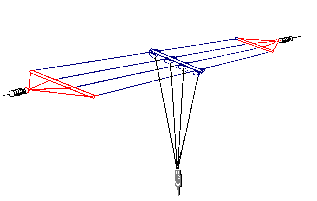
As the rollout of new LF and MF ham bands grows closer for U.S. amateurs, earlier this month, the ARRL requested the FCC to carefully consider the procedural requirements governing the advance notification of local electric authorities of their intended 630m / 2200m operation. The FCC had suggested that under certain circumstances (mainly the distance to the nearest PLC signal-carrying power lines), amateurs would be required to notify and co-operate with power authorities ... but it was all very vague and seemed to place the conditions under which operating authority would be granted into the hands of the power companies.
In what appears to be a preemptive move to head-off the (possibly) overly onerous and impossible roadblocks suggested by power company representatives, the ARRL filing states:
“ARRL does not object to such a notification requirement, provided that it is appropriately circumscribed, not overbroad in its applicability, and not overly burdensome for radio amateurs to comply with,” the League’s statement asserted.
In addition, the power authority Utility Telecom Council (UTC) has been notably silent on the issue ... slowing the process even further.
"The ARRL noted that comments filed by the Utilities Telecom Council (UTC) called for a system of “quasi-coordination” by radio amateurs before commencing operation on 2200 meters (135.7-137.8 kHz). In its remarks to the FCC, the ARRL pointed out, however, that the UTC has not volunteered any information with respect to how a notification process might work nor offered any PLC database information to the ARRL or to the amateur community so prospective users of the band could determine if their operation might be problematic."
The League took the opportunity to remind the FCC, once again, that the low ERP levels generated by amateurs operating on the new bands would have a low probability of creating any interference and further pointed out that PLC systems operating between 9 and 490 kHz are not subject to protection from licensed services.
The ARRL also indicated that any sort of blanket notification requirement prior to transmitting on 2200 or 630 meters “would be clear regulatory overkill,” and that utility companies should clearly be required to demonstrate how amateur operations would cause harmful interference to their PLC (unlicenced) operations.
It's good to see the ARRL still being proactive with regards to procuring these new frequency allotments on behalf of U.S. amateurs ... hopefully making implementation sooner rather than later. The entire ex parte filing can be read here as well as the ARRL's own news posting of the procedure here.
In the meantime, I'll make yet another call-to-arms to fellow Canadian amateurs, who already have these two new bands but aren't using them ... new activity from the western provinces would be especially welcome as there are a now a number of well-equipped stations in VE7 who would like to work you.
Steve McDonald, VE7SL, is a regular contributor to AmateurRadio.com and writes from British Columbia, Canada. Contact him at [email protected].
 Ham Radio Deluxe |
 W5SWL Electronics |
 Ham Radio Prep |
 KB3IFH QSL Cards  Hip Ham Shirts  HamRadioAuctions HamRadioAuctions Reliance Antennas Reliance Antennas Enigma Shop Enigma Shop |  morseDX  Ni4L Antennas  R&L Electronics R&L Electronics antennas.us antennas.us QRV QRV |
- Matt W1MST, Managing Editor
