 |
 AmateurLogic 89: Wires, Wireless & Pi Smack Down
 17 April 2016 | by
AmateurLogic.TV Episode 89 is now available for download.
George shows us how to make a ‘Lineman’s Splice’. Emile introduces us to his Ubiquiti Wireless Point-to-Point bridge. Tommy benchmarks the various models of the Raspberry Pi with some interesting results. And Peter presents the Raspberry Pi 4???
1:04:13
George Thomas, W5JDX, is co-host of AmateurLogic.TV, an original amateur radio video program hosted by George Thomas (W5JDX), Tommy Martin (N5ZNO), Peter Berrett (VK3PB), and Emile Diodene (KE5QKR). Contact him at [email protected].
ICQ Podcast Episode 209 – Erecting Antennas
In this episode, Martin M1MRB / W9ICQ is joined by Chris M0TCH, Dan KB6NU and ED DD5LP to discuss the latest Amateur / Ham Radio news. Colin M6BOY rounds up the news in brief, and this episodes feature is Erecting Antennas.
- Shakespeare 400 Special Event Station
- SARL Amateur Radio Hall of Fame
- New Radio Antenna Avoids Unwanted Signals
- DSTAR Satellite in Space
- Sisters called to White House
- RSGB Announces New General Manager
- ARRL Establishes 'Youth Nets' Web Page
- Implosions Removes 48 Surplus VOA towers
- K1JT is Amateur of the Year
- SSB/CW Filter Modules
Colin Butler, M6BOY, is the host of the ICQ Podcast, a weekly radio show about Amateur Radio. Contact him at [email protected].
ICQ Podcast Episode 209 – Erecting Antennas
In this episode, Martin M1MRB / W9ICQ is joined by Chris M0TCH, Dan KB6NU and ED DD5LP to discuss the latest Amateur / Ham Radio news. Colin M6BOY rounds up the news in brief, and this episodes feature is Erecting Antennas.
- Shakespeare 400 Special Event Station
- SARL Amateur Radio Hall of Fame
- New Radio Antenna Avoids Unwanted Signals
- DSTAR Satellite in Space
- Sisters called to White House
- RSGB Announces New General Manager
- ARRL Establishes 'Youth Nets' Web Page
- Implosions Removes 48 Surplus VOA towers
- K1JT is Amateur of the Year
- SSB/CW Filter Modules
Colin Butler, M6BOY, is the host of the ICQ Podcast, a weekly radio show about Amateur Radio. Contact him at [email protected].
North American QRP CW Club
Later this year, the North American QRP CW Club will celebrate its twelfth year of existence. Birthed during a prolific period when many small ham radio groups coalesced into online radio clubs, the NAQCC has become one of the most successful of the litter.

There’s good reason why this club has continued to thrive where others have faded — you simply won’t find a more active or enthusiastic group of wireless telegraphers on the planet.
The timing was impeccable as interest in QRP activity was peaking in the amateur radio world around the time of the club’s formation. But you would be wrong to assume that the rapid rise of the NAQCC was merely a “fad” as sustained growth in the intervening years have proven.
John Shannon, K3WWP co-founded the organization (along with Tom Mitchell, WY3H) and was its guiding light over the first decade.
Shannon’s resume as a QRP CW operator is polished and he easily straddles the two centuries of our hobby – old school ham radio on the one hand, embracing the Internet as an effective means for spreading his minimalist view of amateur radio on the other.
The many activities of the NAQCC keep members as busy as they want to be on the air. That’s by design. While the NAQCC maintains a wealth of online resources to help new operators in the metamorphosis from beginner to seasoned operator, there’s an understanding among members that they should be on the air, not online — and to that end, the club doesn’t maintain a discussion-type mailing list.
On-air activities include regional nets, sprints, and challenges – like collecting letters from worked call signs to spell keywords. Special operating events are frequent and interesting, many of them taking place outdoors.
On a local level, there are seven chapters around the United States and overseas. These provide opportunity for fellowship, sometimes over coffee, breakfast or sharing a hamfest table.
This seems vital to the success of the organization given that it was created and exists in a virtual world. There’s no club headquarters, office, or paid staff. Its global presence and outreach exists by radio, the Internet, postal mail, and through local chapters.
When asked about those club activities he most enjoys, John Smithson, N8ZYA, Vice-President of the organization, said his favorite activity is the monthly challenges. He likes puzzles and the challenges are “much like doing the crosswords in the morning newspaper” – except it takes place via radio.
A particularly effective tool employed by the club is its monthly newsletter the NAQCC News. It appears as a PDF the first of each and every month. Trust me, this isn’t one of those clubs that publishes a “monthly” newsletter a few times each year as is common in our hobby.
Composed, edited, and published by club President Paul Huff, N8XMS, the publication shows up month after month, chocked full of club news, information, and member articles. It’s well-written and a joy to consume at a leisurely pace. The latest edition (April 2016) tips the scales at 49 pages – it’s more like a magazine than a newsletter.
Co-founders K3WWP and WY3H have since retired and moved on from their leadership roles. By all appearances, that transition has been smooth and seamless, a credit to the founders. There are plenty of reasons why such a change might threaten the continuation of any organization, but this has not been the case for the NAQCC.
Grounded on strong fundamentals and an abundance of enthusiasm, the future looks bright for this specialty club, and the legacy of John Shannon, K3WWP seems firmly cemented in this chapter of amateur radio history.
With over 8,000 members in all 50 states, 9 VE provinces, and 101 countries, the NAQCC might be be for you – if you’re seeking fun, new adventure, friendship, or something to rekindle the magic of radio.
Take a look at this video montage for a complete overview of the club and its activities.
Membership is free, and I’ve no doubt you will be welcomed with open arms.

Jeff Davis, KE9V, is a regular contributor to AmateurRadio.com and writes from Indiana, USA.
Amateur Radio Weekly – Issue 107

ISS Slow Scan TV success
This week, radio hams around the world received Slow Scan Television (SSTV) transmissions from space commemorating 15 years of Amateur Radio on the International Space Station.
Southgate
American Airlines UFO report caught on Ham Radio
The pilot reported seeing an extremely large bright object that he estimated a mile wide to his right.
Open Minds
ARES group boots storm chasers off repeater
The Wichita County ARES group had to shoo at least two storm chasers from the group’s repeater.
Times Record News
Contact with the inventor
I had the honor to meet Joe K1JT on air at 20m JT9 this evening.
PE4BAS
My first attempt at NPOTA
They were chastising me because I wasn’t on the air long enough and were upset because they were waiting for me on 40m and didn’t make enough contacts on 20m.
NT1K
Multi-band Slinky Doublet
Further research showed a single slinky can stretch to ~5m in length and contains ~20m of coiled wire.
M0SPN
29 MHz – the forgotten frequency for amateur radio satellites
Unfortunately, a 29 MHz downlink would not be practical for most of today’s very small satellites, owing to the size of the antenna required.
EE Publishers
Coax cable: It’s all in the family
Even many experienced ham operators will approach a table full of coax cable reels at a swap meet or stare at online listings and feel lost in all the options.
Off Grid Ham
The Eagle has landed
Ten-Tec Eagle — A CW masterpiece.
Ham Radio QRP
Improved GPS reception with a ground plane
It definitely helped make indoors reception in my shack much more reliable.
amateurradio.com
Amateur Radio Weekly is curated by Cale Mooth K4HCK. Sign up free to receive ham radio's most relevant news, projects, technology and events by e-mail each week at http://www.hamweekly.com.
VK4YB Lights Up West Coast On 630m
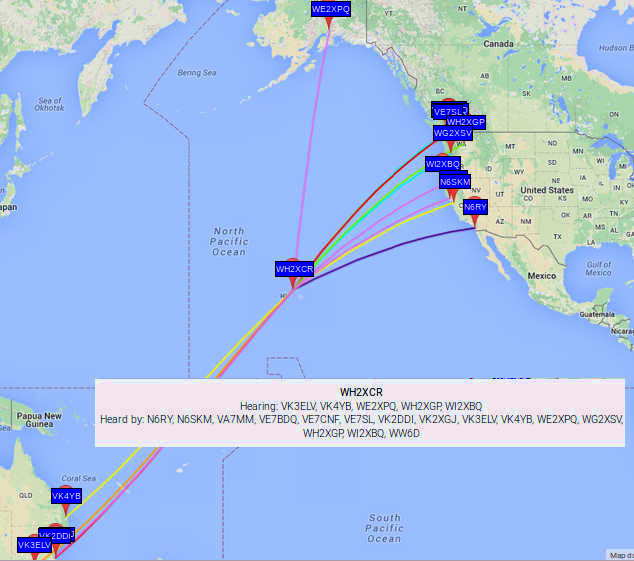 The past few weeks have seen many of the VK 630m WSPR stations making it into North America's west coast and points east. VK2DDI, VK2XGJ, VK3ELV and VK4YB have been the signals most often seen. Particularly dominant is the signal from Roger, VK4YB, the northern-most station, located in Moorina, Queensland, near the Pacific Ocean.
Roger's signal has been decoded locally by myself as well as VE7BDQ and VA7MM, creating excitement over the more normal nightly spots from the central states.
2016-04-13 11:10 VK4YB 0.475646 -28 QG62ku 5 VA7MM CN89og
2016-04-13 11:20 VK4YB 0.475647 -29 QG62ku 5 VA7MM CN89og
2016-04-13 11:28 VK4YB 0.475647 -28 QG62ku 5 VA7MM CN89og
2016-04-13 11:28 VK4YB 0.475644 -23 QG62ku 5 VE7BDQ CN89la
2016-04-13 11:36 VK4YB 0.475644 -26 QG62ku 5 VE7BDQ CN89la
2016-04-13 11:52 VK4YB 0.475643 -25 QG62ku 5 VE7BDQCN89la
2016-04-13 11:56 VK4YB 0.475643 -28 QG62ku 5 VE7BDQ CN89la
2016-04-07 08:54 VK4YB 0.475643 -25 QG62ku 5 VE7SL CN88iu
2016-04-07 09:36 VK4YB 0.475644 -29 QG62ku 5 VE7SL CN88iu
2016-04-07 10:08 VK4YB 0.475644 -29 QG62ku 5 VE7SL CN88iu
2016-04-07 10:18 VK4YB 0.475644 -29 QG62ku 5 VE7SL CN88iu
2016-04-07 11:04 VK4YB 0.475644 -29 QG62ku 5 VE7SL CN88iu
2016-04-13 11:06 VK4YB 0.475644 -24 QG62ku 5 VE7SL CN88iu
2016-04-13 11:10 VK4YB 0.475644 -23 QG62ku 5 VE7SL CN88iu
2016-04-13 11:20 VK4YB 0.475644 -23 QG62ku 5 VE7SL CN88iu
2016-04-13 11:28 VK4YB 0.475644 -28 QG62ku 5 VE7SL CN88iu
2016-04-13 11:32 VK4YB 0.475644 -25 QG62ku 5 VE7SL CN88iu
2016-04-13 11:52 VK4YB 0.475643 -18 QG62ku 5 VE7SL CN88iu
2016-04-13 11:56 VK4YB 0.475643 -22 QG62ku 5 VE7SL CN88iu
2016-04-13 12:16 VK4YB 0.475643 -27 QG62ku 5 VE7SL CN88iu
2016-04-13 12:28 VK4YB 0.475643 -26 QG62ku 5 VE7SL CN88iu
2016-04-13 12:32 VK4YB 0.475643 -25 QG62ku 5 VE7SL CN88iu
2016-04-13 12:54 VK4YB 0.475644 -24 QG62ku 5 VE7SL CN88iu
2016-04-13 12:58 VK4YB 0.475643 -24 QG62ku 5 VE7SL CN88iu
2016-04-13 13:10 VK4YB 0.475643 -25 QG62ku 5 VE7SL CN88iu
2016-04-13 13:24 VK4YB 0.475643 -27 QG62ku 5 VE7SL CN88iu
2016-04-13 13:28 VK4YB 0.475643 -27 QG62ku 5 VE7SL CN88iu
Roger has sent the following information to me regarding his well-planned system:
My QTH is atop of a stony ridge on 10 acres. The previous owner said there was some soil somewhere, but I haven't found it yet! Ground conductivity is very poor, I think. If you drive in two stakes about six inches apart, an ohmmeter says infinity. That's if you can drive in a stake. Because after the first quarter inch you hit shale rock. Interestingly the shale layers are at about 60 degrees to the horizontal. There are some quartz inclusions. Yes, I have tried crushing the quartz and panning it - no gold!
Getting back to my story, I needed to put up a 630m antenna in a hurry. The idea of winding a big loading coil with the rotatable inner coil was a bit daunting. And putting down ground radials or an earth mat was out of the question. So, using only some wire, string and a bow and arrow, this is what I came up with:
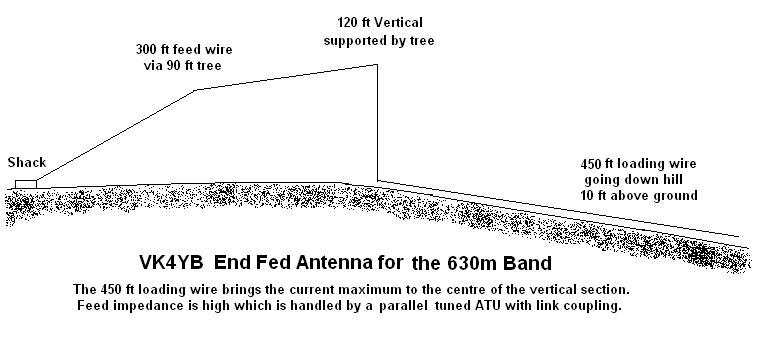
I estimate the feed point impedance is about 3000 ohms. The ATU has 48 turns on the secondary, tuned by fixed capacitors of 960 pF in parallel with a 500 pF variable which is about two thirds meshed. The primary is 5 turns fed by the transverter having a 50 ohm nominal output. The impedance at the top of the secondary should be near 5000 ohms, but the antenna feed wire is tapped about two thirds of the way up the secondary coil, which gives 1.03 : 1 SWR. The earthy end of the coil is connected to the mains earth and the metal work of the shed. I haven't tried terminating the far end. I did think about connecting it to the fence wire that runs round the property but I thought that might be a bit dangerous. There would be high voltage points in places. The transverter output is nominally 50 watts, but it is giving about 90 watts in reality.
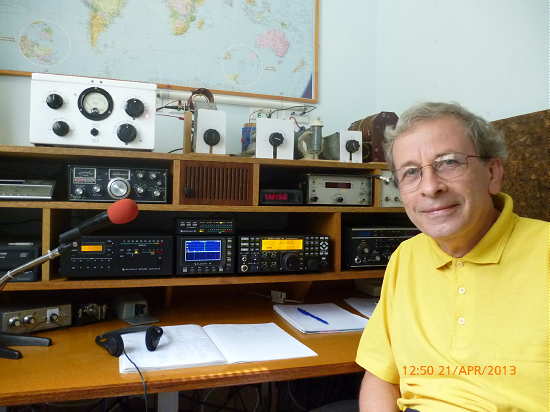 |
| Roger - VK4YB |
Steve McDonald, VE7SL, is a regular contributor to AmateurRadio.com and writes from British Columbia, Canada. Contact him at [email protected].
Bugging Out
Vibroplex Bug QSO
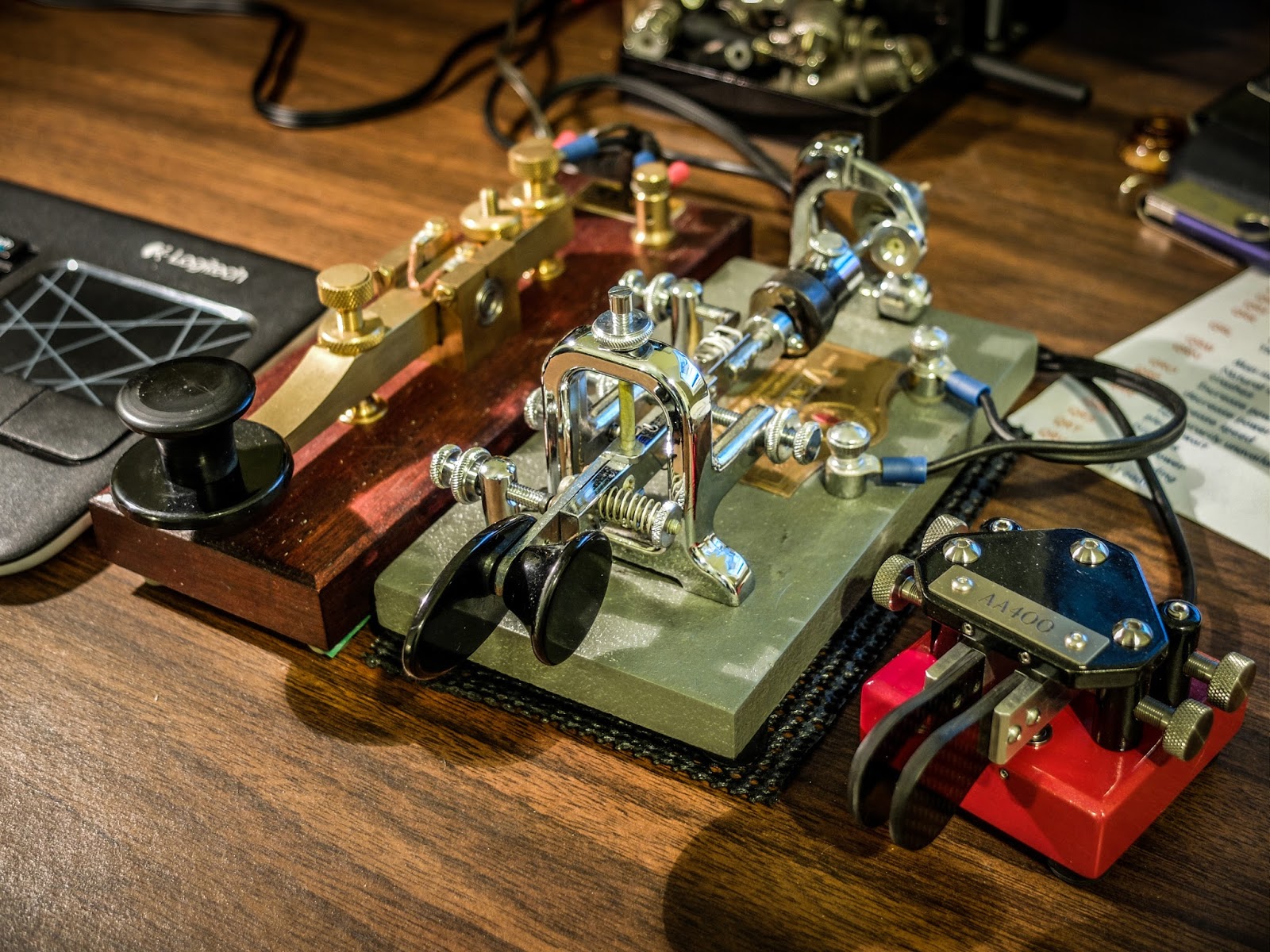 |
| The key lineup with the Bug in the center |
 |
| Ten-Tec Eagle 599 |
The QSO
Richard Carpenter, AA4OO, is a regular contributor to AmateurRadio.com and writes from North Carolina, USA. Contact him at [email protected].
 Ham Radio Deluxe |
 W5SWL Electronics |
 Ham Radio Prep |
 KB3IFH QSL Cards  Hip Ham Shirts  HamRadioAuctions HamRadioAuctions Reliance Antennas Reliance Antennas Enigma Shop Enigma Shop |  morseDX  Ni4L Antennas  R&L Electronics R&L Electronics antennas.us antennas.us QRV QRV |
- Matt W1MST, Managing Editor
