 |
 VE7CNF’s Lightwave Cloubounce / Scatter Tests
 16 May 2016 | by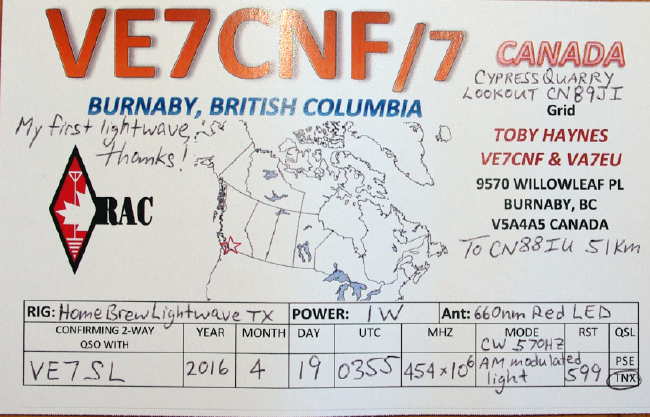
After our recent lightwave CW QSO, described here, Toby (VE7CNF) has been re-focusing on refining his lightwave system for weak signal non-line-of-sight (NLOS) cloudbounce and scatter mode experiments.
His testing to date has been limited to within his own suburban yard, with the transmitter being set up on the south side of the house and the receiver set up on the north, while basically pointing things straight up.
Several tests have already been done with exciting results, including audible CW being returned from a low (5,000') cloud ceiling and weaker returns noted on clear air scatter but readily detected in the CW QRSS mode. Toby has also interfaced his PC audio, via amplifier and FET driver, to enable him to use WSPR and JT9 modes, resulting in positive signal returns using these two digital modes of modulation.
Toby described some of his results and methodology in a recent e-mail updater:
I've done some lightwave backscatter experiments this last week. The transmitter is on my front deck, pointed straight up as verified using a level across the lens end of the box. The receiver is in the back yard and pointed up also. Between the two, the house is about 30ft high and blocks any direct light.
Last night May 8 UTC was clear and I was getting a QRSS10 level signal with the receiver pointed at elevations from 70 to 85 degrees, through the transmitter beam. There was nothing received from straight up, so the clouds were too high for cloud backscatter. At 80 degrees elevation I got the best signal. I've attached an Argo screen grab of QRSS10 (FSK CW with the 570 Hz tone as key-down).
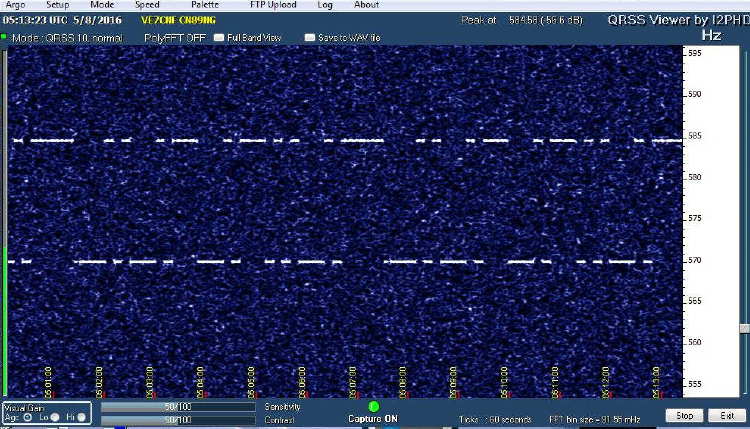 |
| QRSS10 CW clear air scatter return signal |
WSPR2 was decoding consistently and JT9 was about 70%. I tried JT65, BPSK31, and MFSK8 but the SNR was too low for those to work.
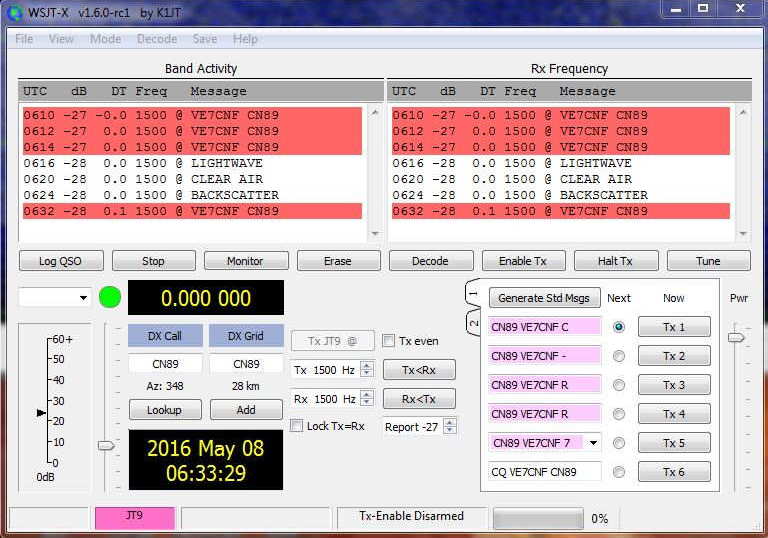 |
| JT9 cloudbounce return signal 14,000 - 24,000 FT |
May 8, 2016 UTC CYVR clouds and temperature/dewpoint data:
0500 FEW CLOUDS (1/8 - 2/8) 14000 FT, SCATTERED CLOUDS (3/8 - 4/8) 24000 FT, 14 C / 11 C
0600 FEW CLOUDS (1/8 - 2/8) 14000 FT, SCATTERED CLOUDS (3/8 - 4/8) 24000 FT, 14 C / 9 C
0700 FEW CLOUDS (1/8 - 2/8) 12000 FT, FEW CLOUDS (1/8 - 2/8) 22000 FT, 13 C / 7 C
... I'll try CW and digital again when there's some lower cloud conditions. That’s tough to get without rain at the same time.
I did get dew on the receiver last night, so I'll be adding heating resistors inside the boxes to keep the lenses warm. Electric heating has worked great to keep dew off the optical surfaces of my telescope. I'll also look at adding shrouds to shield the lenses from the cold sky.
More from May 15th:
I've also attached a screen grab of WSPR2. Signals were up around 0dB this time.
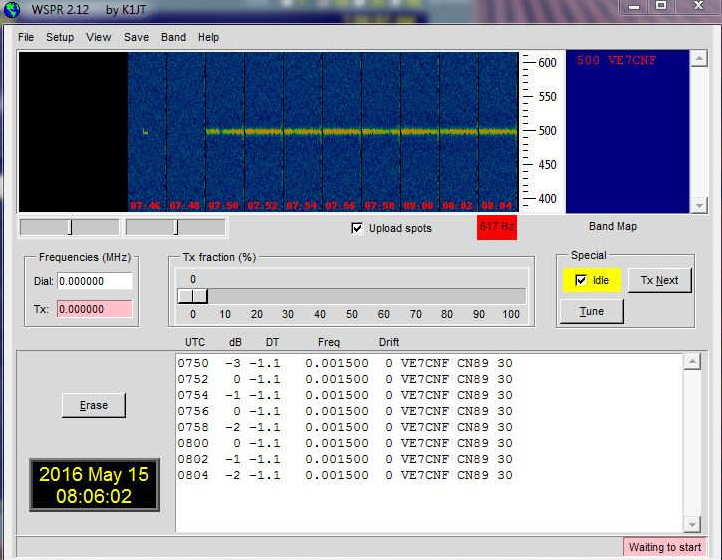 |
| WSPR cloudbounce return signals 1300 - 1900 FT |
I played with a bunch of digital modes and FMHELL and SSTV. Everything was working pretty well off the clouds.
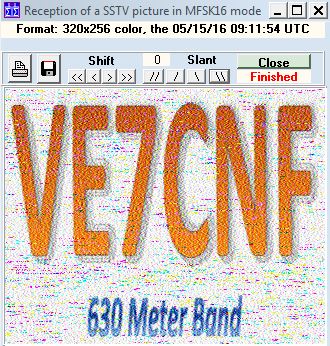 |
| SSTV cloudbounce return signal |
The nextstep is to move the rx farther from home, then to try sending signals over to John or Steve by cloud bounce.
Toby's nearest lightwave neighbour, VA7MM, is in mid-build and is working to complete a system capable of running overnight cloudbounce / scatter tests between their two respective backyards ... the NLOS distance is about 15 km. Although the path includes some bright commercial lighting QRM, with narrow-band modes such as QRSS or WSPR, it may not be a problem. I suspect one of the biggest problems will be getting suitable weather as, here on the west coast, dense clouds usually turn into rain very quickly, especially near the coastal mountains where Toby and Mark are located.
I find Toby's results to be both encouraging and exciting! It will be interesting to try some cloudbounce between their respective stations and my own and maybe hopping the NLOS path across cloudy Georgia Strait. It may well be possible to do this in one of the quicker QRSS CW modes such as QRSS3 or QRSS10, both of which can have fairly fast exchanges of the required information (calls, signal report and final confirmations). Failing that, slower QRSS30 or one of the weak signal digital modes such as JT9 / WSPR which have the ability to dig deep (-30db) into the background noise may be the answer ... there is much to learn yet!
Steve McDonald, VE7SL, is a regular contributor to AmateurRadio.com and writes from British Columbia, Canada. Contact him at [email protected].
Weekly Propagation Summary – 2016 May 16 16:10 UTC
Here is this week’s space weather and geophysical report, issued 2016 May 16 0334 UTC.
Highlights of Solar and Geomagnetic Activity 09 – 15 May 2016
Solar activity was low and only C-class flare activity was observed. Region 2543 (S05, L=002, class/area=Dao/90 on 10 May) produced a C7 flare at 14/1134 UTC which was the largest event of the period. Region 2544 (N21,L=296, class/area=Dao/150 on 15 May) produced five low-level C-class flares on 15 May, the largest being a C1 at 15/0502 UTC. Region 2542 (N12, L=357, class/area=Dai/150 on 09 May) produced a long-duration C3 flare at 15/1603 UTC with an associated filament eruption and partial-halo coronal mass ejection (CME) that departed off of the west limb. Forecaster analysis and WSA/Enlil modelling determined that the CME did not have an Earth-directed component. There were no Earth-directed CMEs during the period.
No proton events were observed at geosynchronous orbit. However, a slight enhancement was observed on 15 May associated with a long-duration C3 flare and filament eruption near Region 2542. A peak flux of 2 pfu was observed on 15 May at 2315 UTC.
The greater than 2 MeV electron flux at geosynchronous orbit was at very high levels from 09-13 May due to the influences of a negative polarity coronal hole high speed stream (CH HSS). High levels were observed on 14 May and moderate levels rounded out the week on 15 May.
Geomagnetic field activity was at unsettled to G3 (Strong) geomagnetic storm levels on 09 May due to the residual effects of a co-rotating interaction region and subsequent negative polarity coronal hole high speed stream (CH HSS). Mainly quiet to unsettled conditions were observed for 10-14 May with a nominal solar wind. A positive polarity CH HSS became connected with Earths magnetic field on 15 May causing quiet to active conditions.
Forecast of Solar and Geomagnetic Activity 16 May – 11 June 2016
Solar activity is expected to be at very low (B-class flares) to low (C-class flares) levels throughout the outlook period.
No proton events are expected at geosynchronous orbit.
The greater than 2 MeV electron flux at geosynchronous orbit is expected to be at high levels on 16-23 May, 30 May-02 Jun, and 06-10 Jun. Moderate flux levels are expected for the remainder of the period.
Geomagnetic field activity is expected to reach G1 (Minor) geomagnetic storm levels on 16, 19-20 May due to the influence of recurrent positive polarity coronal hole high speed streams (CH HSS). G1 (Minor) storm levels are also expected on 29 May and 04-05 June due to the influnce of negative polarity CH HSSs.
Don’t forget to visit our live space weather and radio propagation web site, at: http://SunSpotWatch.com/
Live Aurora mapping is at http://aurora.sunspotwatch.com/
If you are on Twitter, please follow these two users: + https://Twitter.com/NW7US + https://Twitter.com/hfradiospacewx
Get the space weather and radio propagation self-study course, today. Visit http://nw7us.us/swc for the latest sale and for more information!
Check out the stunning view of our Sun in action, as seen during the last five years with the Solar Dynamics Observatory (SDO): https://www.youtube.com/watch?v=zXN-MdoGM9g
We’re on Facebook: http://NW7US.us/swhfr
Visit, subscribe: NW7US Radio Communications and Propagation YouTube Channel
Listen to the music
Comparing CW audio
The Elecraft KX3 and the Ten-Tec Eagle
The radios
Setup
Subjective listening
Richard Carpenter, AA4OO, is a regular contributor to AmateurRadio.com and writes from North Carolina, USA. Contact him at [email protected].
ICQ Podcast Episode 211 – Emergency Comms
In this episode, Martin M1MRB / W9ICQ is joined by ED Durrant DD5LP, Dan Romanchik KB6NU, Chris Howard M0TCH and Martin Rothwell M0SGL to discuss the latest Amateur / Ham Radio news. Colin M6BOY rounds up the news in brief, and this episodes feature is - Emergency Comms
- Young US Ham wins at Science and Engineering Fair
- ARRL Committee Conducting Youth in Amateur RadioSport Survey
- UK Advanced Radio Exam 'on demand'
- Netherlands to Licence Low-Power AM Broadcasters
- RSGB Examination Standards 1st Report
- Hara Arena in Consideration for New Fairgrounds
- UK Air Cadets 5MHz Radio Exercise
- Online Australian Ham Licence Lookup Service
- Robotic Lawn Mower EMC Banned in Sweden
Colin Butler, M6BOY, is the host of the ICQ Podcast, a weekly radio show about Amateur Radio. Contact him at [email protected].
ICQ Podcast Episode 211 – Emergency Comms
In this episode, Martin M1MRB / W9ICQ is joined by ED Durrant DD5LP, Dan Romanchik KB6NU, Chris Howard M0TCH and Martin Rothwell M0SGL to discuss the latest Amateur / Ham Radio news. Colin M6BOY rounds up the news in brief, and this episodes feature is - Emergency Comms
- Young US Ham wins at Science and Engineering Fair
- ARRL Committee Conducting Youth in Amateur RadioSport Survey
- UK Advanced Radio Exam 'on demand'
- Netherlands to Licence Low-Power AM Broadcasters
- RSGB Examination Standards 1st Report
- Hara Arena in Consideration for New Fairgrounds
- UK Air Cadets 5MHz Radio Exercise
- Online Australian Ham Licence Lookup Service
- Robotic Lawn Mower EMC Banned in Sweden
Colin Butler, M6BOY, is the host of the ICQ Podcast, a weekly radio show about Amateur Radio. Contact him at [email protected].
AmateurLogic 90: Everybody’s Talking About Antennas
AmateurLogic.TV Episode 90 is now available for download.
Tommy’s Antenna Hanging. Emile’s Wet Noodle. Peter has a free antenna reference. George builds the Hula Loop.
Plus viewer email and more.
1:02:10
George Thomas, W5JDX, is co-host of AmateurLogic.TV, an original amateur radio video program hosted by George Thomas (W5JDX), Tommy Martin (N5ZNO), Peter Berrett (VK3PB), and Emile Diodene (KE5QKR). Contact him at [email protected].
A New Paddle for a New Extra
 Since my last article was published, I made my fourth attempt to pass the extra exam. I knew I had done better, but was pleasantly surprised when the VEs congratulated me. I’m still trying to believe that since it was only one week ago. Never mind that anyway, it doesn’t really have anything to do with the new CW paddle I made.
Way back when, after I had been on the air for a few months, I decided I’d give CW a shot. I knew I’d need a key or paddle, but didn’t really know where to start. A simple Internet search for CW paddle brought up a very large number of beautiful paddles that nearly made me drool. What prevented the drooling was the price attached to nearly all of those lovely paddles. I wasn’t about to spend that kind of money on something that I didn’t even know I could operate.
My next Internet search included the word “homebrew” to see if it were even possible to make a CW paddle that would work. Much to my amazement, there are hundreds of different designs for homebrew CW paddles. Altoid tins, hacksaw blades, plastic, wood, all wire, metal, you name it, someone had created one. Seeing all of those wonderful homemade paddles, I knew it was possible, but was it possible for me?
Greg Walters, KK4TIX, is a special contributor to AmateurRadio.com and writes from Kentucky, USA.
 Ham Radio Deluxe |
 W5SWL Electronics |
 Ham Radio Prep |
 KB3IFH QSL Cards  Hip Ham Shirts  HamRadioAuctions HamRadioAuctions Reliance Antennas Reliance Antennas Enigma Shop Enigma Shop |  morseDX  Ni4L Antennas  R&L Electronics R&L Electronics antennas.us antennas.us QRV QRV |
- Matt W1MST, Managing Editor
