 |
 Just a reminder
 14 June 2016 | by
 Beginning this year, the Hunt has been moved to the third Sunday in August in order to even out spacing a bit between FOBB, the Skeeter Hunt and the NoGA Peanut Power Classic. Also, there are some rule changes for 2016 in order to more fully incorporate NPOTA into the Skeeter Hunt. Make sure to check them out at www.qsl.net/w2lj.
QRP - When you care to send the very least!
Larry Makoski, W2LJ, is a regular contributor to AmateurRadio.com and writes from New Jersey, USA. Contact him at [email protected].
Just a reminder
Beginning this year, the Hunt has been moved to the third Sunday in August in order to even out spacing a bit between FOBB, the Skeeter Hunt and the NoGA Peanut Power Classic. Also, there are some rule changes for 2016 in order to more fully incorporate NPOTA into the Skeeter Hunt. Make sure to check them out at www.qsl.net/w2lj.
QRP - When you care to send the very least!
Larry Makoski, W2LJ, is a regular contributor to AmateurRadio.com and writes from New Jersey, USA. Contact him at [email protected].
Weekly Propagation Summary – 2016 Jun 13 16:10 UTC
Here is this week’s space weather and geophysical report, issued 2016 Jun 13 0444 UTC.
Highlights of Solar and Geomagnetic Activity 06 – 12 June 2016
Solar activity was at very low levels from 06-08 June and again on 10 June. Low levels were reached on 09 June and again from 11-12 June due to C-class flare activity from Region 2552 (N15, L=359, class/area Dao/150 on 11 June). The largest flare of the period was a C6 at 11/2228 UTC. Region 2552 grew rapidly since its emergence on 07 June to a compact beta-delta magnetic class, but appeared to be in decay by 11 Jun as it neared the NW limb. No Earth-directed coronal mass ejections were observed during the period.
No proton events were observed at geosynchronous orbit.
The greater than 2 MeV electron flux at geosynchronous orbit was at moderate levels on 06 June and again from 11-12 June. High levels were reached from 07-10 June with a peak flux of 1,590 pfu observed at 10/1520 UTC.
Geomagnetic field activity ranged from quiet to G2-Moderate geomagnetic storm levels during the period. The period began with solar wind speeds near 650 km/s and total field values near 7 nT while the Bz component fluctuated between +/- 6 nT under the slowly waning influence of a negative polarity coronal hole high speed stream (CH HSS). As a result, mostly active levels and an isolated G2-Moderate storm period were observed during the first half of the UTC day on 06 June. Solar wind speeds continued to decrease to nominal levels by 10 June. Quiet to unsettled conditions were observed on 07 June with quiet conditions on 08-09 June. By midday on 10 June, a solar sector boundary crossing was observed into a positive (away) sector followed by an increase in total field to 14 nT by late on 10 June. A lesser rise in solar wind speed to near 540 km/s was observed as a positive polarity CH HSS moved into a geoeffective position. Solar wind speeds continued to be elevated in the 450 km/s to 550 km/s range for the rest of the period with total field ranging between 7-10 nT. The geomagnetic field responded with quiet to active periods on 10-11 June and quiet to unsettled levels on 12 June.
Forecast of Solar and Geomagnetic Activity 13 June – 09 July 2016
Solar activity is expected to be at very low to low levels for the forecast period.
No proton events are expected at geosynchronous orbit.
The greater than 2 MeV electron flux at geosynchronous orbit is expected to be at high levels on 17-18 June, 26 June-01 July and 04-07 July in response to CH HSS activity.
The geomagnetic field is expected to be at unsettled to active levels on 13, 15-17, 22-24, 26-27 June and from 02-03, 07-09 July with G1-Minor storming likely on 02-03 July due to recurrent CH HSS activity.
Don’t forget to visit our live space weather and radio propagation web site, at: http://SunSpotWatch.com/
Live Aurora mapping is at http://aurora.sunspotwatch.com/
If you are on Twitter, please follow these two users: + https://Twitter.com/NW7US + https://Twitter.com/hfradiospacewx
Get the space weather and radio propagation self-study course, today. Visit http://nw7us.us/swc for the latest sale and for more information!
Check out the stunning view of our Sun in action, as seen during the last five years with the Solar Dynamics Observatory (SDO): https://www.youtube.com/watch?v=zXN-MdoGM9g
We’re on Facebook: http://NW7US.us/swhfr
Visit, subscribe: NW7US Radio Communications and Propagation YouTube Channel
6m Awakens
 Well Friday morning's planned 2m EME window got pushed to the side when 6m started to show some interesting propagation possibilities. Several Europeans had been working slowly westward, past their usual east coast stopping point. When EA8DBM (Alex) in the Canary Islands reported via the ON4KST 6m chat page that he was hearing a station in Montana, my ears really perked up. At around 10:30 local time, KE7V (Johnny), about 40 miles due south of me in Washington state, was heard working Alex but I could hear nothing from him at all.
 As is often the case between here and KE7V, signals from Europe often move quickly northward and sure enough, about two minutes later, EA8DBM's CW signal appeared at good strength, calling CQ.
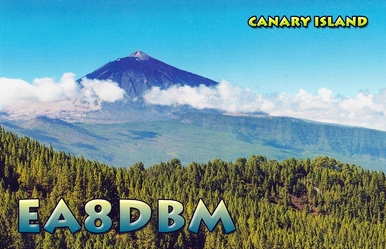
I quickly worked Alex, whose signal stayed around for almost an hour, and then began looking for any others that might be riding along on the same path. Sure enough, his neighbour, EA8TL was heard CQ'ing, but much weaker. After a few calls he came back with my report to which I responded several times, but it was evident that he was having difficulty as he kept repeating my report. Unfortunately, and unlike Alex, he soon faded away without me ever hearing the needed 'RR' for my signal report confirmation.
About an hour later, a rapidly fading and quickly building signal was heard on CW calling CQ at about 25wpm ... it was CN8KD in Rabat, Morocco!
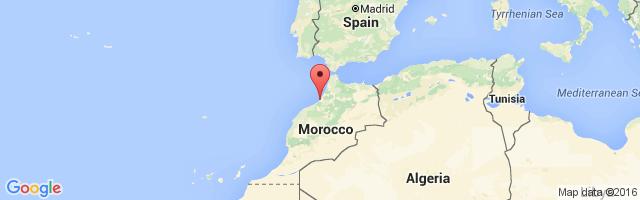 |
| courtesy: https://www.google.ca/maps/ |
I called Mohamed several times as his signal built, but his rapid-fire CQ's continued much to my frustration. As his signal peaked to a solid 569, he sent a '?' and then replied with 'VE6?', probably as shocked as I was. After repeating my call several times, he returned once again but this time with 'VE7NL?'. The next several transmissions from him were the same and as the delicate links between our two stations shifted once again, he was gone as quickly as he'd arrived ... close, but no cigar. This was the first 6m signal that I've ever heard from continental Africa since coming on the band in 1970. I wonder if I will ever hear him again.
With a dead 6m band on Saturday morning, I was able to get back on EME (JT65B mode) for my final day of favorable moonrise windows and had a nice surprise when VE1KG in Nova Scotia answered my first CQ, for initial #81 with my small station ...
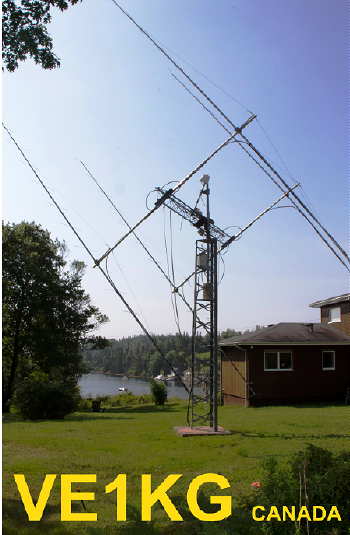
... all-in-all, a pretty fun week on the VHF's!
Steve McDonald, VE7SL, is a regular contributor to AmateurRadio.com and writes from British Columbia, Canada. Contact him at [email protected].
ICQ Podcast Episode 213 – 2016 Q and A
In this episode, Martin M1MRB / W9ICQ is joined by ED Durrant DD5LP, Chris Howard M0TCH, Martin Rothwell M0SGL, and Dan Romanchik KB6NU to discuss the latest Amateur / Ham Radio news. Colin M6BOY rounds up the news in brief, and this episodes feature is - Q and A 2016.
- Pirate Radio in the Digital Age
- 2016 HF Propagation Update
- Northern Ireland Radio Star
- FCC Bans Custom Firmware
- ARRL National Field Day 2016
- Amateur Radio Parity Act Agreement
- Radio Ham Praised for Service to Emergency Planning
- 100 Sprite Satellites to be Deployed
- Yaesu Extend UK Warranties
Colin Butler, M6BOY, is the host of the ICQ Podcast, a weekly radio show about Amateur Radio. Contact him at [email protected].
ICQ Podcast Episode 213 – 2016 Q and A
In this episode, Martin M1MRB / W9ICQ is joined by ED Durrant DD5LP, Chris Howard M0TCH, Martin Rothwell M0SGL, and Dan Romanchik KB6NU to discuss the latest Amateur / Ham Radio news. Colin M6BOY rounds up the news in brief, and this episodes feature is - Q and A 2016.
- Pirate Radio in the Digital Age
- 2016 HF Propagation Update
- Northern Ireland Radio Star
- FCC Bans Custom Firmware
- ARRL National Field Day 2016
- Amateur Radio Parity Act Agreement
- Radio Ham Praised for Service to Emergency Planning
- 100 Sprite Satellites to be Deployed
- Yaesu Extend UK Warranties
Colin Butler, M6BOY, is the host of the ICQ Podcast, a weekly radio show about Amateur Radio. Contact him at [email protected].
Amateur Radio Weekly – Issue 115

ARRL June VHF Contest this weekend
For amateurs in the US and Canada (and their possessions) to work as many amateur stations in as many different 2 degrees x 1 degree Maidenhead grid squares as possible using authorized frequencies above 50 MHz.
ARRL
Hey, which coaxial cable should I use?
We’ll focus on the most popular cables, with 50 ohm impedance to match the output impedance of our transceivers.
Ham Radio School
Is DMR the digital voice winner in Amateur Radio?
It was standing room only at the DMR Forum at Dayton this year.
KB6NU.com
AM: The original speech transmission mode
AM radio has been in slow decline for decades, indeed it’s disappearing completely in some European countries.
Hack A Day
Deceptive Sun
A quick glance at Sunday’s sun reveals a spotless environment, something we will likely be seeing more often in the years to come.
VE7SL
Digital Video Transmission using LimeSDR and GNU Radio
One of the reasons why I find the LimeSDR interesting is that it can transmit high data rates over a wide frequency spectrum. It covers many ham radio bands where we can legally transmit wide signals using high power.
MYRIAD RF
ARES volunteers take part in search for missing plane
Amateur Radio Emergency Service (ARES) volunteers in Kentucky recently joined other volunteer organizations, law enforcement, firefighters, and emergency managers in an effort to locate a missing single-engine private aircraft.
ARRL
Mark’s battle with RFI & EMI
Everyone involved in radio comms will suffer this insane problem at some stage of their hobby career. Interference from cheap and nasty technology destroying listening pleasure!
Delta Alfa
Bouvet… so far away…
Why isn’t the Intrepid DX Group announcing plans to activate Bouvet? It all comes down to money. Lots of money is needed.
N6PSE
Decoding NOAA weather satellite telemetry beacons
The telemetry not only contains data such as the current spacecraft time, day and ID, but also contains scientific data from on-board instruments.
RTL-SDR.com
Wrap it up: Icom sums up Hamvention 2016
Icom America
Video
Amateur Radio Weekly is curated by Cale Mooth K4HCK. Sign up free to receive ham radio's most relevant news, projects, technology and events by e-mail each week at http://www.hamweekly.com.
 Ham Radio Deluxe |
 W5SWL Electronics |
 Ham Radio Prep |
 KB3IFH QSL Cards  Hip Ham Shirts  HamRadioAuctions HamRadioAuctions Reliance Antennas Reliance Antennas Enigma Shop Enigma Shop |  morseDX  Ni4L Antennas  R&L Electronics R&L Electronics antennas.us antennas.us QRV QRV |
- Matt W1MST, Managing Editor
