 |
 FreeCAD 3D design software
 1 June 2016 | by
 Our club has been (slowly) constructing a SatNOGS 3D printed satellite ground station. It uses a bunch of parts that have been designed on a platform called 3D CAD. This is a free (as the name suggests) 3D CAD solids modelling tool. For those not familiar with mechanical design here’s a very quick and simple run through.
 The good old days gave you 2 dimensional CAD packages. One of the most famous was AutoCAD. There have been many releases and it still has a place today (you can even get a free version called Draft Sight).
Perfect for producing 2D drawings in the traditional was. Also ideal for those .dxf files for laser cutting front panels for example. These are simple tools to get your head round but ultimately very powerful. This technology has been used to deliver some pretty complex engineering so don’t underestimate its usefulness
3D CAD design can look like a complex business but as tools develop the proliferation of simple to use applications exist and as expected they use their own language. 2D drawings are no longer the standard and so 3D parametric CAD systems are available from a number of big players like AutoCAD and SolidWorks. They range from very expensive professional packages that have features that only the very keen would need (like finite element analysis, animation and computational fluid dynamics) through to offshoots that are particularly aimed at home users. In amongst these packages are offerings such as FreeCAD and SketchUp which are completely free and very well supported. There is only one preferred standard and that is for the .stl file type although there are key differences between types.
 Solids modelling and Surface modelling. As the names suggest one type produces solid shapes which are determined through sketching a part in 2D then turning that into a 3D part by stretching or revolving it around and axis for instance. These are generally referred to parametric modelling tools and they produce solid shapes. Examples of these types are FreeCAD, AutoCAD inventor and Solidworks. SketchUp on the other hand produces hollow surfaces. An easy analogy is between a dice and a cardboard box. Both are cubes, one is hollow and the other is solid. 3D printers for example need to think in terms of solids. This doesn’t mean you can’t use a surface modelling tool to produce a part, it means there are some additional bits of computer based thinking that needs to be done.
FreeCAD falls squarely into the 3D parametric solids modelling camp (for the purists, yes it does do sheet and mesh work but stay with me on this). It is also nice and simple once you get your head round the basic premise. Sketch something in 2D then pad it to make a solid and perhaps put in a pocket for a bolt hole for example. I have been working my way through a few tutorials on YouTube and can recommend theses…..
Once you get into the workbench idea and the language used it is relatively straightforward producing designs. I think the issues are that the assembly workbench isn’t quite there yet and it isn’t as polished as commercial alternatives, but hey it doesn’t cost thousands.
There are also a number of developing online packages like 123D CAD and Onshape but I haven’t had a look at those in any detail. The premise is still the same. draw a 2D sketch, constrain it with dimensions, symmetry, equality etc and extrude, revolve, pocket to your hearts content. It is a really great step to see such powerful tools available for free.
 It wouldn’t be fair to mention the extremely accessible surface modelling package that is SketchUp. A Once Google product that instead of producing solids models faces and uses clever tricks to make you thinks they are solids. This is a great tool and is good enough for 3D printing parts. Just beware of its limitations and well aware of the huge amount of models available in its warehouse.
Well worth considering for anything from shack layout to 3D parts design.
Hopefully I will get re-antiquated with this new tools as its been a while sine I behaved like a clanky (that is a mechanical engineer to you lot). There are some truly staggeringly clever products available that you only need invest a bit of time in learning.
Alex Hill, G7KSE, is a regular contributor to AmateurRadio.com and writes from Cumbria, UK. Contact him at [email protected].
A Bug in my ICOM ID-31
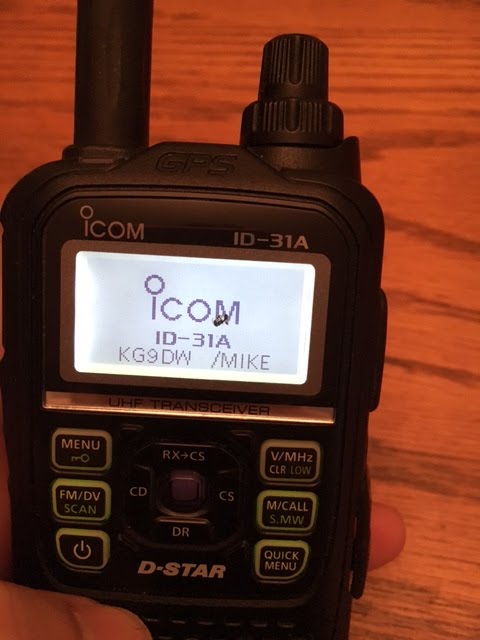
I’ve had my ID-31 for a few years. It has been an excellent handheld for me…a little analog FM and a whole lot of D-Star. But this Spring it developed a bug…not a software bug, an actual bug in the display.
I take the radio along with me around the farm a lot. It seems a pesky ant decided to crawl into the radio and make the display its final resting place. I imagine it crawled in through the speaker holes. I had put up with it for a while, but bugs need to be either outside or connected to a radio (CW bug, hee hee) and not inside a radio.
A screwdriver and some patience and the radio is apart. The bug remains came right out and now my display is clean again. I did break the microSD card that I forgot to remove before popping the case! Doh! Oh well, $5 on Amazon and that problem is solved.
Here’s to a bug free summer of ham radio!
Michael Brown, KG9DW, is a regular contributor to AmateurRadio.com and writes from Illinois, USA. Contact him at [email protected].
A Bug in my ICOM ID-31
I’ve had my ID-31 for a few years. It has been an excellent handheld for me…a little analog FM and a whole lot of D-Star. But this Spring it developed a bug…not a software bug, an actual bug in the display.
I take the radio along with me around the farm a lot. It seems a pesky ant decided to crawl into the radio and make the display its final resting place. I imagine it crawled in through the speaker holes. I had put up with it for a while, but bugs need to be either outside or connected to a radio (CW bug, hee hee) and not inside a radio.
A screwdriver and some patience and the radio is apart. The bug remains came right out and now my display is clean again. I did break the microSD card that I forgot to remove before popping the case! Doh! Oh well, $5 on Amazon and that problem is solved.
Here’s to a bug free summer of ham radio!
Michael Brown, KG9DW, is a regular contributor to AmateurRadio.com and writes from Illinois, USA. Contact him at [email protected].
BM-800 Mic support group opened.
https://www.facebook.com/groups/116507002103281/
Please note this is a Closed group. Anyone can find the group and see who's in it. Only members can see posts.
As well as the the G4IZH modification, it will be interesting hearing your own thoughts and modifications plus any further ideas. Even if you just run a BM-800 into a simple audiomixer please join the group to help others.
73 Steve
Steve, G1KQH, is a regular contributor to AmateurRadio.com and writes from England. Contact him at [email protected].
BM-800 Mic support group opened.
https://www.facebook.com/groups/116507002103281/
Please note this is a Closed group. Anyone can find the group and see who's in it. Only members can see posts.
As well as the the G4IZH modification, it will be interesting hearing your own thoughts and modifications plus any further ideas. Even if you just run a BM-800 into a simple audiomixer please join the group to help others.
73 Steve
Steve, G1KQH, is a regular contributor to AmateurRadio.com and writes from England. Contact him at [email protected].
VE3AB Netty Electronics
 While ordering components for my 630m transverter project, an internet search for some needed FT-37-77 cores brought me to the website run by Earl, VE3AB in NE Ontario.
Purchasing just a small number of parts can usually be expensive, considering the high cost of mailing these days but in this case, the toroids and a few other parts turned into a real bargain. Earl is a retired Defence Department Manager and Technical Specialist and has one of the most colorful and informative sites that I've ever run across. The extensive, somewhat 'eclectic' site, might at first appear to be a bit disorganized but it really all works nicely once you delve a little deeper ... and there are many layers on Earl's site. It really is quite different and one thing that comes through is his passion for doing things the right way!
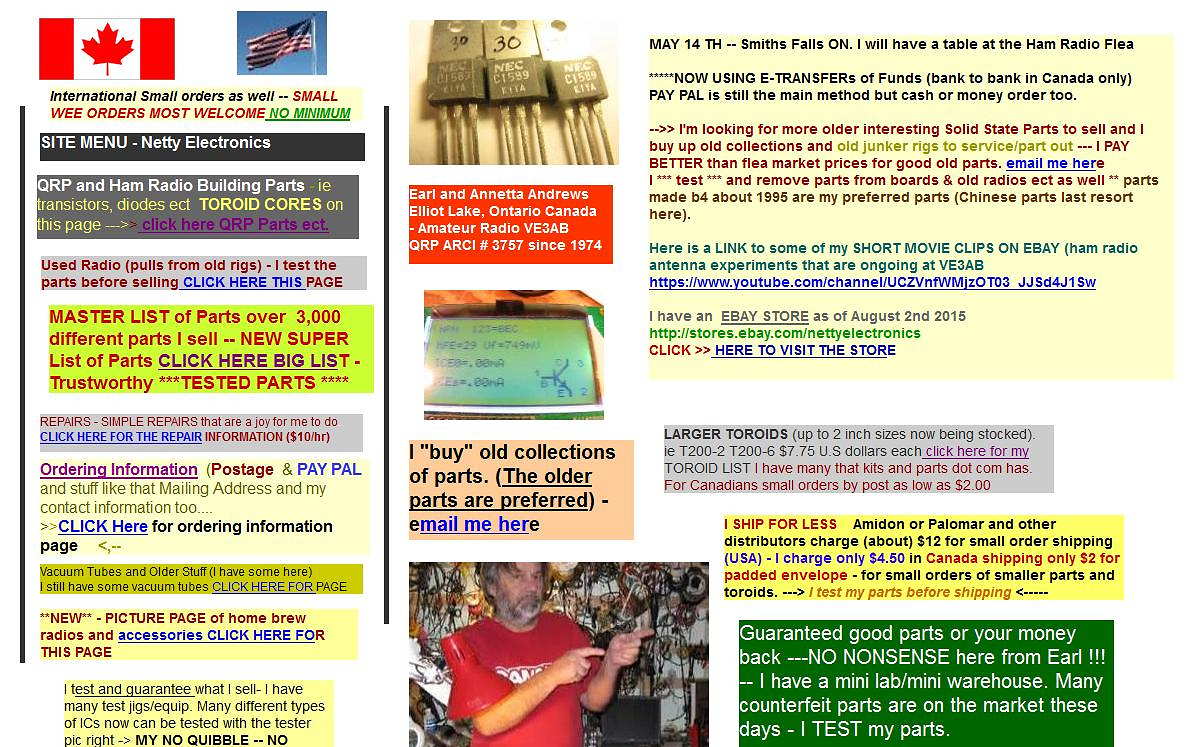
It seems that Earl's two main passions are fishing and supplying quality components at good prices. His dirt-cheap shipping to both Canada and the U.S. is something not often seen any longer, as shipping costs often make small purchases totally uneconomical. Forgive me if this sounds like a blatant plug for Earl's business ... it is not. It's just that I found his site extremely interesting and very different from most ... the fact that he is offering something that many hams might find helpful, is my main motivation.
The introductory 'ham radio' page contains, among other things, a collection of Earl's articles describing repairs on many solid state transceivers while his 'Netty Electronics' page describes his small home-based component selling and acquisition activities. His 'ham electronics magazine' page contains articles on working with circuit boards (re-capping, repairing, de-soldering), antenna articles as well as numerous articles on components, all authored by VE3AB. Earl's website and free services are all financed by personally using monies obtained through sales of parts and part radios as he sees it is a service to the amateur radio hobby, which he obviously loves deeply.
Earl specializes in solid state devices of all description, from vintage to modern. He offers a vast selection of parts for older radios and has information on repairing dozens of older solid state rigs. All parts are tested or guaranteed to be working within specs.

His pages contain extensive information describing his tests of popular Chinese-made transistors, such as this one describing a batch of dual-gate MOSFET BF981 transistors. His 'test' pages are definitely worthy of your attention and, for many, might be a bit of an eye-opener.
If you are looking for a manual for an older rig, Earl has an extensive offering of free manuals on his site. If it's not there, he can probably get it for you.
He is continually buying up collections of older components, as well as new parts ... if you have stuff to unload you might wish to check with him as so many of these valuable parts end up in the trash as shacks go silent. His extensive list of components can be found here. ... you may just find that special part you've been looking for.
One of Earl's goals for the website is to put up a search-engine for his parts but in the meantime, I found my browser's "Find" function worked well in sorting through the large list.
There is enough interesting information on his pages to keep you reading for hours and I find the random nature of much of it rather attractive. Earl says that changes to the site are coming but I hope they're not too drastic ... I kind of like it just the way it is!
Steve McDonald, VE7SL, is a regular contributor to AmateurRadio.com and writes from British Columbia, Canada. Contact him at [email protected].
Buddipole vertical for 80m
I spent the pleasant sunny part of the final day of autumn testing a vertical antenna for 80 metres using Buddipole parts for home.
The back garden space here is barely 4 metres by 4 metres and for the moment the chimney is out of reach. While I have dreams of a magnetic loop for 80m, the vertical is more in reach now.

I installed a counterpoise wire a few feet shy of 66 feet length hidden on a timber fence that runs down the side of the property. The idea is to connect a short fly lead to connect the hidden counterpoise when the antenna is deployed and then disconnect when it’s all packed away. Buddipole components don’t lend themselves to permanent installations. The counterpoise doesn’t follow the recommended dog leg arrangement and is higher off the ground than the 2 feet suggested.
The purpose yesterday was to establish how speedily the antenna could be assembled and adjusted for a frequency of interest such as a net.
Here’s a list of the items used along with the counterpoise:
9′ telescopic whip
2 x 22 inch antenna arms
low band coil + clip
VersaTee
Buddipole short mast
Buddipole tripod
Balun
I was surprised how easily it all went together. The adjustment wasn’t as fiddly as I expected such a short antenna for this band would be, and it appeared to give a usable bandwidth.

Assembly was straightforward. Set up the tripod and mast with only bottom two sections telescoped out. Attach the Versatee horizontally to the top of the mast. Connect the Low Band coil. Leave the red fly lead loose for the moment. Attach two 22 inch antenna arms to a long whip antenna fully extended. Then carefully attach that assembly to the top of the Versatee. I also connected a 1:1 balun between the Versatee and the iP30 SWR Analyser.
The next step is to simply drag the fly lead across the coil turns to identify the best spot to tap the coil. Background noise level rises as you get in the zone. I used the iP30 SWR analyser to narrow it down to a spot 16 turns up from the base of the coil.
This means I was shorting out the bottom 16 turns of the coil. The adjustment is too coarse on a turn by turn basis. You appreciate the value of being able to tap at 1/8 of a turn increments. (The coil is on an octagonal former.)
It took me a few measurements to realise that as I progressed left (from my point of view) I was decreasing the amount shorted out and hence increasing the loading inductance and so lowering the resonant frequency. It’s actually more confusing reading that sentence than understanding it in practice!
My target frequency was 3535kHz and this is a chart of the SWR readings I had when the coil tap was set at what I calculate to be 15 3/4 turns up from the base of the coil.
| frequency | SWR | frequency | SWR |
|---|---|---|---|
| 3505 | 1.8:1 | 3550 | 1.1 |
| 3510 | 1.6 | 3555 | 1.1 |
| 3515 | 1.4 | 3560 | 1.1 |
| 3520 | 1.3 | 3565 | 1.2 |
| 3525 | 1.2 | 3570 | 1.3 |
| 3530 | 1.1 | 3575 | 1.4 |
| 3535 | 1.0 | 3580 | 1.5 |
| 3540 | 1.0 | 3585 | 1.6 |
| 3545 | 1.1 | 3590 | 1.8 |

The 1.0:1 bandwidth was 10 kHz while at 1.5:1 it was in excess of 65 kHz.
From readings at the other possible coil tap points my guess is that at this frequency range each face of the coil moves the resonant frequency by about 4 kHz. One thing to be aware of with the Buddipole hardware is not to accidentally short out adjacent turns of the coil with the coil clip. It’s hard to do but I managed and it will throw your readings.
Next step of course is to make some contacts or at least activate the antenna on WSPR or JT65 to get an idea of whether the signal gets over the fence.
From checking the chart on page 146 of the ‘Buddipole in the Field’ book by B. Scott Andersen, NE1RD, I estimate that my shorting tap at about 16 turns from the base means I’m using about 39-40 uH of loading to achieve resonance at 80m. So that’s a starting point if I wanted to build a more permanent and cheaper vertical installation.
 Ham Radio Deluxe |
 W5SWL Electronics |
 Ham Radio Prep |
 KB3IFH QSL Cards  Hip Ham Shirts  HamRadioAuctions HamRadioAuctions Reliance Antennas Reliance Antennas Enigma Shop Enigma Shop |  morseDX  Ni4L Antennas  R&L Electronics R&L Electronics antennas.us antennas.us QRV QRV |
- Matt W1MST, Managing Editor
