 |
 6m Awakens
 13 June 2016 | by
  Well Friday morning's planned 2m EME window got pushed to the side when 6m started to show some interesting propagation possibilities. Several Europeans had been working slowly westward, past their usual east coast stopping point. When EA8DBM (Alex) in the Canary Islands reported via the ON4KST 6m chat page that he was hearing a station in Montana, my ears really perked up. At around 10:30 local time, KE7V (Johnny), about 40 miles due south of me in Washington state, was heard working Alex but I could hear nothing from him at all.
 As is often the case between here and KE7V, signals from Europe often move quickly northward and sure enough, about two minutes later, EA8DBM's CW signal appeared at good strength, calling CQ.
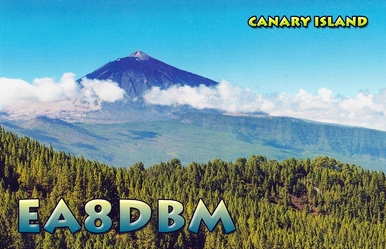
I quickly worked Alex, whose signal stayed around for almost an hour, and then began looking for any others that might be riding along on the same path. Sure enough, his neighbour, EA8TL was heard CQ'ing, but much weaker. After a few calls he came back with my report to which I responded several times, but it was evident that he was having difficulty as he kept repeating my report. Unfortunately, and unlike Alex, he soon faded away without me ever hearing the needed 'RR' for my signal report confirmation.
About an hour later, a rapidly fading and quickly building signal was heard on CW calling CQ at about 25wpm ... it was CN8KD in Rabat, Morocco!
 |
| courtesy: https://www.google.ca/maps/ |
I called Mohamed several times as his signal built, but his rapid-fire CQ's continued much to my frustration. As his signal peaked to a solid 569, he sent a '?' and then replied with 'VE6?', probably as shocked as I was. After repeating my call several times, he returned once again but this time with 'VE7NL?'. The next several transmissions from him were the same and as the delicate links between our two stations shifted once again, he was gone as quickly as he'd arrived ... close, but no cigar. This was the first 6m signal that I've ever heard from continental Africa since coming on the band in 1970. I wonder if I will ever hear him again.
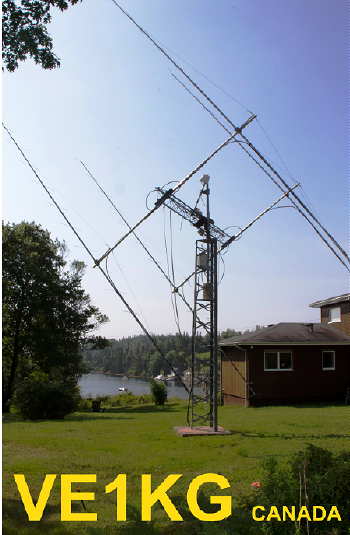
With a dead 6m band on Saturday morning, I was able to get back on EME (JT65B mode) for my final day of favorable moonrise windows and had a nice surprise when VE1KG in Nova Scotia answered my first CQ, for initial #81 with my small station ...
... all-in-all, a pretty fun week on the VHF's!
Steve McDonald, VE7SL, is a regular contributor to AmateurRadio.com and writes from British Columbia, Canada. Contact him at [email protected].
ICQ Podcast Episode 213 – 2016 Q and A
In this episode, Martin M1MRB / W9ICQ is joined by ED Durrant DD5LP, Chris Howard M0TCH, Martin Rothwell M0SGL, and Dan Romanchik KB6NU to discuss the latest Amateur / Ham Radio news. Colin M6BOY rounds up the news in brief, and this episodes feature is - Q and A 2016.
- Pirate Radio in the Digital Age
- 2016 HF Propagation Update
- Northern Ireland Radio Star
- FCC Bans Custom Firmware
- ARRL National Field Day 2016
- Amateur Radio Parity Act Agreement
- Radio Ham Praised for Service to Emergency Planning
- 100 Sprite Satellites to be Deployed
- Yaesu Extend UK Warranties
Colin Butler, M6BOY, is the host of the ICQ Podcast, a weekly radio show about Amateur Radio. Contact him at [email protected].
ICQ Podcast Episode 213 – 2016 Q and A
In this episode, Martin M1MRB / W9ICQ is joined by ED Durrant DD5LP, Chris Howard M0TCH, Martin Rothwell M0SGL, and Dan Romanchik KB6NU to discuss the latest Amateur / Ham Radio news. Colin M6BOY rounds up the news in brief, and this episodes feature is - Q and A 2016.
- Pirate Radio in the Digital Age
- 2016 HF Propagation Update
- Northern Ireland Radio Star
- FCC Bans Custom Firmware
- ARRL National Field Day 2016
- Amateur Radio Parity Act Agreement
- Radio Ham Praised for Service to Emergency Planning
- 100 Sprite Satellites to be Deployed
- Yaesu Extend UK Warranties
Colin Butler, M6BOY, is the host of the ICQ Podcast, a weekly radio show about Amateur Radio. Contact him at [email protected].
Amateur Radio Weekly – Issue 115

ARRL June VHF Contest this weekend
For amateurs in the US and Canada (and their possessions) to work as many amateur stations in as many different 2 degrees x 1 degree Maidenhead grid squares as possible using authorized frequencies above 50 MHz.
ARRL
Hey, which coaxial cable should I use?
We’ll focus on the most popular cables, with 50 ohm impedance to match the output impedance of our transceivers.
Ham Radio School
Is DMR the digital voice winner in Amateur Radio?
It was standing room only at the DMR Forum at Dayton this year.
KB6NU.com
AM: The original speech transmission mode
AM radio has been in slow decline for decades, indeed it’s disappearing completely in some European countries.
Hack A Day
Deceptive Sun
A quick glance at Sunday’s sun reveals a spotless environment, something we will likely be seeing more often in the years to come.
VE7SL
Digital Video Transmission using LimeSDR and GNU Radio
One of the reasons why I find the LimeSDR interesting is that it can transmit high data rates over a wide frequency spectrum. It covers many ham radio bands where we can legally transmit wide signals using high power.
MYRIAD RF
ARES volunteers take part in search for missing plane
Amateur Radio Emergency Service (ARES) volunteers in Kentucky recently joined other volunteer organizations, law enforcement, firefighters, and emergency managers in an effort to locate a missing single-engine private aircraft.
ARRL
Mark’s battle with RFI & EMI
Everyone involved in radio comms will suffer this insane problem at some stage of their hobby career. Interference from cheap and nasty technology destroying listening pleasure!
Delta Alfa
Bouvet… so far away…
Why isn’t the Intrepid DX Group announcing plans to activate Bouvet? It all comes down to money. Lots of money is needed.
N6PSE
Decoding NOAA weather satellite telemetry beacons
The telemetry not only contains data such as the current spacecraft time, day and ID, but also contains scientific data from on-board instruments.
RTL-SDR.com
Wrap it up: Icom sums up Hamvention 2016
Icom America
Video
Amateur Radio Weekly is curated by Cale Mooth K4HCK. Sign up free to receive ham radio's most relevant news, projects, technology and events by e-mail each week at http://www.hamweekly.com.
June’s EME Moonrise Window

With the QSL's from spring's EME activity gradually showing up in the mail, June's EME moonrise action should keep the postman busy next month as well.
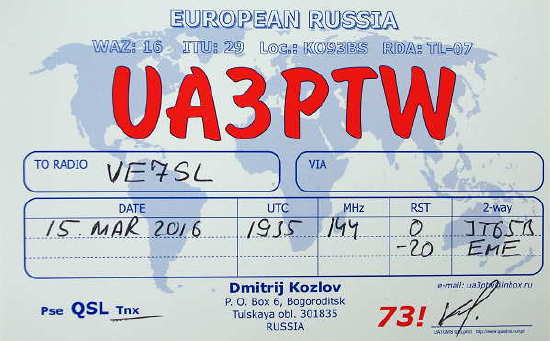 |
| Dmitrij - UA3PTW - Initial #60 |
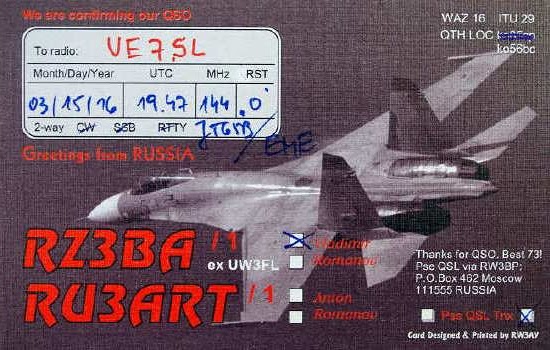 |
| Vlad - RZ3BA/1 - Initial #61 |
 |
| Oleg, UX5UL - Initial #72 |
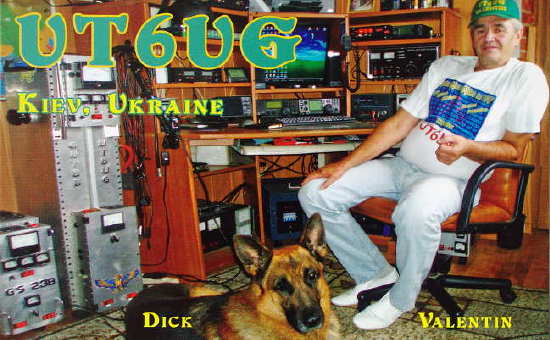 |
| Val - UT6UG - Initial #73 ...both Oleg & Val are in the same city |
 |
| Jorg - DK3WG - Initial #74 |
 |
| Bernie - ZS4TX - Initial #75 |
I have about five days of favorable moonrises directly over the ocean in front of my antenna (9el m2 Yagi), and a couple of hours each day before the moon gets too high for my antenna as it lacks any elevation control. After five days the moonrises usually move too far to the south and I am pointing into too many RF-absorbing Douglas Firs on my neighbor's property.
I started on Tuesday morning, which according the EME data graph shown below, should have been the best of the week since the moon was as close as it would get and the skynoise was low but unexpectedly, no signals at all were heard!
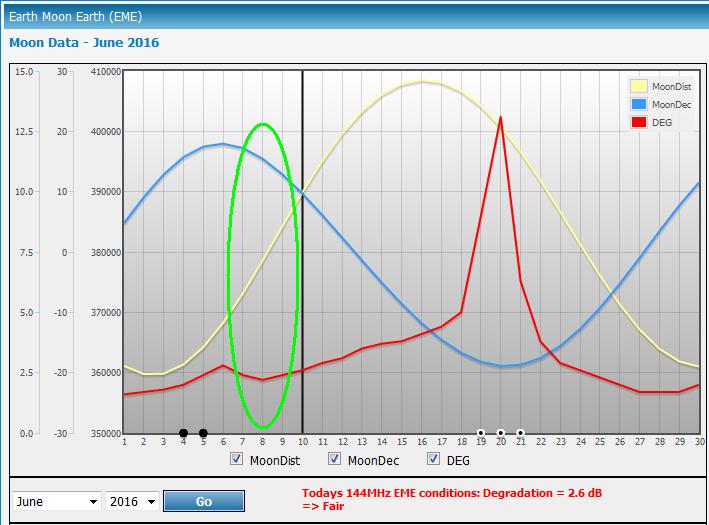 |
| courtesy: http://www.mmmonvhf.de/eme.php |
On Wednesday, things should not have been as favorable since the moon was another 5000 miles further away, but the magic of radio did not disappoint ... my first CQ, with the moon barely 1 degree high, brought something that has never occurred here before ... three replies!
I soon completed three new initials with my QRP (140 watts) station ... RW1AY (# 76 ), DK3BU (#77 ) and DK5SO (#78 ). I have no idea why Tuesday was so poor or why Wednesday was so good, but I'll take it.
Today's conditions were also good again, with my first CQ being answered by N2CV in Florida, for #79.
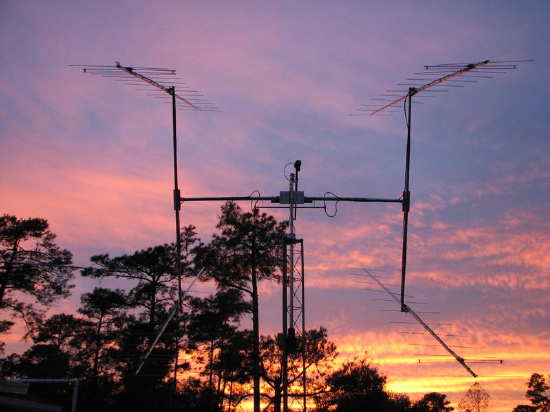 |
| Barry - NC2V - Initial #79 4 x 20 el array |
About an hour later, the strong CQ of YU7AA was heard who responded to my first call. After that his signal faded for some time and eventually returned to speaker quality level and the contact was completed for #80 ... I keep wondering if or when I'll run out of stations large enough to work.
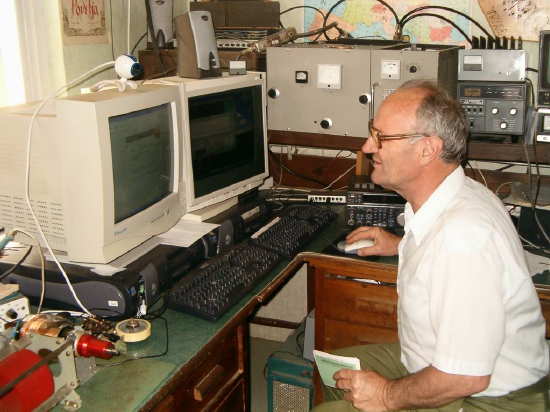 |
| Jozef - YU7AA - Initial #80 |
Who knows what tomorrow will bring, but as the moon climbs further away and rises further to the south, working anyone will be a nice surprise. I've usually avoided summer EME work, as often the best moonrises are very close to the sunrise, making it difficult for bigger stations to hear me when pointing near the sun. After June's good luck, it seems that summers might require more attention ... the next few months might be more interesting than I had thought.
Steve McDonald, VE7SL, is a regular contributor to AmateurRadio.com and writes from British Columbia, Canada. Contact him at [email protected].
2016 Ham Nation Forum at Dayton
This is the full length video of the 2016 Dayton Hamvention, Ham Nation forum.
George Thomas, W5JDX, is co-host of AmateurLogic.TV, an original amateur radio video program hosted by George Thomas (W5JDX), Tommy Martin (N5ZNO), Peter Berrett (VK3PB), and Emile Diodene (KE5QKR). Contact him at [email protected].
80 Meters Was out of Reach…
 I have a pal who lives a stone’s throw away from me. He kept telling me about a group that he chatted with most nights on 80 meters. The closest I could get was 40 meters with my multiband inverted vee. I could hear those guys clear as anything, all 300 miles away. Try as I might, my 40, which tuned for 80 just couldn’t make the trip with my barefoot 100 watts.
It took me a while to figure out how to get such a long antenna in my rented back yard. I did a lot of measuring and drawing in Autocad to make absolutely sure I could put this up back there. When I was finally convinced, I told my pal Lloyd, that I was going to do it. I told him I’d get it as soon as I ordered and received some more wire. Being the great guy he is, he told me he had wire for me to just come and get it. I was more than appreciative.
Wire in hand, I knew I’d need a balun to bring it in from my 450 ohm line that I would use from the feed point to near my window. I ventured onto the Internet and found an outdoor electronic project box. It was about 3.5×5. Perfect for the toroids I had already purchased. Parts in hand, I began work.
Greg Walters, KK4TIX, is a special contributor to AmateurRadio.com and writes from Kentucky, USA.
 Ham Radio Deluxe |
 W5SWL Electronics |
 Ham Radio Prep |
 KB3IFH QSL Cards  Hip Ham Shirts  HamRadioAuctions HamRadioAuctions Reliance Antennas Reliance Antennas Enigma Shop Enigma Shop |  morseDX  Ni4L Antennas  R&L Electronics R&L Electronics antennas.us antennas.us QRV QRV |
- Matt W1MST, Managing Editor
