 |
 100mW’s of raw power!!
 20 August 2016 | by
Mike Weir, VE9KK, is a regular contributor to AmateurRadio.com and writes from New Brunswick, Canada. Contact him at [email protected].
100mW
Mike Weir, VE9KK, is a regular contributor to AmateurRadio.com and writes from New Brunswick, Canada. Contact him at [email protected].
Review – BTech UV-5X3 TriBand Handheld
 UV-5X3
Although the case design is familiar, the radio inside is not. BTech has recently introduced the new UV-5X3 to the US Ham Radio market. This radio is a true triband transceiver with internal filters specifically configured for triband operation.The firmware in this radio has been reworked to include several new features not found in similar appearing radios.
.
In the Box
Included with the radio are the:
– 1500mAh Li-Ion Battery **
– 85 page User Guide – English
– Charger base & AC adapter
– Hand strap
– Belt clip
– PTT Earpiece / Microphone
– Antenna (1) – VHF / UHF 6 3/4″ (17cm) A-V85
– Antenna (2) – 220 MHz 6 1/4″ (15.5cm)
.
** This is the identical battery that is commonly mislabeled as 1800mAh on some handhelds.
The UV-5X3 was specifically designed as a Tri-Band transceiver. The internal filtering allows not only the traditional VHF and UHF frequencies, but also includes the 222-225 MHz Ham band for the US.
 Case Design
The UV-5X3 has the traditional case design, which allows me to use my high capacity BL-5L 3800mAh battery with no alteration to the base. Accessories such as my mobile battery eliminator, Spkr/Micr, etc. are fully compatible.
.
Transmitter
The frequency range is VHF 130-176 / 222-225 / UHF 400-480 MHz, supporting both Wide and Narrowband with 2.5kHz steps.The radio’s filtering scheme allows for full power on all bands. My OTA audio reports have been clean with clear with mellow audio. Power levels are respectable using a Bird VHF/UHF Termaline.
|
DTMF / IRLP Access
Something new also appearing on this model is a DTMF gain adjustment, allowing me to adjust the DTMF audio to the transmitter to a comfortable level for both repeater control and IRLP access.
If you are in a area that requires tone burst for repeater or network access, the 1000Hz, 1450Hz, 1750Hz, and 2000Hz burst are accessible by pressing the PTT along with one of the four pre-assigned keypad keys.
The receiver sensitivity is excellent, and the audio quality is clear, loud, and undistorted. Along with the 3 TX/RX bands, the receiver also includes the traditional commercial FM radio band. (65MHz-108MHz)
.
Tone Scanning – The receiver also has the ability to identify the tone of a repeater being transmitted by a received signal.
This feature gives me the ability to add / delete channels from the scanning list using the keypad. No longer a software only function. The more I can do from the keypad, the better I like it.
A Long Press of the [*SCN] button will start the scanning process.Channel Mode – When scanning with the Display Sync set to ON, the upper and lower display will scan together. This is explained below under Display Synchronization.Frequency Mode – When entering Scan, the image below will appear on the screen. Enter the first 3 digits set the range start, the second 3 digits sets the stop.
Example: Entering 146 : 146
Start the scan range at 146.000
Ends the scan range at 146.999
 Antenna
I found two antennas included with the radio. One was the standard upgraded A-V85 antenna, and a slightly shorter one for the 220MHz band.
Antenna (1) – VHF / UHF 6 3/4″ (17cm) A-V85
Antenna (2) – 220 MHz 6 1/4″ (15.5cm)
The separate antenna specifically tuned for 220 MHz is a great addition. The SWR shows 1.3 which is excellent. No compromise. I labeled my 220 antenna, as they are very close in appearance.
 .
.Display
The radio has a tri-color display, allowing the color options of the blue, orange and purple. The LCD can be formatted in either of three formats. Choices are Frequency, Channel number, or up to 6 Alpha Characters.Display Synchronization
The UV-5X3 supports display syncing, which gives ability to track both the upper and lower LCD. I keep mine set to display the channel name in display A, and the frequency in display B. When you change the channel, both the upper and lower displays move together.
 .
.Programming
Manual programming is pretty straight forward once you enter a few channels. A programming guide can be found at Manual Programming with a Menu Definition summary available at Menu Definitions.
The software support for the UV-5X3 can be found in the Latest Daily Build of CHIRP. There are a few new options that will be added to the 5X3 in the near future. One is the ability to Stun, Kill, Revive. This gives you the ability to disable your radio remotely.
The new chipset (RDA1846S and RDA5802N) provides reduced AGC switching noise and a low-IF digital audio processor for improved sound quality.
The programming cable requires a traditional two pin Baofeng / Kenwood style. There are several cable available. The generic cables may require special drivers, due to the use of cloned chips. For Plug and Play, a cable using an FTDI chip is recommended.
 Conclusion
The UV-5X3 firmware has obviously been reworked to include:
– Tri-Band Support: VHF/1.25M/UHF
– D-ANI (Display incoming DTMF Tones)
– Synchronized Displays
– DTMF audio gain level adjustment
– Add / Remove Channels from Scanning list via keypad (LCD Dot Indication)
– On the Fly scanning by Frequency Range
– 4 Tone Burst options
– Remote Stun, Kill, Revive


Hans, PD0AC, is a regular contributor to AmateurRadio.com and writes from Almere, The Netherlands. Contact him at [email protected].
JT65 Bringing New Activity To 50MHz
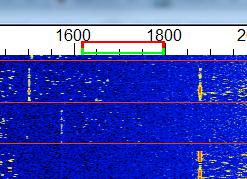 |
| JT65 Waterfall |
As mentioned in previous blogs, this summer's Es season on 50MHz has seen a huge increase in the number of stations using the weak-signal JT65 mode.
Although this mode has been around for a few years, for some reason, it really took off this season. I witnessed many long-time, 'CW-forever' operators (myself included), gingerly move up the band to see what this mode could offer.
At first I thought the activity I was seeing was probably mostly from magic-band regulars, who like me, were also curious ... but I now think this is not the case.
Normally, my 6m summertime Es activities result in just one or two stations requesting a QSL to confirm the contact. These are usually guys that either need a VE7 card or are looking to confirm my grid-square ... just a few cards arrive, in spite of many dozens of contacts over the summer months. This summer I noticed a much different pattern.
This summer saw a tenfold increase in the number of QSL requests and every single one was for a JT65 or JT9 digital mode contact! It soon became apparent that these were not 6m diehards that had just moved up the band, but rather, very enthusiastic newcomers to the band ... what an exciting thing to see! Many of the cards did not have any grid-square information ... the telltale sign of all VHF operators. They had discovered the magicband, using JT65.
Perhaps these were mostly 'no-code' amateurs or those living in antenna-challenged situations such as condos or apartments. Whatever the reason, it really is interesting to see such a profound change in 6m operating tactics, by both the veteran ops and by the newcomers ... all happening so quickly. Hopefully some of the new arrivals will venture down the band to try CW or SSB where contacts can be made much more quickly than on the digital modes but all of this new activity is wonderful to see.
Steve McDonald, VE7SL, is a regular contributor to AmateurRadio.com and writes from British Columbia, Canada. Contact him at [email protected].
Weekly Propagation Summary – 2016 Aug 15 16:10 UTC
Here is this week’s space weather and geophysical report, issued 2016 Aug 15 0115 UTC.
Highlights of Solar and Geomagnetic Activity 08 – 14 August 2016
Solar activity was at very low to low levels with C-class activity observed on 08, 09, 11 and 14 Aug. Region 2574 (N05, L=173, class/area Dho/290 on 09 Aug) was the most active region recording six C-class flares. The largest of these was a C8/Sf observed at 09/0042 UTC. Regions 2571 (N13, L=268, class/area Dac/200 on 08 Aug) and 2572 (N13, L=320, class/area Dao/110 on 07 Aug) each produced weak C-class flares on 08 Aug. The period ended with a C1 flare observed at 14/1936 UTC from an unnumbered region on the NE limb. A few CMEs were observed during the period, but none had an Earth-directed component.
No proton events were observed at geosynchronous orbit.
The greater than 2 MeV electron flux at geosynchronous orbit was at high levels throughout the summary period. A maximum of 12,032 pfu was observed at 13/1745 UTC.
Geomagnetic field activity was at quiet to active levels on 08 Aug through early on 12 Aug due to effects from a positive polarity CH HSS. Quiet levels were observed for the remainder of the period. Solar wind speeds reached a maximum speed of about 675 km/s at 10/0830 UTC. Bt ranged between 3-8 nT while the Bz component varied between +7 to -5 nT early in the period. The phi angle was in a predominately positive sector throughout the period.
Forecast of Solar and Geomagnetic Activity 15 August – 10 September 2016
Solar activity is expected to be very low with a chance for C-class activity through the outlook period.
No proton events are expected at geosynchronous orbit.
The greater than 2 MeV electron flux at geosynchronous orbit is expected to be at high levels on 15, 19-23, 26-28, 31 Aug and 01-10 Sep. Normal to moderate levels are expected for the remainder of the outlook period.
Geomagnetic field activity is expected to be at G1 (Minor) storm levels on 16 and 30-31 Aug due to recurrent CH HSS activity. Unsettled to active levels are expected on 15, 17-19, 24-25 Aug and 01-08 Sep, all due to recurrent CH HSS activity. Mostly quiet conditions are expected for the remainder of the outlook period.
Don’t forget to visit our live space weather and radio propagation web site, at: http://SunSpotWatch.com/
Live Aurora mapping is at http://aurora.sunspotwatch.com/
If you are on Twitter, please follow these two users: + https://Twitter.com/NW7US + https://Twitter.com/hfradiospacewx
Get the space weather and radio propagation self-study course, today. Visit http://nw7us.us/swc for the latest sale and for more information!
Check out the stunning view of our Sun in action, as seen during the last five years with the Solar Dynamics Observatory (SDO): https://www.youtube.com/watch?v=zXN-MdoGM9g
We’re on Facebook: http://NW7US.us/swhfr
Visit, subscribe: NW7US Radio Communications and Propagation YouTube Channel
AmateurLogic 94: Plain Brown Wrapper
AmateurLogic.TV Episode 94 is now available for download.
In this extra long episode Peter adds a display to his Arduino Uno. Emile visits the W5SLA hamfest. George explains how a triode tube amplifier works.
Our friend from the ‘Great White North’, Mike Morneau, VE3MIC demonstrates the Universal Digital Repeater Controller operating D-Star on a competing format repeater.
We unwrap a ‘Mystery Package’ that arrived from a foreign country. George and Tommy sample fine Canadian cuisine and Marmite for the first time. Which wins the title of most awful taste ever, Marmite or Vegemite?
Plus plenty of the usual fun and some great viewer photos.
1:55:40
George Thomas, W5JDX, is co-host of AmateurLogic.TV, an original amateur radio video program hosted by George Thomas (W5JDX), Tommy Martin (N5ZNO), Peter Berrett (VK3PB), and Emile Diodene (KE5QKR). Contact him at [email protected].
Lithuania from the Beach
Judy and I went to the beach today. It was 93F. We walked along the shore, rode our bikes, and I worked a little DX.

After walking a mile or so along the beach, Judy took a swim and lay down for some sun, and I set up the KX3 on a bench overlooking Rye Harbor. Above the rocky shore wild roses decorated the entire area. I set up a 33 foot collapsible DK9SQ mast, which I happened to have in the camper. I used a cord to hold it to the back of the bench.

The wire is running alongside the pole. The yellow string you see coming out the side is just a line attached to the wire. I usually use it to toss over a tree branch. I didn’t bother to disconnect it.
I tuned up on 20 meters and made my first contact with John W5LNI in Arkansas. He gave me a 559 and he was 599 with 300 watts and a log periodic antenna. “UR 8 watts doing FB here,” he sent. I was really happy to make a contact with the poor band conditions.

Next I heard another station in Arkansas calling CQ. Darron KG5ABL answered and we exchanged quick 599s. He said he was having trouble with QSB and we signed.
Up the band a little, Remi LY8O in Lithuania was very strong. I answered his CQ and he gave me a 559. What a thrill to work Europe from the beach. Thanks for the nice QSO, Remi.
After packing up, we rode our bikes along the coast for a couple of miles. What a glorious day!
Jim Cluett, W1PID, is a regular contributor to AmateurRadio.com and writes from New Hampshire, USA. Contact him at [email protected].
 Ham Radio Deluxe |
 W5SWL Electronics |
 Ham Radio Prep |
 KB3IFH QSL Cards  Hip Ham Shirts  HamRadioAuctions HamRadioAuctions Reliance Antennas Reliance Antennas Enigma Shop Enigma Shop |  morseDX  Ni4L Antennas  R&L Electronics R&L Electronics antennas.us antennas.us QRV QRV |
- Matt W1MST, Managing Editor
