 |
 Antenna tuning by stealth
 4 August 2016 | by
 One of the most important documents for anyone who wants to know what makes a magnetic loop tick is Leigh Turner VK5KLT’s “An Overview of the Underestimated Magnetic Loop HF Antenna” which can be found on his club website.
Midway through building my version of Loftur Jónasson – TF3LJ / VE2LJX‘s Automatic Loop Controller, I came across Leigh Turner’s impassioned plea to consider this noise bridge antenna tuning design mentioned on page 32 of the “Overview”. As a concluding note VK5KLT states that he considers “The perceived need for a slick and salubrious auto-controller for properly tuning an MLA is oftentimes overrated and exaggerated, IMHO”.
He argued that elaborate microcontroller aided automatic loop tuning circuits are unnecessary and people should consider using this more covert and considerate approach. I think the bridge could be an excellent idea and a simpler way of staying in tune as you change frequency for all sorts of antennas. For a magnetic loop, it still requires a way to remotely adjust the tuning capacitor.
“The circuit goes inline between the rig and the antenna and sends a gated broadband noise signal to the antenna using a directional coupler and a noise bridge. You just listen on the desired operating frequency and watch your RX S-meter for a sharp dip whilst adjusting the loop tuning capacitor.
You simply remotely tune the loop with the aid of the receiver S-meter while you are on the wanted frequency without keying up and TX power output. This makes tuning a breeze without having to move off frequency and have the TX put out any RF power.”
VK5KLT mentioned the MFJ-212 Matchmaker that uses this same approach (and which is still on the MFJ catalog at US$99.95) and also referenced ZL3KB’s April 2001 RadCom article (pp17-21) as an easy and more economical way to replicate the same functionality.
“The distinguishing merit of the novel gated coupler/noise bridge loop tuning method is it’s completely passive and covert in operation; you don’t transmit any TX power whatsoever to attain an optimal loop tune setting. The technique makes for fast, QRM free, safe and easy QSY shifts and netting a frequency.” Leigh Turner adds that it’s even simpler if you use a pan adaptor or a modern SDR receiver as you can see the sharp null on the screen of the band scope display.
Kelvin Barnsdale ZL3KB’s RadCom article describes building and using the wide band noise bridge as a silent antenna tuning indicator. These four pages include circuit, PCB design and layout and full details of BOM and balun/transformer construction.
On 14 May 2001 ZL3KB published a 4-page follow-up pdf document “Instructions for Antenna tuning Noise Bridge” with info supplementary to the RadCom article about construction and operation. This article has an updated circuit and parts layout and refers to an issue B of the PCB. The new board includes places for the LED and dropping resistor R14, and pads for the two 100Ω load resistors and the two diodes D2 & D3.

This is the updated circuit with some updated values.

This indicates parts placement with the updated PCB.
Here is the foil side of the updated PCB

I contacted Kelvin Barnsdale and was lucky enough to obtain the PCB above.
Ham College 19
More about Multi-mode transceivers and a few demonstrations.
1:03:27
George Thomas, W5JDX, is co-host of AmateurLogic.TV, an original amateur radio video program hosted by George Thomas (W5JDX), Tommy Martin (N5ZNO), Peter Berrett (VK3PB), and Emile Diodene (KE5QKR). Contact him at [email protected].
CWT Sprint from Potter Place Railroad Stn
This afternoon Judy and I rode our bikes to the old railroad station at Potter Place. I operated about 20 minutes and worked 8 stations on 20 meters.

We started in Andover and rode about 2.5 miles to the northwest. It was a gorgeous day. We arrived after about 20 minutes and I tossed a wire over an oak tree above the picnic table. I set up the KX3. The CWT Sprint was in full swing and stations were strong. The exchange is simple: name and CWOPS number. Here’s my log transcribed from the paper notebook:
3 Aug-16 1908 14 N5DX CW 599 599 Kevin 1293
3 Aug-16 1913 14 K9MA CW 599 599 Scott 1385
3 Aug-16 1915 14 K1GU CW 599 599 Ned 884
3 Aug-16 1916 14 KC4D CW 599 599 Bill 419
3 Aug-16 1919 14 AD8J CW 599 599 John 1395
3 Aug-16 1920 14 K4OAQ CW 599 599 Fritz 1658
3 Aug-16 1925 14 K9WX CW 599 599 Tim 1462
3 Aug-16 1926 14 N4ZZ CW 599 599 Don 902

After 20 minutes I packed up and we rode back. The air was delightful. We stopped by the covered bridge across the Blackwater River and Judy took a quick photo.

Jim Cluett, W1PID, is a regular contributor to AmateurRadio.com and writes from New Hampshire, USA. Contact him at [email protected].
UK Hams, Here’s Your Chance to Own the Ultimate Ham-Mobile!
 If you live in the UK, here’s some great news!
A communications company is disposing of three Nissan Patrols outfitted with 10-meter pneumatic masts and backseat radio operating positions.
In addition to the mast and compressor, each of the three SUVs are fitted with storage and bench units in the back — but unfortunately, the radio gear shown in the photos is not included.
No word on pricing or terms.
UPDATE SEPTEMBER, 2016: All of the Nissan Patrols have been sold.


Matt Thomas, W1MST, is the managing editor of AmateurRadio.com. Contact him at [email protected].
Another Rare Visit From The ‘Snowman’

Thursday's blog lamenting this summer's poor domestic Sporadic-E season on 6m must have struck a sour note with the propagation gods as Saturday afternoon and evening saw a massive opening to the eastern U.S., Alaska as well as to the Canadian Arctic ... it was even strong enough to show up the next morning and continue on and off for most of the day. Now that's the type of thing we used to see with fair regularity and it was a welcome respite from what has generally been acknowledged, along with last summer, as the poorest Es seasons in many years. The long-lasting, strong-signal opening provided us dedicated 6m junkies with a nice late season flurry of fun, which would not have been out of place had it occurred in mid-June ... maybe the Es 'metamorphosis' eluded to in my last blog also includes an extension of the normal season. Who knows what effect global warming is having on this aspect of natural phenomenon ... there is just not enough yet known about this fascinating mode of propagation that generates so much interest every summer.
The map below shows the 'leftover' activity on Sunday morning ... not as much as Saturday night but still a pretty good showing for the last day of July!
 |
| courtesy: http://www.dxmaps.com/spots/map.php |
I spent most of my time working this opening on JT65, up at 50.276, and learning the ropes of this fast-growing mode. One thing is abundantly clear however ... ideally, the chosen JT mode for 6m Es should be JT9 and not JT65.
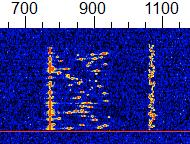
Using JT9 would allow 10 times the number of stations to fit into the present JT-window ... that's 100 JT9 stations instead of 10! With JT65, the window fills-up quickly and the QRM can soon take its toll with the usual ear-splitting strength of Es signals.The waterfall below shows the much narrower, more sensitive JT9 mode on the right compared with the wider JT65 signal on the left.
 |
| courtesy: https://sm7vrz.wordpress.com/jt9-english/ |
I took the opportunity to send out a few JT9 CQ's and did work a number of stations with several of them being well into the -20db range ... too weak for CW but readily worked on JT9. The sensitivity of JT9 will allow two-way contacts to be completed right down to the -27db range, over a one minute transmission period. This is pretty close to the popular WSPR none-QSO mode! I'm surprised that WSPR is so popular on HF when hams could actually be working each other, on-the-air in weak-signal mode JT, instead of relying on a backdoor computer link to see who is hearing their signals ... isn't two-way communication what it's all about? Granted, WSPR beaconing is great for observing propagation trends when you can't be there to watch, and therein lies its utility. Please excuse my short WSJT rant!
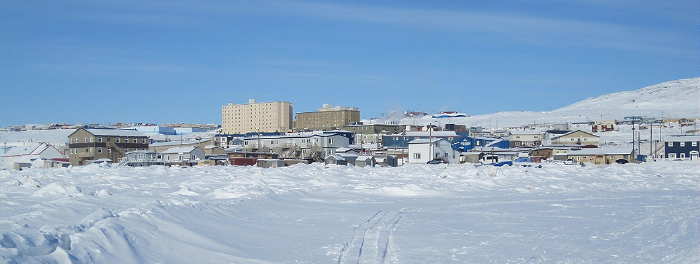
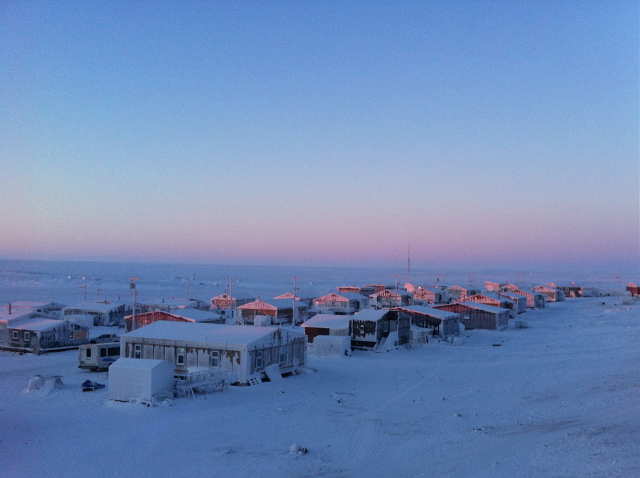
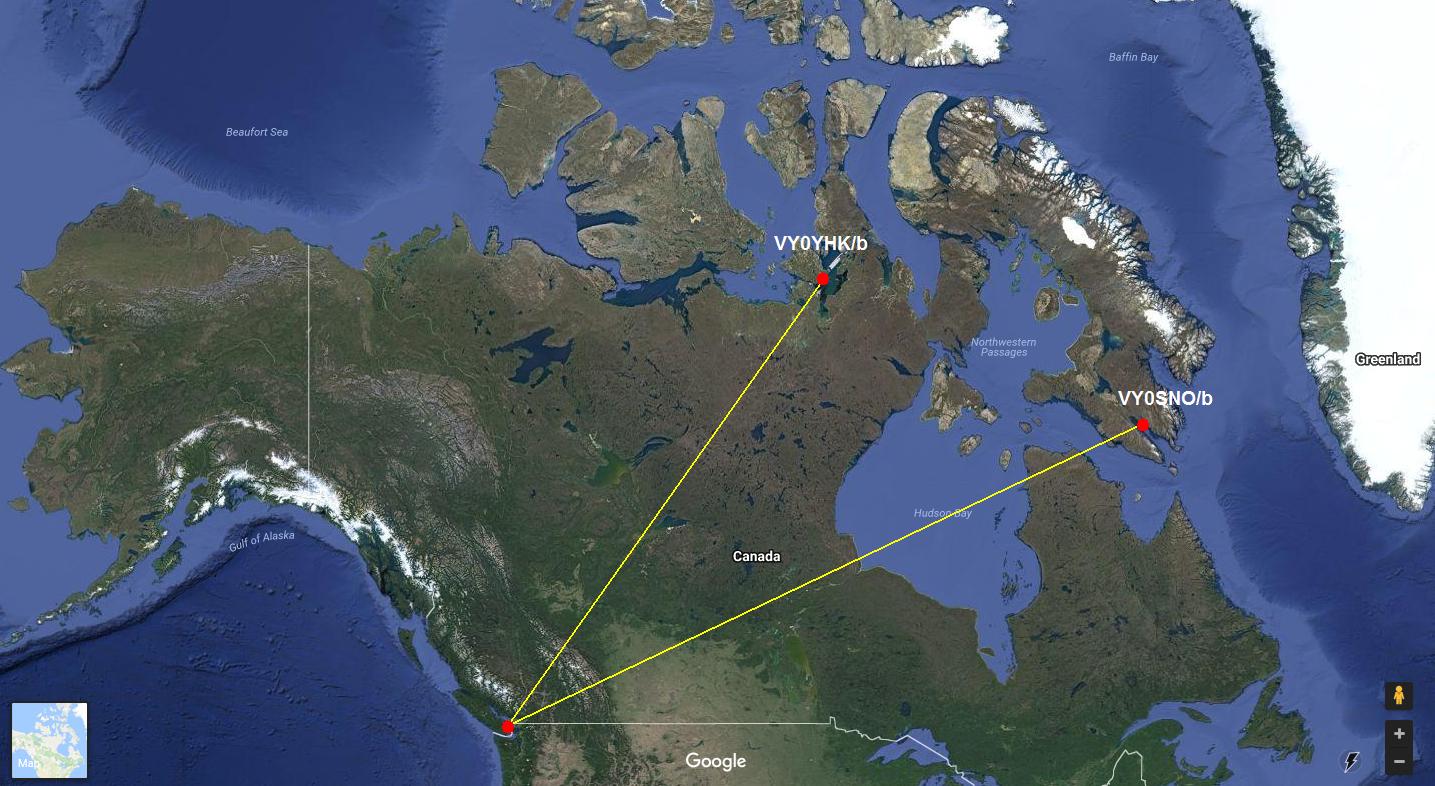
Saturday night's opening provided another rare visit from the 6m 'snowman' ... VYØSNO/b, located in Iqaluit, Nunavut in the Canadian Arctic. The beacon is rarely heard as far west as VE7 and it is always a great treat to catch it. It is basically unmaintained so when it fails, may never be repaired ... it's nice to know that its 25 W transmitter is still doing the job. I suspect that if anything fails, it will be the antenna in the brutal Arctic winter weather. The beacon's vertical antenna is located on the top of the high building on the left.
 |
| courtesy: https://en.m.wikipedia.org |
 |
| Sunset at VYØYHK courtesy: https://thesongiliveby.com |
 |
| courtesy: https://www.google.ca/maps |
This short video was made during Saturday evening's opening to the north and before the VYØYHK/b appeared. The weaker beacon on 50.030 is VY1DX in Whitehorse, Yukon Territory.
This morning, as I write this, the band is open to W1 and points to the east ... still some life left in the band yet.
It will be interesting to watch what happens over the next two weeks, when most Es activity on 6m usually folds its tent and quietly disappears until the following May ... let's hope the Fat Lady still needs more practice before pulling the curtain.
Steve McDonald, VE7SL, is a regular contributor to AmateurRadio.com and writes from British Columbia, Canada. Contact him at [email protected].
Weekly Propagation Summary – 2016 Aug 01 16:10 UTC

Here is this week’s space weather and geophysical report, issued 2016 Aug 01 0511 UTC.
Highlights of Solar and Geomagnetic Activity 25 – 31 July 2016
Solar activity was very low throughout the period with the exception of a single C1 flare at 25/0909 UTC from departed Region 2567 (N05, L=166, class/area Dki/380 on 21 July). Region 2570 (N10E24, Axx/alpha) was the sole numbered sunspot for the majority of the period but was unimpressive and did not contribute any significant flaring. A 25 degree filament, centered near N01E06, was observed lifting off of the visible disk in SDO/AIA imagery beginning at 28/1620 UTC. ENLIL analysis showed an Earth-directed component with CME arrival expected early on 02 August.
No proton events were observed at geosynchronous orbit.
The greater than 2 MeV electron flux at geosynchronous orbit was at moderate levels on 25, 28-29 July and high levels on 26-27 and 30-31 July.
Geomagnetic field activity was at quiet to active levels on 25 July due to residual influence from a weak transient that arrived at Earth on 24 July. This shock enhancement was likely associated with flare activity from 20 July. Geomagnetic field activity was quiet on 26-27 July under a nominal solar wind regime. Quiet to active conditions were observed on 28-29 July after the arrival of a CIR followed by a transition into a negative polarity CH HSS. Wind speeds reached 600 km/s while total field (Bt) measurements were as high as 17 nT. Geomagnetic field activity returned to quiet conditions on 30-31 July.
Forecast of Solar and Geomagnetic Activity 01 August – 27 August 2016
Solar activity is expected to be at very low levels from 01-04 August. Low levels with a chance for M-class (R1-R2, Minor-Moderate) flares are expected from 05-19 August with the return of Regions 2565 and 2567. A return to very low levels is expected on 20-27 August.
No proton events are expected at geosynchronous orbit.
The greater than 2 MeV electron flux at geosynchronous orbit is expected to be at high levels on 08, 5-15, 18-22, 25-27 August due to recurrent CH HSS activity. Normal to moderate levels are expected for the remainder of the forecast period.
Geomagnetic field activity is expected to be at unsettled to active levels on 04-05, 10-11, 15-16, 24-25 August with G1 (Minor) storm levels likely on 03 August due to recurrent CH HSS activity. A CME associated with the eruptive filament from 28 July is likely to arrive early on 02 August causing unsettled to G2 (Moderate) storm levels. Quiet to unsettled conditions are expected for the remainder of the period.
Don’t forget to visit our live space weather and radio propagation web site, at: http://SunSpotWatch.com/
Live Aurora mapping is at http://aurora.sunspotwatch.com/
If you are on Twitter, please follow these two users: + https://Twitter.com/NW7US + https://Twitter.com/hfradiospacewx
Get the space weather and radio propagation self-study course, today. Visit http://nw7us.us/swc for the latest sale and for more information!
Check out the stunning view of our Sun in action, as seen during the last five years with the Solar Dynamics Observatory (SDO): https://www.youtube.com/watch?v=zXN-MdoGM9g
We’re on Facebook: http://NW7US.us/swhfr
Visit, subscribe: NW7US Radio Communications and Propagation YouTube Channel
LHS Episode #173: Chips and SOTA
 Linux in the Ham Shack is back with another riveting episode all about open-source software, ham radio and fun. Topics for this fortnight include the closing of a large online ham radio equipment retailer, a new call sign database (yes, another one), SOTA, Solus, a bit of depth on the Hamradio Pure Blend and much more. Thank you as always for tuning in--and don't forget to check out another great ham radio podcast that always gives us the time of day, HamRadio 360.
73 de The LHS Crew
Russ Woodman, K5TUX, co-hosts the Linux in the Ham Shack podcast which is available for download in both MP3 and OGG audio format. Contact him at [email protected].
 Ham Radio Deluxe |
 W5SWL Electronics |
 Ham Radio Prep |
 KB3IFH QSL Cards  Hip Ham Shirts  HamRadioAuctions HamRadioAuctions Reliance Antennas Reliance Antennas Enigma Shop Enigma Shop |  morseDX  Ni4L Antennas  R&L Electronics R&L Electronics antennas.us antennas.us QRV QRV |
- Matt W1MST, Managing Editor
