 |
 Weekend plans go semi awry.
 18 September 2016 | by
 My first planned activity was to participate in the NJ QSO Party on Saturday. The work party that I attended at the Middlesex County Office of Emergency Management went longer than I anticipated. I'm glad we got the work done that we did, though, as it was important that it got done before the Simulated Emergency test in October. When I got home, there was still plenty of time to participate in the contest - no doubt. Other chores had to be taken care of first, though; and I made sure I got those done. End result? One very tired W2LJ and no NJQP on Saturday.
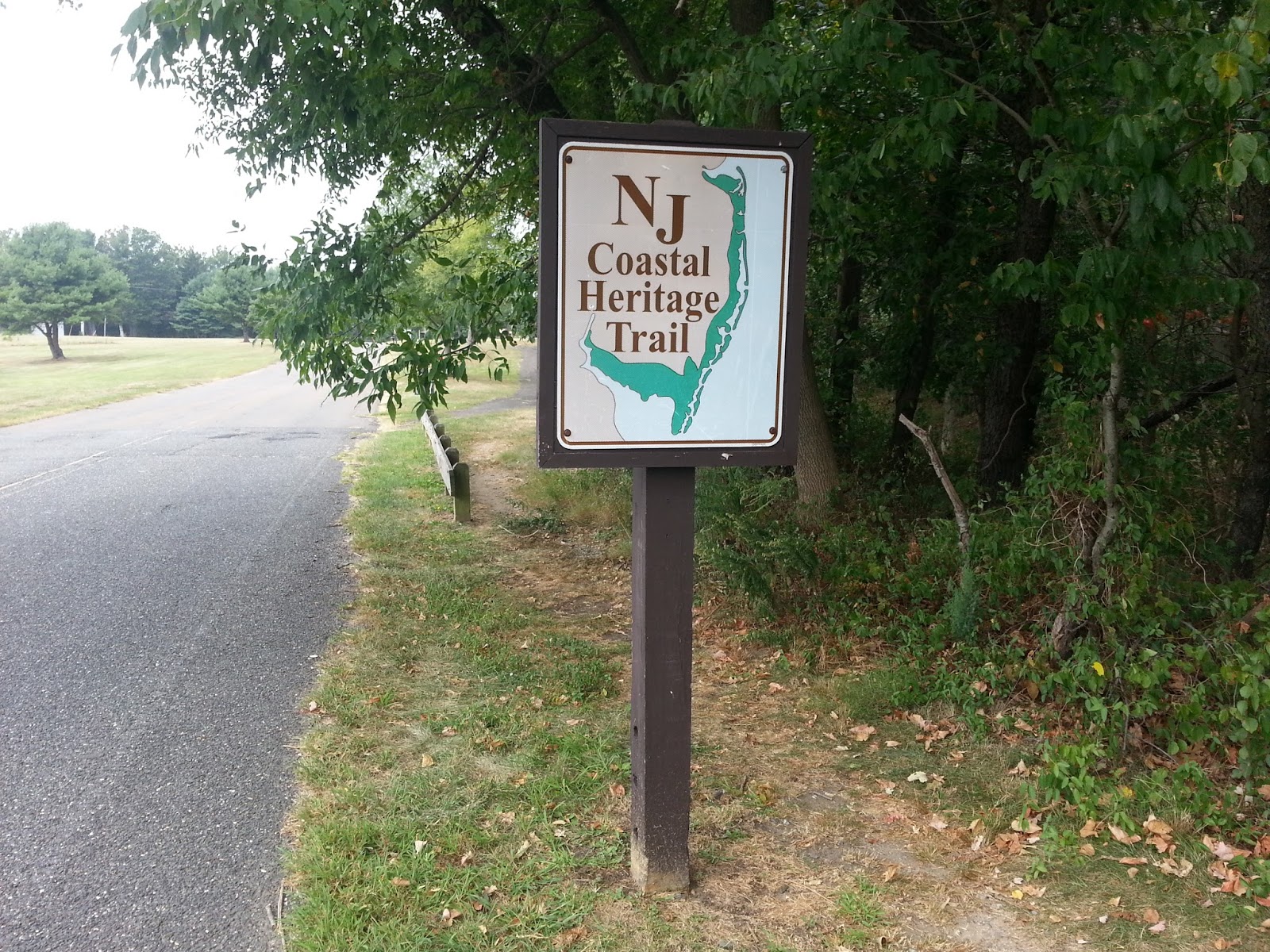
After dinner, I sat down with the tablet and saw on the ARRL NPOTA Facebook page that Peter K0BAK was doing a sweep of NJ activations this weekend, including AA17, the New Jersey Coastal Heritage Trail. My heart sank a bit because he's such a superb operator and activator - does AA17 really need to be activated twice the same day? And if you had the chance to work either me or Peter .... heck, even I'd rather work Peter than me !!!
Larry Makoski, W2LJ, is a regular contributor to AmateurRadio.com and writes from New Jersey, USA. Contact him at [email protected].
ICQ Podcast Episode 220 – Taking part in SSB Field Day
In this episode, Martin M1MRB / W9ICQ is joined by Leslie Butterfield G0CIB, Edmund Spicer M0MNG, Matthew Nassau M0NJX and Andy Mace M0MUX to discuss the latest Amateur / Ham Radio news. Colin M6BOY rounds up the news in brief, and this episodes feature is Taking part in SSB Field Day.
- CEPT Novice Licence and HAREC Changes
- UK CubeSat Forum - Lunar Opportunity
- Companies Plead Guilty to Capacitors Price Fixing
- FCC Proposes Substantial Fine for Unlicensed Amateur Operation / False Police Call
- Morse code at Eurovision?
- Australian Club's 60th Birthday
- WIA Seek New Ham Radio Allocations
- Aberdeen Radio Club Celebrate 70th Anniversary
Colin Butler, M6BOY, is the host of the ICQ Podcast, a weekly radio show about Amateur Radio. Contact him at [email protected].
ICQ Podcast Episode 220 – Taking part in SSB Field Day
In this episode, Martin M1MRB / W9ICQ is joined by Leslie Butterfield G0CIB, Edmund Spicer M0MNG, Matthew Nassau M0NJX and Andy Mace M0MUX to discuss the latest Amateur / Ham Radio news. Colin M6BOY rounds up the news in brief, and this episodes feature is Taking part in SSB Field Day.
- CEPT Novice Licence and HAREC Changes
- UK CubeSat Forum - Lunar Opportunity
- Companies Plead Guilty to Capacitors Price Fixing
- FCC Proposes Substantial Fine for Unlicensed Amateur Operation / False Police Call
- Morse code at Eurovision?
- Australian Club's 60th Birthday
- WIA Seek New Ham Radio Allocations
- Aberdeen Radio Club Celebrate 70th Anniversary
Colin Butler, M6BOY, is the host of the ICQ Podcast, a weekly radio show about Amateur Radio. Contact him at [email protected].
Amateur Radio Weekly – Issue 125

Amateur Radio Parity Act passes in the US House
“This is huge step in our effort to enact legislation that will allow radio amateurs who live in deed-restricted communities the ability to construct an effective outdoor antenna.”
ARRL
First VK-VE 630m contact
This is the first-ever QSO between North America and Australia on the relatively new 630m MF band.
VE7SL
Radio-Dakar QSL card sells for $1,195 on eBay
This QSL card started out life on eBay at $9.50 with free shipping.
The SWLing Post
Ham Nation: Hams Gone YL’ed
It’s an all YL cast tonight! We interview VA1YL, Amanda explains emergency situations, and a space weather update from Dr. T
TWiT
Get the right signal tone
One of the most common set of signaling tones is called the Dual Tone Multi-Frequency (DTMF) tone system, often known as Touch-Tones. This system was invented for use in telephone systems by AT&T in 1963.
Ham Radio School
Portable logging for iPad & iPhone
The upgrade to the water/dust proof case was just the ticket, despite it adding some bulk it really protects the device well.
M0JCQ’s Ham Blog
Review: BTech UV-50X3 tri-band mobile
Four years after its initial design, the VGC 6600PRO has evolved into the BTech UV-50X3, a full featured Tri-Band mobile that delivers a full 50W on VHF and UHF.
tri-band-review
Video
75 meter yagi installation
Installation of a 75 meter yagi antenna at W0AIH contest station.
YouTube
A teardown of the Kenwood TH-D74
YouTube
Amateur Radio Weekly is curated by Cale Mooth K4HCK. Sign up free to receive ham radio's most relevant news, projects, technology and events by e-mail each week at http://www.hamweekly.com.
First VK-VE 630m Contact!
 |
| courtesy: https://www.google.ca/maps |
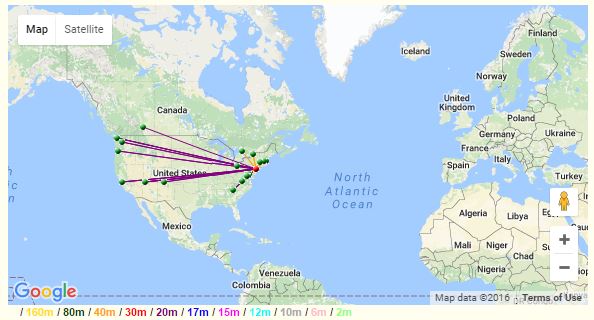
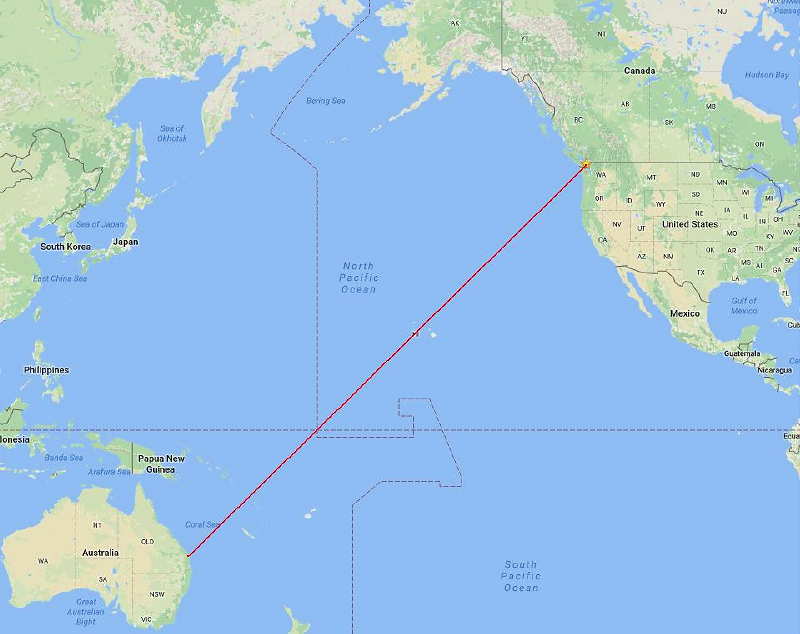
Shortly before sunrise yesterday morning, VK4YB (Roger) and I were able to work each other on 630m ... 475.300 kHz to be exact!
This is the first-ever QSO between North America and Australia on the relatively new 630m MF band. As well, at 11,802km, it presently represents the furthest two-way contact on this band, worldwide ... but I don't expect this record will last very long once the U.S. gets the band as I believe Roger's fine station is very capable of reaching much further afield.
Our contact on JT9, the WSPR QSO mode, was made at 1319Z, about 30 minutes before my local sunrise with the sky surprisingly bright. Blog readers will know that Roger and I have been carefully watching the pre-dawn Trans-Pacific propagation path for the last week. I have been checking-in with him via the ON4KST LF/MF chat page every morning at around 0345 local time at which point a decision is made ... "get out of bed and head for the shack" or "go back to sleep". Each morning's (or in Roger's case, each evening's) propagation quality is assigned a code number by Roger, based upon what he has been hearing during the early evening hours ... a '6' or below is 'sleep-time', a '7' is a 'you decide' while an '8' or above is 'get your butt moving'.
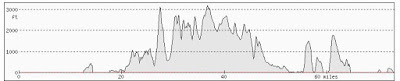
Yesterday, Roger issued a 'code 7' but as I joked with him later, I think he tricked me as it seemed more like a '6.5' from this end! Trans-Pacific conditions were very good about 500 miles to my south but seemed to drop-off quickly much further to the north. I also need to get over a significant obstruction immediately to the SW of me and in line with Roger. That's me directly at the base of the hill on the right while the remaining peaks are on nearby Saltspring Island and then Vancouver Island before reaching the open Pacific.
 |
| courtesy: http://www.heywhatsthat.com/profiler.html |
I believe this requires some enhancement of high-angle arrival (and departure) which often occurs around dawn due to a short period of ionospheric 'tilting'. This is often noted by topband operators near their local sunrise, who regularly observe stronger signals on low (cloud-warming) dipoles than they do on their normal large (low-angle) verticals or beverage antennas.
We enjoyed significantly stronger conditions a week ago, but unlike Thursday when I could run at full 5W EIRP, I was only able to generate a little less than 1W EIRP at the time. So far, this week, conditions have been improving steadily each day, from a 'code 3' to a 'code 7'. Hopefully they will continue to improve and we can do it all over again sometime soon.
With my new antenna / transverter / amplifier relay control box working nicely, it seems that Roger and I can now fully take advantage of TP propagation from 'mediocre' to 'excellent' but we have yet to see just how good it can get.
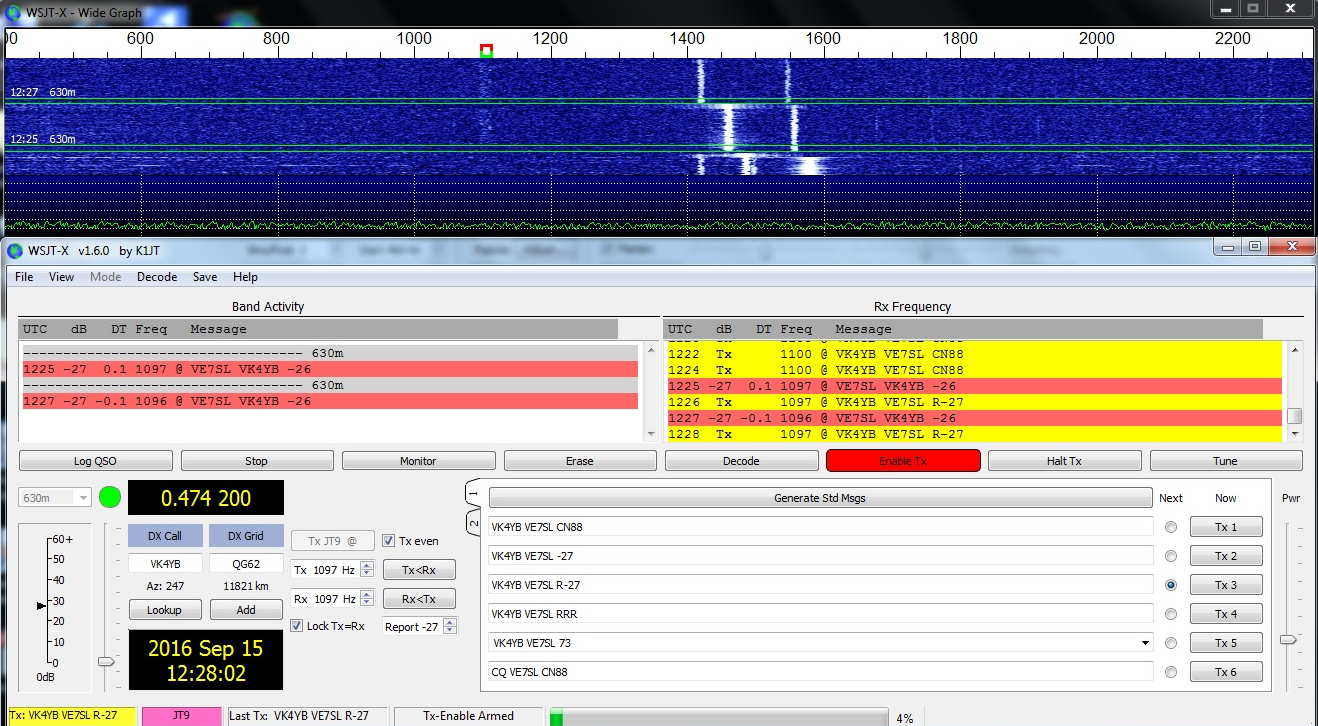 |
| Roger's signal is at +1100Hz |
It is hoped that our contact will inspire new interest among amateurs worldwide and particularly in North America. If you are planning a station, it seems that the main mode of two-way communications will be CW or JT9 ... a simple transverter would allow both modes as well as the use of the WSPR beacon mode. More information may be found here as well as in earlier 630m blogs.
See also: http://www.arrl.org/news/a-record-breaker-on-630-meters
Steve McDonald, VE7SL, is a regular contributor to AmateurRadio.com and writes from British Columbia, Canada. Contact him at [email protected].
New Jersey QSO Party this weekend!
For all the details, please visit: http://www.k2td-bcrc.org/k2td_index.html
I have a Middlesex County OEM work detail to attend in the morning. I hope to get some operating time in sometime during the afternoon. Maybe out on the patio table with the mag loop?
72 de Larry W2LJ
QRP - When you care to send the very least!
Larry Makoski, W2LJ, is a regular contributor to AmateurRadio.com and writes from New Jersey, USA. Contact him at [email protected].
New Jersey QSO Party this weekend!
For all the details, please visit: http://www.k2td-bcrc.org/k2td_index.html
I have a Middlesex County OEM work detail to attend in the morning. I hope to get some operating time in sometime during the afternoon. Maybe out on the patio table with the mag loop?
72 de Larry W2LJ
QRP - When you care to send the very least!
Larry Makoski, W2LJ, is a regular contributor to AmateurRadio.com and writes from New Jersey, USA. Contact him at [email protected].
 Ham Radio Deluxe |
 W5SWL Electronics |
 Ham Radio Prep |
 KB3IFH QSL Cards  Hip Ham Shirts  HamRadioAuctions HamRadioAuctions Reliance Antennas Reliance Antennas Enigma Shop Enigma Shop |  morseDX  Ni4L Antennas  R&L Electronics R&L Electronics antennas.us antennas.us QRV QRV |
- Matt W1MST, Managing Editor
