 |
 Getting Ready For The ’29 QSO Party
 7 September 2016 | by
Although the Bruce Kelly 1929 QSO Party is not until December, now is really the time to be putting something together if you've been thinking about getting in on the fun this year!
Like almost all of the operating in 1929, this is a CW only affair and if you've taken a listen in previous years, you know that the chirps, yoops, sudden frequency excursions and musical notes are all part of the original difficulties faced by the boys of '29 as they struggled with the relatively new adventure of 'amateur radio'.
Why 1929 you ask? It was the Radio Act of 1927 that came into effect in 1929 that laid out the foundation and future of amateur radio, with most of the early tenets still in effect today. The BK QSO Party celebrates the turning point in what had been pretty much a radio 'free-for-all' up until that time. Real progress was made quickly once the ground rules were established.
Rules of the BK Party require that all transmitters use tubes that were available in 1929 or earlier and must be self-excited ... no crystals allowed! This might seem to present a daunting task but in reality there are many readily available tubes that will make your transmitter legal.
In three previous blogs I've outlined some of the construction options available to new BK entrants and you can probably find enough information there to get you well on your way to some mid-winter fun. You will find links to these on the sidebar to the right.
Over the past three years I have posted a lot of 1929-related material, covering construction as well as BK Party activity. You can get all of these '29 blogs here and get enough bedtime reading for the week and hopefully, enough inspiration to grab the soldering iron and think about throwing something together for the party ... and it doesn't have to be pretty, as long as it works and is 'legal'! As well, my website has detailed construction information for three of my own '29-style transmitters.
I'm always impressed with the level of operating seen in the BK Party. For some reason, these guys can copy the weakest most awful sounding signals with ease. If you can get something going with a couple of watts or more, I guarantee that you will be heard and will work many of the '29 stations ... just don't wait to late to start building as I'd hate for you to miss all the fun!
Steve McDonald, VE7SL, is a regular contributor to AmateurRadio.com and writes from British Columbia, Canada. Contact him at [email protected].
Haven’t said this in a while
On the QRP side of things, I see from an e-mail by Doug KI6DS to the QRP-L list that the QRPGuys have a new kit offering out. The following is their description:
The QRPGuys Multi-Tuner is a Z-match design that will match a wide range of coax fed, long wire, and balanced line antennas, like high-impedance, low-loss UHF twinlead or ladder line for 40m-10m.
It uses the N7VE integral led swr indicator with an absorptive bridge to protect your final transistors from a poor match. In the TUNE position, you cannot damage your transmitter caused by a high SWR. It is looking at a 50 ohm load and the LED is indicating only the reflected power. At full brilliance your SWR is 4:1 or greater, at half brilliance your SWR is approximately 2:1, and the LED will completely extinguish at 1:1.
Rated for 5 watts continuous, 10 watts intermittant, weighs (4.3 oz.) and comes with female BNC connectors for the input/output, with S.S. hardware for the long wire and balanced line connections. There is no point to point wiring. All connections are accomplished by mounting the components on the PCB. This kit can be built in a couple of hours. On a difficulty scale of 1 to 5, 5 being the most difficult, this is rated at 3.
For more information, and ordering, you can go to http://www.qrpguys.com/
I don't have to tell you (but will, anyway) how important it is for us to patronize concerns like QRPGuys, QRPMe, QRP Kits, SOTA Beams, and the numerous other QRP vendors around the world that are out there. Blogging is my way to give a bit back to the hobby. Offering kits is the way these guys give back to the hobby. Yeah, they are there to make a buck or two; but they're definitely not in this with visions of becoming the next Elecraft. You keep me "in business' by reading; and we keep them in business (and as a result, keep the QRP hobby alive) by purchasing their wares.
72 de Larry W2LJ
QRP - When you care to send the very least!
Larry Makoski, W2LJ, is a regular contributor to AmateurRadio.com and writes from New Jersey, USA. Contact him at [email protected].
Haven’t said this in a while
On the QRP side of things, I see from an e-mail by Doug KI6DS to the QRP-L list that the QRPGuys have a new kit offering out. The following is their description:
The QRPGuys Multi-Tuner is a Z-match design that will match a wide range of coax fed, long wire, and balanced line antennas, like high-impedance, low-loss UHF twinlead or ladder line for 40m-10m.
It uses the N7VE integral led swr indicator with an absorptive bridge to protect your final transistors from a poor match. In the TUNE position, you cannot damage your transmitter caused by a high SWR. It is looking at a 50 ohm load and the LED is indicating only the reflected power. At full brilliance your SWR is 4:1 or greater, at half brilliance your SWR is approximately 2:1, and the LED will completely extinguish at 1:1.
Rated for 5 watts continuous, 10 watts intermittant, weighs (4.3 oz.) and comes with female BNC connectors for the input/output, with S.S. hardware for the long wire and balanced line connections. There is no point to point wiring. All connections are accomplished by mounting the components on the PCB. This kit can be built in a couple of hours. On a difficulty scale of 1 to 5, 5 being the most difficult, this is rated at 3.
For more information, and ordering, you can go to http://www.qrpguys.com/
I don't have to tell you (but will, anyway) how important it is for us to patronize concerns like QRPGuys, QRPMe, QRP Kits, SOTA Beams, and the numerous other QRP vendors around the world that are out there. Blogging is my way to give a bit back to the hobby. Offering kits is the way these guys give back to the hobby. Yeah, they are there to make a buck or two; but they're definitely not in this with visions of becoming the next Elecraft. You keep me "in business' by reading; and we keep them in business (and as a result, keep the QRP hobby alive) by purchasing their wares.
72 de Larry W2LJ
QRP - When you care to send the very least!
Larry Makoski, W2LJ, is a regular contributor to AmateurRadio.com and writes from New Jersey, USA. Contact him at [email protected].
How I Became a DXer
I took my Class B amateur radio exam on November 25th, 1949 which was the day after Thanksgiving. In early 1950 my W2DEC license arrived in the mail, I was the happiest kid in the state of New Jersey. My pathway into operational ham radio was a home built transmitter and a purchased receiver. A generation of Novices would soon pursue this same route.
I worked the entire summer prior to getting my license saving enough money to purchase a Hallicrafter S-40A. My first transmitter was based on a QST article and contained a crystal controlled 6AQ5 driving a 6L6 amplifier I had no idea how much power I was running, who could afford a meter? My first antenna was a folded dipole constructed using 300-ohm twin lead commonly used to feed TV antennas. The antenna ran around the ceiling of a first-floor apartment. The performance of this antenna could charitably be described as abysmal.
With this rig my QSO rate was about one every third day. I did learn an important lesson, if you have a weak signal don’t waste your time calling CQ because only those skilled in clairvoyance would be attracted to answer a signal that was 90% imagination. However I could, on occasion, get someone calling CQ to respond to my reply.
My home was Hillside, NJ which is between Newark and Elizabeth. All my contacts were with the first, second and third call areas plus a couple of VEs. My best DX was a QSO with a very patient operator in Northern Maine.
After about five months using this rig, I talked two neighbors into allowing me to string my folded dipole between their clothesline poles and things started to improve dramatically. Suddenly, station in the fourth, eighth and ninth call areas were within my grasp. My best DX was Miami FL, I was on my way with flying colors.
My Elmer, Jim McGintey W2YYP, helped me set up a BC459 (WWII general use transmitter) with a power supply scrounged from parts from a discarded TV set. The difference when using when using a VFO controlled transmitter was dramatic. The transition from an indoor antenna to an outdoor antenna and from a crystal controlled to a VFO rig had taken my QSO rate from one every second or third day to frequently five, or more, Qs per day.
One evening I heard KG4AN calling CQ NYC. KG4, at the time, was exclusive Guantanamo Bay Cuba. Since I was close to NYC I called him and back he came. I was so nervous I could barely send coherent code. KG4AN was a Marine stationed on Gitmo and his wife had just given birth to a baby girl. He asked me to call his parents on Long Island to pass along the good news , I happily complied. I was now on my way to becoming a DXer with three countries, W, VE and KG4, worked and soon to be confirmed. The KG4AN QSL hung on my wall for many years; unfortunately, the card became a victim of hurricane Sandy.
Almost all of my operating was in the afternoon after school or the early evenings. I heard a few Europeans but didn’t have enough confidence to even call them. I had yet to work anyone west of the Mississippi.
One night I woke up about 2 AM with a toothache and couldn’t get back to sleep. I wondered if anyone was on the air at that hour and got up and turned on the rig. I didn’t touch a single dial and there was a W7 calling CQ. I called him and much to my surprise he came back. In those days you were located in the call area where you call indicated unless you were signing /some other call area. Sure enough, he was in Arizona. I was so excited I sent him an air mail QSL card. In 1950 postage to send a QSL card was a penny and an air mail QSL cost 4 cents. I sprang for mailing my card in an envelope which set me back 6 cents. The card from W7RA hung in a place of honor on my wall for years to come. I sometimes wonder if Mark Zuckerberg’svFacebook idea of putting important things on a wall didn’t originate with radio hams.
Taking one more look at the band before heading back to bed I hear another W7 calling CQ. Can I be lucky twice in the same session? Yes sir and Washington State was added to my growing list of states worked. That glorious night taught me two important lessons; learn about propagation and if you want different states and try operating at times you usually not on the air.
The next night the toothache was gone but I was again up a 2 AM. I worked a W6 and a couple of W0s stations. A few nights later I was tuning the band and there was a KH6 working another W2. I waited until they were done and called the KH6. Another miracle, he came back. A few nights later a ZL was added to my log and the DX hook had been firmly set. The rest, as they say, is history.
Although I worked my way up to being one country off the top of the honor roll in 1965, none of the contacts putting me at that lofty level equaled the thrill of working the first KG4, W7 and KH6. If it hadn’t been for a toothache who knows how my ham radio career would have unfolded, I may have never become a DXer.
Urb LeJeune, W1UL, is the creator of Ham-Cram, a ham radio test preparation website. He writes from New Jersey, USA. Contact him at [email protected].
Weekly Propagation Summary – 2016 Sep 05 16:10 UTC
Here is this week’s space weather and geophysical report, issued 2016 Sep 05 0405 UTC.
Highlights of Solar and Geomagnetic Activity 29 August – 04 September 2016
Solar activity was at low levels from 29-31 Aug. Regions 2583 (N13, L=025, class/area Dao/130 on 29 Aug) and 2585 (N08, L=222, class/area Ekc/590 on 03 Sep) were responsible for the C-class activity. Activity dropped to very low levels for the remainder of the period. No Earth-directed CMEs were observed.
No proton events were observed at geosynchronous orbit.
The greater than 2 MeV electron flux at geosynchronous orbit was at high levels on 29 Aug and 02-04 Sep due to CH HSS influence.
Geomagnetic field activity was at quiet to unsettled levels on 29-31 Aug with active conditions late on 30 Aug due to CH HSS effects. Mostly active to major storm conditions were observed on 01-03 Sep due to effects from an extension of the northern polar coronal hole. Active to minor storm levels prevailed on 04 Sep due to continued CH HSS effects.
Forecast of Solar and Geomagnetic Activity 05 September – 01 October 2016
Solar activity is expected to be at very low to low levels throughout the forecast period.
No proton events are expected at geosynchronous orbit.
The greater than 2 MeV electron flux at geosynchronous orbit is expected to reach high to very high levels on 05-12 Sep due to CH HSS influence. Normal to moderate levels are expected from 13-20 Sep and 26-28 Sep. High levels are expected on 21-25 Sep and 29 Sep-01 Oct due to effects from anticipated recurrent CH HSS events.
Geomagnetic field activity is expected to be at unsettled to active levels on 05-06 Sep with minor storms expected early on 05 Sep as CH HSS effects continue. Quiet to unsettled conditions are expected on 07-08 Sep as effects begin to subside. Mostly quiet conditions are expected from 09-18 Sep with isolated unsettled periods likely on 13, 14 and 17 Sep due to weak recurrent CH HSS events. Quiet to unsettled levels are expected on 19-21 Sep with active periods possible on 19 Sep due to effects from a recurrent, negative polarity CH HSS. Mostly quiet conditions are expected from 22-25 Sep. Quiet to unsettled conditions are expected on 26-27 Sep followed by active to major storm levels from 26 Sep-01 Oct due to effects from the northern polar coronal hole extension.
Don’t forget to visit our live space weather and radio propagation web site, at: http://SunSpotWatch.com/
Live Aurora mapping is at http://aurora.sunspotwatch.com/
If you are on Twitter, please follow these two users: + https://Twitter.com/NW7US + https://Twitter.com/hfradiospacewx
Get the space weather and radio propagation self-study course, today. Visit http://nw7us.us/swc for the latest sale and for more information!
Check out the stunning view of our Sun in action, as seen during the last five years with the Solar Dynamics Observatory (SDO): https://www.youtube.com/watch?v=zXN-MdoGM9g
We’re on Facebook: http://NW7US.us/swhfr
Visit, subscribe: NW7US Radio Communications and Propagation YouTube Channel
September Prop Awakens
As our sunsets start to come earlier and dawn arrives later and later, the sun's accelerated southerly excursion has brought sudden changes to 630m propagation.
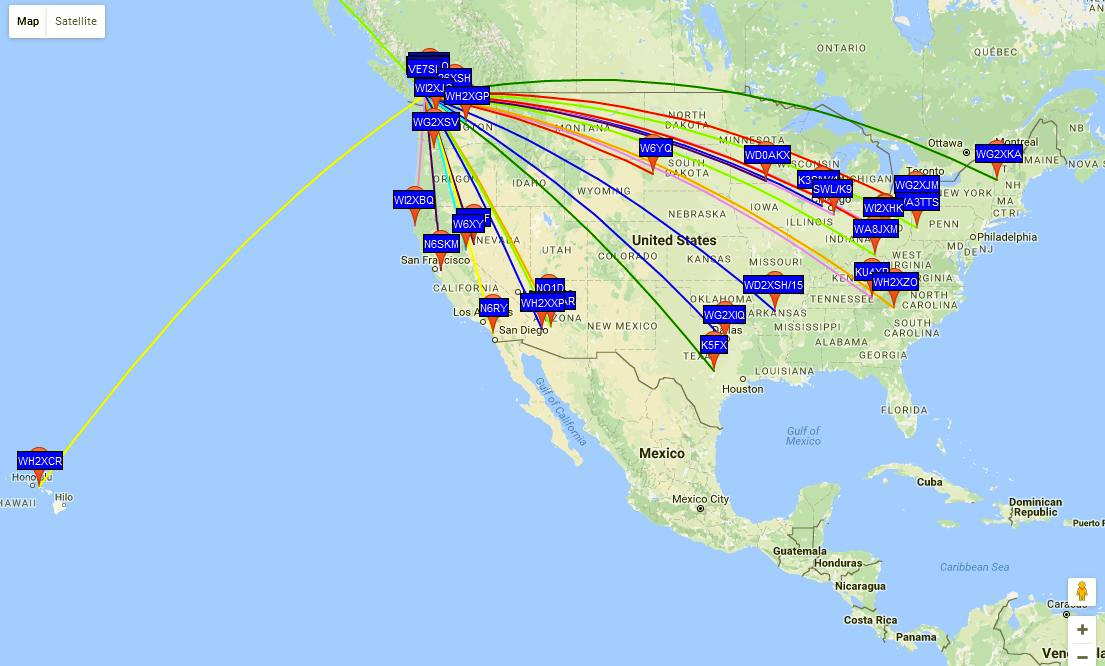
This past weekend's CLE activity saw universally poor propagation as well as weather related QRN from lightning ... but as usual at this time of the year, things can change rapidly. Wednesday's overnight map of my own 630m WSPR activity illustrates why September propagation on LF and MF can often be spectacular and this is with just 65 watts total power output:
 |
| courtesy: http://wsprnet.org/drupal/ |
Among other things, the map indicates the growing interest among U.S. amateurs in the 630m band. Hopefully they won't have to wait too much longer, although I seem to be saying this more often than I would like to. It is of interest to note that even though these were WSPR reports, signal levels at most reporting stations were either into the 'audible CW' levels or at 'JT9 workable' levels ... all stations should be workable once the 630m ham band becomes a reality for all North Americans. Midwinter conditions over the next several years should see an abundance of transcontinental contacts on both CW and on JT9!
The east-west path is the bread and butter direction for interesting possibilities, when it comes to those of us in VE7 land. Normally it only really sets in when geomagnetic conditions are quiet but, as a result of coronal hole streaming, this week's geomagnetic field has been anything but quiet. As John Langridge, KB5NJD / WG2XIQ reported today in his invaluable '630m daily reports':
The geomagnetic field was extremely active, with many reporting periods at storm levels. The Bz is pointing to the South and solar wind velocities are very high, peaking at 700 km/s. This event is significant and I am just glad to see that it is helping and not hurting propagation. When will the bottom drop out? Clearly there is a lot going on here that we do not understand.
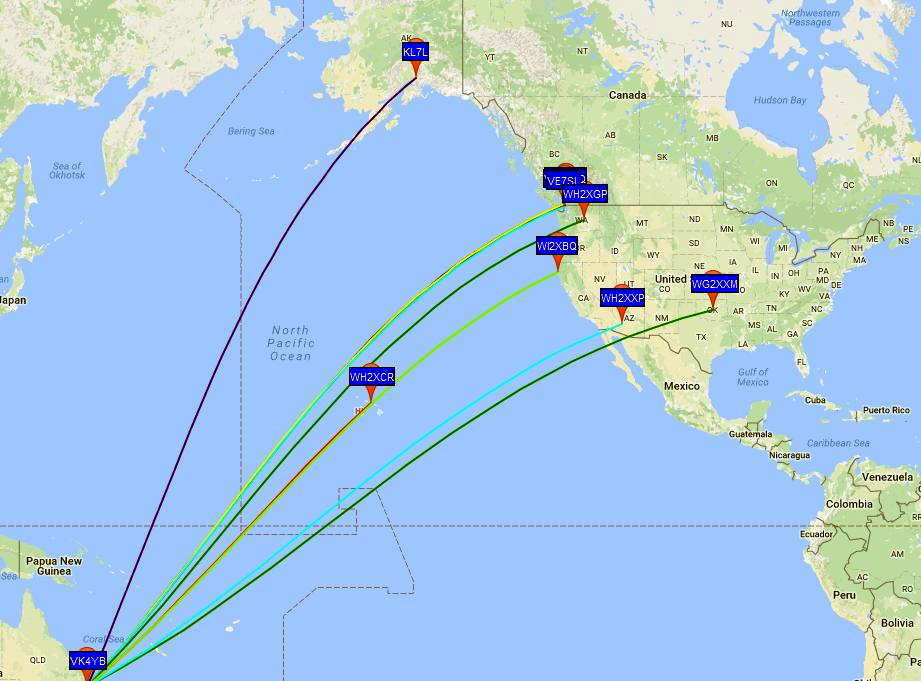
With stormy conditions continuing throughout the week, Friday's path to down-under enjoyed some enhancement as well, not unusual when the east-west path is disturbed. VK4YB's 90 watt signal was widely heard by several VE7's (VE7CNF, VA7MM and VE7BDQ) in the predawn hour, as Roger's signal peaked up briefly for several WSPR decodes.
 |
| courtesy: http://wsprnet.org/drupal/ |
As the coronal hole streaming continues, this morning's path to VK seemed even better along with a new antenna at VK4YB favoring the northwest:
12:24 VK4YB 0.475622 -21 VE7BDQ 11844 km
12:12 VK4YB 0.475621 -22 VE7BDQ 11844 km
12:08 VK4YB 0.475622 -17 VE7BDQ 11844 km
11:04 VK4YB 0.475622 -24 VE7BDQ 11844 km
11:02 VK4YB 0.475623 -22 VE7BDQ 11844 km
10:54 VK4YB 0.475623 -22 VE7BDQ 11844 km
12:28 VK4YB 0.475626 -21 VE7SL 11820 km
12:24 VK4YB 0.475625 -23 VE7SL 11820 km
11:54 VK4YB 0.475623 -25 VE7SL 11820 km
11:04 VK4YB 0.475623 -23 VE7SL 11820 km
11:02 VK4YB 0.475625 -26 VE7SL 11820 km
10:54 VK4YB 0.475626 -21 VE7SL 11820 km
11:22 VK4YB 0.475614 -28 VA7MM 11872 km
11:04 VK4YB 0.475614 -28 VA7MM 11872 km
11:02 VK4YB 0.475615 -33 VA7MM 11872 km
10:54 VK4YB 0.475615 -26 VA7MM 11872 km
I should mention that the other VE7 stations are all operating from noisy suburbs near Vancouver ... clearly fine examples of what can be done on 630m under less than ideal operating conditions and by paying close attention to system optimization. Please don't let living in the city stop you from enjoying the mysteries and challenges that our latest ham band has to offer ... as mentioned earlier, there is still much to be learned about using this band at amateur radio power levels and small backyard antennas. How exciting is that!
Steve McDonald, VE7SL, is a regular contributor to AmateurRadio.com and writes from British Columbia, Canada. Contact him at [email protected].
ICQ Podcast Episode 219 – Trouble with Mobile Antennas
In this episode, Martin M1MRB / W9ICQ is joined by Martin Rothwell M0SGL, Dan Romanchik KB6NU and Matthew Nassau M0NJX to discuss the latest Amateur / Ham Radio news. Colin M6BOY rounds up the news in brief, and this episodes feature is Trouble with Mobile Antennas
- FO-29 20th Birthday
- NIST’s Rolling Wireless Net Helps Improve First-Responder Communications
- 18th World ARDF Championship
- Illegal GPS Sea Buoys on 10m
- UK Amateur Radio Club 50 Years on the Air
- Latvia Gains Two New Amateur Radio Bands
- Ham Radio Around the World Balloon
Colin Butler, M6BOY, is the host of the ICQ Podcast, a weekly radio show about Amateur Radio. Contact him at [email protected].
 Ham Radio Deluxe |
 W5SWL Electronics |
 Ham Radio Prep |
 KB3IFH QSL Cards  Hip Ham Shirts  HamRadioAuctions HamRadioAuctions Reliance Antennas Reliance Antennas Enigma Shop Enigma Shop |  morseDX  Ni4L Antennas  R&L Electronics R&L Electronics antennas.us antennas.us QRV QRV |
- Matt W1MST, Managing Editor
