 |
 LHS Episode #175: True Lies on VHS
 12 September 2016 | by
  Hurricanes, YOLO, Spanish letters, BSD, rocket science, call books, loggers, Maylasia, cult movies and more--all in this episode of Linux in the Ham Shack!
73 de The LHS Crew
Russ Woodman, K5TUX, co-hosts the Linux in the Ham Shack podcast which is available for download in both MP3 and OGG audio format. Contact him at [email protected].
AmateurLogic 95: What Goes Up
AmateurLogic.TV Episode 95 is now available for download.
It’s out of this world. In this episode D-Star hotspots just got easier to use. Tommy shows us the DVMega Blue Stack. George Interviews Bill Brown, WB8ELK in Huntsville and learns about his Pico Balloon experiments. Emile brings to light a possible Commspiracy.
Details of our 11th Anniversary Icom IC-7300 giveaway and more.
1:23:49
George Thomas, W5JDX, is co-host of AmateurLogic.TV, an original amateur radio video program hosted by George Thomas (W5JDX), Tommy Martin (N5ZNO), Peter Berrett (VK3PB), and Emile Diodene (KE5QKR). Contact him at [email protected].
Slacker SOTA Activation in the Tetons (W7Y/TT-061)
The Grand Teton National Park has plenty of mountains for Summits On The Air (SOTA) activations, so I wanted to activate a few of them as we enjoyed the park. I am still recovering from a fractured ankle, so I was definitely looking for an easy-peasy summit to activate on our trip. It turns out there is a summit right at the top of the Jackson Hole Arial Tram that operates during the summer months (W7Y/TT-061). (This tram serves the ski area during the winter.)
The SOTA database shows this summit as unnamed and refers to it by elevation, 10450. The locals may refer to this as Rendezvous Mountain, not to be confused with Rendezvous Peak (W7Y/TT-035). For SOTA purposes its just “10450”.
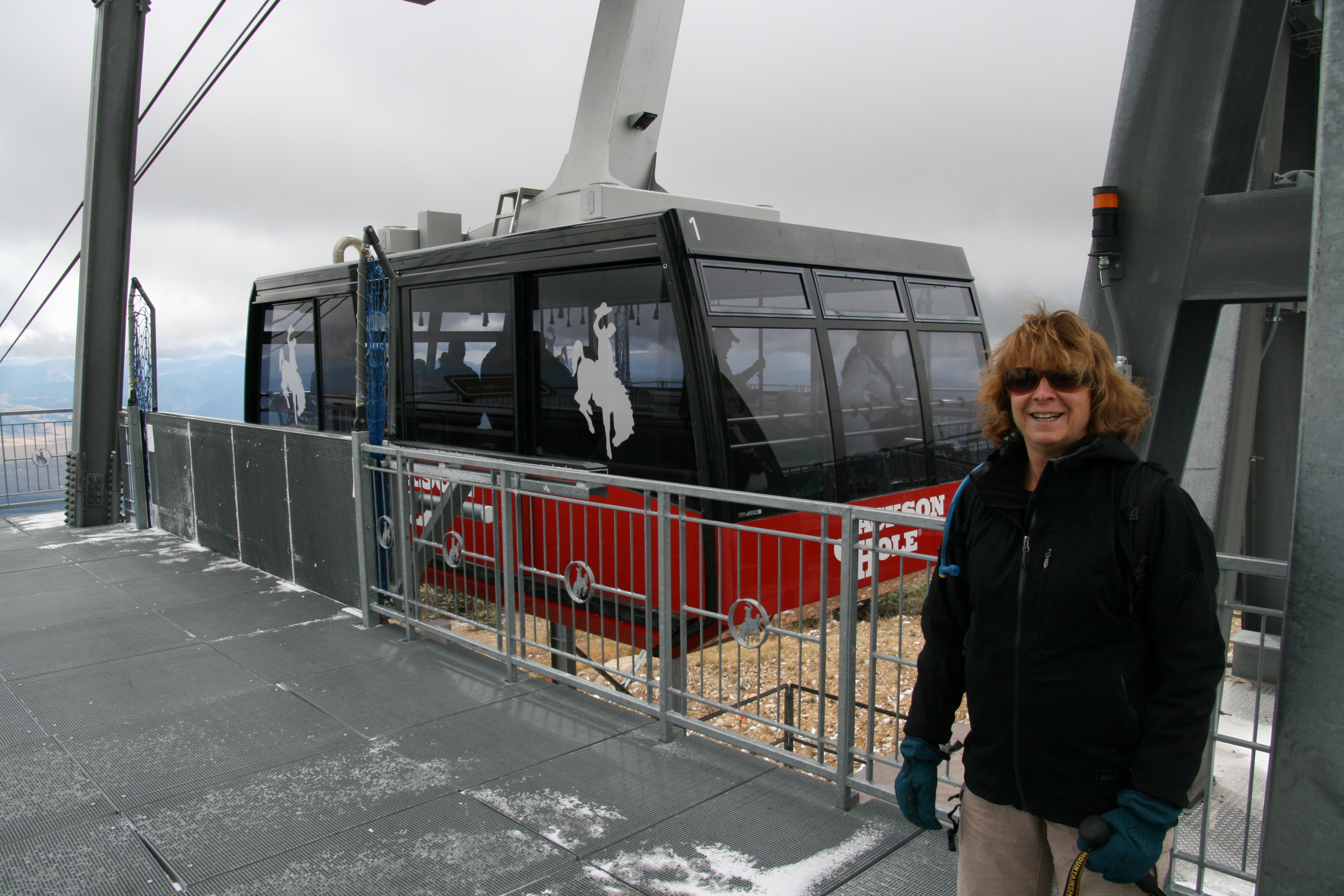
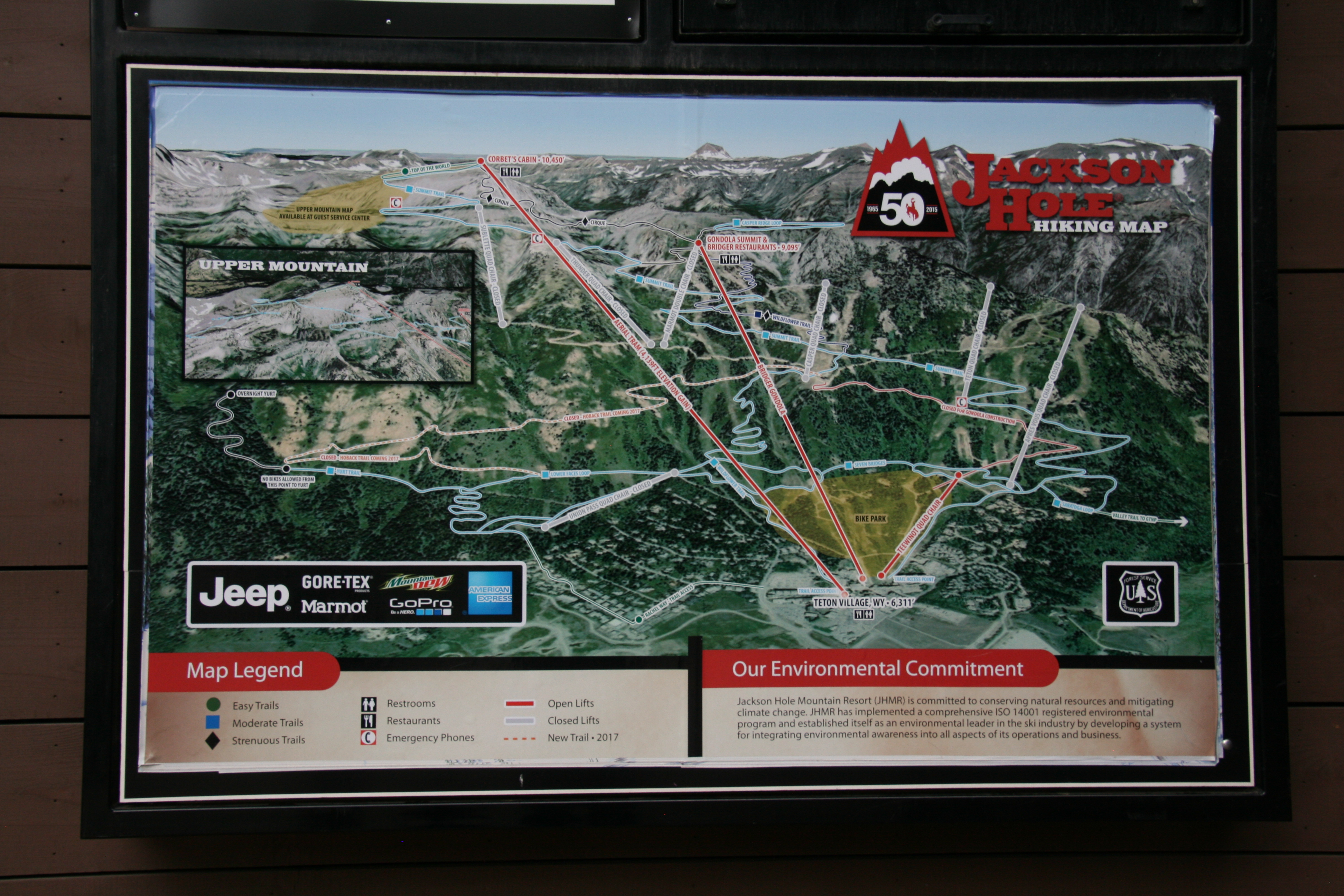
Well, this sounds pretty awesome…ride the tram to the top and play ham radio. Now the bad news: the ticket for the tram is $42. It’s an all day pass that gives you access to other lifts and plenty of hiking trails but still it is expensive. OK, slightly better news: if you purchase online you can get the pass for $32. There are senior and other pricing options, so check out the web site for the latest info.
The September weather was overcast and cold at the summit. I opted for a simple VHF activation using my Yaesu FT-1DR and a half-wave vertical antenna. I had my 3-element 2m yagi with me but I didn’t deploy it. I figured that my ability to contact folks on 2m fm would be limited more by who happens to be monitoring…signal strength would not be a major factor.
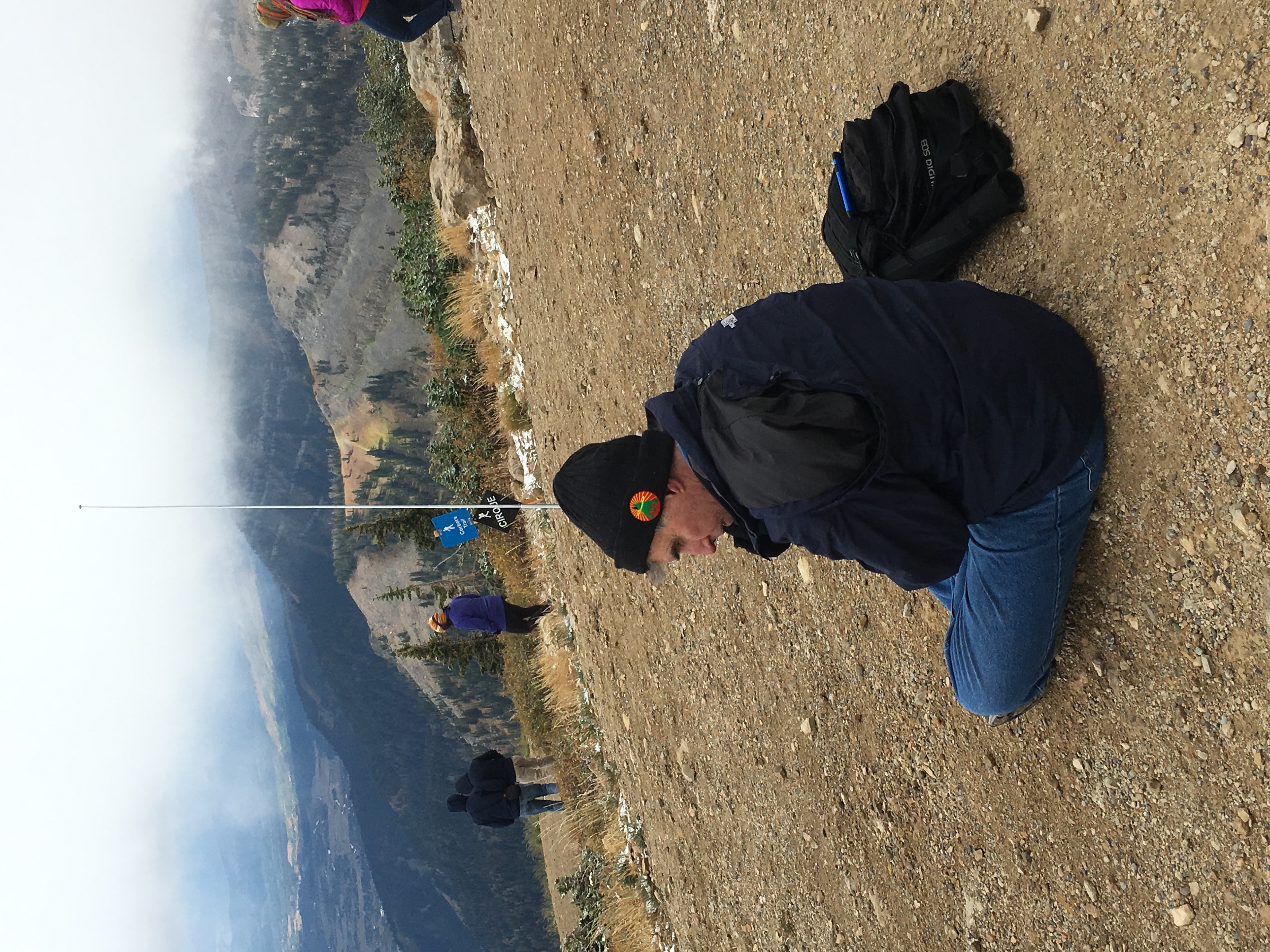
It was cold at the top and I was glad that I packed my gloves, hat and a decent jacket. I made five contacts by calling on 146.52 MHz.
The tram ride was quite enjoyable with good views of the Jackson Hole area. However, this may go down in history as my most expensive SOTA activation.
73, Bob K0NR
The post Slacker SOTA Activation in the Tetons (W7Y/TT-061) appeared first on The KØNR Radio Site.
Bob Witte, KØNR, is a regular contributor to AmateurRadio.com and writes from Colorado, USA. Contact him at [email protected].
Amateur Radio Weekly – Issue 124

Air Force to ‘bomb the sky’ to improve radio reception
CubeSats could carry massive amounts of ionized gas to the ionosphere to create radio-reflecting plasma.
Prepared Ham
Smaller solar cycles ahead?
Data suggest that Cycle 24, the current solar cycle, will bottom out in 2020.
ARRL
Michigan State Parks on the Air
It looks like the program will get started next year.
KB6NU
Emergency preparedness: How will you communicate?
September is recognized as National Preparedness Month.
Icom America
The woman behind the KM5R repeater
Once upon a time there lived a home-schooled fairy princess named, Melissa, or as she later became known, KM5R.
Weekly North Texas net for YLs
YL International Single Sideband System
The ISSB System operates on 14.332 MHz, 365 days of the year.
YL System
September VHF Contest this weekend
The goal is to contact as many different stations in as many 2 × 1 grid squares as possible on frequencies above 50 MHz.
ARRL
Batteries for portable Amateur Radio use
I’ve used everything from car batteries, Sealed Lead Acid Batteries (SLAB), standard AA’s, Lithium Polymer (LiPo) and Lithium Iron Phosphate Batteries (LiFePo).
M0JCQ’s Ham Blog
Can you ID this mystery digital signal?
I noted beeps at Hz repetition rate, does not appear to be data, it beeps for about a minute then there is a short data burst then beeping again for a minute or two.
The SWLing Post
Video
VHF Transmitter key-up analysis
Based on what I learned about this radio, I won’t be operating it at the high power level due to the frequency drift.
W2AEW
Random wire portable antenna back yard test
I decided to try a random wire in the back yard with QRP power and portable set up for some fun and to see how it would work for me.
RadioHamGuy
Jogging while listening to the Space Station
This is my reception of Astronaut Jeff Williams talking with summer camp students at the Kopernik Observatory and Science Center.
Space Comms
Lightning strikes on the Maestro/Flex 6300
Perhaps it’s time to disconnect the antennas and call it a day.
The Radio Hobbyist
Amateur Radio Weekly is curated by Cale Mooth K4HCK. Sign up free to receive ham radio's most relevant news, projects, technology and events by e-mail each week at http://www.hamweekly.com.
AREDN Mesh Weather Camera
 |
| PTZ HD weather cam on the mesh! |
Last week Randy (KD9FGO) and I mounted a pan-tilt-zoom (ptz) camera up on a grain elevator. At 250 feet, the view is great. The purpose of the camera is to be able to watch the weather roll into the area. We do send out weather spottters occasionally, but there are few locations where you get such a great view as from 250 feet above the surrounding terrain! We used a Sunba 1080p HD IP camera, sold for $330 on Amazon. A single shielded CAT5 line runs from the camera to a Power Over Ethernet+ (POE+) injector, and then on to an ethernet switch where the AREDN mesh 5GHz node is connected.
We’ve added another AREDN node at the fire station (EOC) so that the camera can be viewed from there. And of course, it can be viewed from other nodes on the mesh. Right now, that means at the home of another ham and my shack as well. (Our other mesh sites are un-manned repeater sites.)
The picture above was taken with a cell phone, taking a picture of a laptop at the EOC. The actual picture quality is HD – it is absolutely amazing.
The next step is to add another ptz camera 5 miles north of town at another grain elevator. This site has a better view to the north and north west, while the first site has a great view from south to north west. We are also planning to showcase this solution to a couple of the other area emergency managers. Now that we have a solid mesh backbone established, adding additional sites is as easy as adding a $100 mesh node and a $330 camera.
Michael Brown, KG9DW, is a regular contributor to AmateurRadio.com and writes from Illinois, USA. Contact him at [email protected].
AREDN Mesh Weather Camera
|
| PTZ HD weather cam on the mesh! |
Last week Randy (KD9FGO) and I mounted a pan-tilt-zoom (ptz) camera up on a grain elevator. At 250 feet, the view is great. The purpose of the camera is to be able to watch the weather roll into the area. We do send out weather spottters occasionally, but there are few locations where you get such a great view as from 250 feet above the surrounding terrain! We used a Sunba 1080p HD IP camera, sold for $330 on Amazon. A single shielded CAT5 line runs from the camera to a Power Over Ethernet+ (POE+) injector, and then on to an ethernet switch where the AREDN mesh 5GHz node is connected.
We’ve added another AREDN node at the fire station (EOC) so that the camera can be viewed from there. And of course, it can be viewed from other nodes on the mesh. Right now, that means at the home of another ham and my shack as well. (Our other mesh sites are un-manned repeater sites.)
The picture above was taken with a cell phone, taking a picture of a laptop at the EOC. The actual picture quality is HD – it is absolutely amazing.
The next step is to add another ptz camera 5 miles north of town at another grain elevator. This site has a better view to the north and north west, while the first site has a great view from south to north west. We are also planning to showcase this solution to a couple of the other area emergency managers. Now that we have a solid mesh backbone established, adding additional sites is as easy as adding a $100 mesh node and a $330 camera.
Michael Brown, KG9DW, is a regular contributor to AmateurRadio.com and writes from Illinois, USA. Contact him at [email protected].
Late Summer Hike on Shute Hill
I hiked on Shute Hill this afternoon. It’s definitely late summer. The sounds of crickets say so. The loud buzzing of bees on the goldenrod tell me fall is around the corner. I made a wonderful 2-way QRP QSO with Georgia.

The trail goes south and east from the old cemetery off the Rufus Colby Road. It goes all the way over the hill to the range road on the other side.
I walk for about 20 minutes. There are asters and goldenrod everywhere.

I set up along the trail under a beautiful oak tree. I’m using the MTR by Steve Weber, KD1JV. It’s a tiny 3-band rig powered by 8 AA cells. It gives me about 3 watts. I have hung a 20 meter dipole as a vertical from a branch and I sit on the ground with the MTR in my lap.

I hear K4JPN Steve in Georgia finishing up a QSO and I call him. He answers right away and gives me a 579. He is 599. He is running a K2 to a 3 element beam. He drops his power down to 2 watts. I still have solid copy and we chat for about 15 minutes. I’ve worked Steve about a half dozen times before. He spent lots of time in New Hampshire as a youngster and he’s as glad as I am for the contact.
Here’s my view from my operating position. At the bottom right of the photo, you will see a water bottle. It is hanging from the end of the dipole keeping the antenna taut.

It’s not a fancy place with a spectacular view. But it’s beautiful nonetheless. I pack up and hike back to the cemetery where I left my car.
Jim Cluett, W1PID, is a regular contributor to AmateurRadio.com and writes from New Hampshire, USA. Contact him at [email protected].
 Ham Radio Deluxe |
 W5SWL Electronics |
 Ham Radio Prep |
 KB3IFH QSL Cards  Hip Ham Shirts  HamRadioAuctions HamRadioAuctions Reliance Antennas Reliance Antennas Enigma Shop Enigma Shop |  morseDX  Ni4L Antennas  R&L Electronics R&L Electronics antennas.us antennas.us QRV QRV |
- Matt W1MST, Managing Editor
