 |
 Ham College 20
 30 August 2016 | by
 Noise and Interference part 1.
1:12:15
George Thomas, W5JDX, is co-host of AmateurLogic.TV, an original amateur radio video program hosted by George Thomas (W5JDX), Tommy Martin (N5ZNO), Peter Berrett (VK3PB), and Emile Diodene (KE5QKR). Contact him at [email protected].
Weekly Propagation Summary – 2016 Aug 29 16:10 UTC
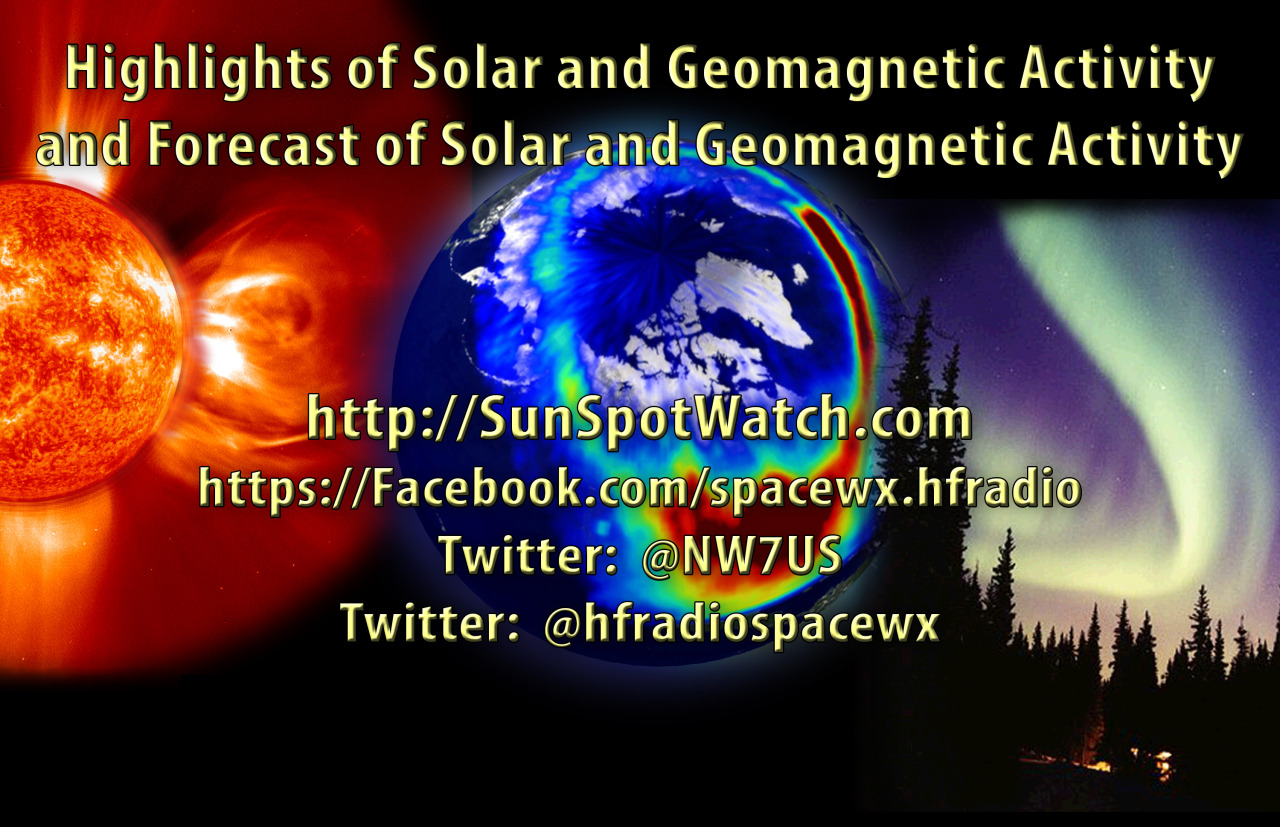
Here is this week’s space weather and geophysical report, issued 2016 Aug 29 0520 UTC.
Highlights of Solar and Geomagnetic Activity 22 – 28 August 2016
Solar activity was at very low levels the majority of the period with low levels reached on 28 August due to an isolated C1/Sf flare at 28/2128 UTC from Region 2583 (N13, L=023, class/area Dao/030 on 28 Aug). Regions 2579 (N12, L=034, class/area Dao/090 on 23 Aug) and 2581 (N12, L=337, class/area Cao/110 on 28 Aug) were the largest spot groups on the visible disk, but were in a decay phase as of 24 and 28 August, respectively. No Earth-directed coronal mass ejections were observed during the period.
No proton events were observed at geosynchronous orbit.
The greater than 2 MeV electron flux at geosynchronous orbit was at normal levels on 22 August, moderate levels on 23-24 August, and high levels from 25-28 August. The maximum flux reached 2,334 pfu at 27/1705 UTC.
Geomagnetic field activity ranged from quiet to G1-minor storm levels during the period. The beginning of the period, solar wind conditions were nominal with solar wind speeds between 350 km/s and 420 km/s. The geomagnetic field was at quiet levels on 22 August. By 23 August, total field increased to around 14 nT with the solar wind speed increasing to around 550 km/s as a negative polarity coronal hole high speed stream (CH HSS) moved into geoeffective position. By midday on 24 August, total field had decreased to near 5 nT, however solar wind speeds remained elevated until late on 25 August when they began to decline. The geomagnetic field responded with quiet to G1-minor storm levels on 23-24 August, followed by quiet to unsettled conditions on 25-27 August. Quiet conditions were observed on 28 August under a nominal solar wind environment.
Forecast of Solar and Geomagnetic Activity 29 August – 24 September 2016
Solar activity is expected to be at very low to low levels throughout the period.
No proton events are expected at geosynchronous orbit.
The greater than 2 MeV electron flux at geosynchronous orbit is expected to be at normal to moderate levels with high levels expected on 31 August-12 September and again from 21-24 September due to recurrent CH HSS activity.
Geomagnetic field activity is expected to be at unsettled to active levels on 29 August-08 September, 13-14 September, 17 September, and 19-21 September with G1-minor storm levels likely on 29-30 August due to recurrent CH HSS activity.
Don’t forget to visit our live space weather and radio propagation web site, at: http://SunSpotWatch.com/
Live Aurora mapping is at http://aurora.sunspotwatch.com/
If you are on Twitter, please follow these two users: + https://Twitter.com/NW7US + https://Twitter.com/hfradiospacewx
Get the space weather and radio propagation self-study course, today. Visit http://nw7us.us/swc for the latest sale and for more information!
Check out the stunning view of our Sun in action, as seen during the last five years with the Solar Dynamics Observatory (SDO): https://www.youtube.com/watch?v=zXN-MdoGM9g
We’re on Facebook: http://NW7US.us/swhfr
Visit, subscribe: NW7US Radio Communications and Propagation YouTube Channel
LHS Episode #174: Swedish Hamballs
 Tin foil hats, the United States Air Force, the FCC, a 5 GHz kerfuffle, databases, ReactOS, Quisk, SDRs, podcast trolls and more--all in this episode of Linux in the Ham Shack.
73 de The LHS Crew
Russ Woodman, K5TUX, co-hosts the Linux in the Ham Shack podcast which is available for download in both MP3 and OGG audio format. Contact him at [email protected].
The First DMR-station in Taiwan
Playing around with DMR in Holland was fun. But back in Taiwan my brand new Tytera MD-390 would be totally useless. There is no DMR activity here (yet) and up till recently I was the first and only ham in Taiwan with a DMR ID (4661001).
Luckily there are little devices called “hotspots” and one of the most popular one right now is the DV4mini, designed by DG8FAC (Stefan Reimann), DG1HT (Torsten Schultze) and DJ0ABR (Kurt Moraw). The DV4mini is a tiny USB stick that can turn any PC into a hotspot for all the amateur digital modes: C4FM, D-Star and of course DMR. It does P25 and dPMR, too. Basically it is a router for your DMR transceiver. Ham radio purists will undoubtedly cringe at the thought of RF being routed via the internet, but this is 2016 and everything is connected to the internet, so let’s get over it.
Still in Holland Cor (PD0GHF) was again very helpful and invited me into his shack for me to check out his DV4mini setups. Yes, setups, because Cor is a man with a lot of radio equipment, especially in his trusty Volvo. For the DV4mini to work you need to hook it up to a computer, install the software, configure it and off you go. The computer can be your laptop, PC, but also one of those mini computers, like the Raspberry Pi. With a tiny 3.5 inch TFT screen you can make a very portable hotspot. Cor already made two of them.
 Unfortunately for me Cor didn’t want to part with one of his hotspots, but luckily I had already bought my own DV4mini. Now some of you may know I am not a big fan of the Raspberry Pi, but Cor’s setup looked very appealing. And then Dave (PD5DOF) gave me a 3.5″ TFT screen as a parting gift at the last VERON meeting I attended. So I sighed and ordered a Rpi from RS, which arrived in a couple of days. I ordered the Rpi3 because it is the first Pi with on-board WiFi, so no need to buy a separate WiFi adapter.
There are many ready-made images, with the DV4mini software already installed, available to download on the net. You burn an image on a micro SD card, insert it in the Rpi and your Pi will come alive. But of the 10+ images I tried not one worked on my Pi3, probably because they were made for the Pi2. The plain vanilla Raspbian image did work with my Pi3 and the 3.5″ TFT screen, but the DV4mini software wouldn’t work. The Ubuntu MATE image would work with the DV4mini software, but not with my 3.5″ TFT screen.
So after a week of fiddling around I took the latest Raspian image, installed the latest version of Mono (open source version of MS.NET) from scratch and then the special version of the DV4mini software for small screens. And because I did all that I can now present you with……
THE FIRST EVER DMR AMATEUR RADIO STATION IN TAIWAN….. As you can see I am connected to the reflector connecting all of Holland (4500). I can now take my MD-390, walk out of the shack, sit on the couch and be able to talk with all my fine friends back home, while being in Taiwan!
In Holland most repeaters are connected to the Brandmeister network. In fact, if you look at this map it is becoming the most popular network to connect DMR repeaters to in the world. The Brandmeister network has a dashboard at https://brandmeister.network/ and the good thing about this dashboard is that you can actually see if you connected to the network. Not only that, your most recent transmissions are also logged.
 Apart from QSOs with Dutch hams I have also had QSOs with the US, Sweden and Australia and they were real QSOs as well. Not much use exchanging a “59” when using DMR, is it now? For me this is most important as it allows me to break my isolation here in Taiwan by being able to have QSOs with ham friends from back home and also make new friends all over the world. I always thought that that was the essence of amateur radio. Am I right?
Hans "Fong" van den Boogert, BX2ABT, is a regular contributor to AmateurRadio.com and writes from Taiwan. Contact him at [email protected].
General License Class (Black Forest, CO)
 Ham Radio General License
Two-day Class
Black Forest, Colorado
Two class sessions on Sat Sept 24 and Sat Oct 1 (8 AM to 5 PM) FCC Exam session on Oct 8th
Location: Black Forest Fire Station
Intersection of Burgess Rd. & Teachout Rd.
The General License provides access to regional and worldwide communications on the HF bands via ionospheric skip, greatly expanding operational capabilities!
- Upgrade from Technician to General Class radio privileges
- Pass your FCC General Class amateur license exam Oct 8 *
- Live equipment demonstrations and activities
- Learn to operate on the HF bands, 10 Meters to 160 Meters
- Gain a deeper understanding of radio electronics and theory
- Take the next step with antennas, amplifiers, digital modes
Registration fee: $30
(No FCC exam fee required at Oct 8 exam session)
In addition, students must have the required study guide:
HamRadioSchool.com General License Course
Second Edition, effective 2015 – 2019, $22.95
Current FCC Technician License required for registration. Advanced registration is required by Sept 10th or earlier. First-come registration acceptance until class is full.
To register for the class, contact: Bob Witte KØNR
Email: [email protected] or Phone: 719/659-3727
Sponsored by the Tri-Lakes Monument Radio Association.
The post General License Class (Black Forest, CO) appeared first on The KØNR Radio Site.
Bob Witte, KØNR, is a regular contributor to AmateurRadio.com and writes from Colorado, USA. Contact him at [email protected].
Episode 71 Practical Amateur Radio Podcast
Episode 71 of the Practical Amateur Radio Podcast has been released and is available for download either through iTunes, Android, any other RSS podcatcher software or direct via the PARP website.

The general discussion theme of episode 71 borrows the motto from the Worldwide Floral and Fauna Program “Make Nature your Shack”. While I won’t complain about the warmth of my ham shack on a cold January day, as fall approaches we have many reasons to take our gear outdoors. I discuss the 2016 ARRL National Parks on the Air, Summits on the Air and the Worldwide Floral and Fauna programs.
During the featured website segment I introduce PARP listeners to the FieldRadio.org group and also share a new US amateur radio license preparation site called Ham-Cram.com.
Remember, this Saturday is the Colorado QSO Party. I hope you’ll hear me calling CQ. Thank you for listening to the Practical Amateur Radio Podcast and reading my blog.
Until next time…
73 de KDØBIK (Jerry)
Jerry Taylor, KD0BIK, is a regular contributor to AmateurRadio.com and writes from Colorado, USA. He is the host of the Practical Amateur Radio Podcast. Contact him at [email protected].
Episode 71 Practical Amateur Radio Podcast
Episode 71 of the Practical Amateur Radio Podcast has been released and is available for download either through iTunes, Android, any other RSS podcatcher software or direct via the PARP website.

The general discussion theme of episode 71 borrows the motto from the Worldwide Floral and Fauna Program “Make Nature your Shack”. While I won’t complain about the warmth of my ham shack on a cold January day, as fall approaches we have many reasons to take our gear outdoors. I discuss the 2016 ARRL National Parks on the Air, Summits on the Air and the Worldwide Floral and Fauna programs.
During the featured website segment I introduce PARP listeners to the FieldRadio.org group and also share a new US amateur radio license preparation site called Ham-Cram.com.
Remember, this Saturday is the Colorado QSO Party. I hope you’ll hear me calling CQ. Thank you for listening to the Practical Amateur Radio Podcast and reading my blog.
Until next time…
73 de KDØBIK (Jerry)
Jerry Taylor, KD0BIK, is a regular contributor to AmateurRadio.com and writes from Colorado, USA. He is the host of the Practical Amateur Radio Podcast. Contact him at [email protected].
 Ham Radio Deluxe |
 W5SWL Electronics |
 Ham Radio Prep |
 KB3IFH QSL Cards  Hip Ham Shirts  HamRadioAuctions HamRadioAuctions Reliance Antennas Reliance Antennas Enigma Shop Enigma Shop |  morseDX  Ni4L Antennas  R&L Electronics R&L Electronics antennas.us antennas.us QRV QRV |
- Matt W1MST, Managing Editor
