 |
 Amateur Radio Weekly – Issue 131
 29 October 2016 | by
BITX40 40 meter transceiver
The BITX40 is a single circuit 40 meter SSB transceiver capable of 7 watts.
HF Signals
Ham proposes vanity call sign rule changes
W4ADL is proposing that any licensee obtaining a vanity call sign be required to keep it for the full license term.
ARRL
Open Repeater Project
The OpenRepeater Project is the development of a low cost, low power, but a feature rich duplex Linux based amateur radio repeater controller using computers like the Raspberry Pi 2.
Open Repeater Project
24 GHz handheld
Vegetation completely blocks 24 GHz signals. A tree or even the smallest bush blocks the signal.
EA4EOZ
Designing an idiot switch
Building a micro controller device that removes power from a soldering iron when the user leaves it turned on for too long.
Ham Radio 360: Workbench
APRSpro
iOS APRS client with built-in iGate.
APRSpro
Taking your QRP signal to the next steps
The heavy lifting is done not by you but by the DX who is trying to dig you out of the mud.
AmateurRadio.com
Graphing realtime WSPR propagation
This gives useful information about when a certain part of the world can be heard and worked.
PE4BAS
Why you should care about software defined radio
It hasn’t become a household term yet, but Software-Defined Radio (SDR) is a major player on the developing technology front.
Hack A Day
Amateur Radio and FreeBSD [PDF]
Many of the applications written generically or specifically for Linux are easily transferred to FreeBSD.
FreeBSD Journal
Video
K7AGE Visits the new TWIT Studio
On my way to the Pacificon Hamfest, I stopped by the new TWIT studio and I was on Ham Nation.
K7AGE
Drone footage of 2017 Hamvention site
Quad-Copter touring the Greene County (Ohio) Fairgrounds
W8WWV
Drone footage of antenna install
The team at RemoteHamRadio.com installed two rotating towers in Maine.
YouTube
Amateur Radio Weekly is curated by Cale Mooth K4HCK. Sign up free to receive ham radio's most relevant news, projects, technology and events by e-mail each week at http://www.hamweekly.com.
November’s 630m Activity / CW Crossband Night!
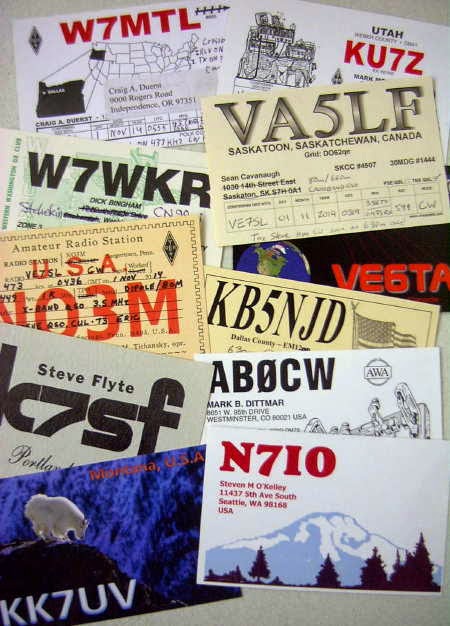
Once again the 630m band will become a cacophony of CW and other sounds on Saturday night, November 12th! The actual motivation for the weekend event is a celebration of the November, 1906, Berlin Treaty ... making 500 kHz the International Distress Frequency for the next eighty years. It's also a great excuse for a lot of 630m diehards to get on the air and celebrate the band.
Three different groups will participate:
U.S. Experimental Operators
Canadian Amateurs
Maritime Radio Historical Society
U.S. Part-5 Experimental Operators including WD2XSH stations and others will operate in the 472 – 479 kHz band. They will use CW transmissions for QSOs and beacons with special messages. There may also be some operation on 500 kHz itself.
Canadian Amateurs will be concentrating their efforts on providing two-way cross-band CW QSO's with other amateurs in the U.S.A. and Canada. They will be transmitting on specified frequencies (see below) and listening for replies to their 'CQ' on specified QSX frequencies within the 160, 80 and 40m CW bands.
The Maritime Radio Historical Society will activate its KSM/KPH transmitter at Bolinas, CA for a mini “Night of Nights” with special messages and bulletins.
Listeners are encouraged to send their reception reports to individual stations or via the LF/MF ON4KST chat page which should be very active during the event. Most experimental calls can be found via QRZ.com listings.
All amateurs are encouraged to participate in the cross-band activity by being able to listen on 630m but being able to answer on one of the specified HF bands.
So far this fall, propagation on the 630m band has been excellent and hopefully will continue well into November. Previous cross-band events have seen contacts made from coast-to-coast as well as west to Hawaii.
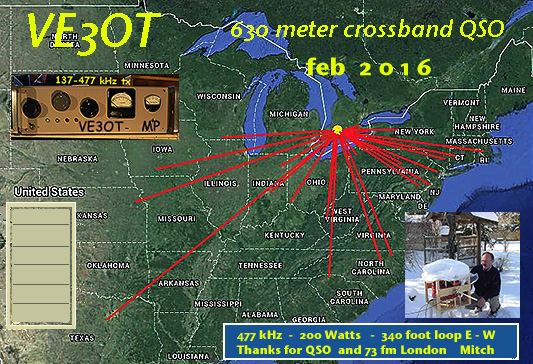 |
| VE3OT QSL and coverage from previous crossband event |
Confirmed Canadian stations include:
Station: VA7MM (Mark) CN89 Coquitlam, B.C.
Time: 0400Z – 0800Z (Saturday night Nov 13 Z)
TX Frequency: 475.0 kHz
RX (QSX) Frequency: 1801 kHz / 3574 kHz / 7062 kHz
Station: VE7BDQ (John) CN89 Delta, B.C. November 2016
Time: 0300Z – 0700Z (Saturday night Nov 13 Z)
TX Frequency: 474.0 kHz
RX (QSX) Frequency: 3555 kHz
Station: VE7CNF (Toby) CN89 Burnaby, B.C.
Time: 0300Z – 0800Z (Saturday night Nov 13 Z)
TX Frequency: 476.5 kHz
RX (QSX) Frequency: 1836 kHz / 3558 kHz / 7031 kHz
Station: VE7SL (Steve) CN88 Mayne Island, B.C.
Time: 0200Z – 0700Z (Saturday night Nov 13 Z)
TX Frequency: 473.0 kHz
RX (QSX) Frequency: 3566 / 7066 kHz
Station: VE7CA (Markus) CN89 North Vancouver, B.C.
Time: 0200Z – 0700Z (Saturday night Nov 13 Z)
TX Frequency: 477.5.0 kHz
RX (QSX) Frequency: 1820 / 3550 / 7048 kHz
Station: VO1NA (Joe) GN37 Torbay, Newfoundland
Time: 2130Z – 0130Z (Saturday night Nov 12 Z – Sunday Nov 13 Z)
TX Frequency: 477.7 kHz
RX (QSX) Frequency: 3562 kHz
Station: VE3OT (Mitch) EN92 London, ON.
Time: 0000Z – 0400Z (Saturday night Nov 13 Z)
TX Frequency: 477.0 kHz
RX (QSX) Frequency: 3563 kHz / 7058 kHz
Several US Experimental stations also will be in operation throughout the band, in two-way QSO mode with each other, using CW or JT9. Some stations will also use WSPR and QRSS CW beacon modes.
The success of this event largely depends upon the participation of as many amateurs as possible.
Hopefully you will be able to participate in the two-way cross-band activity by being able to listen on 630m and then able to switch over to HF to transmit. This could involve the use of a separate receiver / transmitter or can often be easily implemented via your transceiver's 'A/B' switch.
No antenna for receiving on 630m? Don't let that stop you from taking part in the fun. Surprisingly good results can often be had by using a low band wire antenna such as a dipole or inverted-L for listening on 630m ... the antenna does not necessarily need to be resonant. In fact, often times, a non-resonant receiving antenna can provide a better overall S/N ratio than one which is resonant, as these often gather more noise along with signals.
You may want to experiment before hand by listening to many of the numerous U.S. experimental stations operating nightly, mostly in the WSPR mode, between 475.6 and 475.8kHz. Most operators provide a CW identifier following their WSPR transmission but a better way to decode these signals is by installing the latest WSPR software, WSJT-X (freeware), at K1JT's website here. The software works extremely well and is easy to install and get working. If you set the software to 'upload spots', you can share your nightly catches with dozens of other listeners throughout the continent on the WSPRnet website.
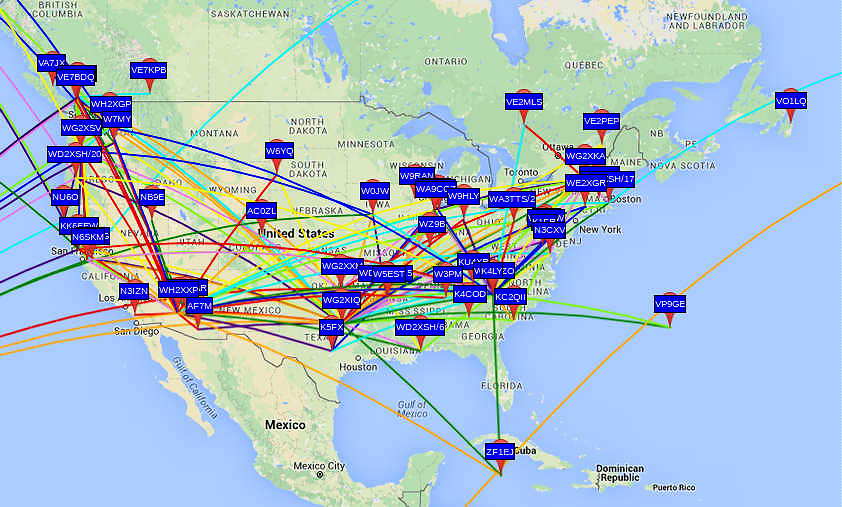 |
| courtesy: KB5NJD's 630m Daily Blog |
If you have further questions, please contact myself or John Langridge, KB5NJD / WG2XIQ.
Steve McDonald, VE7SL, is a regular contributor to AmateurRadio.com and writes from British Columbia, Canada. Contact him at [email protected].
The ARRL has done it again!

Mike Weir, VE9KK, is a regular contributor to AmateurRadio.com and writes from New Brunswick, Canada. Contact him at [email protected].
The ARRL has done it again!
Mike Weir, VE9KK, is a regular contributor to AmateurRadio.com and writes from New Brunswick, Canada. Contact him at [email protected].
Hunting For NDBs In CLE 212
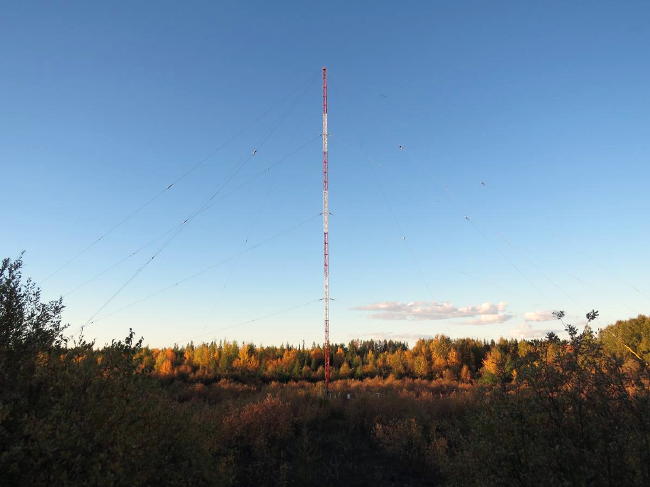 |
| YPM-274 courtesy: ve3gop.com |
Another NDB CLE challenge is in store this coming weekend with CLE 212. This time the frequency range is 270 - 319.9 kHz bringing it into the DGPS band, although these signals should not be reported.
A good target for this range is 25W YPM in Pikangikum, Ontario, transmitting on 274 kHz. It is widely reported throughout North America, thanks to its large antenna system, pictured here. Look for it on 274.361 kHz with your receiver in 'CW' mode. Remember that most Canadian NDBs use a ~ 400Hz tone for modulation while the U.S. ones are usually ~1020Hz on both sidebands.
'CLE's' are 'Co-ordinated Listening Events', and NDB DXers around the world focus their listening time on one small slice of the NDB spectrum ... but this time around, the range has been expanded.
From CLE coordinator Brian Keyte (G3SIA), via the Yahoo ndblist Group, comes the following reminder:
Hello all
The NDB List has really come back to life recently - you can see the effect
of the good recent propagation on the number of emails we have posted
to NDB List each month since last June:
Jun Jul Aug Sep Oct (so far)
197 279 404 663 768
Our 212th co-ordinated listening event is this weekend, covering a 50 kHz
frequency range - about three times wider than usual.
Days: Friday 28 October - Monday 31 October
Times: Start and end at midday, your LOCAL time
Range: 270.0 - 319.9 kHz (NOT DGPS beacons)
We can expect very good propagation, but in part of the frequency range
it will be a bit of a challenge to tease out the NDB signals from among
the DGPS ones.
Any first-time CLE logs will be very welcome, as always.
Please log the normal NDBs you can identify that are listed in the range
(it includes 270 kHz but not 320 kHz).
Please send your CLE log to NDB List, if possible as a plain text email
and not in an attachment, with 'CLE212' at the start of its title.
Show on EVERY line of your log:
# The Date (e.g. '2016-10-28' or just '28', etc.)
# UTC (the day changes at 00:00 UTC).
# kHz - the beacon's nominal published frequency if you know it.
# The Call Ident.
Those main items can be in any order within themselves, but BEFORE any
other optional details (Location, Distance, etc.) later in the same line.
Many of us in Europe will be changing our house clocks this weekend.
UTC time continues unchanged of course, but as we finish the CLE on
Monday at LOCAL midday we may win an extra hour's listening!
As always, give details in your log of your own location and the receiver,
aerial(s), etc. that you were using.
If you send any interim logs, please also send a Final (complete) one.
You can find anything else to help you, including seeklists for your part
of the World, from the CLE page, http://www.ndblist.info/cle.htm
I will send the usual 'Any More Logs?' email at about 18:00 UTC on Tuesday so that you can check that your CLE log has been found OK. Do make sure
that your log has arrived at the very latest by 09:00 UTC next Wednesday,
2nd November. I am hoping to make all the combined results on that day.
Enjoy your listening
Brian
----------------------------------------------------------
From: Brian Keyte G3SIA ndbcle'at'gmail.com
Location: Surrey, SE England (CLE co-ordinator)
----------------------------------------------------------
(Reminder: You could use any one remote receiver for your loggings,
stating its location and owner - with their permission if required.
A remote listener may NOT also use another receiver, whether local or
remote, to obtain further loggings for the same CLE).
These listening events serve several purposes. They:
- determine, worldwide, which beacons are actually in service and on-the-air so the online database can be kept up-to-date
- determine, worldwide, which beacons are out-of-service or have gone silent since the last CLE covering this range
- will indicate the state of propagation conditions at the various participant locations
- will give you an indication of how well your LF/MF receiving system is working
- give participants a fun yet challenging activity to keep their listening skills honed
Final details can be found at the NDB List website, and worldwide results, for every participant, will be posted there a few days after the event. If you are a member of the ndblist Group, results will also be e-mailed and posted there.
The very active Yahoo ndblist Group is a great place to learn more about the 'Art of NDB DXing' or to meet other listeners in your region. There is a lot of good information available there and new members are always very welcome. As well, you can follow the results of other CLE participants from night to night as propagation is always an active topic of discussion.
If you are contemplating getting started on 630m, listening for NDBs is an excellent way to test out your receive capabilities as there are several NDBs located near this part of the spectrum.
You need not be an ndblist member to participate in the CLEs and all reports, no matter how small, are of much value to the organizers. 'First-time' logs are always VERY welcome!
Reports may be sent to the ndblist or e-mailed to either myself or CLE co- ordinator, Brian Keyte (G3SIA), whose address appears above.
Please ... give the CLE a try ... then let us know what NDB's can be heard from your location! Your report can then be added to the worldwide database to help keep it up-to-date.
Steve McDonald, VE7SL, is a regular contributor to AmateurRadio.com and writes from British Columbia, Canada. Contact him at [email protected].
Taking your QRP signal to the next step.
DXing Tips For Little Pistols Like Me
Here are some additional tricks to slay that DXing dragon I learned from Brian Smith WO9I. Some are
(1) "Sharpen your sword. Never embark on a DX quest without first tuning-up your rig. Make sure
(2) See which bands are open before starting the hunt. Bandconditions.com is a good resource.
(3) Never send “CQ DX.” Rare and even not so rare DX station seldom answer such calls, especially
(4) Use the contests. If you could operate only a few days a year, I’d pick the weekends of the major
(5) After the contest, hang around, to see if rare stations—particulary DXpeditions—want to hang
(6) Peek into the DX alleys, which are usually located just inside the General band
(7) Know when to quit. Don’t spend your life trying to break pile-ups; when the band’s open,
(8) Nail the newcomers. Now for real guerilla tactics: Move to the slow edge of a band and,
Late means wait. As you’re hunting stations coming on frequency, also check for QSOs that are
(10) Develop DX ears. DX signals rarely sound like statesiders. They’re weaker and more
(11) Be watchful for 10 or 12 meter openings. Ten meters is the little guy’s equalizer. When the
(12) WFWL (work first worry later). If an exotic-sounding station appears, don’t look up its
Rehearse. Rare DX stations are sometimes barely audible, or covered with QRM. A trained ear
(13) Upgrade. Much of the delectable DX swims in the extra portion of the band. Thus reeling it
(14) Rock around the clock. DX conditions vary with the time of day, so don’t just operate from
Turn lemons into lemonade. “Bad breaks” aren’t always what they seem. Sometimes they even
(15) Talk the talk. Even with Q signals, all CW stations don’t sound the same. DX stations favour
(16) Less is Morse. Not only CW is less popular than SSB (decreasing your competition), but
Read the news. Serious operators learn about DXpeditions and such by subscribing to publications
(17) Never assume. Once, during a Boy Scout jamboree weekend, I heard a Liberian station with
(18) Beat the bushes. Many people think all the primo DX hangs out on the low ends, but
Listen for swan songs. Normally, when sunspots are high, upper HF bands such as 10 and
(19) Check and double check the DX call. Don’t just scribble down a DX callsign; make
Mike Weir, VE9KK, is a regular contributor to AmateurRadio.com and writes from New Brunswick, Canada. Contact him at [email protected].
Taking your QRP signal to the next step.
DXing Tips For Little Pistols Like Me
Mike Weir, VE9KK, is a regular contributor to AmateurRadio.com and writes from New Brunswick, Canada. Contact him at [email protected].
 Ham Radio Deluxe |
 W5SWL Electronics |
 Ham Radio Prep |
 KB3IFH QSL Cards  Hip Ham Shirts  HamRadioAuctions HamRadioAuctions Reliance Antennas Reliance Antennas Enigma Shop Enigma Shop |  morseDX  Ni4L Antennas  R&L Electronics R&L Electronics antennas.us antennas.us QRV QRV |
- Matt W1MST, Managing Editor
