 |
 Amateur Radio Weekly – Issue 128
 8 October 2016 | by
ARES responds to Hurricane Matthew
ARES volunteers in Florida, Georgia, and the Carolinas are helping or gearing up to support communication during the response to Hurricane Matthew.
ARRL
Frequencies in use in conjunction with Hurricane Matthew response
Please avoid interfering with these frequencies, and do not check into any emergency nets unless you genuinely have something of importance to contribute.
ARRL
How to use Amazon Echo in Ham Radio
Putting the voice activated computers on line, we can send voice commands followed by DTMF and access the Internet directly.
Southgate
Circular SWR ruler
This tool can calculate gain, loss, SWR and return loss in a second with enough precision for most amateur works.
TK5EP
Catching CubeSat chatter? There’s an app for that!
Estévez’s gr-satellites project provides a collection of applications to decode satellite telemetry.
The Register
What I pack for the Chicago Marathon
For the fourth year, I will be part of the Medical Communication Team at the Chicago Marathon this weekend.
N4AE
An end fed halfwave antenna for portable ops
My main reason for not putting much effort into portable operation is that when I go out into nature, I want to enjoy my surroundings and not be distracted by radios.
AA7EE
Inverter generators: What you need to know
Inverter generators convert the high frequency, three phase AC into DC current via a solid state rectifier, and from there the electricity goes into a conventional 60 Hz.
Off Grid Ham
American Morse Code
American Morse Code was first used on the Baltimore-Washington telegraph line, a telegraph line constructed between Baltimore, Maryland, and the old Supreme Court chamber in the Capitol building in Washington, D.C.
Wikipedia
Video
12V battery performance comparison
Sealed Lead Acid vs A123 and Bioenno LiFePO4
KF7IJZ
Amateur Radio Weekly is curated by Cale Mooth K4HCK. Sign up free to receive ham radio's most relevant news, projects, technology and events by e-mail each week at http://www.hamweekly.com.
Portable QRP operations in the park.
 |
| Hunting for that one contact |
Mike Weir, VE9KK, is a regular contributor to AmateurRadio.com and writes from New Brunswick, Canada. Contact him at [email protected].
Portable QRP operations in the park.
|
| Hunting for that one contact |
Mike Weir, VE9KK, is a regular contributor to AmateurRadio.com and writes from New Brunswick, Canada. Contact him at [email protected].
Matthew
Earnest prayers that Matthew leaves you as un-battered and un-bruised as possible - AND that all your antennas stay up in the air.
Be safe; and have those batteries charged and those "Go Kits" locked and loaded!
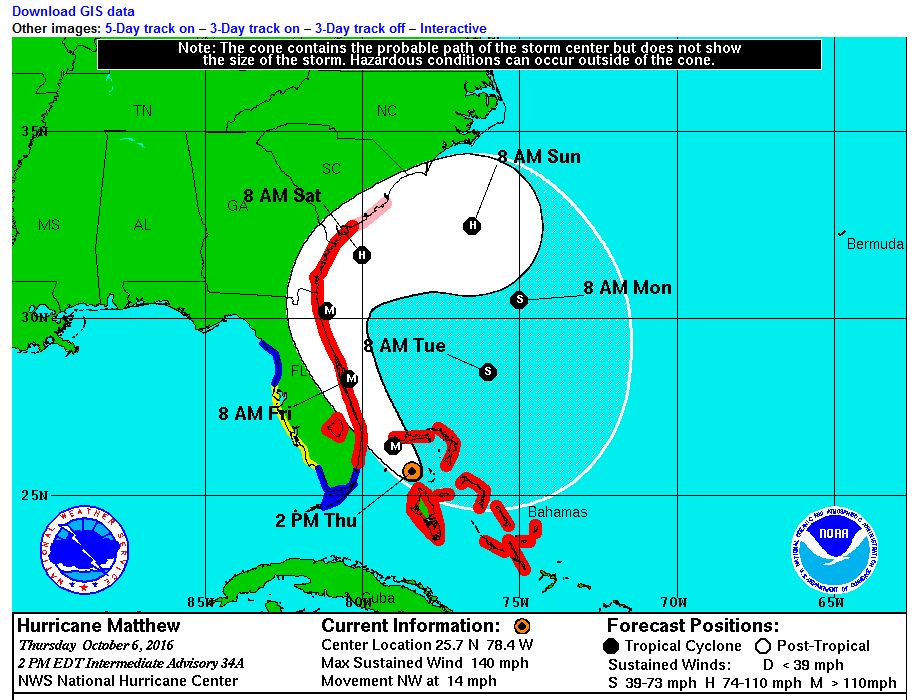
And special prayers go out for our friends in the Carribean nations who are dealing with the aftermath.
72 de Larry W2LJ
QRP - When you care to send the very least!
Larry Makoski, W2LJ, is a regular contributor to AmateurRadio.com and writes from New Jersey, USA. Contact him at [email protected].
Matthew
Earnest prayers that Matthew leaves you as un-battered and un-bruised as possible - AND that all your antennas stay up in the air.
Be safe; and have those batteries charged and those "Go Kits" locked and loaded!
And special prayers go out for our friends in the Carribean nations who are dealing with the aftermath.
72 de Larry W2LJ
QRP - When you care to send the very least!
Larry Makoski, W2LJ, is a regular contributor to AmateurRadio.com and writes from New Jersey, USA. Contact him at [email protected].
Rehab for the KØNR Repeater
My UHF repeater has been operating on 447.725 MHz here in Monument for a couple of decades now. It started out as a classic “pet repeater” project and has been operating from my basement all this time. Over time it has picked up additional users and has turned into the de facto hangout for our local radio club.
The repeater system has gone through a number of revisions over the years, especially for the RF transmitter and receiver. I wanted to retire the pair of Motorola Mitrek mobile radios I have been using when they started to exhibit a few lose connections. Really though, I thought it was time for some synthesized, modern RF gear in a compact package.
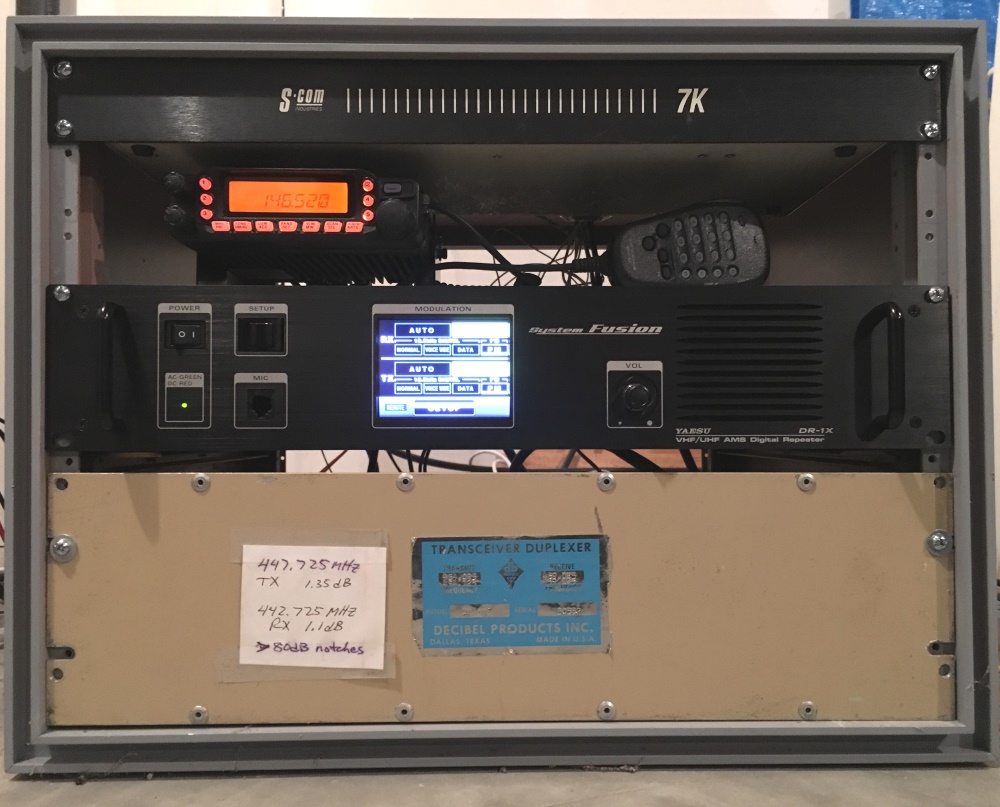 When Yaesu offered an attractive price on their DR-1X Fusion repeater, I jumped at the chance. Initially, I put it on the air in mixed analog-digital mode with the repeater automatically switching modes to handle either analog FM or C4FM digital. I used the internal controller of the DR-1X which is quite simple and has limited functionality. The DR-1X supports using an external controller but implementing the mixed analog-digital mode is…well…challenging. (Various people have figured out ways to do it with modifications to the DR-1X or using additional hardware.) In the end, I decided to just run the repeater in analog FM mode and have the expanded features of a real controller.
The repeater controller is an SCOM 7K that has been in service for decades. SCOM has long since moved on to a newer, improved model but my 7K keeps on ticking. The 7K has the voice synthesis and autopatch options installed, so, yes the repeater has an autopatch (not that anyone cares). A Yaesu FT-7800R is used as a 2m remote base and the duplexer is a classic Decibel Products. Not shown in the photo is a Bearcat WX100 weather receiver that is used to transmit weather information when an alert occurs in our area.
I’ve documented the wiring diagram and configuration used here: k0nr-repeater-construction-notes
This was a good opportunity to clean up some of the cabling and physical mounting that had degraded over time. (A kluge here, a kluge there and entropy takes over.) I am happy with the result.
73, Bob K0NR
The post Rehab for the KØNR Repeater appeared first on The KØNR Radio Site.
Bob Witte, KØNR, is a regular contributor to AmateurRadio.com and writes from Colorado, USA. Contact him at [email protected].
VK-VE 630m Repeat
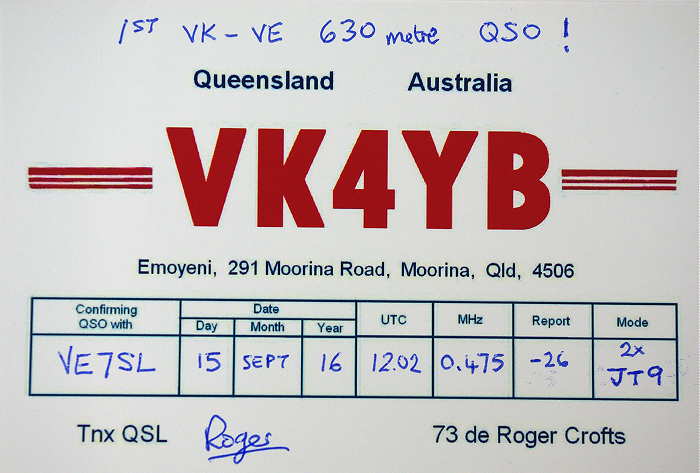
On Saturday morning, VK4YB and I had our second QSO on 630m using JT9, the WSPR QSO mode. Signals were slightly better than our initial contact but still far from previously seen conditions on the 11,000 + km Trans-Pacific path. However what happened following our contact was equally exciting.
I thanked Roger for the contact, via the ON4KST LF / MF chat page and indicated I was going back to bed as it was still pre-sunrise here on the west coast. He indicated that my signal strength had increased noticeably on my last two transmissions and asked if we might try CW for a few minutes.
We had previously devised our CW protocol to follow a similar one to that used in CW moonbounce work. We would transmit and receive in one minute sequences, with me transmitting on the even minutes and Roger on the odd. Instead of using the RST code for signal reporting, an 'O' is used to indicate reception strong enough to have been able to copy both calls. Both stations are required to copy the 'O', which cannot be sent until both calls have been fully copied. An acknowledgement ('R') must also be sent and copied by both stations to indicate receipt of the signal report. Once the 'R' has been copied, the final transmission(s) are a '73'. Once both stations have copied the 'R', the '73' is technically not required but when copied, further confirms the completion of a valid contact.
For both of us (late at night for him and pre-dawn for me), it was a bit of a mad scramble to make a quick changeover to CW. From my end, there are a number of changes that must be made correctly to avoid over-driving the transverter and damaging the frequency doubler as well as changing to manual PTT to avoid hot-switching of the antenna relays. I also need to bring up the PC's visible clock-face with its sweep second-hand ... but we both made the transition in about two minutes.
We ran for about 45 minutes during which time I heard Roger's CW on two back-to-back sequences (1331Z and 1333Z), copying both calls on each sequence. From 1331Z on, I added Roger's signal report to my calls to him ... 'VK4YB VE7SL OOO'.
We stopped at my sunrise but Roger had only copied fragments of my transmission and never enough to copy both calls. It appeared that we could both have used a few more db on the path as previous estimates have indicated that we might see at least another 5 or 6db yet, on a really good morning. As well, it seemed that the TP pipeline on Saturday morning had centered itself to my south, around northern California and VE7 was on the far northern edge of the propagation path.
Well it seemed that Sunday morning had moved the path further to the north and our 'extra 5-6db' was on hand. All of the local VE7's had numerous decodes of Roger's WSPR signals, including my own 20 decodes in the pre-dawn hours, but ... as 'Murphy' would have it, Roger was suffering receiver-blocking thunderstorm / lightning noise, keeping his K3's s-meter hard against the pin and absolutely no chance of a CW sked. It may have been a much more exciting morning had the spring weather near Roger been more cooperative.
This morning, the weather was still restricting good reception down-under but is forecast to dissipate shortly. But Murphy has not finished with us yet, as the TP path had also noticeably deteriorated today as well. It looks as though the challenge will now be getting everything to come into perfect alignment before the summer weather in VK shuts our CW attempts down for the season.
Steve McDonald, VE7SL, is a regular contributor to AmateurRadio.com and writes from British Columbia, Canada. Contact him at [email protected].
 Ham Radio Deluxe |
 W5SWL Electronics |
 Ham Radio Prep |
 KB3IFH QSL Cards  Hip Ham Shirts  HamRadioAuctions HamRadioAuctions Reliance Antennas Reliance Antennas Enigma Shop Enigma Shop |  morseDX  Ni4L Antennas  R&L Electronics R&L Electronics antennas.us antennas.us QRV QRV |
- Matt W1MST, Managing Editor
