 |
 Amateur Radio Weekly – Issue 140
 31 December 2016 | by
2016 Year in Review
For this last issue of the year, I pulled the most popular links from each issue and complied the top 10
as a ‘look back’ on the world of Amateur Radio in 2016. Enjoy! –Cale K4HCK
#10
A stealthy HOA HamStick directional dipole
This is a sneak peek at a very detailed build, tune, and operation on 20 and 40 meter bands using both Phone and PSK31.
Prepared Ham (Issue 94)
#9
Hey, which coaxial cable should I use?
We’ll focus on the most popular cables, with 50 ohm impedance to match the output impedance of our transceivers.
Ham Radio School (Issue 115)
#8
Five common mistakes new Hams make
This short list comes from working with a gaggle of new hams over the years and trying to help them get started in ham radio.
Ham Radio School (Issue 137)
#7
Hidden Antennas for HOA restrictions?
I have a confession to make… I live in a HOA! I know most hams say what the hell did you do that for, you knew you could not put up a 60 foot tower. Turn in your FCC license…
Prepared Ham (Issue 97)
#6
Easy, homemade Outernet antenna
An antenna for less than $1 total cost, doable without power tools and soldering, in less than 30 minutes.
Radio for Everyone (Issue 136)
#5
Portable antenna options for HF
For all the choices, it’s surprisingly hard to find a portable antenna for HF that is affordable and practical.
Off Grid Ham (Issue 138)
#4
End-Fed antenna revisited
I really like the simplicity of this antenna for many aspects: fast to deploy, works on many bands, no antenna to tune…
VA2SS (Issue 126)
#3
New: Baofeng UV-50X3 tri-band mobile
Baofeng just launched the UV-50X3 tri-band mobile radio and it looks like a jab, cross and left hook to the established Japanese manufacturers who were caught dreaming about DMR, C4FM, D-STAR and other leprechauns.
QRPblog (Issue 120)
#2
Repeater owner bans Baofeng radios
Simply put, these radios do not allow for “advancing skills in both the communication and technical phases of the art” (Part 97.1).
N4NJJ (Issue 108)
#1
First impressions of the Icom IC-7300 HF + 6M transceiver
We did not use the transmit functions on the radio, but were able to test out the receiver at my campsite with a Budipole antenna on 40 meters.
AB4BJ (Issue 99)
Amateur Radio Weekly is curated by Cale Mooth K4HCK. Sign up free to receive ham radio's most relevant news, projects, technology and events by e-mail each week at http://www.hamweekly.com.
LHS Episode #181: Drinking to the Future
 In the final episode for 2016, Linux in the Ham Shack discusses 60-meter operation, a new version of fldigi, OpenShot, bash on WIndows, Cheryl installing Ubuntu, a new release of Andy's Ham Radio Linux, predictions for 2017, whiskey and a whole lot more. Thanks for tuning in. We hope you have a happy and prosperous 2017.
73 de The LHS Crew
Russ Woodman, K5TUX, co-hosts the Linux in the Ham Shack podcast which is available for download in both MP3 and OGG audio format. Contact him at [email protected].
The Spectrum Monitor — January, 2017
 Stories you’ll find in our January, 2017 issue:
Living the Shortwave Broadcasting Dream at WTWW
By Keith Baker KB1SF/VA3KSF
Ted Randall WB8PUM is a lucky guy. Every day he gets to play radio with some pretty big transmitters and some very large antennas. What’s more, his whole family gets to play too. And at night, after work, he gets to play some more! Keith Baker tells us all about the radio engineer behind the mic at the “QSO Radio Show,” Tuesday evenings on 5.085 MHz shortwave.
SteppIR BigIR MK IV: Going to Great Lengths
By Mark Haverstock K8MSH
In limited spaces, the vertical has become the go-to antenna for many installations. They seem like a perfect solution; footprints are small, and simple radial systems are easy to hide in the turf. Verticals also exhibit lower angles of radiation, making them perfect for DX work. The SteppIR BigIR stands out as an alternative, providing a system that will mechanically create a quarter wave vertical on any of the major ham bands–even MARS frequencies.
Going Mobile with SDR
By Robert Gulley AK3Q
There are a number of reasons to go mobile with an SDR, not the least of which is the adventure factor! Every new place offers new listening opportunities; it is a bit like fingerprints in that no two locations are exactly the same. Every location offers something different, and with the wide-ranging capabilities of the SDR there are always new things to hear. Robert shows us what to bring along, how to hook up to power and an antenna. It’s easier than you might think!
The Extra Punch of SSB on CB
By Cory Sickles
In recent months, Cory has spent a good deal of time on the VHF and UHF aspects of Citizens Band, but CB is thought of more for what goes on at 27 MHz. To be sure, the core HF allocation is where the majority of CB users start and where they stay. As a simple option to enter the two-way radio hobby, it’s hard to beat. But that doesn’t mean the world of CB has to be limited to 4 watts of amplitude modulation. Cory explains what happens when CB goes SSB.
Basics of Motorized Satellite Reception: Part 1
By Mike Kohl
Free-to-Air satellite-TV enthusiasts get the most out of their systems, whether they’re Ku-only or C/Ku-Band big-dish systems, when they are motorized. But, moving small dishes or big dishes requires the right sort of motor and proper connections. Mike shows us how it’s done in Part 1.
Klingenfuss Utility Monitoring Book
By Bob Grove W8JHD
For several decades, Joerg Klingenfuss has been the consummate publisher of radio frequency directories on a global basis. His latest offerings include frequency guides, databases and CDs, code books, signal sound CDs, a frequency list for the Perseus SDR, screen-shots on a USB stick, and Internet web pages. Bob Grove takes a look at this extensive new collection.
Scanning America
By Dan Veenaman
New Digital Modes for Some Scanners
Federal Wavelengths
By Chris Parris
A New Year In Federal Monitoring
Utility Planet
By Hugh Stegman NV6H
U. of Twente WebSDR Featured in Popular Video
HF Utility Logs
By Mike Chace-Ortiz and Hugh Stegman
Digitally Speaking
By Cory Sickles WA3UVV
The Advantages of DMR on VHF
VHF and Above
By Joe Lynch N6CL
Aurorasaurus.org: Aurora Tracking in Real Time
Amateur Radio Insights
By Kirk Kleinschmidt NT0Z
A Vertical in Winter
Radio 101
By Ken Reitz KS4ZR
FTA Satellite TV Part II: “Hidden” Signals on Satellite TV
Radio Propagation
By Tomas Hood NW7US
Solar Cycle 24 Downgraded (Again)
The World of Shortwave Listening
By Jeff White
HFCC B16 Coordinating Conference in Miami and Okeechobee
The Shortwave Listener
By Fred Waterer
Radio Australia Leaves Shortwave
Maritime Monitoring
By Ron Walsh VE3GO
The Old and the New
The Longwave Zone
By Kevin O’Hern Carey WB2QMY
More LW Information Sources and Readers’ LW Logs
Adventures in Radio Restoration
By Rich Post KB8TAD
Hallicrafters S-38B: the UL-Approved Basket Case
Antenna Connections
By Dan Farber AC0LW
Sunspots Maybe, Part 2: Hey, Dan, What About Stealth?
The Spectrum Monitor is available in PDF format which can be read on any desktop, laptop, iPad®, Kindle® Fire, or other device capable of opening a PDF file. Annual subscription is $24. Individual monthly issues are available for $3 each.
Ken Reitz, KS4ZR, is publisher and managing editor of The Spectrum Monitor. Contact him at [email protected].
Practicing CW QSO’s without RF
The bands are starting to make my cw practice pretty heavy going. I got one contact over the Christmas period with my ft-817 and end fed antenna and to be frank I made bit of a hash of it. Lots of errors mainly caused by a lack of practice time on the key.
I’m sure that I won’t be alone in saying that practice software goes a long way to getting rid of those errors and helps you move up from glacial sending and receiving speeds but nothing matches on air work . But what can you do when there’s no chance of a decent QSO / Sked. Well there may be an answer in iCW.  It is a Mumble based system that does away with all that pesky RF and simply allows you to connect you key (via a keyer or in my case from the audio out of my transceiver) to a computer and then hey presto you can practice with your friends to your hearts content.
There seem to be a couple of websites that cover the detail. The main one and a one that shows you a bit more detail. Its a bit confusing but having said that the setup is pretty straightforward and some really helpful video’s help get the finer points sorted.
So it dire times of s9 noise and no propagation. There’s plenty of opportunity to get some practice in.
Alex Hill, G7KSE, is a regular contributor to AmateurRadio.com and writes from Cumbria, UK. Contact him at [email protected].
Going cold turkey
I smoked for a very brief period of time (maybe 1/2 a year) when I was in college and to this day, I'll enjoy a cigar at a wedding, if they're being offered; but I never smoked to the point where it became a habit. I can imagine though, for a hard core chain smoker, the thought of going "cold turkey" probably produces cold sweats and chills down the spine.
Thanks to the ARRL, many of us have become addicted to National Parks on the Air. I say that in a teasing and friendly manner. But the fact remains that for the past 12 months we have really enjoyed chasing and activating the over 400 National Park System entities.
A lot of folks went in whole hog and seemed to make it their mission to activate as many entities as possible. Some made it a family affair, taking their spouses and children on a tour of the USA. Some seemed to take a sabbatical from work in order to satisfy their craving. Some slept in cars, hopping from site to site, alternately activating and then hunting for a spot with WiFi so they could upload their logs to Logbook of the World. A lot were like me, activating sites that were relatively close to home when chores and family commitments allowed some of that seemingly rare commodity - free time. One thing seemed certain, though, whether you were a hard core NPOTA'er or just an occasional dabbler ...... everyone who got involved had a good time.
So it is with mixed emotions that I anticipate the end of NPOTA 2016. I will always have fond memories of my activations, and of how I incorporated NPOTA into the 2016 NJQRP Skeeter Hunt, and of the many hours I spent behind the key (and microphone) as a chaser. I think I spent more time behind the microphone this year than in all my 38 years of Amateur Radio combined.
I will also fondly remember the friendships that have formed with many activators and fellow chasers on the air and through the NPOTA page on Facebook. Call signs have become names and faces instead of just random letter/number combinations. In a few instances, Hams that I have known for years and have only worked via Morse Code have now become familiar voices! And when was the last time a fellow Ham gave you cookies or a pizza for working them? Chalk up those innovative ideas for fellowship to NPOTA!
For many, NPOTA became an opportunity for us to rethink how we thought about Amateur Radio. A lot of us had to shed all previous notions and start thinking outside the box. For many it was the first time they ever operated outside the home Shack other than Field Day. NPOTA became a fantastic opportunity to learn about what works and what doesn't. Many of us became more in tune with our equipment, using it in ways we never had before, expanding our capabilities and experiences. It was an opportunity for many to build and experiment with new antenna systems, new power systems, new ways of doing things that were previously taken for granted. For many of us, it also became a school for learning (real fast!) how to improvise when piece of equipment was forgotten; or how to make quick (and sometimes not so pretty) repairs when something would break or malfunction. Through it all, we became better Amateur Radio Operators because of it; and there's no amount of money you can place on that.
It will be very hard for all NPOTA'ers when 23:59:59 UTC rolls around on December 31st and it's all gone; and we're all going "cold turkey". As far as this particular event is concerned, microphones and keys will go silent and we'll only have the sweet memories of the past 12 months to comfort us. It will seem strange not to turn on the rig and twiddle the dial looking for that new entity to work - looking for familiar call signs that we could count on to be activating some new place of historical significance.
So many thanks go out. To Sean Kutzko KX9X and Norm Fusaro W3IZ from the League, who did a magnificent job tending and managing the NPOTA program. To the ARRL for sponsoring the event and making the resources available that are necessary to run something of this magnitude. Web space and server space don't grow on trees, so the next time you're ready to grouse about "What does the ARRL do for me?" ....... well, here's a good example.

Thanks to the many before mentioned activators, who provided me with so many moments of fun as well as so many moments of anticipation, and yes, even some moments of frustration. Many thanks to the chasers who worked me (and will work me tomorrow during my two, final activations). Without all you fine folks, this NPOTA concept would have been just that - a concept. You all breathed life into what may well go down in history as the most fondly remembered activity the ARRL ever sponsored.
Lastly, so many thanks to the National Park System and its employees. You have been the most kind and gracious hosts to all of us these past twelve months. You not only were knowledgeable and competent guides, you also became good friends. We are in your debt for your generous hospitality.
72 de W2LJ
QRP - When you care to send the very least!
Larry Makoski, W2LJ, is a regular contributor to AmateurRadio.com and writes from New Jersey, USA. Contact him at [email protected].
Going cold turkey
I smoked for a very brief period of time (maybe 1/2 a year) when I was in college and to this day, I'll enjoy a cigar at a wedding, if they're being offered; but I never smoked to the point where it became a habit. I can imagine though, for a hard core chain smoker, the thought of going "cold turkey" probably produces cold sweats and chills down the spine.
Thanks to the ARRL, many of us have become addicted to National Parks on the Air. I say that in a teasing and friendly manner. But the fact remains that for the past 12 months we have really enjoyed chasing and activating the over 400 National Park System entities.
A lot of folks went in whole hog and seemed to make it their mission to activate as many entities as possible. Some made it a family affair, taking their spouses and children on a tour of the USA. Some seemed to take a sabbatical from work in order to satisfy their craving. Some slept in cars, hopping from site to site, alternately activating and then hunting for a spot with WiFi so they could upload their logs to Logbook of the World. A lot were like me, activating sites that were relatively close to home when chores and family commitments allowed some of that seemingly rare commodity - free time. One thing seemed certain, though, whether you were a hard core NPOTA'er or just an occasional dabbler ...... everyone who got involved had a good time.
So it is with mixed emotions that I anticipate the end of NPOTA 2016. I will always have fond memories of my activations, and of how I incorporated NPOTA into the 2016 NJQRP Skeeter Hunt, and of the many hours I spent behind the key (and microphone) as a chaser. I think I spent more time behind the microphone this year than in all my 38 years of Amateur Radio combined.
I will also fondly remember the friendships that have formed with many activators and fellow chasers on the air and through the NPOTA page on Facebook. Call signs have become names and faces instead of just random letter/number combinations. In a few instances, Hams that I have known for years and have only worked via Morse Code have now become familiar voices! And when was the last time a fellow Ham gave you cookies or a pizza for working them? Chalk up those innovative ideas for fellowship to NPOTA!
For many, NPOTA became an opportunity for us to rethink how we thought about Amateur Radio. A lot of us had to shed all previous notions and start thinking outside the box. For many it was the first time they ever operated outside the home Shack other than Field Day. NPOTA became a fantastic opportunity to learn about what works and what doesn't. Many of us became more in tune with our equipment, using it in ways we never had before, expanding our capabilities and experiences. It was an opportunity for many to build and experiment with new antenna systems, new power systems, new ways of doing things that were previously taken for granted. For many of us, it also became a school for learning (real fast!) how to improvise when piece of equipment was forgotten; or how to make quick (and sometimes not so pretty) repairs when something would break or malfunction. Through it all, we became better Amateur Radio Operators because of it; and there's no amount of money you can place on that.
It will be very hard for all NPOTA'ers when 23:59:59 UTC rolls around on December 31st and it's all gone; and we're all going "cold turkey". As far as this particular event is concerned, microphones and keys will go silent and we'll only have the sweet memories of the past 12 months to comfort us. It will seem strange not to turn on the rig and twiddle the dial looking for that new entity to work - looking for familiar call signs that we could count on to be activating some new place of historical significance.
So many thanks go out. To Sean Kutzko KX9X and Norm Fusaro W3IZ from the League, who did a magnificent job tending and managing the NPOTA program. To the ARRL for sponsoring the event and making the resources available that are necessary to run something of this magnitude. Web space and server space don't grow on trees, so the next time you're ready to grouse about "What does the ARRL do for me?" ....... well, here's a good example.
Thanks to the many before mentioned activators, who provided me with so many moments of fun as well as so many moments of anticipation, and yes, even some moments of frustration. Many thanks to the chasers who worked me (and will work me tomorrow during my two, final activations). Without all you fine folks, this NPOTA concept would have been just that - a concept. You all breathed life into what may well go down in history as the most fondly remembered activity the ARRL ever sponsored.
Lastly, so many thanks to the National Park System and its employees. You have been the most kind and gracious hosts to all of us these past twelve months. You not only were knowledgeable and competent guides, you also became good friends. We are in your debt for your generous hospitality.
72 de W2LJ
QRP - When you care to send the very least!
Larry Makoski, W2LJ, is a regular contributor to AmateurRadio.com and writes from New Jersey, USA. Contact him at [email protected].
CQ – 630m Crossband Anyone?

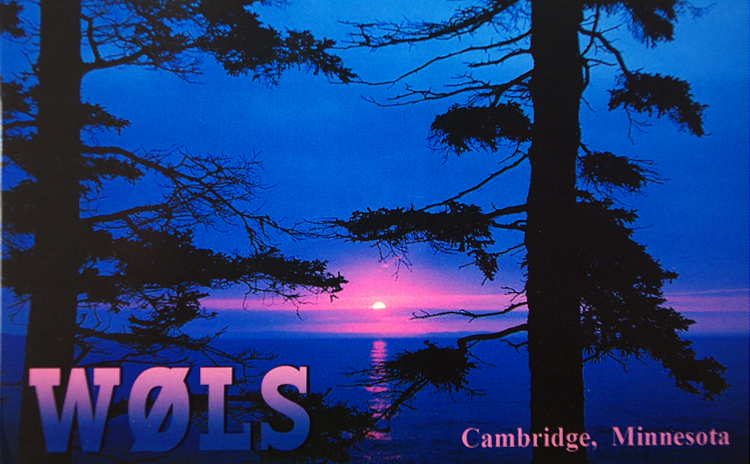
A very beautiful QSL arrived in the mail last week, confirming my 630m crossband contact with Harry, WØLS, in Minnesota.
According to Harry's card, this was the first time he had ever listened on 630m and was very surprised to hear me, let alone complete the two-way contact.
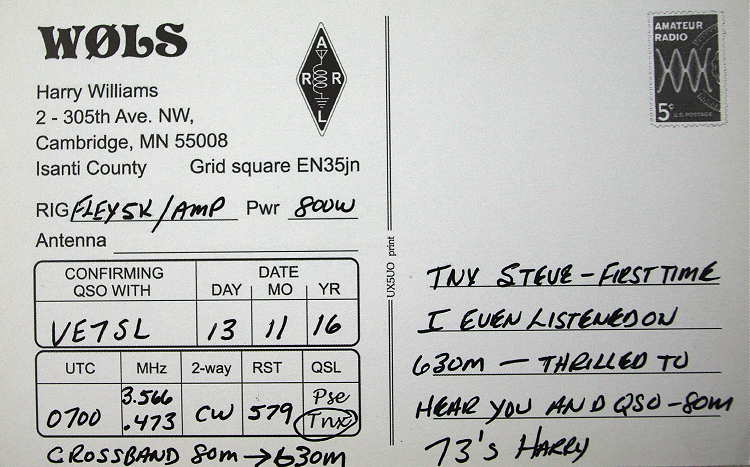
Harry was transmitting on 80m CW while I was transmitting on 630m, on 473.00 kHz. It really does not take too much to be able to hear signals on 630m, especially if you are not overwhelmed with a high noise floor ... most low band wire antennas will hear pretty well down there, when pressed into service.
This week, the card from Jeffrey, KGØVL in Iowa arrived. This one also confirmed a 630m crossband contact. Both of these QSO's were made during the November's 630m activity night.
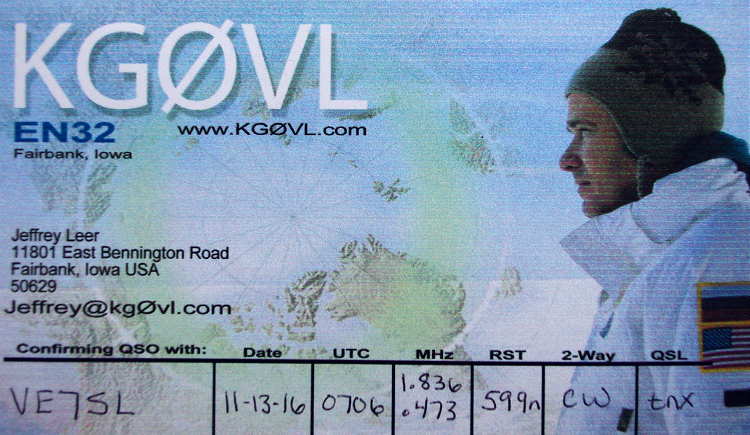
Jeffrey was transmitting on 160m while listening to my signal on 473.00 kHz with his 160m inverted-L.
It's not really necessary to wait for another activity night to have some fun, so ... if you would be interested in trying a crossband CW contact, I would be more than excited to give it a shot.
I can listen on 160, 80 or 40m for you, if you can listen on 630m for me! If we can arrange a sked, I could probably talk a few of the other local 630m VE7's into tagging-along so that you end up with a double or triple-header of VE7's in the logbook.
Please e-mail if you would like to try... ve7sl at shaw.ca
Steve McDonald, VE7SL, is a regular contributor to AmateurRadio.com and writes from British Columbia, Canada. Contact him at [email protected].
 Ham Radio Deluxe |
 W5SWL Electronics |
 Ham Radio Prep |
 KB3IFH QSL Cards  Hip Ham Shirts  HamRadioAuctions HamRadioAuctions Reliance Antennas Reliance Antennas Enigma Shop Enigma Shop |  morseDX  Ni4L Antennas  R&L Electronics R&L Electronics antennas.us antennas.us QRV QRV |
- Matt W1MST, Managing Editor
