 |
 ZF1 – VE7 On 630m
 24 January 2017 | by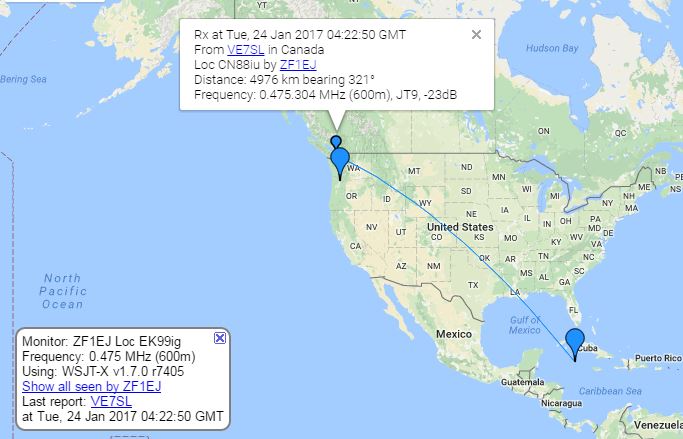
Early last night ZF1EJ (Eden) and I were able to easily complete a two way JT9 QSO on 630m ... 475.300 kHz to be more exact.
This was Eden's first 630m JT9 QSO as well as the first ever 630m QSO between Canada and the Cayman Islands. The contact was completed shortly between 8:15 and 8:30 PM local time. The contact attempt was initiated via the ON4KST 2200m / 630m chat page after I had decoded Eden's signal shortly before 7 PM local time ... the first time I have seen his signal so early in the evening.
Eden was using a VK4YB Monitor Sensors Transverter and a newly deployed transmitting antenna described below in the KB5NJD Daily 630m Report:
"This is how the antenna is setup:- It is a tophat vertical, the tophat is 65’ 6” long and about 80’ above ground, the vertical is 74’ 6”, There are 4 radials 10’ above ground, each 128’ 6” long. The antenna is made of #10, stranded insulated wire. The tophat is strung between two towers and is side on about 45 deg. The tuner was built by Ron and Ward a few month ago and shipped down to me. Just found the time to set it up recently. The SWR is 1.1-1 and I am using a Monitor Sensors Transverter built by Roger, VK4YB. Output to antenna 22 watts."
The only change to the above report was Eden's e-mail follow-up indicating that his power output during our QSO was 32 watts ... conditions must have been even better than I thought.
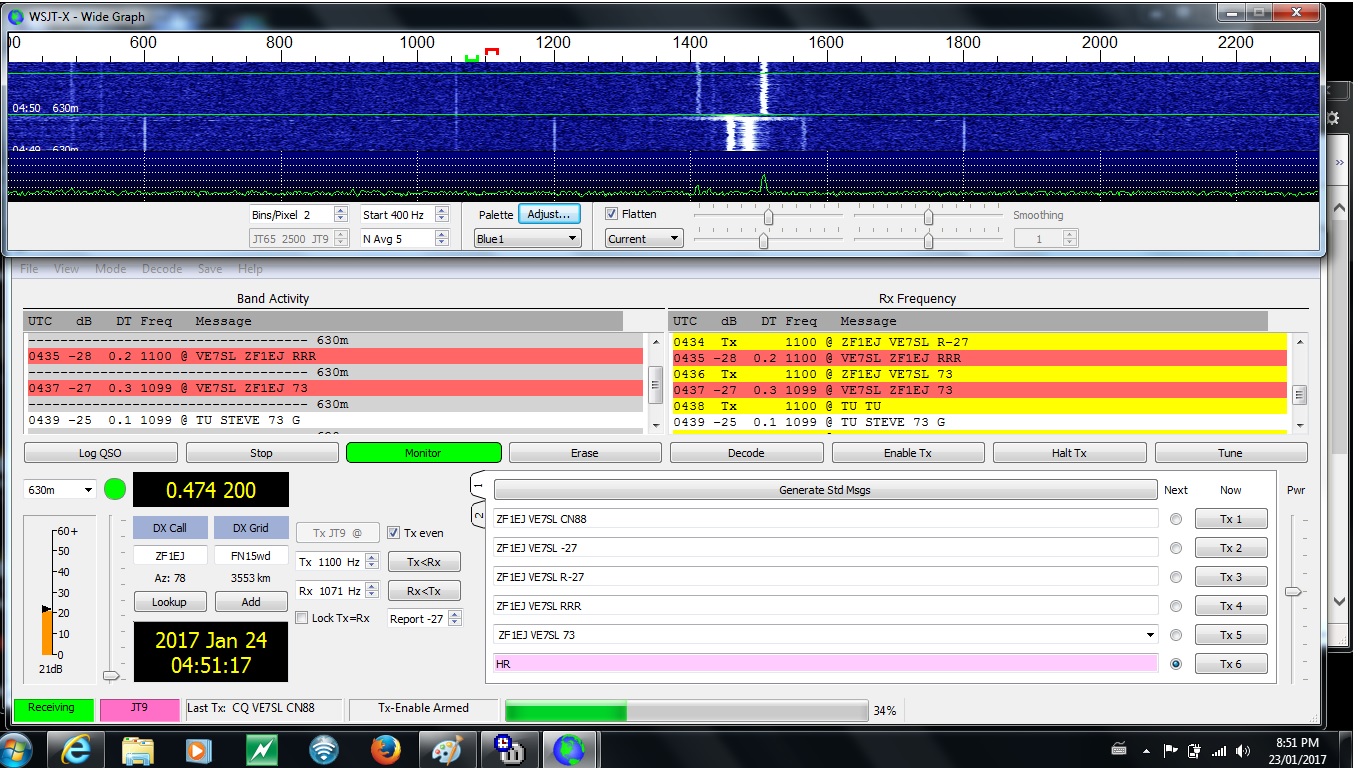 |
| JT-9 Screen At VE7SL |
With an even newer JT-9A mode now promising a 2db improvement, making contacts should be even easier. Once the USA gets access to 630m, it is clear that Eden will be a popular target for most North American stations!
Steve McDonald, VE7SL, is a regular contributor to AmateurRadio.com and writes from British Columbia, Canada. Contact him at [email protected].
ICQ Podcast Episode 229 – Small Computers for Ham Radio
In this episode, Martin M1MRB / W9ICQ is joined by Chris Howard M0TCH, Martin Rothwell M0SGL, and Ed Durrant DD5LP to discuss the latest Amateur / Ham Radio news. Colin M6BOY rounds up the news in brief, and this episode’s features is Small computers for Ham Radio.
We would like to thank our monthly and annual donors for keeping the podcast advert free. To donate, please visit - http://www.icqpodcast.com/donate
- End of Norwegian FM
- RAYNET Supporting Jaywick Evacuation
- Illegal Drone Transmitters Complaint
- CW Saves Man with Broken Leg
- Czech Keep 60m Band for 2017
- Small Changes to Australian Plan
- School Wins ARRL Grant
Colin Butler, M6BOY, is the host of the ICQ Podcast, a weekly radio show about Amateur Radio. Contact him at [email protected].
ICQ Podcast Episode 229 – Small Computers for Ham Radio
In this episode, Martin M1MRB / W9ICQ is joined by Chris Howard M0TCH, Martin Rothwell M0SGL, and Ed Durrant DD5LP to discuss the latest Amateur / Ham Radio news. Colin M6BOY rounds up the news in brief, and this episode’s features is Small computers for Ham Radio.
We would like to thank our monthly and annual donors for keeping the podcast advert free. To donate, please visit - http://www.icqpodcast.com/donate
- End of Norwegian FM
- RAYNET Supporting Jaywick Evacuation
- Illegal Drone Transmitters Complaint
- CW Saves Man with Broken Leg
- Czech Keep 60m Band for 2017
- Small Changes to Australian Plan
- School Wins ARRL Grant
Colin Butler, M6BOY, is the host of the ICQ Podcast, a weekly radio show about Amateur Radio. Contact him at [email protected].
Amateur Radio Weekly – Issue 143

Parity Act bill reintroduced in US House of Representatives
The bill’s language is identical to that of the 2015 measure, H.R. 1301, which passed in the House late last summer but failed in the waning days of the US Senate.
ARRL
Standing desks for Ham shacks?
I’m quickly realizing standing is clearly helpful, because the same problems came up, even though my new chair was more ergonomic.
N0SSC
Ham Radio EMCOMM Go Kit
In order to simplify the cabling between the SignaLink and my laptop I decided to us a powered USB hub and to make the USB hub accessible on the back of the case.
High On Solder
Amateur Radio Club Survey 2017
We’ve just launched our 2017 amateur radio survey to get a snapshot of an aspect of the hobby.
Essex Ham
Ambulances to jam car radios in Sweden
Ambulances in Stockholm are testing a system that interrupts in-car audio systems to warn drivers that they need to get through.
BBC News
Walkie Talkie Duino
An open source wireless shield for Arduino that can send data and audio.
Tindie
Property owner wants to remove ham radio towers from atop hotel
The property’s new owner wants to take down the repeater site due to what it calls safety and security concerns.
News12
Callsign lookup when portable
QRZ is one of the more popular websites for looking up callsigns but the website is not formatted for use on mobile devices.
Ham Radio QRP
Codec 2 700C
My endeavor to produce a digital voice mode that competes with SSB continues.
Rowetel
Video
Internet over powerline can wipe out the HF band
These devices allow you to use your house power cables as a convenient ethernet connection for sharing the internet. However they are extremely noisy and can wipe out the entire HF band.
YouTube
Amateur Radio Weekly is curated by Cale Mooth K4HCK. Sign up free to receive ham radio's most relevant news, projects, technology and events by e-mail each week at http://www.hamweekly.com.
The Green Glow

Recent emails from two friends brought new insight into a blog that I had been intending to do for some time.
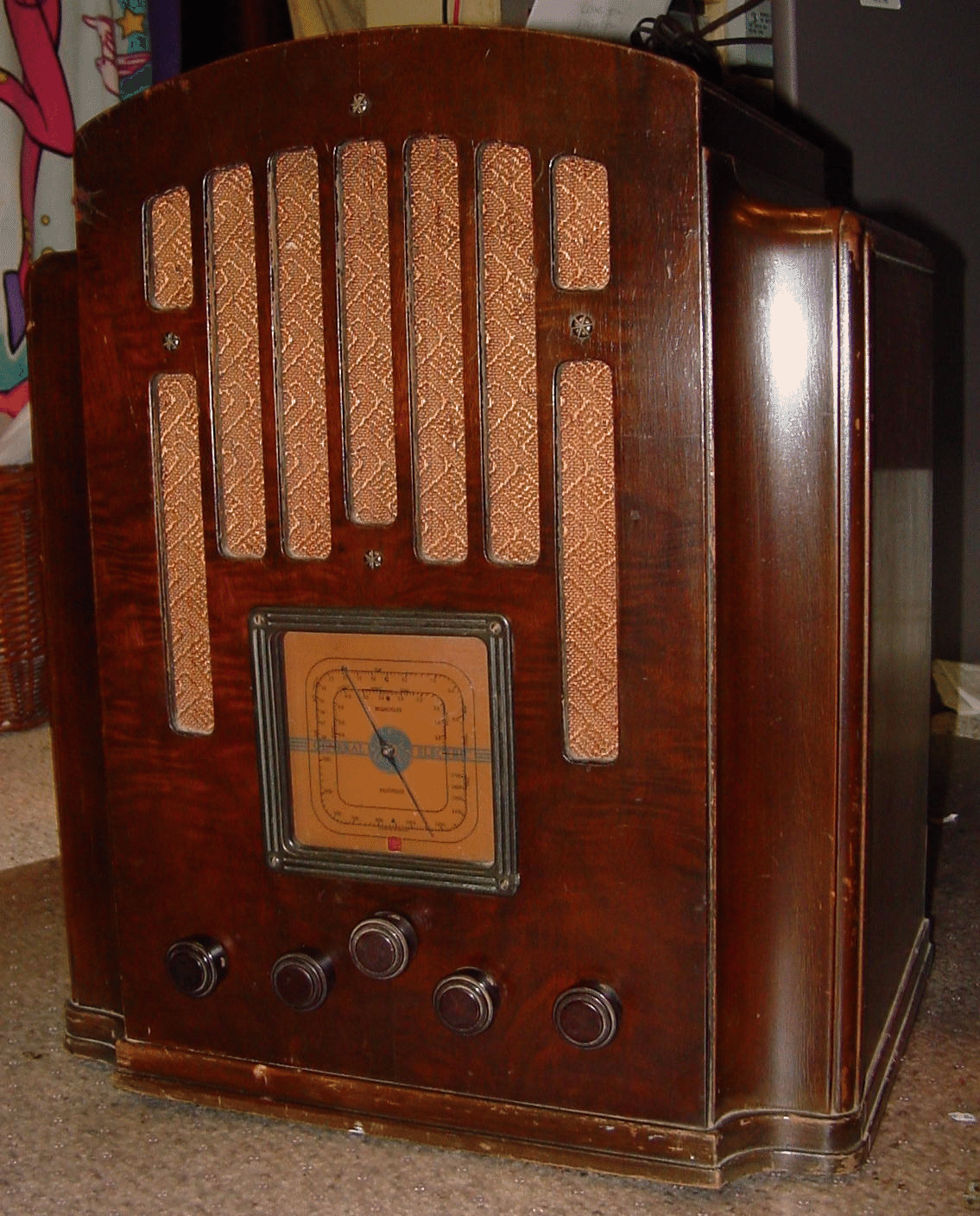
As has been mentioned on more than one occasion, I discovered radio at the age of 10, after reading an article about shortwave-listening in a drugstore magazine. My father was able to rescue an old GE cathedral from grandpa's downtown barbershop, where it sat gathering dust for several years in the back room storage space. Fortunately, it immediately came to life when plugged in and soon after dad spent an afternoon scurrying about on the roof of our 3-story house in central Vancouver, my radio-adventures began.
As I recall, the first couple of weeks were spent listening to radiotelephone traffic between various tugboats and their dispatchers, in the 2 megacycle marine band. Initially it took me awhile to figure out what I was listening to but found it fascinating to hear the tugboats up and down the coast getting their daily marching orders.
It wasn't too much later that I discovered the international shortwave bands and I was soon keeping detailed logs of my catches and mailing for a coveted QSL. Friday nights were always special as it meant I could DX well into the night and not worry about having to get out of bed for school early the next morning. My 3rd floor bedroom shack was the true definition of 'warm and cozy' and a memory I will always cherish.
Up to this point I had yet to discover ham radio. I must have tuned across a few conversations on phone but evidently hadn't been too awestruck at what I had heard ... perhaps I didn't know what I was hearing or was unable to comprehend some of the expressions they were using or what they were talking about when describing their gear. For whatever reason, the ham radio 'trigger-event' had not yet transpired ... but it soon would.
By this time, I had moved upward, from the Boy Cubs to the Boy Scouts. I must explain that these activities were forced upon me by my parents and not something I particularly enjoyed, especially the midwinter camping trips that were always pouring rain or freezing. Again, from grandfather, I had been provided with an old, virtually uninsulated, WW1 sleeping bag, that wouldn't have kept anyone alive at the western front for longer than a week. These all too regular winter excursions to the rain forest were pure misery and if I wasn't freezing to death then my sleeping bag was usually getting soaked from the river of rain running through the tent ... most of these weekend outings were sleepless and left me feeling like a zombie for the next few days. But ... not every scouting experience was bad and in fact, it was a scouting event that would soon provide my ham-radio 'trigger'!
The opportunity arrived for those that wished, to visit a local 'ham station' to partake in some sort of 'on-the-air experience'. This would have been in 1958 and having been already familiar with shortwave radio, I immediately signed-on.
A few weeks later, about six of us found ourselves in the basement shack of Ernie Savage, VE7FB. Although a stranger to me, Ernie was a well known 75m phone traffic man and an ardent 75m mobile operator. Although he was only about five-foot two, Ernie was a powerhouse of a personality and most of us cowered quietly as Ernie tweaked the dials and with a tight grip on his large microphone, barked louder than his small stature might suggest ... all of us quietly prayed that Ernie wouldn't pass the microphone to any of us.
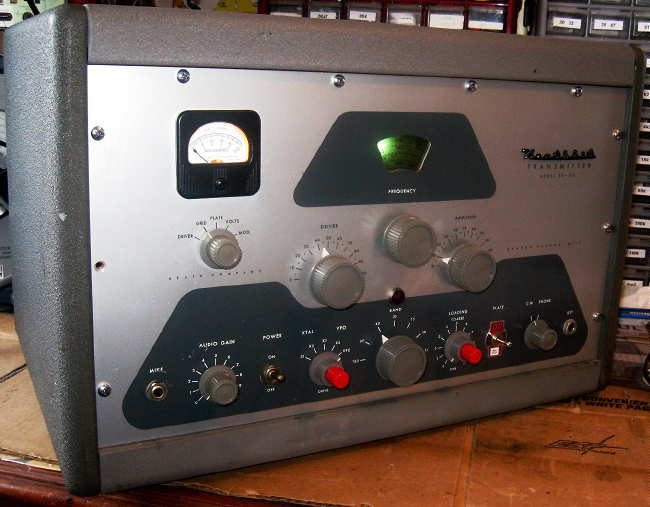
And then I saw it! Although I didn't know it at the time, it was a pivotal moment in my development and would shape all aspects of my life from that point forward.
 |
| courtesy: Paul's Tube Radio Restorations |
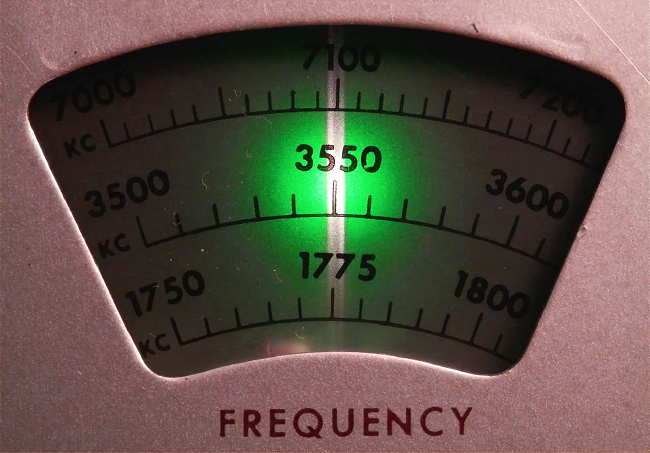 |
| Heathkit VF-1 VFO Dial |
Perhaps the Heathkit engineers had learned of the 'power of green' from those earlier genius Hallicrafter's draftsmen ... can anyone deny the alluring appeal of a Hallicrafter's front panel or dial?
 |
| Hallicrafters SX-42 Dial |
As a young teen, I could never afford to buy a DX-100 but I was able to buy a VF-1 and added one to my Heathkit DX-20 magic transporter. With the lights turned off in the high attic bedroom shack, the orange dials of the Super Pro and its backlit S-meter combined with the seductive green glow of the VF-1. It just couldn't get any better!
Until recently, I had no real idea of why I had found the green dials so enchanting but an email from Mark, VA7MM, finally made it all perfectly clear. Mark offered the most plausible explanation ... the diabolical Heathkit and Hallicrafters engineers had been putting Kryptonite in their dials ... the stuff that even Superman found overpowering and unable to resist!
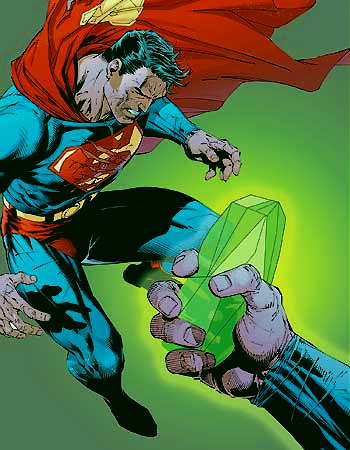 |
| Powerless |
Steve McDonald, VE7SL, is a regular contributor to AmateurRadio.com and writes from British Columbia, Canada. Contact him at [email protected].
The Green Glow
Recent emails from two friends brought new insight into a blog that I had been intending to do for some time.
As has been mentioned on more than one occasion, I discovered radio at the age of 10, after reading an article about shortwave-listening in a drugstore magazine. My father was able to rescue an old GE cathedral from grandpa's downtown barbershop, where it sat gathering dust for several years in the back room storage space. Fortunately, it immediately came to life when plugged in and soon after dad spent an afternoon scurrying about on the roof of our 3-story house in central Vancouver, my radio-adventures began.
As I recall, the first couple of weeks were spent listening to radiotelephone traffic between various tugboats and their dispatchers, in the 2 megacycle marine band. Initially it took me awhile to figure out what I was listening to but found it fascinating to hear the tugboats up and down the coast getting their daily marching orders.
It wasn't too much later that I discovered the international shortwave bands and I was soon keeping detailed logs of my catches and mailing for a coveted QSL. Friday nights were always special as it meant I could DX well into the night and not worry about having to get out of bed for school early the next morning. My 3rd floor bedroom shack was the true definition of 'warm and cozy' and a memory I will always cherish.
Up to this point I had yet to discover ham radio. I must have tuned across a few conversations on phone but evidently hadn't been too awestruck at what I had heard ... perhaps I didn't know what I was hearing or was unable to comprehend some of the expressions they were using or what they were talking about when describing their gear. For whatever reason, the ham radio 'trigger-event' had not yet transpired ... but it soon would.
By this time, I had moved upward, from the Boy Cubs to the Boy Scouts. I must explain that these activities were forced upon me by my parents and not something I particularly enjoyed, especially the midwinter camping trips that were always pouring rain or freezing. Again, from grandfather, I had been provided with an old, virtually uninsulated, WW1 sleeping bag, that wouldn't have kept anyone alive at the western front for longer than a week. These all too regular winter excursions to the rain forest were pure misery and if I wasn't freezing to death then my sleeping bag was usually getting soaked from the river of rain running through the tent ... most of these weekend outings were sleepless and left me feeling like a zombie for the next few days. But ... not every scouting experience was bad and in fact, it was a scouting event that would soon provide my ham-radio 'trigger'!
The opportunity arrived for those that wished, to visit a local 'ham station' to partake in some sort of 'on-the-air experience'. This would have been in 1958 and having been already familiar with shortwave radio, I immediately signed-on.
A few weeks later, about six of us found ourselves in the basement shack of Ernie Savage, VE7FB. Although a stranger to me, Ernie was a well known 75m phone traffic man and an ardent 75m mobile operator. Although he was only about five-foot two, Ernie was a powerhouse of a personality and most of us cowered quietly as Ernie tweaked the dials and with a tight grip on his large microphone, barked louder than his small stature might suggest ... all of us quietly prayed that Ernie wouldn't pass the microphone to any of us.
And then I saw it! Although I didn't know it at the time, it was a pivotal moment in my development and would shape all aspects of my life from that point forward.
|
| courtesy: Paul's Tube Radio Restorations |
|
| Heathkit VF-1 VFO Dial |
Perhaps the Heathkit engineers had learned of the 'power of green' from those earlier genius Hallicrafter's draftsmen ... can anyone deny the alluring appeal of a Hallicrafter's front panel or dial?
|
| Hallicrafters SX-42 Dial |
As a young teen, I could never afford to buy a DX-100 but I was able to buy a VF-1 and added one to my Heathkit DX-20 magic transporter. With the lights turned off in the high attic bedroom shack, the orange dials of the Super Pro and its backlit S-meter combined with the seductive green glow of the VF-1. It just couldn't get any better!
Until recently, I had no real idea of why I had found the green dials so enchanting but an email from Mark, VA7MM, finally made it all perfectly clear. Mark offered the most plausible explanation ... the diabolical Heathkit and Hallicrafters engineers had been putting Kryptonite in their dials ... the stuff that even Superman found overpowering and unable to resist!
|
| Powerless |
Steve McDonald, VE7SL, is a regular contributor to AmateurRadio.com and writes from British Columbia, Canada. Contact him at [email protected].
LHS Episode #182: You May Experience Browsiness
 In this breathtaking episode of Linux in the Ham Shack, your quasi-intelligent and always goofy hosts discuss new Boy Scout merit badges with a ham radio twist, sending balloons into space, Hamvention, Web browser you may not have heard of, a bunch o' Linux distros, upcoming cons, pineapples, great new music, Scotch and more. Thank you for tuning in and Happy New Year for 2017.
73 de The LHS Crew
Russ Woodman, K5TUX, co-hosts the Linux in the Ham Shack podcast which is available for download in both MP3 and OGG audio format. Contact him at [email protected].
 Ham Radio Deluxe |
 W5SWL Electronics |
 Ham Radio Prep |
 KB3IFH QSL Cards  Hip Ham Shirts  HamRadioAuctions HamRadioAuctions Reliance Antennas Reliance Antennas Enigma Shop Enigma Shop |  morseDX  Ni4L Antennas  R&L Electronics R&L Electronics antennas.us antennas.us QRV QRV |
- Matt W1MST, Managing Editor
