 |
 Amateur Radio Weekly – Issue 144
 28 January 2017 | by
Winter Field Day this weekend
If you are as serious about emergency communications as we are, we welcome you to join us for our yearly event.
WFDA
New FCC Chairman praises Parity Act
Newly designated FCC Chairman Ajit Pai praised the House action on H.R. 555 and other telecommunications-related legislation that cleared the chamber.
ARRL
HamRadio360: All about APRS
APRS, oh the questions you’ve raised!
HamRadio360
CIA documents about Ham Radio declassified
The CIA has recently released around 13 million pages of declassified documents. Among these documents is a set of reports on Ham Radio in the former Soviet Union.
Ham Radio Reviews
Making broadcast towers bird-friendly
In 1976 in Gun Lake, Mich., one tower killed more than 2,300 birds in one night.
NPR
Mt Herman Winter Activation
We returned to the Most Radio Active Mountain in Colorado, Mount Herman, for a combination VHF contest, SOTA activation and winter hike.
K0NR
Simple Wi-Fi Yagi
It’s easy to make a small Yagi for a wireless router even if it lacks an antenna connector. The photo shows how I added two parasitic elements to the sleeve dipole of my Netgear WGR614.
K6STI
Building an ADS-B station
Complete guide to building an ADS-B station: theory, components, maximizing reception performance.
Radio for Everyone
Headset shootout
Headset reviews are about a dime a dozen on the internet. They’re all subjective too. Everyone’s hearing is different. Especially mine!
K5ACL
Video
Winter Field Day: 5 basic winter survival tips
Winter Field Day is an opportunity to test your gear and personal effectiveness in cold weather conditions.
OH8STN
WSJT-X Raspberry Pi split mode
WSJT-X on a Raspberry Pi.
K0PIR
Amateur Radio Weekly is curated by Cale Mooth K4HCK. Sign up free to receive ham radio's most relevant news, projects, technology and events by e-mail each week at http://www.hamweekly.com.
Happy Year of the Rooster
 The monkeys are out, the roosters are in. If you are celebrating or not, a happy Chinese New Year to you.
Not much to report from my side. Amateur radio has taken a back seat, partly due to work, partly due to the enormous noise levels that plague me on HF. With the sun not cooperating there is little to be found on the bands, except for way down low. Steve (VE7SL) has promoted NDB DXing more than once here on Amateurradio.com and I am hooked (again), too. Even with my limited antenna I can pick up new stations every time I turn on my TS-440S. My best DX sofar is an NDB from Indonesia; over 3000 kilometers away. Not bad, but not good enough either. Unfortunately I have many AM stations in the area putting out ghost signals on Long Wave. Dealing with them is a pain, but it’s necessary if I want to join the fun on 630 meters. So far, no luck, but we’ll keep on trying.
Hans "Fong" van den Boogert, BX2ABT, is a regular contributor to AmateurRadio.com and writes from Taiwan. Contact him at [email protected].
IO IO it’s off Yahoo groups we go!
Groups.io is the new place where Hams and I guess many others are moving their discussion groups from Yahoo. I was first notified over a month ago that QRPLABS was moving over, I created an account with groups.io and sure enough if by magic it apppeared in my new groups.io account. Using it has become very easy and straight forward, and I find it doesn't suffer from the access lag that Yahoo groups suffered. Since joining, the BITX20 group has also moved and so have a few others, I expect many others will follow.
Groups.io has a full automated transfer service for groups that wish to transfer over:https://groups.io/static/transfer I have not used the transfer myself, but all the groups that have moved I am member of that have chosen to move to the new service appear to have gone over smooth, and they popped into my group.io account.
Steve, G1KQH, is a regular contributor to AmateurRadio.com and writes from England. Contact him at [email protected].
IO IO it’s off Yahoo groups we go!
Groups.io is the new place where Hams and I guess many others are moving their discussion groups from Yahoo. I was first notified over a month ago that QRPLABS was moving over, I created an account with groups.io and sure enough if by magic it apppeared in my new groups.io account. Using it has become very easy and straight forward, and I find it doesn't suffer from the access lag that Yahoo groups suffered. Since joining, the BITX20 group has also moved and so have a few others, I expect many others will follow.
Groups.io has a full automated transfer service for groups users that wish to transfer over:https://groups.io/static/transfer I have not used the transfer myself, but all the groups that have moved I am member of that have chosen to move to the new service appear to have gone over smooth, and they popped into my group.io account.
Steve, G1KQH, is a regular contributor to AmateurRadio.com and writes from England. Contact him at [email protected].
TX Factor Episode 14 Is Now Propagating!
Beat the winter blues and enjoy part two of our informative series on HF and VHF propagation. Steve Nichols G0KYA concludes with his explanation on how space weather affects our ability to communicate on the HF bands. Bob parts with some cash at Hamfest and Mike chats to Phil Willis M0PHI and Cathy Clark G1GQJ, two movers and shakers in the world of amateur radio.
We hope you enjoy the show!
Nick Bennett 2EØFGQ co-hosts TX Factor with Bob McCreadie GØFGX and Mike Marsh G1IAR. Contact the team at [email protected]
2017 Mt Herman Winter Activation
On Saturday, we returned to the Most Radio Active Mountain in Colorado, Mount Herman (W0C/FR-063), for a combination VHF contest, SOTA activation and winter hike. Our radio crew consisted of Steve/WGØAT, Caleb/W4XEN, Joyce/KØJJW and me. I’ve worked Steve forty times on various summits and often when he was activating Mount Herman, but this is the first time we did an activation together. What a treat be on the same summit as the Goathiker! Not only that, Peanut goat came along to supervise the entire operation.
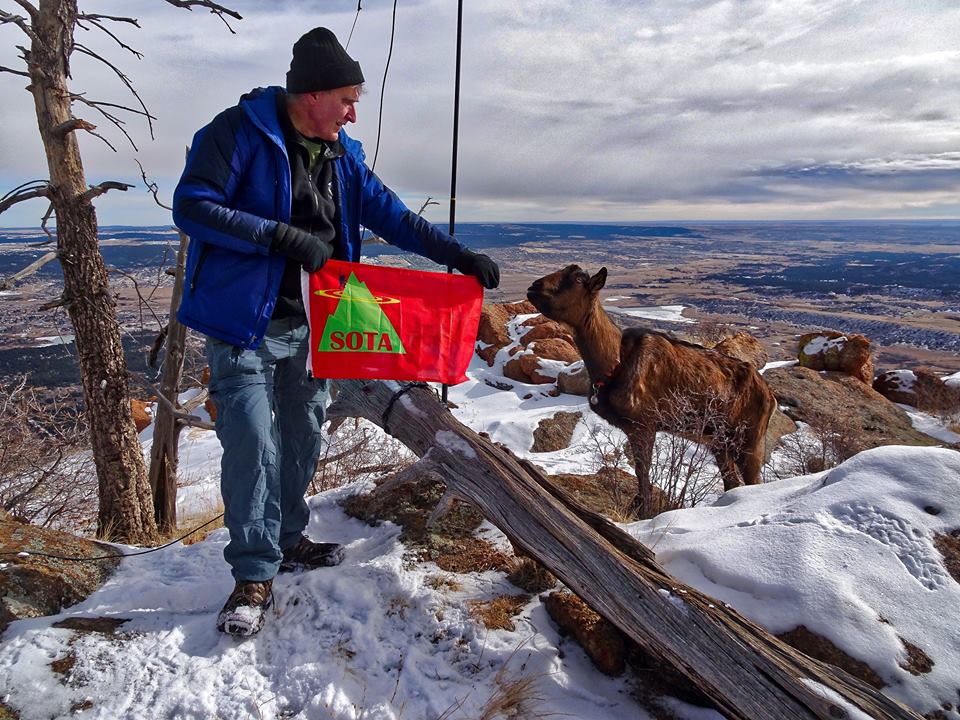
My objective for the day was to chalk up another VHF SOTA activation, while also making some Qs in the VHF contest. For most SOTA activations, I just focus on 2 meters. During a VHF contest, I bring more gear to cover the other bands. The main rig for SSB/CW was my FT-817 driving an Arrow II dualband yagi for 2m and 70 cm. For 6m, I used an inverted Vee dipole supported by a crappie pole. I also had two FT-1D handheld radios listening on 146.52 and 446.0 MHz.
I made 21 contacts on 6m, 2m and 70cm, with 7 grids/mults and a Single Operator Portable score of 164. Not that great of a contest score but it was only a few hours of operating. From a SOTA perspective, this is an attractive number of VHF QSOs in a relatively short time.
 Surprisingly, even during a VHF contest, most of the contacts were on FM with the usual SSB contest stations rather scarce. It was very handy to be able to use 146.52 MHz for the contest, finding a number of casual contesters on that frequency.
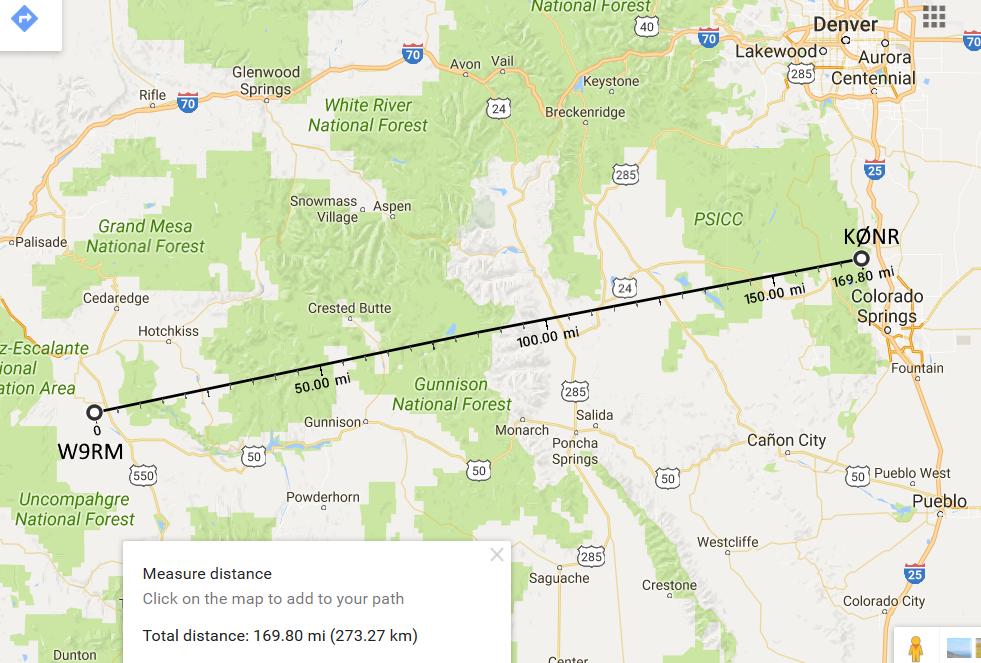
The high point of the day was working Jay W9RM on the other side of the state in DM58 using 2m CW on 144.210 MHz. The distance was about 170 miles on a path that went over or through several mountain ranges. Not too bad for QRP. (Oh, I guess it doesn’t hurt that W9RM has a serious weak-signal VHF station: 2M-5WL yagi at 50 feet.) This contact demonstrates the advantage of CW and SSB on 2 meters. Most VHF SOTA action is on FM due to the convenience of a 2m FM HT. But FM has poor weak-signal performance so much better range can be achieved with both CW and SSB. When is the last time you made a 170 mile QSO with an FM handheld?
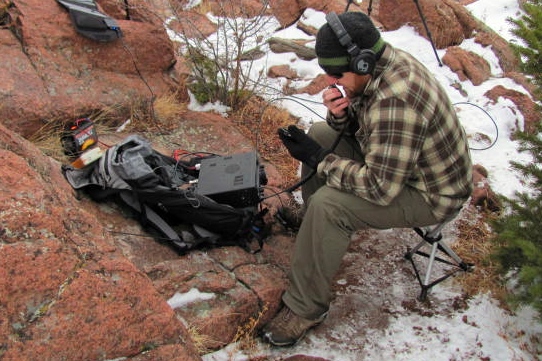
This was the first SOTA activation for Caleb/W4XEN. Judging by the smile on his face, it won’t be his last one either. While I played on VHF, Steve did his usual thing on HF using CW, using a KX3 to drive an end-fed antenna. Caleb did a bit of both HF and VHF, managing to get a nice pile up going on 20m SSB. Joyce made a few contacts on 2m FM but mostly took pictures and occasionally tossed GORP in my direction.
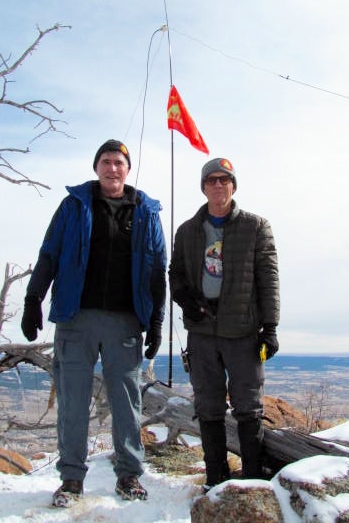
On my last winter activation, my iPhone quit in the cold, so I did not want to rely on it for logging this time. I had a clipboard with my paper log on it, also holding the dual-paddle key. The key moved around a bit and my Morse code sending was sloppy. I don’t work a lot of CW for SOTA but it does come in handy at times, so I’ll be looking at improving my setup.
The 6m inverted Vee worked out OK but it was a little inconvenient to run the coaxial cable to the apex of the antenna. I’ll be looking to swap that antenna out for an end-fed half wave, which is so common on the HF bands for SOTA.
Steve brought along a large umbrella for use as an instant-up wind shelter. That looks like a practical way to block the wind.
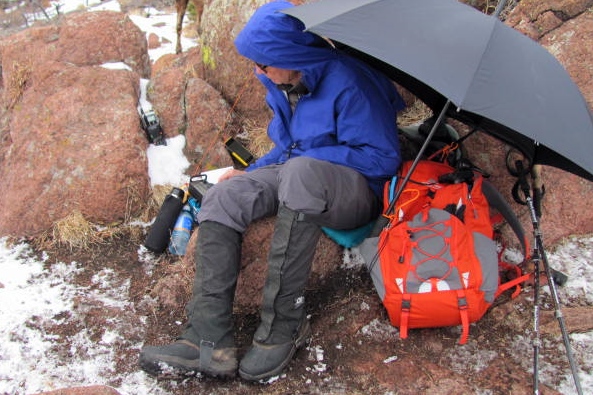
The weather was not great…we had a few patches of blue sky but it was mostly overcast and cold (probably 25 degrees F). We lasted about 2 hours before the cold started to take its toll, then we scooted on down the mountain.
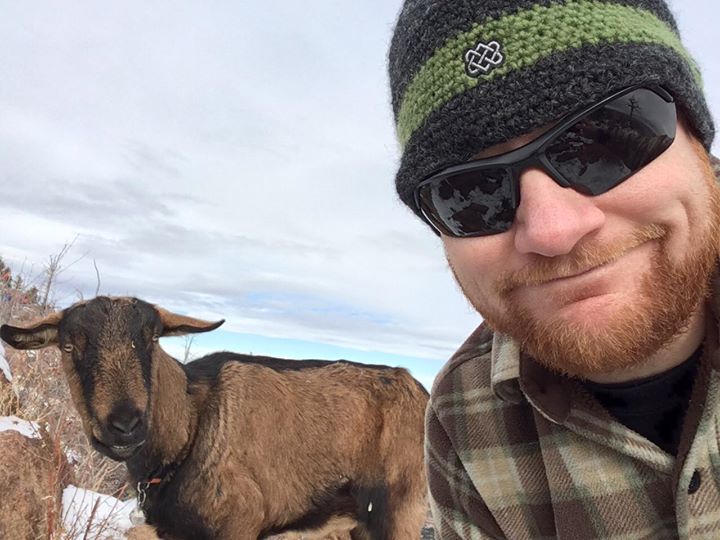
Thanks to Joyce, Steve and Caleb for a great day playing radio in the mountains.
73, Bob KØNR
The post 2017 Mt Herman Winter Activation appeared first on The KØNR Radio Site.
Bob Witte, KØNR, is a regular contributor to AmateurRadio.com and writes from Colorado, USA. Contact him at [email protected].
ZF1 – VE7 On 630m
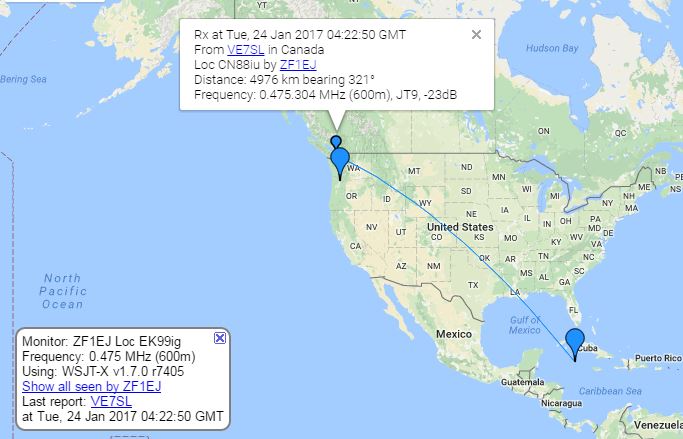
Early last night ZF1EJ (Eden) and I were able to easily complete a two way JT9 QSO on 630m ... 475.300 kHz to be more exact.
This was Eden's first 630m JT9 QSO as well as the first ever 630m QSO between Canada and the Cayman Islands. The contact was completed shortly between 8:15 and 8:30 PM local time. The contact attempt was initiated via the ON4KST 2200m / 630m chat page after I had decoded Eden's signal shortly before 7 PM local time ... the first time I have seen his signal so early in the evening.
Eden was using a VK4YB Monitor Sensors Transverter and a newly deployed transmitting antenna described below in the KB5NJD Daily 630m Report:
"This is how the antenna is setup:- It is a tophat vertical, the tophat is 65’ 6” long and about 80’ above ground, the vertical is 74’ 6”, There are 4 radials 10’ above ground, each 128’ 6” long. The antenna is made of #10, stranded insulated wire. The tophat is strung between two towers and is side on about 45 deg. The tuner was built by Ron and Ward a few month ago and shipped down to me. Just found the time to set it up recently. The SWR is 1.1-1 and I am using a Monitor Sensors Transverter built by Roger, VK4YB. Output to antenna 22 watts."
The only change to the above report was Eden's e-mail follow-up indicating that his power output during our QSO was 32 watts ... conditions must have been even better than I thought.
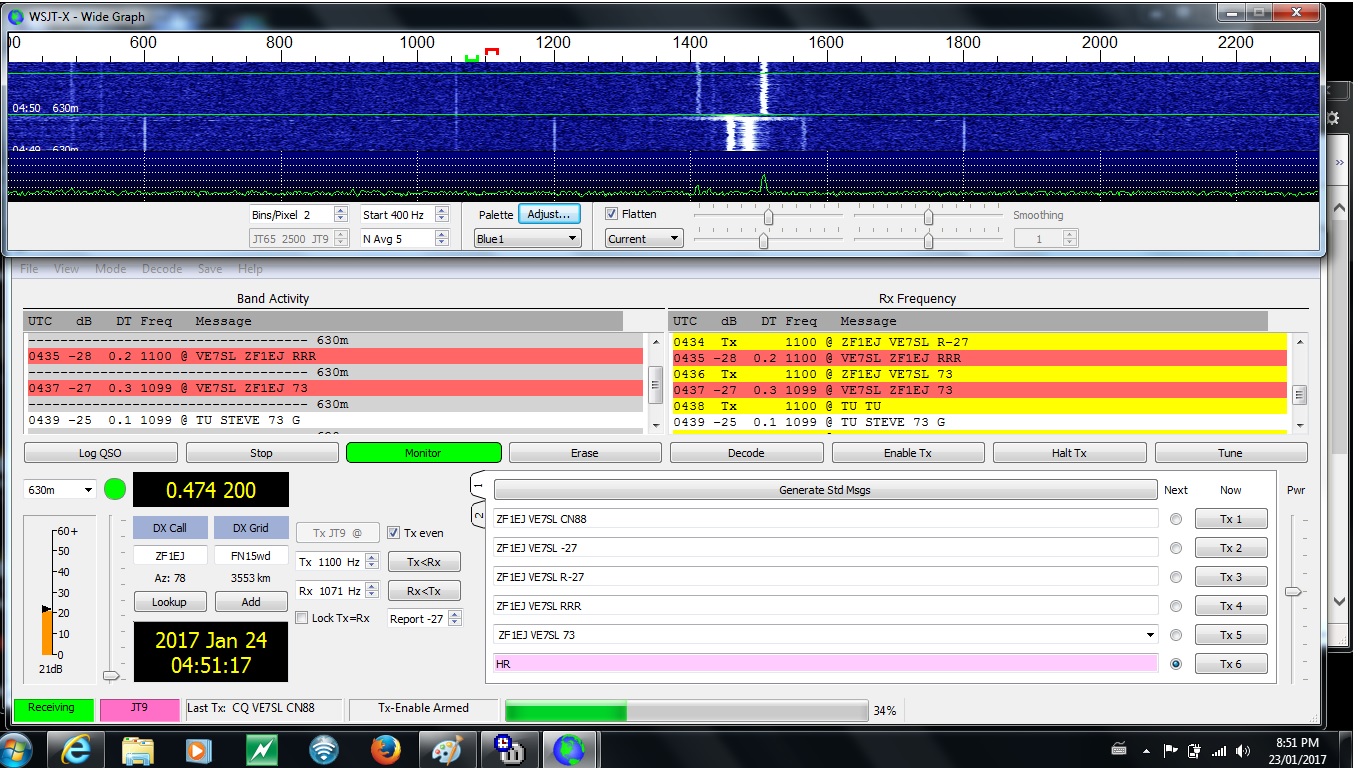 |
| JT-9 Screen At VE7SL |
With an even newer JT-9A mode now promising a 2db improvement, making contacts should be even easier. Once the USA gets access to 630m, it is clear that Eden will be a popular target for most North American stations!
Steve McDonald, VE7SL, is a regular contributor to AmateurRadio.com and writes from British Columbia, Canada. Contact him at [email protected].
 Ham Radio Deluxe |
 W5SWL Electronics |
 Ham Radio Prep |
 KB3IFH QSL Cards  Hip Ham Shirts  HamRadioAuctions HamRadioAuctions Reliance Antennas Reliance Antennas Enigma Shop Enigma Shop |  morseDX  Ni4L Antennas  R&L Electronics R&L Electronics antennas.us antennas.us QRV QRV |
- Matt W1MST, Managing Editor
