 |
 Pre-production X5105 SSB Test at 5 watts
 21 February 2017 | by

Worked David W5WAZ on 14.300 today just after 1600z. Took a bit for him to hear me in his noise, but he got me and we had a qso after that. Used the MFJ whip and counterpoise facing south direction.
Fred Lesnick, VE3FAL, is a regular contributor to AmateurRadio.com and writes from Thunder Bay Ontario, Canada. Contact him at [email protected].
ICQ Podcast Episode 231 – Ed’s 2017 Predictions
In this episode, Martin M1MRB / W9ICQ is joined by Dan Romanchik KB6NU and Ed Durrant DD5LP to discuss the latest Amateur / Ham Radio news. Colin M6BOY rounds up the news in brief, and this episode’s features is Ed Durrant DD5LP predictions for 2017.
We would like to thank Michael Casavant, N1XRR and our monthly and annual donors for keeping the podcast advert free. To donate, please visit - http://www.icqpodcast.com/donate
- Amateur / Ham Radio Licence Status
- VHF/UHF DX Book Replica Edition
- NOSintro Book
- ACMA Reverses CB Decision
- Online UK Advanced Exam
- ARES Volunteers Support Oroville Dam Evacuation
- Making VHF/UHF Contests Better
- Ivory Coast DXpedition
- SOTA Summit to Summit VK-EU Event
Colin Butler, M6BOY, is the host of the ICQ Podcast, a weekly radio show about Amateur Radio. Contact him at [email protected].
ICQ Podcast Episode 231 – Ed’s 2017 Predictions
In this episode, Martin M1MRB / W9ICQ is joined by Dan Romanchik KB6NU and Ed Durrant DD5LP to discuss the latest Amateur / Ham Radio news. Colin M6BOY rounds up the news in brief, and this episode’s features is Ed Durrant DD5LP predictions for 2017.
We would like to thank Michael Casavant, N1XRR and our monthly and annual donors for keeping the podcast advert free. To donate, please visit - http://www.icqpodcast.com/donate
- Amateur / Ham Radio Licence Status
- VHF/UHF DX Book Replica Edition
- NOSintro Book
- ACMA Reverses CB Decision
- Online UK Advanced Exam
- ARES Volunteers Support Oroville Dam Evacuation
- Making VHF/UHF Contests Better
- Ivory Coast DXpedition
- SOTA Summit to Summit VK-EU Event
Colin Butler, M6BOY, is the host of the ICQ Podcast, a weekly radio show about Amateur Radio. Contact him at [email protected].
Amateur Radio Weekly – Issue 146

Amateur Radio Satellite Nayif-1 launched
Just like FUNcube-1, this mode has the spacecraft sending high power telemetry when in sunlight and with the SSB/CW transponder active when in eclipse.
AMSAT UK
Hamcation Recap
Hamcation is a great Hamfest. It’s huge, spread out, and located in the one place where the weather is actually amazing – Orlando. It’s sunny, 75 degrees, and I’m pretty sure I’m sunburnt. I forgot that this kind of weather exists.
N0SSC
DMR Hotspot from SharkRF
The first thing I noticed when listening to some of the more active talk groups is that it seems like every person getting on the system said “I just got this Tytera MD-380 radio and you are my first DMR contact.”
K0NR
Decibel hell – the reign of antenna gain pain
Let’s step our way though the topic and see what we can learn from the pros.
Ham Radio . Magnum Experimentum
FreeDV 700C
The US test team report 700C contacts over 2500km at SNRs down to -2dB, in conditions where SSB cannot be heard.
Rowetel
W8SRC repeater IDs are distinctive… to say the least
If you want to get a little more professional with your repeater ID, just ask.
KB6NU
PicSafari: QRZ Ham Radio Image Library
QRZ has the world’s largest collection of amateur radio related images.
QRZ.com
Alaska’s HAARP facility once again open for business
The High Frequency Active Auroral Research Program (HAARP) in Gakona, Alaska, will soon undertake its first scientific research campaigns since the facility was taken over by the University of Alaska Fairbanks.
ARRL
Video
2 Meter tape measure beam antenna
The 2 Meter band tape measure beam antenna is a 3 element Yagi with about 7.2 db of forward gain.
KB9VBR
Setup Icom 7300 on iMac with RUMLogNG
This is for beginners and I’m a beginner on the Mac, but it proved to be simple.
K0PIR
Amateur Radio Weekly is curated by Cale Mooth K4HCK. Sign up free to receive ham radio's most relevant news, projects, technology and events by e-mail each week at http://www.hamweekly.com.
The 2017 Novice Rig Round-Up!
 |
| VE7AIJ's Original Setup |
There's a relatively 'new' contest in town that seems to be gathering a lot of growing interest. I'm talking about the 'NRR' or "Novice Rig Round-Up".
Harry, VE7AIJ, recently sent me a wonderful picture of his original station reproduction as used back in 1956. Hopefully Harry will be able to activate it along with countless others in the upcoming NRR.
The NRR is the brainchild of Bryan, AF4K, and Gary Johanson, WD4NKA, who developed the idea through chat on the Boatanchor and Glowbugs reflectors. They put the concept to the test in 2015 with the initial running of the NRR. Station pictures and soapbox comments from the last two runnings may be viewed here and here ... and they are truly inspirational.
With so many retired or soon to be retired 'baby boomers', there are a lot of guys out there that really enjoy recreating their original station setup, which for most U.S. hams, would have been their Novice station. There is also a huge group of 'not so old' hams that just enjoy refurbishing or homebrewing rigs from the 50's and putting them on the air ... the NRR will present another great opportunity to get on-the-air and light up those filaments once again.
As indicated on the NRR website, this is "more of an EVENT than just a typical contest ... once again taking our OLD ham radios off the shelf and putting them to use again! "
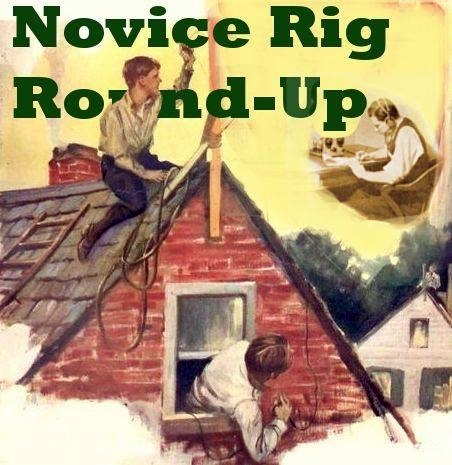 |
| courtesy: http://novicerigroundup.com/ |
The full rules are available on the dedicated NRR webpage. You will also find information there for Yahoo's NRR Group as well as the Facebook link. An excellent FAQ page also makes for valuable reading.
Many of the contest stations will be crystal controlled, just as they were back in the Novice days and a list of individual rockbound frequencies can be downloaded for your reference here ... those using crystal control will also tune well above and below their own frequencies for callers, a long-lost technique once required, when all Novice stations were using crystal controlled rigs ... tuning high and low should give rockbound stations better chances of success.
The NRR takes place from 0000 UTC February 18 through 2359 UTC February 26 - 9 full days, covering two full weekends.
Suggested HF frequencies are: 3550 - 3650 kHz, 3579, 7055, 7060, 7080, 7100 -7125 kHz, 21.114, 21.120, 21.150 MHz, 28.114, 28.120 MHz.
An automatic logger page has been set up for log handling as well as a 'live skeds' page to announce your frequency or to chat. Clearly, a lot of effort by the organizers has gone into this event!
Hopefully you can participate and make the 3rd annual NRR an even more enjoyable event than the first two. I know of several VE7's, including myself, that will be operating.
Harry's homebrew 6AQ5 crystal oscillator (Feb '55 Popular Electronics) and Hallicrafters S-53, pictured above, allowed him to work the world back in the amazing radio days of Cycle 19. Let's relive some of that excitement in the closing days of Cycle 24 ... in the NRR!
Steve McDonald, VE7SL, is a regular contributor to AmateurRadio.com and writes from British Columbia, Canada. Contact him at [email protected].
The 2017 Novice Rig Round-Up!
|
| VE7AIJ's Original Setup |
There's a relatively 'new' contest in town that seems to be gathering a lot of growing interest. I'm talking about the 'NRR' or "Novice Rig Round-Up".
Harry, VE7AIJ, recently sent me a wonderful picture of his original station reproduction as used back in 1956. Hopefully Harry will be able to activate it along with countless others in the upcoming NRR.
The NRR is the brainchild of Bryan, AF4K, and Gary Johanson, WD4NKA, who developed the idea through chat on the Boatanchor and Glowbugs reflectors. They put the concept to the test in 2015 with the initial running of the NRR. Station pictures and soapbox comments from the last two runnings may be viewed here and here ... and they are truly inspirational.
With so many retired or soon to be retired 'baby boomers', there are a lot of guys out there that really enjoy recreating their original station setup, which for most U.S. hams, would have been their Novice station. There is also a huge group of 'not so old' hams that just enjoy refurbishing or homebrewing rigs from the 50's and putting them on the air ... the NRR will present another great opportunity to get on-the-air and light up those filaments once again.
As indicated on the NRR website, this is "more of an EVENT than just a typical contest ... once again taking our OLD ham radios off the shelf and putting them to use again! "
|
| courtesy: http://novicerigroundup.com/ |
The full rules are available on the dedicated NRR webpage. You will also find information there for Yahoo's NRR Group as well as the Facebook link. An excellent FAQ page also makes for valuable reading.
Many of the contest stations will be crystal controlled, just as they were back in the Novice days and a list of individual rockbound frequencies can be downloaded for your reference here ... those using crystal control will also tune well above and below their own frequencies for callers, a long-lost technique once required, when all Novice stations were using crystal controlled rigs ... tuning high and low should give rockbound stations better chances of success.
The NRR takes place from 0000 UTC February 18 through 2359 UTC February 26 - 9 full days, covering two full weekends.
Suggested HF frequencies are: 3550 - 3650 kHz, 3579, 7055, 7060, 7080, 7100 -7125 kHz, 21.114, 21.120, 21.150 MHz, 28.114, 28.120 MHz.
An automatic logger page has been set up for log handling as well as a 'live skeds' page to announce your frequency or to chat. Clearly, a lot of effort by the organizers has gone into this event!
Hopefully you can participate and make the 3rd annual NRR an even more enjoyable event than the first two. I know of several VE7's, including myself, that will be operating.
Harry's homebrew 6AQ5 crystal oscillator (Feb '55 Popular Electronics) and Hallicrafters S-53, pictured above, allowed him to work the world back in the amazing radio days of Cycle 19. Let's relive some of that excitement in the closing days of Cycle 24 ... in the NRR!
Steve McDonald, VE7SL, is a regular contributor to AmateurRadio.com and writes from British Columbia, Canada. Contact him at [email protected].
The 2017 Novice Rig Round-Up!
|
| VE7AIJ's Original Setup |
There's a relatively 'new' contest in town that seems to be gathering a lot of growing interest. I'm talking about the 'NRR' or "Novice Rig Round-Up".
Harry, VE7AIJ, recently sent me a wonderful picture of his original station reproduction as used back in 1956. Hopefully Harry will be able to activate it along with countless others in the upcoming NRR.
The NRR is the brainchild of Bryan, AF4K, and Gary Johanson, WD4NKA, who developed the idea through chat on the Boatanchor and Glowbugs reflectors. They put the concept to the test in 2015 with the initial running of the NRR. Station pictures and soapbox comments from the last two runnings may be viewed here and here ... and they are truly inspirational.
With so many retired or soon to be retired 'baby boomers', there are a lot of guys out there that really enjoy recreating their original station setup, which for most U.S. hams, would have been their Novice station. There is also a huge group of 'not so old' hams that just enjoy refurbishing or homebrewing rigs from the 50's and putting them on the air ... the NRR will present another great opportunity to get on-the-air and light up those filaments once again.
As indicated on the NRR website, this is "more of an EVENT than just a typical contest ... once again taking our OLD ham radios off the shelf and putting them to use again! "
|
| courtesy: http://novicerigroundup.com/ |
The full rules are available on the dedicated NRR webpage. You will also find information there for Yahoo's NRR Group as well as the Facebook link. An excellent FAQ page also makes for valuable reading.
Many of the contest stations will be crystal controlled, just as they were back in the Novice days and a list of individual rockbound frequencies can be downloaded for your reference here ... those using crystal control will also tune well above and below their own frequencies for callers, a long-lost technique once required, when all Novice stations were using crystal controlled rigs ... tuning high and low should give rockbound stations better chances of success.
The NRR takes place from 0000 UTC February 18 through 2359 UTC February 26 - 9 full days, covering two full weekends.
Suggested HF frequencies are: 3550 - 3650 kHz, 3579, 7055, 7060, 7080, 7100 -7125 kHz, 21.114, 21.120, 21.150 MHz, 28.114, 28.120 MHz.
An automatic logger page has been set up for log handling as well as a 'live skeds' page to announce your frequency or to chat. Clearly, a lot of effort by the organizers has gone into this event!
Hopefully you can participate and make the 3rd annual NRR an even more enjoyable event than the first two. I know of several VE7's, including myself, that will be operating.
Harry's homebrew 6AQ5 crystal oscillator (Feb '55 Popular Electronics) and Hallicrafters S-53, pictured above, allowed him to work the world back in the amazing radio days of Cycle 19. Let's relive some of that excitement in the closing days of Cycle 24 ... in the NRR!
Steve McDonald, VE7SL, is a regular contributor to AmateurRadio.com and writes from British Columbia, Canada. Contact him at [email protected].
 Ham Radio Deluxe |
 W5SWL Electronics |
 Ham Radio Prep |
 KB3IFH QSL Cards  Hip Ham Shirts  HamRadioAuctions HamRadioAuctions Reliance Antennas Reliance Antennas Enigma Shop Enigma Shop |  morseDX  Ni4L Antennas  R&L Electronics R&L Electronics antennas.us antennas.us QRV QRV |
- Matt W1MST, Managing Editor
