 |
 LHS Episode #184: Don’t Eat the Baby
 27 February 2017 | by
  Welcome to the 184th installment of Linux in the Ham Shack. In this episode, your hosts discuss the upward trend in amateur radio licensing, ARES, ARISS, April Fool's Day, R, marketing, Linux distros, bugs in Synergy and TrustedQSL, cw trainers, and much, much more. Thank you for tuning in!. Also, please remember our Hamvention 2017 campaign. We hope to see you all there.
73 de The LHS Crew
Russ Woodman, K5TUX, co-hosts the Linux in the Ham Shack podcast which is available for download in both MP3 and OGG audio format. Contact him at [email protected].
Ham College 26
More Coax, SWR, Dummy Loads and Technicians pool questions.
1:13:42
George Thomas, W5JDX, is co-host of AmateurLogic.TV, an original amateur radio video program hosted by George Thomas (W5JDX), Tommy Martin (N5ZNO), Peter Berrett (VK3PB), and Emile Diodene (KE5QKR). Contact him at [email protected].
Amateur Radio Weekly – Issue 147

Icom previews details of ID-4100E D-STAR VHF/UHF mobile radio
The Callsign routing terminal mode feature will allow each radio to be connected like an access point to the worldwide D-STAR repeater network through the internet.
Southgate
Radio News Magazine archive
Every issue from 1919 to 1959.
American Radio History
How-to: Icom External Keypad
A short press on the M1 to M4 button triggers a single voice keyer send, whereas hold the M1 to M4 button for a second enables auto repeating of sending voice keyer memories.
M1BXF
End Fed Antennas – Where’s the other half?
My favorite tends to be the classic ‘Sloper’ with the feed point located on the ground.
K5ACL
International Radio Network
The IRN (International Radio Network) is a VoIP/RoIP system using Teamspeak 3 (TS3) that allows licensed radio users to talk around the World.
International Radio Network
WSPR Antenna Comparison (Loop vs Dipole vs End Fed)
I did 24 hour WSPR runs using 5 watts of power with each antenna on successive days.
High on Solder
Universal Radio Hacker: investigate wireless protocols like a boss
The Universal Radio Hacker is software for investigating unknown wireless protocols.
Johannes Pohl
Open-air wireless charging
Disney Research has invented a new method of wirelessly charging mobile devices that could someday allow amusement park patrons to walk about freely while also getting their mobile devices charged.
Computer World
Video
Assembling the BITX-40
BITX-40, a QRP, SSB, 10 watt, kit.
KE0OG
Visualising shortwave band activity throughout the year
An animation of 24-hour shortwave spectrum plots from Twente WebSDR.
London Shortwave
Amateur Radio Weekly is curated by Cale Mooth K4HCK. Sign up free to receive ham radio's most relevant news, projects, technology and events by e-mail each week at http://www.hamweekly.com.
UK speaker source for BITX40 & other QRP projects
Two speakers including cases for One Pound!!
The speakers are marketed for use with portable stereos, MP3 players, etc. A simple test to see if they were any good, I connected them to a reliable audio source and found although not HI-FI, they are perfectly adequate for use in the BITX Kit, or other QRP constructional projects.

They come packed in either Black or Silver.
Once unscrewed the back of the case, the speaker simply drops out to reveal a 5.5cm 2" unit.
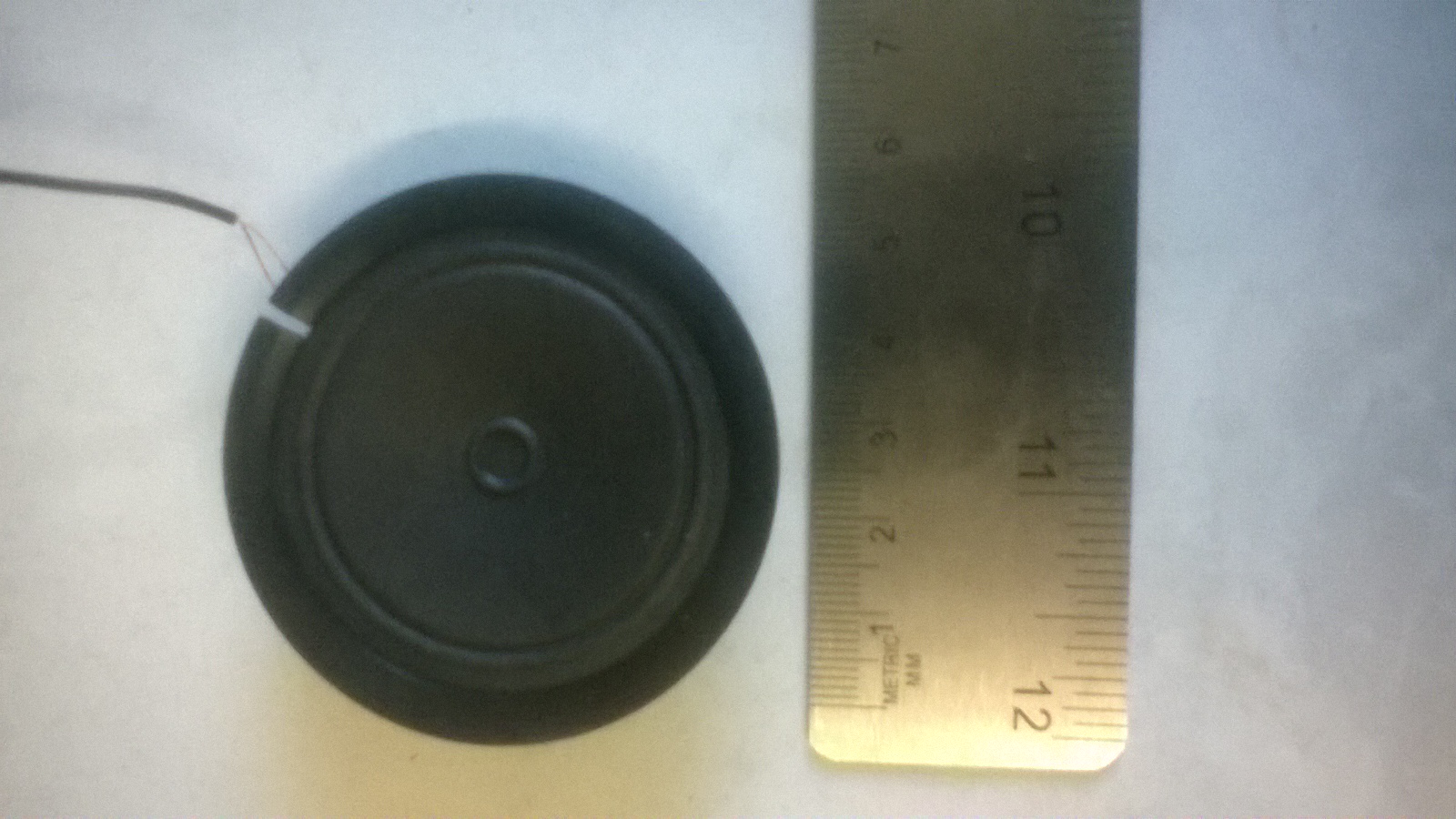
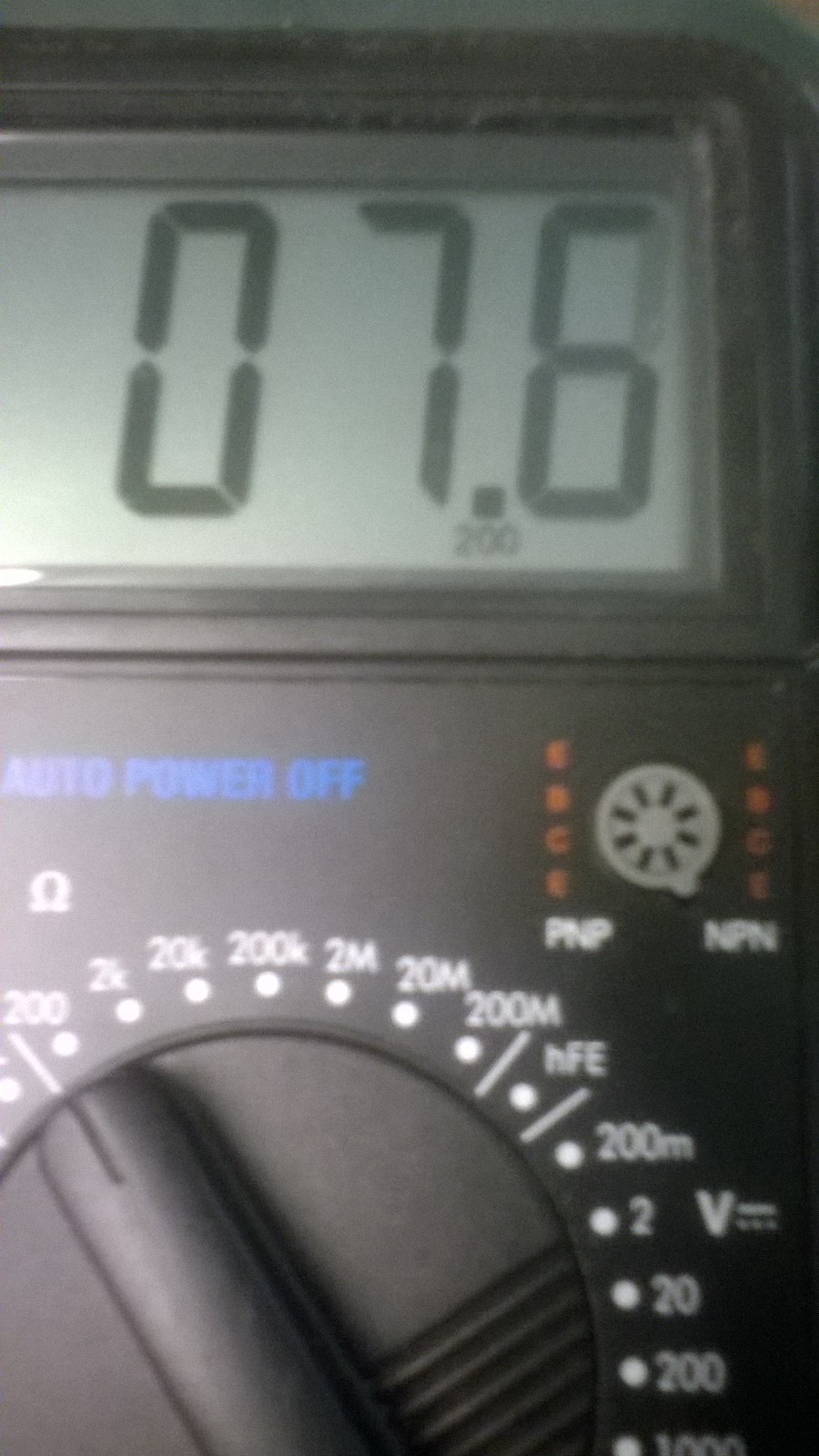
A quick test on the multimeter revealed the value of 7.6 ohm:
Recently while out shopping I have visited 4 different Poundworld's, one as far North as Southport. All carried a plentyful supply of stock in their electrical area. I am sorry I cannot help my readers from overseas, but the unit is obviously made in China so try your Dollar shops.
Good hunting!
Steve, G1KQH, is a regular contributor to AmateurRadio.com and writes from England. Contact him at [email protected].
UK speaker source for BITX40 & other QRP projects
Two speakers including cases for One Pound!!
The speakers are marketed for use with portable stereos, MP3 players, etc. A simple test to see if they were any good, I connected them to a reliable audio source and found although not HI-FI, they were perfectly adequate for use in the BITX Kit, or other QRP constructional projects.
They come packed in either Black or Silver.
Once unscrewed the back of the case, the speaker simply drops out to reveal a 55cm 2" unit.
A quick test on the multimeter revealed the value of 7.6 ohm:
Recently while out shopping I have visited 4 different Poundworld's, one as far North as Southport. All carried a plentyful supply of stock in their electrical area. I am sorry I cannot help my readers from overseas, but the unit is obviously made in China so try your Dollar shops.
Good hunting!
Steve, G1KQH, is a regular contributor to AmateurRadio.com and writes from England. Contact him at [email protected].
Comparing two antennas with WSPR
 |
| Ultimate 3S with 5-band relay module in front, variable LM2596 power supply (with voltmeter) for the power amplifier behind left, a variable LM2596 supply set for 5 Volts for the Ultimate 3S in the middle, and the antenna switch to the right in the back. |
WSPR – The system for Weak Signal Propagation Reporter makes it easy to compare antennas if your transmitter can instantly switch antennas. The system shown here can send on antenna 1 for almost two minutes and then switch immediately to antenna 2 for the next transmission.
The Ultimate 3S already has software that supports that and application note 3 from QRPLabs (Controlling additional relays using the Ultimate3S “Aux”) describes how. I built mine following that note and the experience from EA1CDV.
The circuit is controlled from pin D7 and consists of a transistor, a relay, a resistor and an electrolytic capacitor. In addition I have two LEDs that indicate which antenna which is in use. In the first picture the green LED in the back right under the BNC antenna connector shows that antenna 1 is connected.
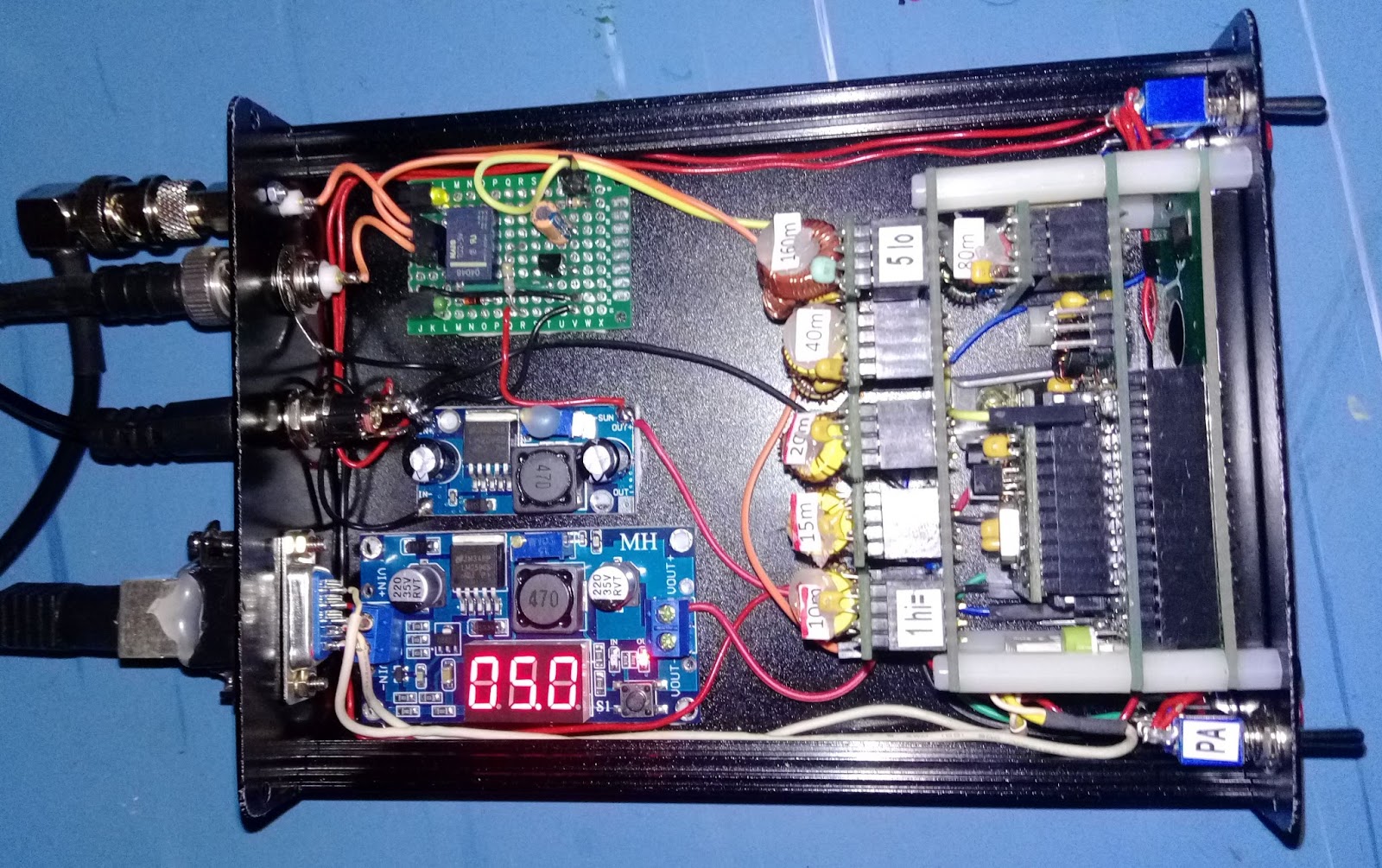
In the next picture, the whole layout is shown a little better. In this case LED 2 is lit, the faint yellow one. It sits right under the additional SMA antenna connector in the top left-hand corner that I had to fit.
I have used this setup for a few days now on 7, 10, 14, and 18 MHz with some crossed doublet antennas (somewhat like this setup, but not in the same location). I change the frequency between antennas, e.g. 50 Hz below the center frequency of the band for antenna 1 and 50 Hz above for antenna 2 in order to simplify discrimination between the transmissions.
The short 13 m antenna transmits best East-West, and the longer 26 m antenna North-South. The directivity is in general confirmed by the WSPR reports I see. Sometimes the difference can be more than 10 dB in SNR, but more often it is closer to 5 dB. But it also happens that only one of the transmissions is detected. This should make for some interesting analysis in the coming months.
The post “Comparing two antennas with WSPR” first appeared on the LA3ZA Radio & Electronics Blog.
Sverre Holm, LA3ZA, is a regular contributor to AmateurRadio.com and writes from Norway. Contact him at [email protected].
Comparing two antennas with WSPR
|
| Ultimate 3S with 5-band relay module in front, variable LM2596 power supply (with voltmeter) for the power amplifier behind left, a variable LM2596 supply set for 5 Volts for the Ultimate 3S in the middle, and the antenna switch to the right in the back. |
WSPR – The system for Weak Signal Propagation Reporter makes it easy to compare antennas if your transmitter can easily switch antennas. The system shown here can send on antenna 1 for almost two minutes and then switch immediately to antenna 2 for the next transmission.
The Ultimate 3S already has software that supports that and application note 3 from QRPLabs (Controlling additional relays using the Ultimate3S “Aux”) describes how. I built mine following that note and the experience from EA1CDV.
The circuit is controlled from pin D7 and consists of a transistor, a relay, a resistor and an electrolytic capacitor. In addition I have two LEDs that indicate which antenna which is in use. In the first picture the green LED in the back right under the BNC antenna connector shows that antenna 1 is connected.
In the next picture, the whole layout is shown a little better. In this case LED 2 is lit, the faint yellow one. It sits right under the additional SMA antenna connector in the top left-hand corner that I had to fit.
I have used this setup for a few days now on 7, 10, 14, and 18 MHz with some crossed doublet antennas (somewhat like this setup, but not in the same location). I change the frequency between antennas, e.g. 50 Hz below the center frequency of the band for antenna 1 and 50 Hz above for antenna 2 in order to simplify discrimination between the transmissions.
The short 13 m antenna transmits best East-West, and the longer 26 m antenna North-South. The directivity is in general confirmed by the WSPR reports I see. Sometimes the difference can be more than 10 dB in SNR, but more often it is closer to 5 dB. But it also happens that only one of the transmissions is detected. This should make for some interesting analysis in the coming months.
The post “Comparing two antennas with WSPR” first appeared on the LA3ZA Radio & Electronics Blog.
Sverre Holm, LA3ZA, is a regular contributor to AmateurRadio.com and writes from Norway. Contact him at [email protected].
 Ham Radio Deluxe |
 W5SWL Electronics |
 Ham Radio Prep |
 KB3IFH QSL Cards  Hip Ham Shirts  HamRadioAuctions HamRadioAuctions Reliance Antennas Reliance Antennas Enigma Shop Enigma Shop |  morseDX  Ni4L Antennas  R&L Electronics R&L Electronics antennas.us antennas.us QRV QRV |
- Matt W1MST, Managing Editor
