 |
 I made it to YouTube!
 14 April 2017 | by
 So I’m just a few weeks into learning my new Flex 6500. I had sold my old Bencher iambic paddle a few years back when I got the KX3 and its attached keyer. When the Flex arrived, I quickly realized I was missing a paddle except for an old straight key that WA9EIC had given me. My struggles with the straight key are a story for another day. So off to my favorite online swapmeet places…QRZ and QTH.com. I found an ARRL 100 year anniversary Vibroplex! This one only had the serial number engraved and not a callsign, so it was perfect purchase, and a great match with the 6500.
I had played on 40M CW on and off. With the KX3, I’m ashamed to say that I became dependent on the CW decoder. Part of it was my newness to CW, but part of it was that it was so darn easy to use…and pretty darn accurate. With the Flex, there isn’t a built-in decoder. You could use any number of digital programs or a skimmer if you wanted. For now, I’ve sworn those off so I’ve been back to doing CW decoding the old way…with my head. With the Flex, 40M CW is joy. You get on, look around, and you can SEE people calling CQ just by watching the regular pattern of their signals.
It was a quiet night at the Brown household, and I was up in the shacking playing with the Vibroplex and the 6500. Up around 7.105 was an interesting signal. It wasn’t the purest CQ I’d ever heard, but a nice fist and an interesting chirp. I answered and had a short QSO. I remember it well as the transmitter the ham was using drifted after our second round. The thing went outside my filter….I figured it was QSB, but when I looked up at the panadapter I found him about 500kHz south of where we started! Being new to the Flex, it took me a few seconds to find the RIT. I got him tuned back in and found him on top of another QSO. I kinda panicked and figured the safest thing to do was tell him he drifted a bit and then sign off and move to another. No big deal. No harm, no foul!
Well today I get a phone call from my buddy Dennis, KE9UA. Dennis asked if I knew I was on YouTube. What??? Yep, seems that N6TLU had done a video on operating a Lysco 600, and little ole KG9DW was on the other side of his QSO! Well, now I’m famous. Or should I say infamous….
Terry is truly an interesting character, both on the air and in his videos. Here it is, my YouTube CW debut, in a supporting role in “Hammered Ham!”
Michael Brown, KG9DW, is a regular contributor to AmateurRadio.com and writes from Illinois, USA. Contact him at [email protected].
That’s Not Real Ham Radio
 Things had been pretty quiet on the ham front lately but then I ran into a string of “That’s Not Real Ham Radio” discussions. This happens from time to time…I usually ignore it…but this time I got sucked into the topic.
It started with some HF enthusiasts I know talking about how “digital modes” are just not very satisfying. Their point is that with CW and SSB, there is an audio connection to your ear that makes you an integral part of the radio communication. The extreme-DSP modes such as JT65 insert serious signal processing that essentially removes the human connection. This can quickly lead to the generalization that these digital modes “aren’t real ham radio.”
I think its fair to say that most hams think of the HF bands as the center of the hobby…getting on the air, bouncing signals off the ionosphere to talk to someone over the horizon. Some hams will go even further and say that CW is the only way to go. Anything less is just phone. FM and repeaters? Forget that stuff…not enough skill required. And certainly, don’t get stuck on 2 meters.
In a previous post, I argued we should not confuse religion with modulation. I do occasionally make snarky comments about the continued use of AM (AKA Ancient Modulation), but I’ve tried to tone that down in recent years.
What About DMR?
Just last week, I was playing around with a DMR hotspot on the Brandmeister network. It really struck me that people on the system were having a blast talking to each other across North America and around the world. But then that nagging little voice in the back of my head said “hey, wait a minute…this is not real DX…the RF signal might only be traveling 20 feet or so from an HT to a hotspot.”
This caused me to put out a plea for insight on twitter:
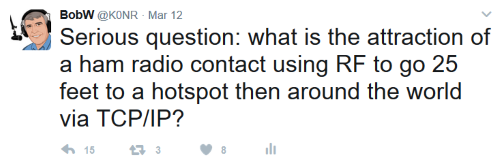 I received a lot of good replies with the answers tending to clump into these three categories:
- I don’t know (“That’s Not Real Ham Radio”)
- It’s fun, new technology
- It’s a digital network that brings ham radio operators together
My interest seems to fall into the second category: this is fun, new technology. Which does make me wonder how long this new technology will remain interesting to me. Well, that is difficult to predict but I’ll invoke the principle of try not to overthink it. The idea that DMR is a digital network that brings ham radio operators together makes some sense. In the past, I have argued that amateur radio is not for talking. In other words, if you just want to talk someone, there are much more convenient ways of doing that. Still, there is something attractive about this ham-radio-only digital network.
It really is important to not overthink this kind of stuff. Ham radio is supposed to be fun, so if you are having fun, you are probably doing it right. If you are not having fun, then you might want to examine what you are doing. See my post on the Universal Purpose of Amateur Radio.
Sometimes hams can get a little spun up about those other guys that don’t appreciate our way of doing ham radio. What the heck is wrong with them anyway? I’ve always been inspired by the Noise Blankers Mission Statement:
Do radio stuff.
Have fun doing it.
Show people just how fun it is.
If your preferred form of ham radio is so superior, it ought to be easy to show other hams how cool it is. If not, then maybe you aren’t doing it right. Conversely, as long as other hams are having fun and operating legally, don’t knock what they are doing. In fact, encourage them. We need more people having fun with ham radio, even if it’s not your favorite kind of fun.
That’s my opinion. What do you think?
73, Bob K0NR
The post That’s Not Real Ham Radio appeared first on The KØNR Radio Site.
Bob Witte, KØNR, is a regular contributor to AmateurRadio.com and writes from Colorado, USA. Contact him at [email protected].
April Moonbounce
 |
| My Moonrise |
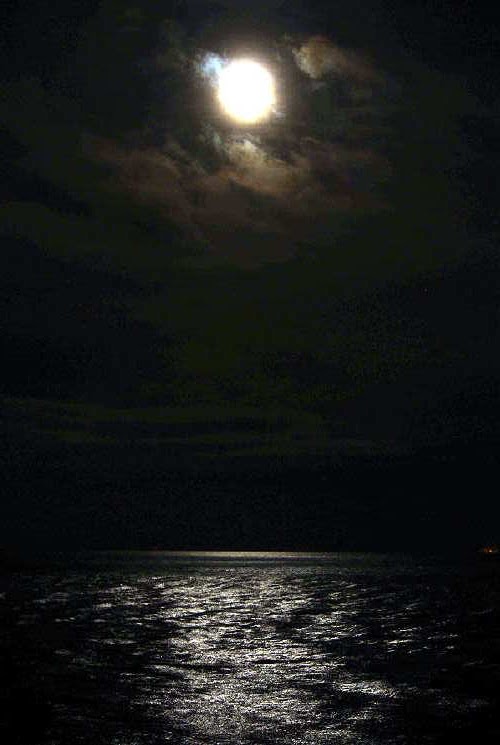
This week I had several days of unobstructed ocean moonrises as the Moon peaked on its monthly northern declination track. Thanks to the recent topping of my next door neighbour's large Douglas Fir, and removal of low-hanging branches, I am now able to track moonrises a little further to the south than before and can add two more EME days that were previously blocked by the large tree. All operations are on 2m JT65B mode, using a 9el Yagi and 140W output.
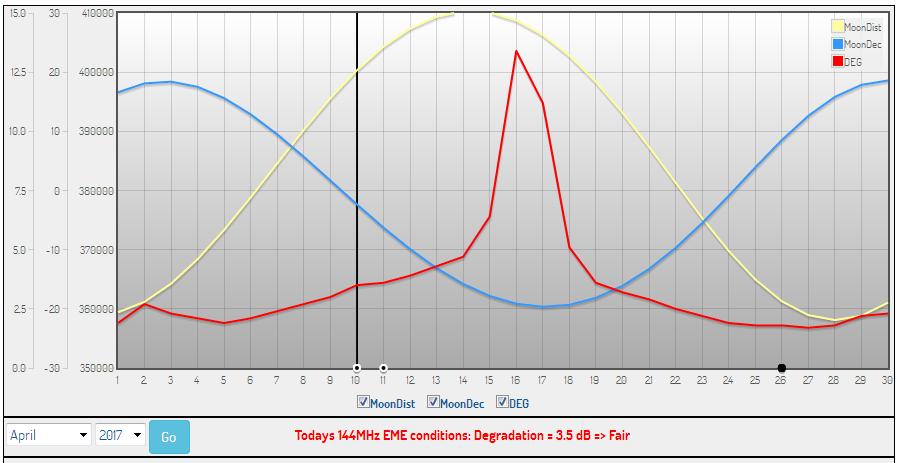
When I started (April 1) conditions looked as if they should be good, with lunar perigee (Moon's closest approach), degradation (background skynoise) and declination all looking favorable, but I was in for a surprise.
The rising yellow plot indicates the Earth-Moon distance growing further apart (increasing path losses) while the red plot indicates fluctuation in daily skynoise (temperature) near the moon. The blue plot indicates declination track from north to south ... for me, the higher the better.
 |
| courtesy: http://www.mmmonvhf.de/eme.php |
On day three, five new 'initials' were worked including one new state (New York) and two new DXCC countries! Truly surprising was that two of the stations worked were using just two Yagis, with both stations answering one of my 'CQ's.
Good conditions continued for the next few days, bringing my initials count from #87 to # 95, with the following stations all going into the log, turning a disappointing start into one of the best lunar sessions I have encountered:
HA6NQ, LZ2FO (two 13 el Yagis), EB5EEO, K2ZJ (two 14 el Yagis), DK5YA, S52LM, F8DO, PA5Y, SV6KRW, UA3PTW, OK1UGA.
April's operation brought my 2m DXCC count to 29 and states worked total to 27.
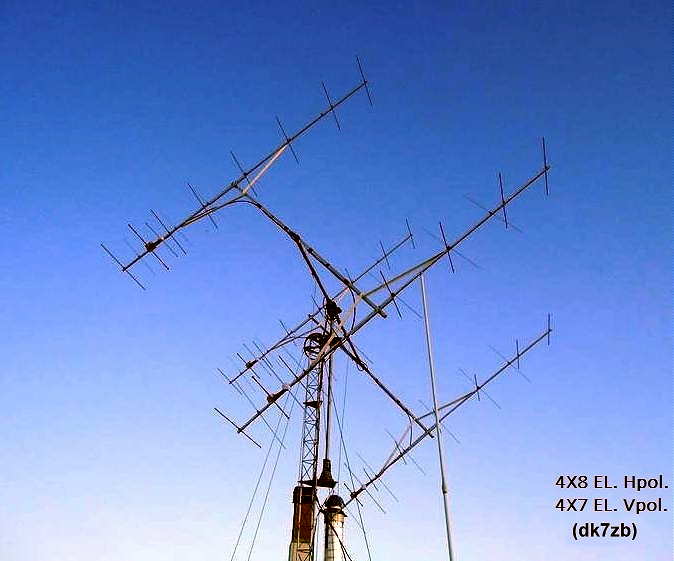 |
| SV6KRW's 4 x 8el Array |
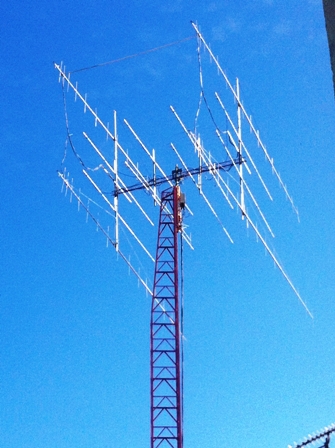 |
| EB5EEO's 4 x 32el Cross-polarized Array (16V / 16H) |
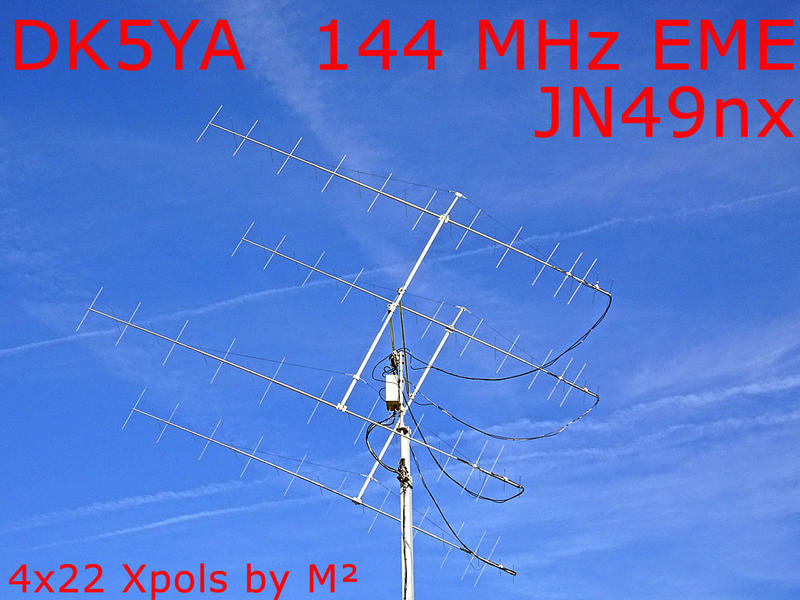 |
| DK5YA's 4 x 22 Cross-polarized Array (11V / 11H) |
Steve McDonald, VE7SL, is a regular contributor to AmateurRadio.com and writes from British Columbia, Canada. Contact him at [email protected].
April Moonbounce
|
| My Moonrise |
This week I had several days of unobstructed ocean moonrises as the Moon peaked on its monthly northern declination track. Thanks to the recent topping of my next door neighbour's large Douglas Fir, and removal of low-hanging branches, I am now able to track moonrises a little further to the south than before and can add two more EME days that were previously blocked by the large tree. All operations are on 2m JT65B mode, using a 9el Yagi and 140W output.
When I started (April 1) conditions looked as if they should be good, with lunar perigee (Moon's closest approach), degradation (background skynoise) and declination all looking favorable, but I was in for a surprise.
The rising yellow plot indicates the Earth-Moon distance growing further apart (increasing path losses) while the red plot indicates fluctuation in daily skynoise (temperature) near the moon. The blue plot indicates declination track from north to south ... for me, the higher the better.
|
| courtesy: http://www.mmmonvhf.de/eme.php |
On day three, five new 'initials' were worked including one new state (New York) and two new DXCC countries! Truly surprising was that two of the stations worked were using just two Yagis, with both stations answering one of my 'CQ's.
Good conditions continued for the next few days, bringing my initials count from #87 to # 95, with the following stations all going into the log, turning a disappointing start into one of the best lunar sessions I have encountered:
HA6NQ, LZ2FO (two 13 el Yagis), EB5EEO, K2ZJ (two 14 el Yagis), DK5YA, S52LM, F8DO, PA5Y, SV6KRW, UA3PTW, OK1UGA.
April's operation brought my 2m DXCC count to 29 and states worked total to 27.
|
| SV6KRW's 4 x 8el Array |
|
| EB5EEO's 4 x 32el Cross-polarized Array (16V / 16H) |
|
| DK5YA's 4 x 22 Cross-polarized Array (11V / 11H) |
Steve McDonald, VE7SL, is a regular contributor to AmateurRadio.com and writes from British Columbia, Canada. Contact him at [email protected].
Amateur Radio Weekly – Issue 153

First transceiver with built-in FreeDV
“All Ham Band” RS-918SSB HF SDR Transceiver offers FreeDV as an operating mode.
marxy.org
Digital Amateur Television from the International Space Station
In principle, the HamVideo DATV transmitter is permanently transmitting from Columbus, the European ISS module.
AMSAT-ON
Same-band “Dueling CQs” now prohibited in all ARRL Contests
ARRL has clarified its contest rules to clearly prohibit the practice of interleaved CQs.
ARRL
Keeping New Radio Hams
Crucially, the Camb-Hams have no committee, no finances (so no subscription), and any amateur who wants to call him/herself a ‘Camb-Ham’ is automatically a member.
Southgate
Irony
The FCC is requiring radio amateurs be at least 1 km from electric power transmission lines using Power Line Carrier (PLC) systems on those bands.
Radio Artisan
RF Propagation Analytics
See which bands are open now.
The University of Alabama
GNU Radio decoder for AO-73
The modulation that the FUNcube satellites use is DBPSK at 1200baud. The coding is based on a CCSDS concatenated code with a convolutional code and Reed-Solomon, but it makes extensive use of interleaving to combat the fading caused by the spin of the spacecraft.
destevez.net
Video
Decapsulating a ceramic integrated circuit
Decapsulation (decapping) a ceramic integrated circuit to get at the die is easy with MAP gas.
YouTube
Standing Inside a broadcast transmitter while it’s on
See inside a Gates BC-250-GY broadcast transmitter from the 40’s era.
Mr. Carlson’s Lab
Amateur Radio Weekly is curated by Cale Mooth K4HCK. Sign up free to receive ham radio's most relevant news, projects, technology and events by e-mail each week at http://www.hamweekly.com.
QRP ARCI Spring QSO Party this weekend
2017 QRP-ARCI(sm) SPRING QSO PARTY
Date/Time:
1200Z on 8 April 2017 through 2400Z on 9 April 2017. You may work a maximum of 24 hours of the 36 hour period.
Mode: HF CW only.
Exchange:
Members send: RST, State/Province/Country, ARCI member number
Non-Members send: RST, State/Province/Country, Power Out
QSO Points:
Member = 5 points
Non-Member, Different Continent = 4 points
Non-Member, Same Continent = 2 points
Multiplier:
SPC (State/Province/Country) total for all bands. The same station may be worked on multiple bands for QSO points and SPC credit.
Power Multiplier:
>5 Watts = x1
>1 - 5 Watts = x7
>250 mW - 1 Watt = x10
>55 mW - 250 mW = x15
55 mW or less = x20
Suggested Frequencies:
160m - 1810 kHz
80m - 3560 kHz
40m - 7030 kHz (please listen at 7040 kHz for rock bound participants)
20m - 14060 kHz
15m - 21060 kHz
10m - 28060 kHz
Score:
Final Score = Points (total for all bands) x SPCs (total for all bands) x Power Multiplier.
BONUS POINTS: None available for this contest.
Categories:
Entry may be All-Band, Single Band, High Bands (10m-15m-20m) or Low Bands (40m-80m)
How to Participate:
Get on any of the HF bands except the WARC bands and hang out near the QRP frequencies. Work as many stations calling CQ QRP or CQ TEST as possible, or call CQ QRP or CQ TEST yourself! You can work a station for credit once on each band.
Log Submission:
Submit your entry online at http://www.qrpcontest.com
Contest logs are not required for entry, but may be requested by the Contest Manager if required.
Deadline: Entries must be postmarked on or before 23 April 2017.
Results: Will be published in QRP Quarterly and shown on the QRP-ARCI website.
Certificates: Will be awarded to the Top 10 Scoring Entrants.
Hopefully, I'll see you on the air at some point this weekend! (At least this year, the contest doesn't fall on Easter Weekend!)
72 de Larry W2LJ
QRP - When you care to send the very least!
Larry Makoski, W2LJ, is a regular contributor to AmateurRadio.com and writes from New Jersey, USA. Contact him at [email protected].
QRP ARCI Spring QSO Party this weekend
2017 QRP-ARCI(sm) SPRING QSO PARTY
Date/Time:
1200Z on 8 April 2017 through 2400Z on 9 April 2017. You may work a maximum of 24 hours of the 36 hour period.
Mode: HF CW only.
Exchange:
Members send: RST, State/Province/Country, ARCI member number
Non-Members send: RST, State/Province/Country, Power Out
QSO Points:
Member = 5 points
Non-Member, Different Continent = 4 points
Non-Member, Same Continent = 2 points
Multiplier:
SPC (State/Province/Country) total for all bands. The same station may be worked on multiple bands for QSO points and SPC credit.
Power Multiplier:
>5 Watts = x1
>1 - 5 Watts = x7
>250 mW - 1 Watt = x10
>55 mW - 250 mW = x15
55 mW or less = x20
Suggested Frequencies:
160m - 1810 kHz
80m - 3560 kHz
40m - 7030 kHz (please listen at 7040 kHz for rock bound participants)
20m - 14060 kHz
15m - 21060 kHz
10m - 28060 kHz
Score:
Final Score = Points (total for all bands) x SPCs (total for all bands) x Power Multiplier.
BONUS POINTS: None available for this contest.
Categories:
Entry may be All-Band, Single Band, High Bands (10m-15m-20m) or Low Bands (40m-80m)
How to Participate:
Get on any of the HF bands except the WARC bands and hang out near the QRP frequencies. Work as many stations calling CQ QRP or CQ TEST as possible, or call CQ QRP or CQ TEST yourself! You can work a station for credit once on each band.
Log Submission:
Submit your entry online at http://www.qrpcontest.com
Contest logs are not required for entry, but may be requested by the Contest Manager if required.
Deadline: Entries must be postmarked on or before 23 April 2017.
Results: Will be published in QRP Quarterly and shown on the QRP-ARCI website.
Certificates: Will be awarded to the Top 10 Scoring Entrants.
Hopefully, I'll see you on the air at some point this weekend! (At least this year, the contest doesn't fall on Easter Weekend!)
72 de Larry W2LJ
QRP - When you care to send the very least!
Larry Makoski, W2LJ, is a regular contributor to AmateurRadio.com and writes from New Jersey, USA. Contact him at [email protected].
 Ham Radio Deluxe |
 W5SWL Electronics |
 Ham Radio Prep |
 KB3IFH QSL Cards  Hip Ham Shirts  HamRadioAuctions HamRadioAuctions Reliance Antennas Reliance Antennas Enigma Shop Enigma Shop |  morseDX  Ni4L Antennas  R&L Electronics R&L Electronics antennas.us antennas.us QRV QRV |
- Matt W1MST, Managing Editor
