 |
 Amateur Radio Weekly – Issue 158
 27 May 2017 | by
Hamvention 2017 Review & Interviews [podcast]
A new look with a familiar feel in an all new Venue… and it was really a good day!
HamRadio 360
2017 Hamvention Report
The short story is that we had a blast and the new location is an improvement over Hara.
K0NR
Reflections on Hamvention 2017
I cannot overstate how little I miss the nasty old Hara. Though I knew where things were and like an old pair of shoes, there was a certain comfort in familiarity… the place simply sucked.
K9ZW
2017 Hamvention photos: Inside Exhibits
The following photos were taken in the main Hamvention buildings at the Greene County Fairgrounds.
The SWLing Post
2017 Hamvention photos: Flea Market
I’ve posted well over one hundred photos I took at the Hamvention Flea Market.
The SWLing Post
MFJ-1026 Noise Canceller tests
Mark, VA7MM, has been testing out his newly-acquired MFJ-1026 Noise Canceller and has provided several videos of the noise canceller in action.
AmateurRadio.com
How to play chess on CW
You can use chess notation to send moves and play chess games on the radio. The CARI group often met on the air to play informal games and tournaments.
KB6NU
The portable solar power station: You CAN have it both ways (sort of)
Many hams would like to have it both ways: Powerful enough to do something besides charge batteries or push a QRP radio while compact and light enough to hit the road.
Off Grid Ham
Video
Icom IC-7610 preview at Hamvention
This radio has 2 receivers, the equivalent of two IC-7300.
YouTube
Flex-6600M preview at Hamvention
Here’s a preview of the Flex-6600M. (M stands for Maestro, with display.)
YouTube
Six meter ham radio dipole for the VHF contests
Get on the 6m magic band during the second weekend of every June for the North American VHF contest.
KA5D
Digital Trunked Scanning Using SDR
Cheap, digital trunked scanning using RTL-SDR for the absolute beginner.
YouTube
Amateur Radio Weekly is curated by Cale Mooth K4HCK. Sign up free to receive ham radio's most relevant news, projects, technology and events by e-mail each week at http://www.hamweekly.com.
Remote Controlled Vehicles and Ham Radio, A Marriage of Two Hobbies – ETH070
Ever since I was a little kid I have loved air planes. It doesn’t matter if it  was riding in them, watching them, or flying them. Over the years, I have bought several little cheap-o toys-r-us style RC planes, I have a RC Boat, and as I’m sure most young boys, Ive had several RC Cars.
When I first got my license and found out that you could marry amateur radio with remote controlled vehicles it really got me interested. Then the questions came to mind, why would you want to marry these two hobbies? The first thing that came to mind, because of the little bit of experience with RC cars, was the frequency issues. There was many times growing up where a friend and I would have RC cars and if both our transmitters were on, they would interfere with each other.
Shortly after I started my blog, about a year before my podcast, Remote Controlled vehicles was one of the topics that I wanted to talk about in an article since about month one, but here two and a half years later, I still haven’t done anything on the topic.

Two of Jason’s planes
That changed a couple weeks ago when a George with the Hamradio 360 podcast got me in contact with a friend of his that was a ham and enjoyed using RC vehicles as well.
In this episode of the Everything Ham Radio Podcast, #70, we talk with Jason Howard, K6DNG. We talk about his experiences with using RC Planes and Drones and how you can use ham radio to control your vehicles with. Even though with the way technology is now, it really isn’t necessary.
http://www.everythinghamradio.com/podcast/70
If you would like to receive emails on when a new podcast episode or a blog post is publish, click here to be taken to my Subscribe page.
Curtis Mohr, K5CLM, is the author/owner of Everything Ham Radio Blog and Youtube channel. Contact him at [email protected].
Hunting For NDBs In CLE 219
 |
| YMW-366 Maniwaki, QC courtesy: VE3GOP |
This coming weekend will see another CLE challenge. This time the hunting grounds will be: 350.0 - 369.9 kHz.
For those unfamiliar with this monthly activity, a 'CLE' is a 'Co-ordinated Listening Event', as NDB DXers around the world focus their listening time on one small slice of the NDB spectrum.
A nice challenge in this one is to hear the Maniwaki NDB, 'YMW', on 366 kHz. It's a 500-watter and is well heard, having been logged from Europe to Hawaii and is a good propagation indicator for listeners in western North America. Look for 'YMW' on 344.401 kHz.
I see a forecast of a possible CME impact sometime Friday, right on schedule for the CLE event! Sometimes these help but usually not. At this time of the year it's usually not the propagation causing problems but rather, the lightning activity and its associated QRN. A good place to check lightning activity in realtime is at the Blitzortung website.
When tuning for NDBs, put your receiver in the CW mode and listen for the NDB's CW identifier, repeated every few seconds. With your receiver in the CW mode, listen for U.S. NDB identifiers approximately 1 kHz higher or lower than the published transmitted frequency since these beacons are tone-modulated with a 1020 Hz tone approximately.
For example, 'AA' in Fargo, MN, transmits on 365 kHz and its upper sideband CW identifier is tuned at 366.025 kHz while its lower sideband CW ident can be tuned at 363.946 kHz. Its USB tone is actually 1025 Hz while its LSB tone is 1054 Hz.
Often, one sideband will be much stronger than the other so if you don't hear the first one, try listening on the other sideband.
Canadian NDBs normally have an USB tone only, usually very close to 400 Hz. They also have a long dash (keydown) following the CW identifier.
All NDBs heard in North America will be listed in the RNA database (updated daily) while those heard in Europe may be found in the REU database. Beacons heard outside of these regions will be found in the RWW database.
From CLE organizer Brian Keyte, G3SIA, comes the usual 'heads-up':
Our 219th Co-ordinated Listening Event is almost here.
Can new 'listening eventers' join in too? YES, PLEASE! I'm always
pleased to help first-time CLE logs through the harvester program.
Days: Friday 26 May - Monday 29 May
Times: Start and End at midday, your LOCAL time
Range: 350.0 - 369.9 kHz
Please log all the NDBs you can identify that are listed in this range (it
includes 350 kHz but not 370) plus any UNIDs that you come across there.
You can find full information to help you, including seeklists made from
RNA/REU/RWW, at the CLE page http://www.ndblist.info/cle.htm
Please send your 'Final' CLE log to the List, if possible as a plain text
email and not in an attachment, with 'CLE219' at the start of its title.
Please show the following main items FIRST on EVERY line of your log: The full Date (e.g. 2017-05-26) or just the day number (e.g. 26)
and UTC (the day changes at 00:00 UTC).
# kHz - the beacon's nominal published frequency, if you know it.
# The Call Ident.
Optional details such as Location and Distance go LATER in the same line.
If you measure LSB/USB offsets and cycle times they are useful too.
Please always include details of your own location and brief details of the
receiver, aerial(s) and any recording equipment you were using, etc.
I will send the usual 'Any More Logs?' email at about 17:00 UTC on Tuesday
so you can check that your log has been found OK.
Do make sure that your log has arrived at the very latest by 08:00 UTC on
Wednesday 31 May. I hope to make all the combined results on that day.
Good listening
Brian
----------------------------------------------------------
From: Brian Keyte G3SIA ndbcle'at'gmail.com
Location: Surrey, SE England (CLE co-ordinator)
----------------------------------------------------------
(Reminder: If you wish you can use a remote receiver for your loggings,
stating its location and owner - with their permission if required.
Sometimes a listener has local problems and can only take part that way.
A remote listener may NOT also use another receiver, whether local or
remote, to obtain further loggings for the same CLE).
These listening events serve several purposes. They:
- determine, worldwide, which beacons are actually in service and on-the-air so the online database can be kept up-to-date
- determine, worldwide, which beacons are out-of-service or have gone silent since the last CLE covering this range
- will indicate the state of propagation conditions at the various participant locations
- will give you an indication of how well your LF/MF receiving system is working
- give participants a fun yet challenging activity to keep their listening skills honed
Final details can be found at the NDB List website, and worldwide results, for every participant, will be posted there a few days after the event. If you are a member of the ndblist Group, results will also be e-mailed and posted there.
The very active Yahoo ndblist Group is a great place to learn more about the 'Art of NDB DXing' or to meet other listeners in your region. It's also a good place to submit your CLE log! There is a lot of good information available there and new members are always very welcome. As well, you can follow the results of other CLE participants from night to night as propagation is always an active topic of discussion.
If you are contemplating getting started on 630m, listening for NDBs is an excellent way to test out your receive capabilities as there are several NDBs located near this part of the spectrum.
You need not be an ndblist member to participate in the CLEs and all reports, no matter how small, are of much value to the organizers.
'First-time' logs are always VERY welcome!
Reports may be sent to the ndblist or e-mailed to either myself or CLE co-ordinator, Brian Keyte (G3SIA), whose address appears above.
Please ... give the CLE a try ... then let us know what NDB's can be heard from your location! Your report can then be added to the worldwide database to help keep it up-to-date.
Good hunting!
Steve McDonald, VE7SL, is a regular contributor to AmateurRadio.com and writes from British Columbia, Canada. Contact him at [email protected].
Hunting For NDBs In CLE 219
|
| YMW-366 Maniwaki, QC courtesy: VE3GOP |
This coming weekend will see another CLE challenge. This time the hunting grounds will be: 350.0 - 369.9 kHz.
For those unfamiliar with this monthly activity, a 'CLE' is a 'Co-ordinated Listening Event', as NDB DXers around the world focus their listening time on one small slice of the NDB spectrum.
A nice challenge in this one is to hear the Maniwaki NDB, 'YMW', on 366 kHz. It's a 500-watter and is well heard, having been logged from Europe to Hawaii and is a good propagation indicator for listeners in western North America. Look for 'YMW' on 344.401 kHz.
I see a forecast of a possible CME impact sometime Friday, right on schedule for the CLE event! Sometimes these help but usually not. At this time of the year it's usually not the propagation causing problems but rather, the lightning activity and its associated QRN. A good place to check lightning activity in realtime is at the Blitzortung website.
When tuning for NDBs, put your receiver in the CW mode and listen for the NDB's CW identifier, repeated every few seconds. With your receiver in the CW mode, listen for U.S. NDB identifiers approximately 1 kHz higher or lower than the published transmitted frequency since these beacons are tone-modulated with a 1020 Hz tone approximately.
For example, 'AA' in Fargo, MN, transmits on 365 kHz and its upper sideband CW identifier is tuned at 366.025 kHz while its lower sideband CW ident can be tuned at 363.946 kHz. Its USB tone is actually 1025 Hz while its LSB tone is 1054 Hz.
Often, one sideband will be much stronger than the other so if you don't hear the first one, try listening on the other sideband.
Canadian NDBs normally have an USB tone only, usually very close to 400 Hz. They also have a long dash (keydown) following the CW identifier.
All NDBs heard in North America will be listed in the RNA database (updated daily) while those heard in Europe may be found in the REU database. Beacons heard outside of these regions will be found in the RWW database.
From CLE organizer Brian Keyte, G3SIA, comes the usual 'heads-up':
Our 219th Co-ordinated Listening Event is almost here.
Can new 'listening eventers' join in too? YES, PLEASE! I'm always
pleased to help first-time CLE logs through the harvester program.
Days: Friday 26 May - Monday 29 May
Times: Start and End at midday, your LOCAL time
Range: 350.0 - 369.9 kHz
Please log all the NDBs you can identify that are listed in this range (it
includes 350 kHz but not 370) plus any UNIDs that you come across there.
You can find full information to help you, including seeklists made from
RNA/REU/RWW, at the CLE page http://www.ndblist.info/cle.htm
Please send your 'Final' CLE log to the List, if possible as a plain text
email and not in an attachment, with 'CLE219' at the start of its title.
Please show the following main items FIRST on EVERY line of your log: The full Date (e.g. 2017-05-26) or just the day number (e.g. 26)
and UTC (the day changes at 00:00 UTC).
# kHz - the beacon's nominal published frequency, if you know it.
# The Call Ident.
Optional details such as Location and Distance go LATER in the same line.
If you measure LSB/USB offsets and cycle times they are useful too.
Please always include details of your own location and brief details of the
receiver, aerial(s) and any recording equipment you were using, etc.
I will send the usual 'Any More Logs?' email at about 17:00 UTC on Tuesday
so you can check that your log has been found OK.
Do make sure that your log has arrived at the very latest by 08:00 UTC on
Wednesday 31 May. I hope to make all the combined results on that day.
Good listening
Brian
----------------------------------------------------------
From: Brian Keyte G3SIA ndbcle'at'gmail.com
Location: Surrey, SE England (CLE co-ordinator)
----------------------------------------------------------
(Reminder: If you wish you can use a remote receiver for your loggings,
stating its location and owner - with their permission if required.
Sometimes a listener has local problems and can only take part that way.
A remote listener may NOT also use another receiver, whether local or
remote, to obtain further loggings for the same CLE).
These listening events serve several purposes. They:
- determine, worldwide, which beacons are actually in service and on-the-air so the online database can be kept up-to-date
- determine, worldwide, which beacons are out-of-service or have gone silent since the last CLE covering this range
- will indicate the state of propagation conditions at the various participant locations
- will give you an indication of how well your LF/MF receiving system is working
- give participants a fun yet challenging activity to keep their listening skills honed
Final details can be found at the NDB List website, and worldwide results, for every participant, will be posted there a few days after the event. If you are a member of the ndblist Group, results will also be e-mailed and posted there.
The very active Yahoo ndblist Group is a great place to learn more about the 'Art of NDB DXing' or to meet other listeners in your region. It's also a good place to submit your CLE log! There is a lot of good information available there and new members are always very welcome. As well, you can follow the results of other CLE participants from night to night as propagation is always an active topic of discussion.
If you are contemplating getting started on 630m, listening for NDBs is an excellent way to test out your receive capabilities as there are several NDBs located near this part of the spectrum.
You need not be an ndblist member to participate in the CLEs and all reports, no matter how small, are of much value to the organizers.
'First-time' logs are always VERY welcome!
Reports may be sent to the ndblist or e-mailed to either myself or CLE co-ordinator, Brian Keyte (G3SIA), whose address appears above.
Please ... give the CLE a try ... then let us know what NDB's can be heard from your location! Your report can then be added to the worldwide database to help keep it up-to-date.
Good hunting!
Steve McDonald, VE7SL, is a regular contributor to AmateurRadio.com and writes from British Columbia, Canada. Contact him at [email protected].
2017 Hamvention Report (K0NR)
After missing it for several years, I managed to attend the Dayton Hamvention this year. This is the largest amateur radio event in the world, so definitely an event to attend if you are into ham radio. I had some concern about going the first year in the new Xenia location, but frankly I was never a fan of Hara Arena so I figured I’d give it a try. I met up with best budd Denny (KB9DPF) in Fort Wayne and we drove down Friday night, attending the event on Saturday and Sunday.
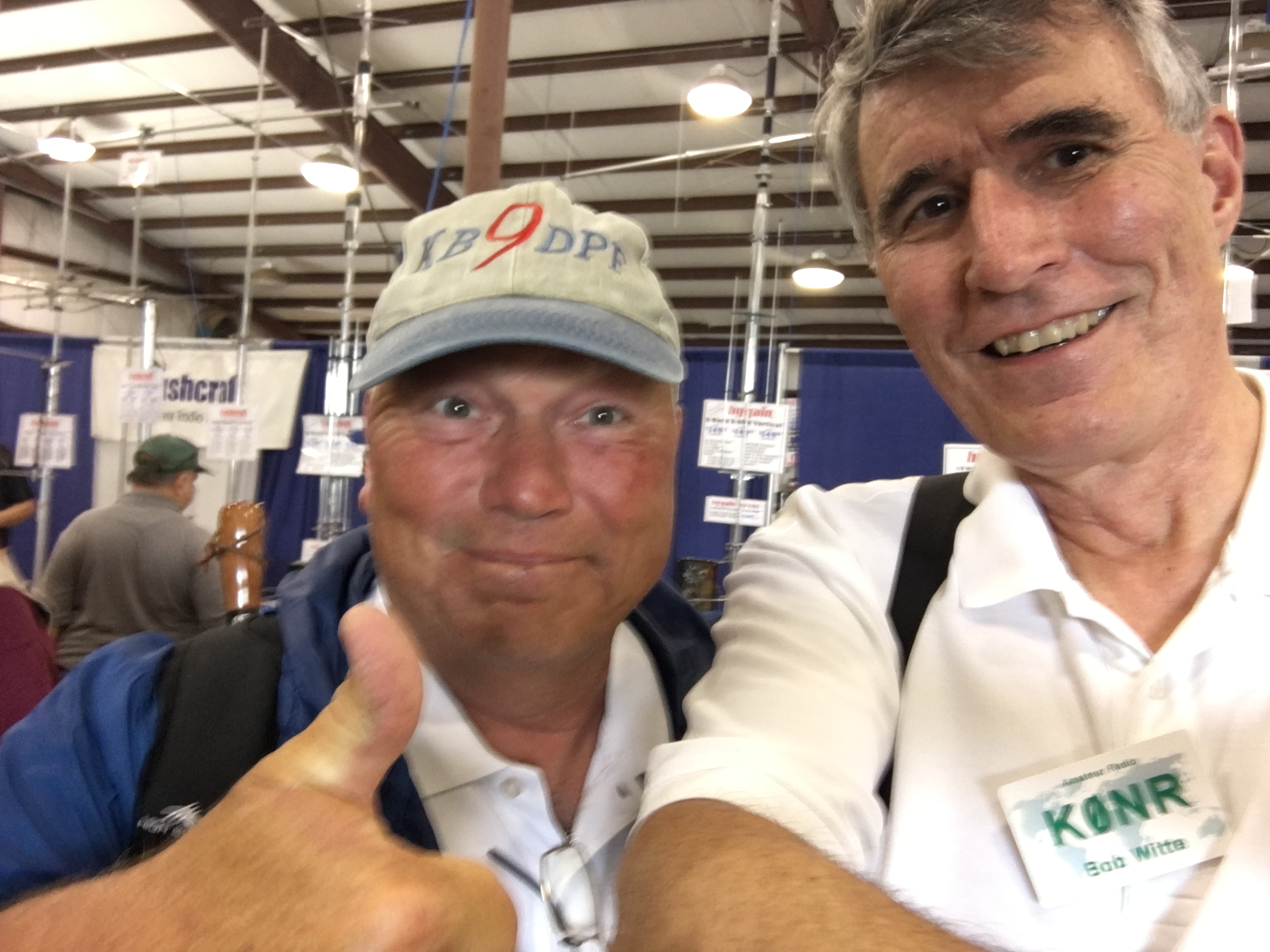
The short story is that we had a blast and the new location is an improvement over Hara (which is, of course, an easy compare).
We went early on Saturday morning, arriving at the fairgrounds around 8 AM (for a 9 AM start time). No traffic issues, easy access to parking. On Sunday we left a little later, arrived at 8:30 AM, again no traffic issues. (I suspect the traffic problems we’ve heard about were associated with arriving from the west, coming from Dayton. Also, that problem seemed to be mostly on Friday morning.)
Positives:
- Most of the buildings were in good shape [insert disparaging comment about Hara].
- Most of the buildings are not air conditioned but it seemed to be comfortable enough.
- The usual vendors were there…I couldn’t think of any didn’t show.
- The food selection was very good…basically “county fair style” vendors. For example, I had Louisiana style chicken, red beans and rice for lunch on Saturday.
- The forum rooms were pretty decent, as in large and convenient [insert disparaging comment about Hara]
- I attended a few forums (all good): contesting, AMSAT, NPOTA
- Parking was convenient and no charge.
Negatives:
- The flea market was a muddy mess, so we skipped that completely. Those that went out there came back with shoes covered with mud. (I saw one guy that came prepared with 18-inch high rubber boots. Smart move.) I’ve seen lots of comments on the web about “well, you can’t control the weather so you just have to deal with the mud.” Yes, you can’t control the weather but even Hara had a paved parking lot for the flea market. Read: no mud.
- All of the food vendors were outside and there was little to no sheltered seating. If the rain had hit around lunch time, I am not sure where people would have eaten.
All in all, not too bad.
I’m sure they’ll be getting lots of feedback and will be working on the problem areas. I think you have to accept the fact that on a weekend in May in Ohio, you will get some rain. So something has to be done about the flea market, else its mud city most years.
Seriously, I think the Dayton Amateur Radio Association (DARA) pulled off a minor miracle getting Hamvention moved to a new location without a major problem. They had a well-oiled machine that knew how to make it happen at Hara but everything had to be reworked this year.
People often ask “well, why do they even hold such a major event in Dayton?”
The answer: because that’s where DARA is.
73, Bob K0NR
The post 2017 Hamvention Report (K0NR) appeared first on The KØNR Radio Site.
Bob Witte, KØNR, is a regular contributor to AmateurRadio.com and writes from Colorado, USA. Contact him at [email protected].
MFJ-1026 Noise Canceller Tests At VA7MM
 |
| courtesy: www.mfjenterprises.com/ |
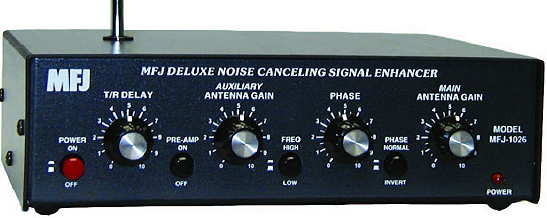
Mark, VA7MM, has been testing out his newly-acquired MFJ-1026 Noise Canceller and has provided several videos of the noise canceller in action.
Like so many other hams, Mark's suburban location has seen a gradually rising noise floor and the noise heard in this video is from an off-site location within his local neighbourhood, located about 400m away.
The noise canceller requires a separate 'noise antenna' in order to cancel any noise on the main receiving antenna and for all of the tests shown below, Mark's noise antenna was a Cushcraft R-7 vertical while using an Icom IC-7600 transceiver for listening.
Test 1 shows the noise canceller being used while listening to a broadcast station on 6.0 MHz:
Test 2 shows the canceller's effect on raw noise while viewing in Spectran:
Test 3 shows the canceller's effect on a 40m CW signal:
Test 4 shows the effect of just the IC-7600's noise blanker on the offending noise:
Mark's comments:
With proper tuning and set up, it looks like the MFJ-1026 can make a worthwhile improvement in unwanted noise reduction. Mark will also be testing and comparing a Timewave ANC-4 Noise Canceller with the MFJ and any videos received will be published here.
Steve McDonald, VE7SL, is a regular contributor to AmateurRadio.com and writes from British Columbia, Canada. Contact him at [email protected].
MFJ-1026 Noise Canceller Tests At VA7MM
|
| courtesy: www.mfjenterprises.com/ |
Mark, VA7MM, has been testing out his newly-acquired MFJ-1026 Noise Canceller and has provided several videos of the noise canceller in action.
Like so many other hams, Mark's suburban location has seen a gradually rising noise floor and the noise heard in this video is from an off-site location within his local neighbourhood, located about 400m away.
The noise canceller requires a separate 'noise antenna' in order to cancel any noise on the main receiving antenna and for all of the tests shown below, Mark's noise antenna was a Cushcraft R-7 vertical while using an Icom IC-7600 transceiver for listening.
Test 1 shows the noise canceller being used while listening to a broadcast station on 6.0 MHz:
Test 2 shows the canceller's effect on raw noise while viewing in Spectran:
Test 3 shows the canceller's effect on a 40m CW signal:
Test 4 shows the effect of just the IC-7600's noise blanker on the offending noise:
Mark's comments:
With proper tuning and set up, it looks like the MFJ-1026 can make a worthwhile improvement in unwanted noise reduction. Mark will also be testing and comparing a Timewave ANC-4 Noise Canceller with the MFJ and any videos received will be published here.
Steve McDonald, VE7SL, is a regular contributor to AmateurRadio.com and writes from British Columbia, Canada. Contact him at [email protected].
 Ham Radio Deluxe |
 W5SWL Electronics |
 Ham Radio Prep |
 KB3IFH QSL Cards  Hip Ham Shirts  HamRadioAuctions HamRadioAuctions Reliance Antennas Reliance Antennas Enigma Shop Enigma Shop |  morseDX  Ni4L Antennas  R&L Electronics R&L Electronics antennas.us antennas.us QRV QRV |
- Matt W1MST, Managing Editor
