 |
 2017 Colorado 14er Event with SOTA
 8 May 2017 | by
  Amateur Radio operators from around Colorado will be climbing many of Colorado’s 14,000-foot mountains and Summits On The Air (SOTA) peaks to set up amateur radio stations in an effort to communicate with other radio amateurs across the state and around the world. Well, last year we celebrated the 25th annual event so this year it must be the 26th. We are continuing the all weekend approach on August 5 and 6. However, many mountaintop activators will hit the trail early in the morning with the goal of being off the summits by noon due to lightning safety concerns.
We still have the very cool 25 Year Anniversary t-shirts (and other great stuff) available at http://www.cafepress.com/wg0at
The 14er event includes Summits On the Air (SOTA) peaks, which add over 1700 now 1805 potential summits! If you aren’t up to climbing a 14er, there are many other summits to choose from (with a wide range of difficulty). See the W0C SOTA web page at w0c-sota.org
Radio operators who plan to activate a summit should post their intent on the ham14er Yahoo Group. To subscribe to the “ham14er” email list, visit the Yahoo groups site at http://groups.yahoo.com/group/ham14er/ . Also, be sure to check out the event information at http://www.ham14er.org It is also a great idea to post an ALERT on the SOTAwatch.org website.
Frequencies used during the event
Activity can occur on any amateur band including HF, VHF and UHF. The 2m fm band plan uses a “primary frequency and move up” approach. The 2m fm primary frequency is 147.42 MHz. At the beginning of the event, operators should try calling on 147.42 MHz. As activity increases on that frequency, move on up the band using the 30 kHz steps. Don’t just hang out on 147.42 MHz…move up! The next standard simplex frequency up from 147.42 MHz is 147.45 MHz, followed by 147.48 and 147.51 MHz. We try to stay off 146.52 MHz, the National Simplex Calling Frequency to avoid overload, but if you need to make a call there, go for it…and be brief.
| Frequency (MHz) | Comments | Frequency (MHz) | Comments |
| 147.42 | Primary 2m FM Frequency, then up in 30 kHz steps | 7.032 | 40m CW Frequency |
| 147.45 | Alternate 2m FM frequency | 7.185 | 40m SSB Frequency |
| 147.48 | Alternate 2m FM frequency | 10.110 | 30m CW Frequency |
| 147.51 | Alternate 2m FM frequency | 14.060 | 20m CW Frequency |
| 446.000 | Primary 70 cm FM frequency | 14.345 | 20m SSB Frequency |
| 446.025 | Alternate 70 cm FM frequency | 18.092 | 17m CW Frequency |
| 144.200 | 2m SSB calling frequency | 18.158 | 17m SSB Frequency |
| 50.125 | 6m SSB calling frequency | 21.060 | 15m CW Frequency |
| 1294.50 | 23 cm FM calling frequency | 21.330 | 15m SSB Frequency |
| Other Bands/Modes | Standard calling frequencies and/or band plans apply. | 28.060 | 10m CW Frequency |
| 28.350 | 10m SSB Frequency |
Warning: Climbing mountains is inherently a dangerous activity.
Do not attempt this without proper training, equipment and preparation.
Sponsored by The Colorado 14er Event Task Force
The post 2017 Colorado 14er Event with SOTA appeared first on The KØNR Radio Site.
Bob Witte, KØNR, is a regular contributor to AmateurRadio.com and writes from Colorado, USA. Contact him at [email protected].
LHS Episode #188: A Sniffle of Coughers
 Thank you for tuning in to episode #188 of Linux in the Ham Shack. In this episode, the hosts discuss changes to FRS, GMRS and Citizen's Band regulations, morse code in Taiwan, an FCC frequency auction, new Linux, Android in a box, an ncurses interface for packet, Zesty Zapus, ham radio in OpenSUSE, chicken marsala and much more. Thank you for listening. Please donate to our Hamvention 2017 fund if you can. See you in Xenia!
73 de The LHS Guys
Russ Woodman, K5TUX, co-hosts the Linux in the Ham Shack podcast which is available for download in both MP3 and OGG audio format. Contact him at [email protected].
Back in the loop
My main project for at least the last 12 months has been building a solid magnetic loop antenna and its companion automatic loop controller. I’ve been roughly tracking its progress at my magnetic loop antenna project page on this blog.
As usual, life has got in the way, but I want to get back on track and complete the project. To start pumping some RF current through it again, over the weekend I spent a short time playing with the loop on WSPR on 40, 30 & 20m. The tests were too brief but they certainly confirm that the loop is capable of transmitting a signal in spite of the fact the loop is only half a metre above ground and surrounded by metal garden furniture, a steel framed awning and gutters.
I used the WSPR Beacon android app to control my transmitter. There was some discrepancy (tens of Hz) between the actual output frequencies on the app and those shown on WSPRnet. I also found that tuning the loop to each WSPR frequency using the iP30 antenna analyzer was easy and the KX2 gave lower SWR figures.
The brief test became an exercise in understanding theWSPRnet results taking into account propagation and loop orientation which was aligned north-south.

This map view combines all 20 spots of the 1W VK2RH transmissions from grid square QF56oc. The first test was logged at 2017-05-07 01:36 UTC. (I’ve trimmed repeated info from the chart below to improve its fit on the page.)
| Time | MHz | SNR | Drift | Reporter | RGrid | km | az |
| 05:24 | 14.097001 | -15 | 1 | VK4ALR | QG56fk | 1151 | 356 |
| 05:24 | 14.097016 | -26 | 0 | VK4TDI | QG62lm | 733 | 14 |
| 04:48 | 10.140109 | -22 | 0 | VK4TDI | QG62lm | 733 | 14 |
| 04:48 | 10.140094 | -23 | 0 | VK7TW | QE37pc | 1057 | 198 |
| 04:48 | 10.140091 | -17 | 0 | VK6XT | OF86td | 3086 | 261 |
| 04:40 | 10.140095 | -27 | 0 | VK7TW | QE37pc | 1057 | 198 |
| 04:40 | 10.140090 | -4 | 0 | VK3WE | QF32se | 547 | 216 |
| 04:40 | 10.140090 | -22 | 0 | ZL1RS | RF64vs | 2069 | 101 |
| 04:40 | 10.140092 | -15 | 0 | VK6XT | OF86td | 3086 | 261 |
| 04:40 | 10.140091 | -16 | 0 | ZL3GA | RE66ho | 2130 | 126 |
| 03:18 | 7.040121 | -24 | 0 | VK3BAL | QF22mc | 711 | 230 |
| 03:18 | 7.040134 | -7 | 0 | VK3AXF | QF33fn | 516 | 235 |
| 03:18 | 7.040135 | -18 | 0 | VK4MOB | QG62ol | 734 | 16 |
| 03:18 | 7.040130 | -18 | 0 | VK3DXE | QF21nv | 720 | 228 |
| 03:18 | 7.040128 | -12 | 0 | VK2TPM | QF56of | 14 | 0 |
| 03:18 | 7.040129 | -14 | 0 | VK7DIK | QE38cu | 918 | 207 |
| 01:36 | 7.040183 | -16 | -1 | VK3AXF | QF33fn | 516 | 235 |
| 01:36 | 7.040177 | -16 | -1 | VK2TPM | QF56of | 14 | 0 |
| 01:36 | 7.040184 | -24 | -1 | VK4MOB | QG62ol | 734 | 16 |
| 01:36 | 7.040179 | -21 | 0 | VK3DXE | QF21nv | 720 | 228 |
40 metres favoured north-south, while 30 metres was literally an all-rounder and 20 metres was too brief. These results probably say more about propagation than the loop, not to mention the heavy lifting done by all the reporter stations extracting my down to -26 or -27 dB signals from the noise! Impressive all round!
I wonder how many people are using the Sotabeams WSPRlite antenna tester device. Certainly looks tempting, especially for longer term antenna evaluation.
In any case, the main purpose of today’s exercise was to re-start the loop project. The To Do list includes
- building & installing the SWR bridge into the loop controller,
- deciding on the best way to couple the stepper motor shaft to the tuning capacitor shaft,
- and wiring it all together with appropriate coax and control cables.
LF / MF News From Monitor Sensors

A note from Roger, VK4YB of Monitor Sensors, reports some interesting news.
You might recall that his company manufactures a very versatile and well-engineered 630m transverter which was used at both ends of our two 630m JT9 contacts last year during the fall equinox propagation peak between North America and down-under.
Roger now reports that Monitor Sensors will be producing a new 2200m transverter, with all of the bells and whistles found on the 630m unit which has proven to be a real workhorse.
Monitor Sensors 2200m Transverter
The Monitor Sensors TVTR2 2200m Transverter enables any Amateur Radio Station, equipped with a conventional HF transceiver, immediate, all mode, access to the new 135.7-137.8 kHz, 2200m band.
The receiver design incorporates a 7pole Chebyshev filter, 3kHz wide roofing filter and a 5 pole Chebyshev filter in cascade before the double balanced, commutating mixer, fed by an ultra stable, temperature compensated, extremely low phase noise, MEMS local oscillator. The mixer is followed by a Chebychev band pass filter into an ultra linear, low noise, current feedback, IF amplifier. The receiver noise floor, in a 500Hz bandwidth, is -125 dBm and yet the onset of compression is not reached until +11dBm. A front end 20dB attenuator can be switched in for even higher signal handling. Overall receiver gain is set to +6dB, or -14dBm with attenuator in.
The transmitter input circuit incorporates a 0-14 dB switched step attenuator to prevent over driving. The same mixer and local oscillator are used on the transmit side. The PA uses 6 rugged lateral FETs in class AB push-pull to easily achieve the 50 watts rated output. Lateral FETs are inherently linear and thermally stable. The transmitter can be run at full power, indefinitely, into a dead short or open circuit without any danger of damaging the FETs. Transmit-receive switching is automatic with user selectable VOX delay. Alternatively the PTT line may be used.
The transverter employs extensive and accurate metering. Power input and output, SWR, Frequency, Attenuation in use, Temperature, Supply Voltage, Current and Resistance are displayed.
Transmission is inhibited if carrier frequencies outside the 135.7-137.8 kHz band are detected. A tuning screen may be selected which displays SWR in digital and graphical form for easy antenna adjustment. The menu system is self explanatory and users report no manual is needed, although one is supplied. A USB socket is provided for future code upgrades (free of charge) from the Monitor Sensors web site.
The transverter has been designed for the best possible protection against accidental mishaps. It will survive reverse polarity supply and the injection of 100 watts of HF into any of its ports whether in transmit or receive mode. If supply current exceeds 25 Amps, the supply is cut in 3 microseconds. This electronic breaker can be reset by simply switching off and on again. The transmitter will shut down in the unlikely event that the internal heat sink reaches 90°C. The cooling fan is under the proportional control of the microcomputer and begins operation above 35°C. Any unusual operation will cause the screen to turn red and an appropriate warning will be displayed.
TVTR2 Specifications
RF frequency range 135.7 to 137.8 kHz
IF frequency range 1805.7 to 1807.8 kHz (others available in the 160m band)
Transmission modes CW, SSB, WSPR, and all other data modes
Output Power 50 Watts Continuous, 100% duty cycle @13.8V supply
Input and Output Impedance 50 Ohms
Supply voltage 13.8 VDC @ 15 Amps nominal, 10-16 VDC operational
Rx noise floor -125 dBm (500 Hz bandwidth)
Rx 3dB compression point +15 dBm (Rx attenuator out)
Rx IF rejection better than 75dB
Rx conversion gain +6dB nominal
Roofing filter in-band ripple +/- 0.5dB
Tx 3rd order IMD -33 dB below PEP, typical at 50W output
Tx 5th order IMD -45dB below PEP, typical at 50W output
Tx harmonics and spurii All better than -50dB
Tx conversion gain +10dB nominal
Power input connector 2 * Anderson Power Poles (one Power cable supplied)
RF connectors 3 * SO239 (one PL259 to PL259 cable supplied)
PTT connectors 2 * RCA (one RCA to RCA cable supplied)
USB connector Micro B USB, (matching cable supplied)
Dimensions 12½ * 4¼ * 3 inches, 320 * 120 * 76 mm
Weight 3.4 lbs, 1.6 kg
In addition to the transverters, Monitor Sensors will also be manufacturing solid state amplifiers for both the 2200m and 630m bands with power levels at around the 450W output level. Like the transverters, these will be 'linear' devices as well. It is possible that a duo-band amplifier will also eventually be produced.
It will be interesting to see if any other new gear becomes commercially available from other manufacturers once the LF / MF ham bands are introduced in the U.S.A. , something that is expected to happen fairly soon.
Steve McDonald, VE7SL, is a regular contributor to AmateurRadio.com and writes from British Columbia, Canada. Contact him at [email protected].
LF / MF News From Monitor Sensors
A note from Roger, VK4YB of Monitor Sensors, reports some interesting news.
You might recall that his company manufactures a very versatile and well-engineered 630m transverter which was used at both ends of our two 630m JT9 contacts last year during the fall equinox propagation peak between North America and down-under.
Roger now reports that Monitor Sensors will be producing a new 2200m transverter, with all of the bells and whistles found on the 630m unit which has proven to be a real workhorse.
Monitor Sensors 2200m Transverter
The Monitor Sensors TVTR2 2200m Transverter enables any Amateur Radio Station, equipped with a conventional HF transceiver, immediate, all mode, access to the new 135.7-137.8 kHz, 2200m band.
The receiver design incorporates a 7pole Chebyshev filter, 3kHz wide roofing filter and a 5 pole Chebyshev filter in cascade before the double balanced, commutating mixer, fed by an ultra stable, temperature compensated, extremely low phase noise, MEMS local oscillator. The mixer is followed by a Chebychev band pass filter into an ultra linear, low noise, current feedback, IF amplifier. The receiver noise floor, in a 500Hz bandwidth, is -125 dBm and yet the onset of compression is not reached until +11dBm. A front end 20dB attenuator can be switched in for even higher signal handling. Overall receiver gain is set to +6dB, or -14dBm with attenuator in.
The transmitter input circuit incorporates a 0-14 dB switched step attenuator to prevent over driving. The same mixer and local oscillator are used on the transmit side. The PA uses 6 rugged lateral FETs in class AB push-pull to easily achieve the 50 watts rated output. Lateral FETs are inherently linear and thermally stable. The transmitter can be run at full power, indefinitely, into a dead short or open circuit without any danger of damaging the FETs. Transmit-receive switching is automatic with user selectable VOX delay. Alternatively the PTT line may be used.
The transverter employs extensive and accurate metering. Power input and output, SWR, Frequency, Attenuation in use, Temperature, Supply Voltage, Current and Resistance are displayed.
Transmission is inhibited if carrier frequencies outside the 135.7-137.8 kHz band are detected. A tuning screen may be selected which displays SWR in digital and graphical form for easy antenna adjustment. The menu system is self explanatory and users report no manual is needed, although one is supplied. A USB socket is provided for future code upgrades (free of charge) from the Monitor Sensors web site.
The transverter has been designed for the best possible protection against accidental mishaps. It will survive reverse polarity supply and the injection of 100 watts of HF into any of its ports whether in transmit or receive mode. If supply current exceeds 25 Amps, the supply is cut in 3 microseconds. This electronic breaker can be reset by simply switching off and on again. The transmitter will shut down in the unlikely event that the internal heat sink reaches 90°C. The cooling fan is under the proportional control of the microcomputer and begins operation above 35°C. Any unusual operation will cause the screen to turn red and an appropriate warning will be displayed.
TVTR2 Specifications
RF frequency range 135.7 to 137.8 kHz
IF frequency range 1805.7 to 1807.8 kHz (others available in the 160m band)
Transmission modes CW, SSB, WSPR, and all other data modes
Output Power 50 Watts Continuous, 100% duty cycle @13.8V supply
Input and Output Impedance 50 Ohms
Supply voltage 13.8 VDC @ 15 Amps nominal, 10-16 VDC operational
Rx noise floor -125 dBm (500 Hz bandwidth)
Rx 3dB compression point +15 dBm (Rx attenuator out)
Rx IF rejection better than 75dB
Rx conversion gain +6dB nominal
Roofing filter in-band ripple +/- 0.5dB
Tx 3rd order IMD -33 dB below PEP, typical at 50W output
Tx 5th order IMD -45dB below PEP, typical at 50W output
Tx harmonics and spurii All better than -50dB
Tx conversion gain +10dB nominal
Power input connector 2 * Anderson Power Poles (one Power cable supplied)
RF connectors 3 * SO239 (one PL259 to PL259 cable supplied)
PTT connectors 2 * RCA (one RCA to RCA cable supplied)
USB connector Micro B USB, (matching cable supplied)
Dimensions 12½ * 4¼ * 3 inches, 320 * 120 * 76 mm
Weight 3.4 lbs, 1.6 kg
In addition to the transverters, Monitor Sensors will also be manufacturing solid state amplifiers for both the 2200m and 630m bands with power levels at around the 450W output level. Like the transverters, these will be 'linear' devices as well. It is possible that a duo-band amplifier will also eventually be produced.
It will be interesting to see if any other new gear becomes commercially available from other manufacturers once the LF / MF ham bands are introduced in the U.S.A. , something that is expected to happen fairly soon.
Steve McDonald, VE7SL, is a regular contributor to AmateurRadio.com and writes from British Columbia, Canada. Contact him at [email protected].
We’ve Got Some Explaining to Do
There was a fun interaction on twitter the other day about how we represent amateur radio to the general public. It started with this tweet from @FaradayRF:
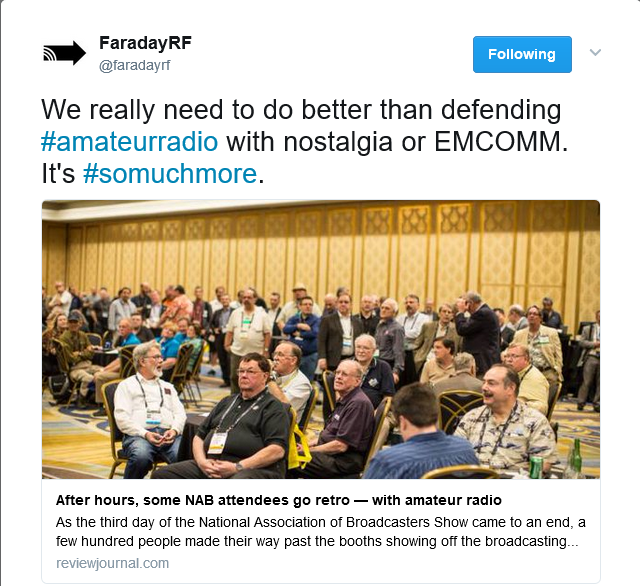 This refers to an article in the Las Vegas Review-Journal newspaper where the author decided to use the theme of “ham radio is retro” to tell the story of a ham radio gathering at NAB. I really hate it when ham radio gets positioned as “old technology” in the world of awesome wireless stuff. Clearly, some of our technology is dated, but the amateur service includes lots of new technology and experimentation. (Actually, the tone of the article was very positive, so we shouldn’t complain too loudly.)
So I replied, along with a few other folks:
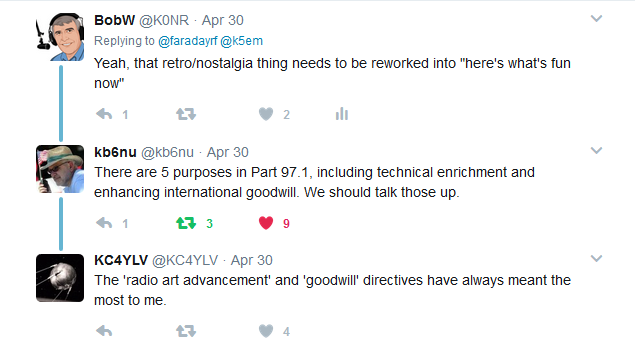 So KB6NU and KC4YLV took the discussion back to good old Part 97 of the FCC rules. (You ever notice how often radio hams like to quote Part 97? It’s right up there with the U.S. Constitution and the Declaration of Independence.) I tried to recall from memory the five things listed in 97.1 as the Basis and Purpose of the Amateur Radio Service, but failed.
I had to look them up, so I’ll save you the trouble and list them here. Actually, I am going to provide the KØNR Abbreviated Version (go here to see the full text):
Part 97.1 Basis and Purpose of Amateur Radio
a) Voluntary public service, including emergency communications
b) Advancement of the radio art
c) Advancement of communication and technical skills
d) Expansion of trained radio/electronics enthusiasts
e) Enhancement of international good will
These five things are still relevant and are being pursued today. Not all radio amateurs contribute to every one of these but as a group we are doing these things. The good news is that many non-hams do understand the When All Else Fails aspect of ham radio…most have had their cellphone become a useless brick during major incidents. Items b, c and d are all about learning new things, building skills and expanding the number of radio hams. We should talk more about that. Enhancing international good will may seem a bit quaint but this crazy world can always use another dose of that.
Part 97 does leave out one thing that is the ultimate attraction and, in fact, the universal purpose of ham radio:
To Have Fun Messing Around with Radios.
73, Bob KØNR
The post We’ve Got Some Explaining to Do appeared first on The KØNR Radio Site.
Bob Witte, KØNR, is a regular contributor to AmateurRadio.com and writes from Colorado, USA. Contact him at [email protected].
ETH067 – I Think I Have The PSK31 Bug Thanks to Ian Kahn, KM4IK

Over the past 67 episodes of my podcast, there has been a couple episodes that have really peaked my interest and kind of lit a fire under me to do whatever that topic is myself. Things like APRS back in episode 6, and Broadband Hamnet in episode 29. However, neither of those got me back onto HF. My HF rig has basically gone unused for close to seven years or so and has been in a box for the last three years!!
I honestly have never been big on voice communications on HF. All of the times that I have operated on HF has either been at home calling CQ or looking for someone else calling it or during things like Field Day. At home I rarely got anyone to answer my CQ call; I think I was getting out. During field day it was, basically the exchange and on to the next contact. Neither of these things were very fun to me.
Digital modes, especially thing like PSK31, seem to be right up my alley! So I decided to look for someone that knew something about it, that I could learn from. I finally found Ian Kahn, KM4IK and he agreed to come onto my show and talk to me about it. We had a great conversation and I learned a lot. If you are interested in learning about PSK31, head over to the show notes of the episode, you can listen right on the page, or you can search for Everything Ham Radio on the major podcast directories.
http://www.everythinghamradio.com/podcast/67
Curtis Mohr, K5CLM, is the author/owner of Everything Ham Radio Blog and Youtube channel. Contact him at [email protected].
 Ham Radio Deluxe |
 W5SWL Electronics |
 Ham Radio Prep |
 KB3IFH QSL Cards  Hip Ham Shirts  HamRadioAuctions HamRadioAuctions Reliance Antennas Reliance Antennas Enigma Shop Enigma Shop |  morseDX  Ni4L Antennas  R&L Electronics R&L Electronics antennas.us antennas.us QRV QRV |
- Matt W1MST, Managing Editor
