 |
 Simple interference fix for the Chinese Pixie
 10 June 2017 | by
 The Chinese Pixie transceiver operating at 7023 kHz has become very popular. It often costs less than 5 USD on Ebay. Like most Pixies it is susceptible to broadcast breakthrough and intermodulation. Much of this is caused by the keying circuit of the audio amplifier, the LM386. The cure is to move the muting diode from the power supply pin (no. 6) to the bypass pin (no. 7). I have described this in another blog post with title: “Using pin 7 of the LM386 to reduce BCI and add side tone to Pixie 2“.
Here are two pictures that show how this can be done for the Chinese Pixie. One needs an additional resistor in the range 10 – 51 ohms. If you can fit it, then use the large 51 ohms resistor that come with some of the kits (I think it is meant for a dummy load). I have used 10 ohms in the picture. It replaces the old R3 of 1 k. The diode D3 is not mounted in the holes provided, and instead it is mounted under the PCB with the minus (denoted by the ring) connected to where D3’s minus was, and the plus side connected to pin 7 of the LM386.
 |
| R3 is indicated by the lower left arrow, and the old placement of D3 is shown with the upper arrow |
 |
| Arrow showing where D3 instead should be soldered. The minus, indicated by the ring, is to the left in the image |
The post “Simple interference fix for the Chinese Pixie” first appeared on the “LA3ZA Radio & Electronics Blog.”
Sverre Holm, LA3ZA, is a regular contributor to AmateurRadio.com and writes from Norway. Contact him at [email protected].
Simple interference fix for the Chinese Pixie
The Chinese Pixie transceiver operating at 7023 kHz has become very popular. It often costs less than 5 USD on Ebay. Like most Pixies it is susceptible to broadcast breakthrough and intermodulation. Much of this is caused by the keying circuit of the audio amplifier, the LM386. The cure is to move the muting diode from the power supply pin (no. 6) to the bypass pin (no. 7). I have described this in another blog post with title: “Using pin 7 of the LM386 to reduce BCI and add side tone to Pixie 2“.
Here are two pictures that show how this can be done for the Chinese Pixie. One needs an additional resistor in the range 10 – 47 ohms. I have used 10 ohms in the picture. It replaces the old R3 of 1 k. The diode D3 is not mounted, and instead it is mounted under the PCB with the minus (denoted by the ring) connected to where D3’s minus was, and the plus side connected to pin 7 of the LM386.
|
| R3 is indicated by the lower left arrow, and the old placement of D3 is shown with the upper arrow |
|
| Arrow showing where D3 instead should be soldered. The minus, indicated by the ring, is to the left in the image |
Sverre Holm, LA3ZA, is a regular contributor to AmateurRadio.com and writes from Norway. Contact him at [email protected].
Amateur Radio Weekly – Issue 160

IRLP rules them all
Superior to all the new digital voice modes – combined.
KE9V
Digital revolution or evolution?
Few or even no CW / SSB signals on the HF bands while at the same time seeing lots of activity throughout the digital portion of the bands.
VE7SL
More Antennas! Receiver Overload! Satellites!
In my never-ending quest to develop the perfect high-altitude ballooning chase car, I’ve added a commercial 70cm turnstile antenna.
RF Head
Why choose the Icom 7300 over the 7610?
You can buy three Icom 7300’s for the same price as a single Icom 7610!
M0JCQ’s Ham Blog
The 6m band holy grail
For us here in Europe the holy grail of the 6m band would be working Japan on 50MHz.
PE4BAS
Hamradio Line Loss Calculator for iOS devices
Coax Line from Federico Romano, IW2MVI is a simple and fast app that allows you to calculate the loss of your coax line.
Mac Ham Radio
Monitoring railroad ATCS control signals with an RTL-SDR
ATCS is used for things like communications between trains, rail configuration data, train location data, speed enforcement, fuel monitoring, train diagnostics and general instructions and messages.
RTL-SDR.com
Hamvention improvements already in the works for 2018
The food and forum venues at the new location got high marks, but the flea market suffered badly from the effects of heavy rainfall.
ARRL
Video
Sporadic E Skip on 10 Meter hand held radio
Be sure to check out 10 meters and 6 meters for sporadic E propagation late mornings or in the evenings. Now is a good time of the year.
RadioHamGuy
Ham radio kite antenna prototype
Our first incarnation of the kite antenna using a smaller kite.
KA5D
Amateur Radio Weekly is curated by Cale Mooth K4HCK. Sign up free to receive ham radio's most relevant news, projects, technology and events by e-mail each week at http://www.hamweekly.com.
Arduino Projects for Amateur Radio with Glen Popiel – ETH072

Do you want to get back to the original roots of Amateur Radio? Maybe you are a new ham and you have a DIY side? Maybe you just want to try something new? There are so many things that you can do with an Arduino that cost only $4 or so! Anything from a morse code keyer to a 40m QRP CW Radio and a whole lot in between. You can even do things with an Arduino that has nothing to do with amateur radio but you will find a use for.
In this episode with talk with Glen Popiel, KW5GP the author of the ARRL published books, Arduino for Ham Radio and his new book that just came out, More Arduino for Ham Radio. He is also the author of the ham mesh networking book, High Speed Multimedia for Amateur Radio.
We had a great conversation and it made me literally go to the ARRL website and buy his new Arduino book while we were recording! Check out the show notes of this episode to listen and to get more information about what we talked about. There are also links to his books that you can go to to buy one for yourself.
Curtis Mohr, K5CLM, is the author/owner of Everything Ham Radio Blog and Youtube channel. Contact him at [email protected].
May Moonbounce / More 6m WSJT Observations
 Late May's EME activity seemed poorer and less active than the previous month of northern declination moonrises.
Unlike winter's northern moonrises, the summer ones occur close to 'new moon' time and for a few days on the much favored northern path, the moon is too close to the sun, resulting in lower activity and higher noise. As well, with the warmer summer weather, outdoor projects or other summer activities often take priority over ham radio operations at this time of the year.
Nevertheless, I did manage to work five stations with my small station, and added four 'new initials', bringing my total unique-station QSO total to 105 ... it seems there are still plenty of folks out there that I have yet to work!
- VE1KG
- OK1DIX #102
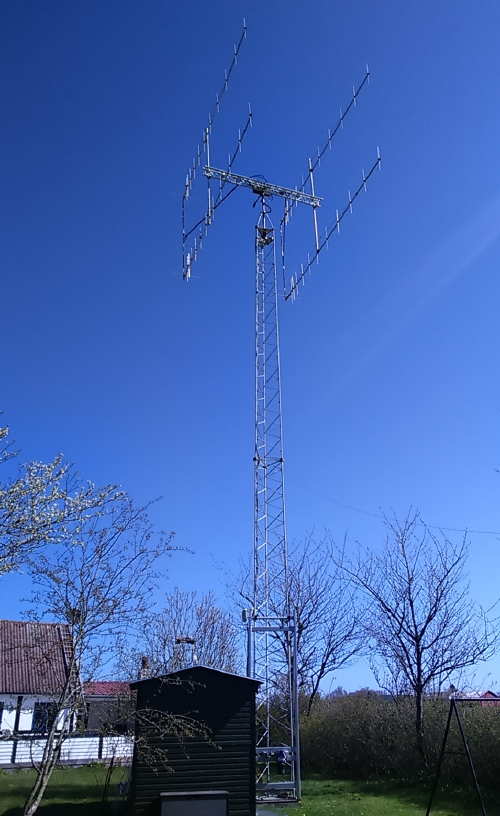
- S53K #103
- IK1UWL #104
- OZ1CT #105
 |
| IK1UWL's 4 x 9el cross-polarized array |
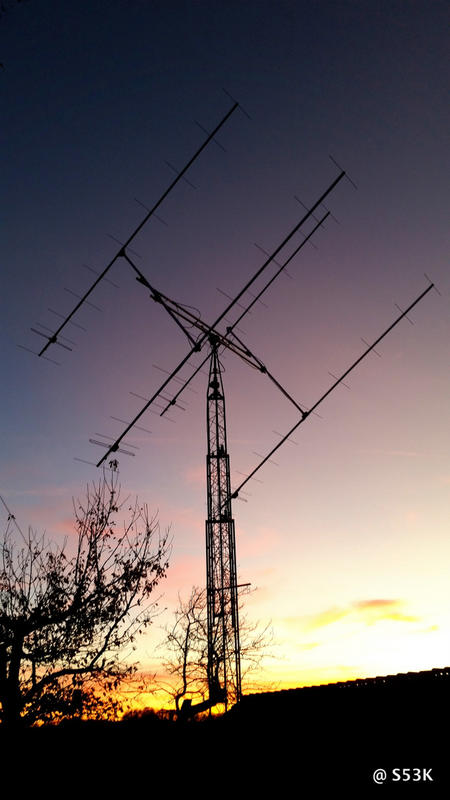 |
| S53K's 4 x 11el array |
 |
| OZ1CT's 4 x 10el cross-polarized array |
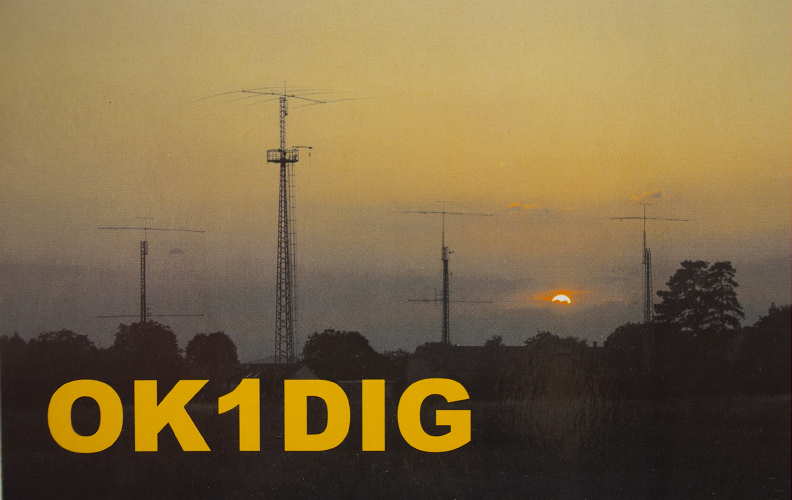
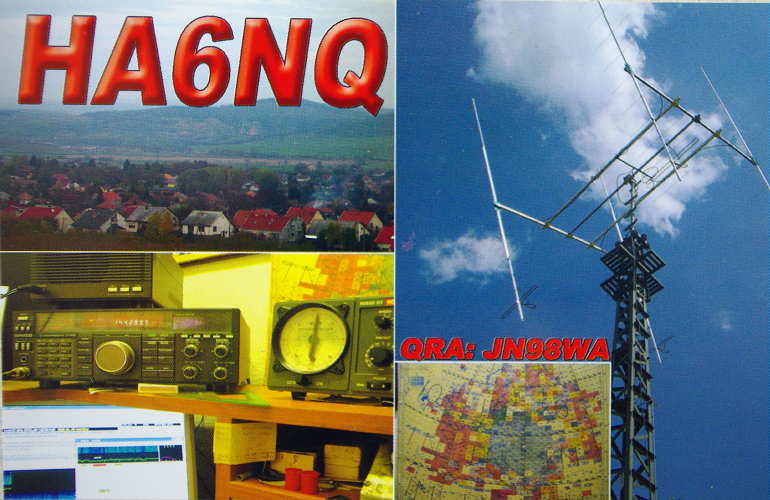
Latest Incoming EME QSLs:




With the summer Sporadic-E season now in full swing, I've had the opportunity to make some early observations regarding the growing use of the weak-signal digital modes. It seems my previous suspicions about the migration from traditional modes to the digital modes is occurring even more rapidly and in much larger numbers than I had expected. Almost all early activity has been concentrated on both JT65 and JT9 modes and most of the chatter on the ON4KST 6m chat page centers around these digital modes.
So far this season I have heard much more DX on JT65 than on CW or SSB, including two stations in Europe on Tuesday (EI4DQ and F5LNU). It seems that many QSO's are taking place with signals that are usually too weak to be heard by ear (~ -16db or weaker) and if listening for CW signals, the band would appear to be pretty much dead. With no full-blown openings to Europe yet, I just wonder if stations will stay put on JT65 or move to the much faster CW mode for making quick contacts when the propagation allows?
Making JT65 contacts is not a particularly fast process, with most QSOs taking a minimum of four minutes, if both operators are well acquainted with the procedures ... longer if not or if QRM or propagation throws a spanner into the works. Some of the newer JT9 sub modes allow for quicker exchanges as does the much less sensitive MSK144 mode but with so many options now available, it's often difficult to get everyone on the same mode or at least figure out what mode you are seeing!
I can see the advantages of using these modes when conditions will not support CW but will still allow digital decodes. If the normal 'weak signal window' can be sustained for a much longer time period than the usually short-lived audible CW-level window, perhaps more stations could actually be worked on these modes even though the QSO rate is much slower. But I still think that many easy CW QSO's will inevitably be missed when operators are watching their digital waterfalls and ignoring the CW end of the band ... of course, if everyone is doing that, then there will be nothing to be heard on CW, even though conditions may well support good signals.
It's a strange new situation and I'm probably not the only one that may be worried about the negative effects of the new weak-signal modes on 6m ... time will tell, but for me, if things keep going along this path, much of 6m's magic may be gone along with it.
Some other initial observations are:
- maybe it's possible to work more DX on weak signal mode, even though it is slower, because of the possibly longer propagation window at sub audible signal levels? ... ie. on a seemingly 'dead band' by ear.
- many are using the wrong sequence when calling for EU or JA. Folks need to pay attention to what sequence the DX is using!
- if your neighbours are running on even or odd sequence, then it might be neighbourly to also use the same sequence to avoid causing disruptive QRM. This seems to go south fast, once the band breaks wide open and it seems like 'every man for himself' ... not unlike 50.125!
- there are too many weak-signal modes and it would be advantageous to settle on a 'standard' mode for 6m DX. It seems as though many are wasting valuable time either switching modes or trying to figure out what mode they are seeing but not decoding! On long haul 6m Es, things change too quickly to waste time.
- there are still a lot of over-driven signals or signals with 60Hz components causing double decodes +/- 60Hz from their main signals.
Steve McDonald, VE7SL, is a regular contributor to AmateurRadio.com and writes from British Columbia, Canada. Contact him at [email protected].
May Moonbounce / More 6m WSJT Observations
Late May's EME activity seemed poorer and less active than the previous month of northern declination moonrises.Unlike winter's northern moonrises, the summer ones occur close to 'new moon' time and for a few days on the much favored northern path, the moon is too close to the sun, resulting in lower activity and higher noise. As well, with the warmer summer weather, outdoor projects or other summer activities often take priority over ham radio operations at this time of the year.
Nevertheless, I did manage to work five stations with my small station, and added four 'new initials', bringing my total unique-station QSO total to 105 ... it seems there are still plenty of folks out there that I have yet to work!
- VE1KG
- OK1DIX #102
- S53K #103
- IK1UWL #104
- OZ1CT #105
|
| IK1UWL's 4 x 9el cross-polarized array |
|
| S53K's 4 x 11el array |
|
| OZ1CT's 4 x 10el cross-polarized array |
Latest Incoming EME QSLs:
With the summer Sporadic-E season now in full swing, I've had the opportunity to make some early observations regarding the growing use of the weak-signal digital modes. It seems my previous suspicions about the migration from traditional modes to the digital modes is occurring even more rapidly and in much larger numbers than I had expected. Almost all early activity has been concentrated on both JT65 and JT9 modes and most of the chatter on the ON4KST 6m chat page centers around these digital modes.
So far this season I have heard much more DX on JT65 than on CW or SSB, including two stations in Europe on Tuesday (EI4DQ and F5LNU). It seems that many QSO's are taking place with signals that are usually too weak to be heard by ear (~ -16db or weaker) and if listening for CW signals, the band would appear to be pretty much dead. With no full-blown openings to Europe yet, I just wonder if stations will stay put on JT65 or move to the much faster CW mode for making quick contacts when the propagation allows?
Making JT65 contacts is not a particularly fast process, with most QSOs taking a minimum of four minutes, if both operators are well acquainted with the procedures ... longer if not or if QRM or propagation throws a spanner into the works. Some of the newer JT9 sub modes allow for quicker exchanges as does the much less sensitive MSK144 mode but with so many options now available, it's often difficult to get everyone on the same mode or at least figure out what mode you are seeing!
I can see the advantages of using these modes when conditions will not support CW but will still allow digital decodes. If the normal 'weak signal window' can be sustained for a much longer time period than the usually short-lived audible CW-level window, perhaps more stations could actually be worked on these modes even though the QSO rate is much slower. But I still think that many easy CW QSO's will inevitably be missed when operators are watching their digital waterfalls and ignoring the CW end of the band ... of course, if everyone is doing that, then there will be nothing to be heard on CW, even though conditions may well support good signals.
It's a strange new situation and I'm probably not the only one that may be worried about the negative effects of the new weak-signal modes on 6m ... time will tell, but for me, if things keep going along this path, much of 6m's magic may be gone along with it.
Some other initial observations are:
- maybe it's possible to work more DX on weak signal mode, even though it is slower, because of the possibly longer propagation window at sub audible signal levels? ... ie. on a seemingly 'dead band' by ear.
- many are using the wrong sequence when calling for EU or JA. Folks need to pay attention to what sequence the DX is using!
- if your neighbours are running on even or odd sequence, then it might be neighbourly to also use the same sequence to avoid causing disruptive QRM. This seems to go south fast, once the band breaks wide open and it seems like 'every man for himself' ... not unlike 50.125!
- there are too many weak-signal modes and it would be advantageous to settle on a 'standard' mode for 6m DX. It seems as though many are wasting valuable time either switching modes or trying to figure out what mode they are seeing but not decoding! On long haul 6m Es, things change too quickly to waste time.
- there are still a lot of over-driven signals or signals with 60Hz components causing double decodes +/- 60Hz from their main signals.
Steve McDonald, VE7SL, is a regular contributor to AmateurRadio.com and writes from British Columbia, Canada. Contact him at [email protected].
We’re Giving Away Free SDR Receiver Packages to 30 Lucky Hams Worldwide!

NooElec and AmateurRadio.com have teamed up
to give away
Software-Defined Radio (SDR) Receiver Packages
to 30 lucky ham radio operators worldwide!
…plus NooElec will even pay the shipping worldwide!
The deadline to enter is 14 June 2017 at 18:00 UTC.
Prize Packages

Two (2)
NESDR SMArt XTR HF Bundles
(with TCXO upgrade module)
Listen to and watch frequencies from
100kHz – 2300MHz+ with this bundle.
 Five (5)
NESDR Nano 2+ ADS-B Bundles
Includes 2 calibrated and programmed SDRs,
4 antennas, and 5 RF adapters per prize.
 Five (5)
NESDR Nano 2 ADS-B Bundles
Includes 2 calibrated and programmed SDRs,
4 antennas, and 5 RF adapters per prize.
 Five (5)
NESDR SMArt and NESDR SMArt XTR Two-Packs
One of each per prize.
 Three (3)
NESDR SMArt XTR bundles with antennas
 Ten (10)
NESDR SMArt XTR SDRs
Eligibility
All licensed ham radio operators worldwide!
 (Free worldwide shipping is included!)
How to Enter
It’s very simple!
Leave a comment to this post.
(e-mail address will not be shared)
Entry Duration
Only 1 week!
You may enter only once from
7 June 2017 18:00 UTC
to
14 June 2017 18:00 UTC
(multiple entries from the same entrant will be discarded)
Winner Announcement
15 June 2017
You can get the winner announcement by
subscribing to our free Amateur Radio Newsletter (subscribe below),
following our posts via RSS feed, via Twitter (@amatradio),
or via Facebook (facebook.com/amatradio).
[widgets_on_pages id=”Inline Subscription”]
Sign up so you won’t miss our next prize drawing!
Please tell your friends about this giveaway!
Thank you to NooElec for offering these fantastic prizes!
Visit their website at NooElec.com / eBay store / Amazon store
Interested in ordering now on their website? Use coupon code
‘AMRADIOTENOFF’
for $10 off orders of $100+
(valid through June 17, 2017 at NooElec.com)
Don’t forget to enter! Just leave a comment to this post.
Matt Thomas, W1MST, is the managing editor of AmateurRadio.com. Contact him at [email protected].
 Ham Radio Deluxe |
 W5SWL Electronics |
 Ham Radio Prep |
 KB3IFH QSL Cards  Hip Ham Shirts  HamRadioAuctions HamRadioAuctions Reliance Antennas Reliance Antennas Enigma Shop Enigma Shop |  morseDX  Ni4L Antennas  R&L Electronics R&L Electronics antennas.us antennas.us QRV QRV |
- Matt W1MST, Managing Editor
