 |
 RFI – More Vigilance Coming?
 11 July 2017 | by
A posting yesterday in the Yahoo MW DXer's Group pointed to a new article at RadioWorld.com, re the new urgency within the broadcast field to address the growing noise floor.
The article "Noise Inquiry Spurs Recommendations" discusses the fallout from last year's FCC Technical Advisory Council's (TAC) Inquiry ET-16-191, seeking public comments on the rapid increase in "man-made RF noise issues".
As radio amateurs have known for decades already, there is a huge problem when it comes to spectrum noise levels. They were even complaining about this way back in 1932's Short Wave Craft ... "The reasons for this extraordinary amount of noise which we have to contend with at the present time are manifold." If only they knew how quiet it really was!
Now that noise is beginning to have severe affects on profit margins when it comes to AM, FM, TV and Wi-Fi connected devices, it seems that there may now be a larger appetite for some resolution.
"Other industries using RF wireless technologies report growing noise trouble as well. A recent IEEE Spectrum article was subtitled “Electronic Noise Is Drowning Out the Internet of Things.” Designers of IoT devices are not getting the range they expect due to unexpectedly high background noise, it reported."
Comments to the enquiry pointed out the usual offenders, all well-known to hams, such as noisy powerlines, switching power supplies, noisy motors etc and emphasized the fact that none of these offenders should cause interference if properly designed.
The TAC Working Group recommended some steps that it thought the FCC should take with the key one being an FCC Notice of Proposed Rulemaking to "resolve unanswered questions and take corrective action".
According to a recent meeting between The Association of Federal Communications Consulting Engineers and FCC officials, it was pointed out that:
- there had been no official RF noise studies done in over 40 years.
- some manufacturers are deliberately cheating to skirt emission requirements.
- those in charge of enforcement (FCC) need to be more diligent.
Other somewhat "telling" recommendations were also put forward and can be viewed in the Radioworld article here.
If you're one of the hundreds (thousands?) struggling with a new mystery noise source, perhaps you can identify the noise signature from one of these two sites:
http://www.arrl.org/sounds-of-rfi
http://www.rfiservices.com/sound.htm
It is reported that the new FCC Chairman seemed receptive to the concerns presented but so far there has been no official action. Hopefully he will soon tackle this with the same gusto shown for chasing down illegal broadcasters. With recent FCC cutbacks and proposed budget slashing from Washington, one wonders if this problem will be given the attention that it needs before it is truly too late to reverse.
Steve McDonald, VE7SL, is a regular contributor to AmateurRadio.com and writes from British Columbia, Canada. Contact him at [email protected].
RFI – More Vigilance Coming?
A posting yesterday in the Yahoo MW DXer's Group pointed to a new article at RadioWorld.com, re the new urgency within the broadcast field to address the growing noise floor.
The article "Noise Inquiry Spurs Recommendations" discusses the fallout from last year's FCC Technical Advisory Council's (TAC) Inquiry ET-16-191, seeking public comments on the rapid increase in "man-made RF noise issues".
As radio amateurs have known for decades already, there is a huge problem when it comes to spectrum noise levels. They were even complaining about this way back in 1932's Short Wave Craft ... "The reasons for this extraordinary amount of noise which we have to contend with at the present time are manifold." If only they knew how quiet it really was!
Now that noise is beginning to have severe affects on profit margins when it comes to AM, FM, TV and Wi-Fi connected devices, it seems that there may now be a larger appetite for some resolution.
"Other industries using RF wireless technologies report growing noise trouble as well. A recent IEEE Spectrum article was subtitled “Electronic Noise Is Drowning Out the Internet of Things.” Designers of IoT devices are not getting the range they expect due to unexpectedly high background noise, it reported."
Comments to the enquiry pointed out the usual offenders, all well-known to hams, such as noisy powerlines, switching power supplies, noisy motors etc and emphasized the fact that none of these offenders should cause interference if properly designed.
The TAC Working Group recommended some steps that it thought the FCC should take with the key one being an FCC Notice of Proposed Rulemaking to "resolve unanswered questions and take corrective action".
According to a recent meeting between The Association of Federal Communications Consulting Engineers and FCC officials, it was pointed out that:
- there had been no official RF noise studies done in over 40 years.
- some manufacturers are deliberately cheating to skirt emission requirements.
- those in charge of enforcement (FCC) need to be more diligent.
Other somewhat "telling" recommendations were also put forward and can be viewed in the Radioworld article here.
If you're one of the hundreds (thousands?) struggling with a new mystery noise source, perhaps you can identify the noise signature from one of these two sites:
http://www.arrl.org/sounds-of-rfi
http://www.rfiservices.com/sound.htm
It is reported that the new FCC Chairman seemed receptive to the concerns presented but so far there has been no official action. Hopefully he will soon tackle this with the same gusto shown for chasing down illegal broadcasters. With recent FCC cutbacks and proposed budget slashing from Washington, one wonders if this problem will be given the attention that it needs before it is truly too late to reverse.
Steve McDonald, VE7SL, is a regular contributor to AmateurRadio.com and writes from British Columbia, Canada. Contact him at [email protected].
ICQ Podcast Episode 241 – Simple Hands Free Kit for Your Mobile
In this episode, Martin M1MRB / W9ICQ is joined by Chris Howard M0TCH, Martin Rothwell M0SGL, Dan Romanchik KB6NU and Ed Durrant DD5LP to discuss the latest Amateur / Ham Radio news. Colin M6BOY rounds up the news in brief, and this episode’s feature is Simple Hands-Free Kit for your Mobile.
We would like to thank Andy (ZS5CEY), an Anonymous Donor and Myles (VE7FSR) and our monthly and annual donors for keeping the podcast advert free. To donate, please visit - http://www.icqpodcast.com/donate
Colin Butler, M6BOY, is the host of the ICQ Podcast, a weekly radio show about Amateur Radio. Contact him at [email protected].
ICQ Podcast Episode 241 – Simple Hands Free Kit for Your Mobile
In this episode, Martin M1MRB / W9ICQ is joined by Chris Howard M0TCH, Martin Rothwell M0SGL, Dan Romanchik KB6NU and Ed Durrant DD5LP to discuss the latest Amateur / Ham Radio news. Colin M6BOY rounds up the news in brief, and this episode’s feature is Simple Hands-Free Kit for your Mobile.
We would like to thank Andy (ZS5CEY), an Anonymous Donor and Myles (VE7FSR) and our monthly and annual donors for keeping the podcast advert free. To donate, please visit - http://www.icqpodcast.com/donate
Colin Butler, M6BOY, is the host of the ICQ Podcast, a weekly radio show about Amateur Radio. Contact him at [email protected].
What is an Amateur Radio Repeater and How Do They Work?
What is an amateur radio repeater and how do they work?
In this video, with a non-amateur-radio viewer in mind, I chat about the very basic concepts of a repeater. This is a vlog (video blog) entry on my video channel, and it is shot in a relaxed, “ride along with me” format. Feel free to share this short overview with those who might be interested in our hobby. There are more of these sorts of ridealongs coming.
Thank you for watching, and for sharing…
..
Visit, subscribe: NW7US Radio Communications and Propagation YouTube Channel
IARU HF Contest from Old Hill Village
Judy and I rode our bicycles along the Pemigewasset River at Old Hill Village this afternoon. I operated the IARU contest on 20 meters. I worked Latvia, Puerto Rico, England, Spain, Germany and four states. What a beautiful day.

We passed through a low area along the river. It was covered with debris from flooding earlier this week.

But there were only a couple of impassable sections; the rest was gorgeous. The trail was strewn with wild flowers… yarrow, buttercups, vetch and daisies to name a few.

We rode south along the trail for more than two miles and stopped under an old butternut tree. Here I tossed my 33 foot wire over a high branch.

I set up the KX3 at the edge of the trail and sat down to operate.

Making contacts was easy. Stations were strong and plentiful. Band conditions were good. I operated for about 20 minutes and made 11 QSOs. Here’s my log… I’ve replaced the ITU zone with the QTH, so you can see where I made contacts:
08 Jul-17 1951 14 DJ7UC CW 599 599 Germany
08 Jul-17 1954 14 K3TN CW 599 599 MD
08 Jul-17 1955 14 W4ML CW 599 599 VA
08 Jul-17 1956 14 YL4HQ CW 599 599 Latvia
08 Jul-17 1957 14 K4P CW 599 599 Puerto Rico
08 Jul-17 2002 14 GR2HQ CW 599 599 England
08 Jul-17 2003 14 K4AB CW 599 599 AL
08 Jul-17 2006 14 K2DSW CW 599 599 IA
08 Jul-17 2008 14 DL0CS CW 599 599 Germany
08 Jul-17 2010 14 EF4HQ CW 599 599 Spain
08 Jul-17 2013 14 W0FLS CW 599 599 IA

Jim Cluett, W1PID, is a regular contributor to AmateurRadio.com and writes from New Hampshire, USA. Contact him at [email protected].
Using 1.2 GHz for SOTA
One of the cool things about the Summits On The Air program is that it has many different awards available. The SOTA database records the QSOs of everyone involved in the program and is used to qualify for the awards. QSL cards are not required. The most coveted awards are Shack Sloth (reaching 1000 points as a “chaser”) and Mountain Goat (reaching 1000 points as an “activator”). There are so many SOTA activators on the air these days, reaching Shack Sloth is not too difficult. Just get on the air and make the contacts. (Last year, I completed Shack Sloth using VHF and higher frequencies only.) Mountain Goat is much more of a challenge because you have to physically go out and activate each summit, one at a time. Currently, there are 9 radio hams that achieved Mountain Goat status in Colorado. I have a long way to go for Mountain Goat.
 Most of my SOTA contacts have been on the 2 meter band (144 MHz) using FM, SSB and CW. Recently, I put additional emphasis on making QSOs on two of the UHF bands: 70 cm (433 MHz) and 23 cm (1.2 GHz). With the SOTA scoring system, there are no extra points or credit for working the same station on additional bands. Still, I’ll often check with the other station on 2m to see if they want to make a QSO on one of the other bands…just because. The SOTA database does keep track of these QSOs separately so you can go in and look at your results on, say, just the 70 cm band.
For some unexplained reason, 1.2 GHz has my interest right now and I’ve been trying out my capabilities on that band. The 23 cm amateur band is one huge hunk of spectrum: 1240 to 1300 MHz (US allocation). To put this in perspective, this 60 MHz swath of spectrum is 171 times the size of the 20m amateur band. (Yeah, I grant you, the propagation on 20m is usually a lot more interesting.) So the first thing I ran into on this band is the lack of commercially available equipment. I think the number of radios that will do 1.2 GHz has actually declined in the last decade. I ended up buying a pair of Alinco DJ-G7T handheld tranceivers that put out 1W of RF power on 1.2 GHz.The second thing I ran into is the lack of other hams that have 1.2 GHz gear. But when you do find them, they usually are interested in making a contact! (I suppose it gets lonely on that band.)
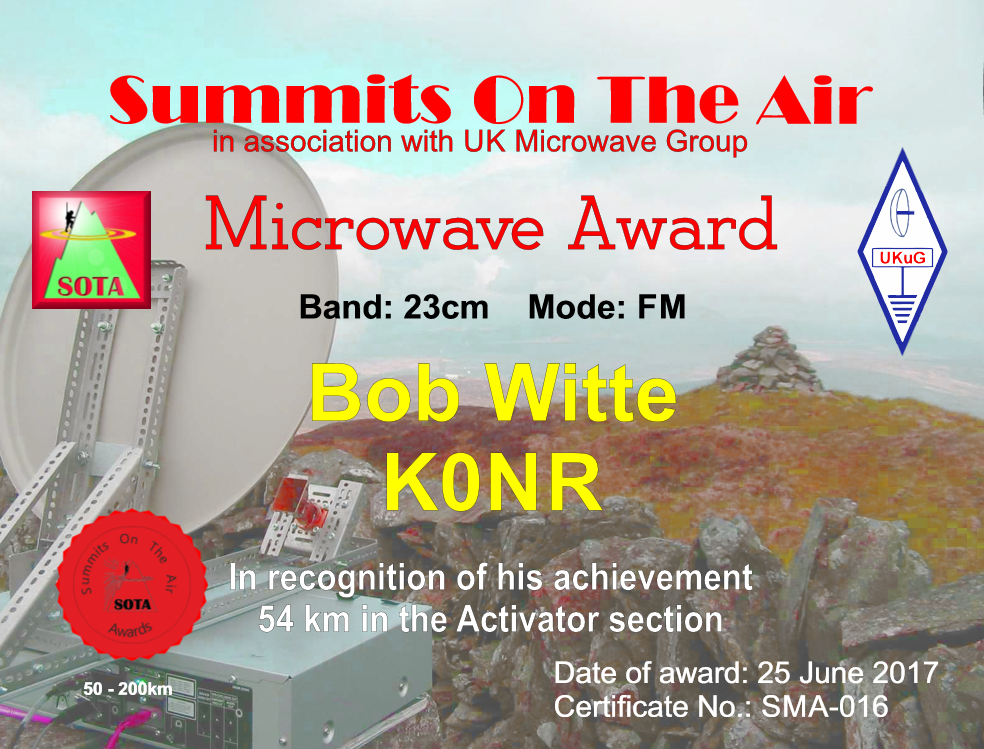
Initially, Joyce K0JJW and I made some short-range SOTA contacts on 1.2 GHz using the two handheld radios, on the 1294.5 MHz FM calling frequency. Then I started looking for DX contacts from local stations that have 23 cm gear. To provide some additional antenna gain, I used a 4-foot yagi antenna (Comet CYA-1216E), specified as 16.6 dBi. One of the cool things about UHF and higher is that compact antennas can provide some serious gain. My best DX so far is 54 km (33.5 miles) but I expect to be able to do distances 3 to 4 times that. The SOTA awards system considers the 23 cm band to be “microwave” so my 54 km QSO just barely qualifies me for the 50 km award. (The microwave awards are based on distance worked, unlike the other SOTA awards.)
Just another fun thing to do on the ham bands, pursuing the Universal Purpose of Amateur Radio.
73, Bob K0NR
The post Using 1.2 GHz for SOTA appeared first on The KØNR Radio Site.
Bob Witte, KØNR, is a regular contributor to AmateurRadio.com and writes from Colorado, USA. Contact him at [email protected].
 Ham Radio Deluxe |
 W5SWL Electronics |
 Ham Radio Prep |
 KB3IFH QSL Cards  Hip Ham Shirts  HamRadioAuctions HamRadioAuctions Reliance Antennas Reliance Antennas Enigma Shop Enigma Shop |  morseDX  Ni4L Antennas  R&L Electronics R&L Electronics antennas.us antennas.us QRV QRV |
- Matt W1MST, Managing Editor
