 |
 ICQ Podcast Episode 243 – Friedrichshafen Ham Radio 2017 Manufacturers
 30 July 2017 | by
 In this episode extra episode, Martin M1MRB / W9ICQ, Chris Howard M0TCH/N4CTH and Ed Durrant DD5LP interview Yaesu, Kenwood, Flex Radio, Elecraft and ICom during the recent Ham Radio 2017 show.
Colin Butler, M6BOY, is the host of the ICQ Podcast, a weekly radio show about Amateur Radio. Contact him at [email protected].
Amateur Radio Weekly – Issue 167

17 year old ISS APRS packet module bites the dust
ARISS has received several reports stating that the packet system on ISS is down. Here is what we know and our current forward plan.
AMSAT
[PDF] ARRL Annual Report
Well designed report with a focus on members, NPOTA, and women in radio.
ARRL
Traditional Ham Radio leaves youngsters uninterested
ARRL President Rick Roderick, K5UR, expressed his surprise when he discovered his usual amateur radio talk didn’t impress young people.
Southgate
A story from a numbers stations operator
The purpose of all this was to send messages to spies implanted in an enemy (or target) country. However not all – or even not many – of the broadcasts were actually messages.
numbers-stations.com
Amateur Radio at Alert, Nunavut
When the UHF link from Alert to Eureka was installed in the early 1980’s, it brought telephone service to Alert for the very first time.
VE3FAB
Single lever paddle for the KX series
If you want to have an attachable paddle for your KX3 or KX2, but feel squeamish about parting with the dinero for a set of Elecraft KX3PD or KX2PD attachable iambic paddles, then you might want to look into buying one of these.
W2LJ
QRP vs. QRO… Let’s “go there”
The QRP vs. QRO dilemma seems to be a top concern for off grid hams. Let’s objectively try to sort this one out.
Off Grid Ham
A history of CB radio in the US and UK
Probably the first recorded users of the illegal 27MHz band were the Charlie Bravo Group who seem to have appeared in about 1965.
RF-man
Video
Tropo band opening VHF/UHF Midwest USA
This is the time of year here in my area for some good tropospheric band openings on the VHF and UHF bands on ham radio. Here is a little sample of what I was hearing and talking to from my ham shack.
RadioHamGuy
Kenwood TH-D74 – review and quick tour
This video is a quick tour, but complete, of the Kenwood TH-D74.
Laboenligne.ca
Amateur Radio Weekly is curated by Cale Mooth K4HCK. Sign up free to receive ham radio's most relevant news, projects, technology and events by e-mail each week at http://www.hamweekly.com.
K2BSA at National Boy Scout Jamboree
However, I just participated in a noteworthy activity that needs to be published. This year I was on the staff of K2BSA at the recently completed 2017 National Boy Scout Jamboree and what a wonderful experience it was. For a comprehensive, day by day, look at the activities at K2BSA, have look at the K2BSA Facebook page.
One of the old timer mantra's in ham radio is, "where are the next generation of hams coming from", but all too often nothing is done to address the problem. However, I can say that the K2BSA team is very busy about addressing that issue through efforts to expose Boy Scouts to Amateur Radio. During this Jamboree, 300+ radio merit badges were awarded to boys who completed the requirements which requires a contact via ham radio and a classroom session that delivers a solid primer on Amateur Radio.
Other activities included Amateur Radio Direction Finding (ARDF), a Summits On The Air (SOTA) activation, Satellite operations, both base station and portable, VHF/UHF operation and a nightly net for the hams participating at the Jamboree. There were typically ~60 check-ins each night including local hams not participating in the Jamboree and interested hams from around the world, including JA, KL7 and VK based hams via Echo Link. As you can see a comprehensive presentation of ham radio was on display.
K2BSA is a non-profit, 501(c)(3) organization making contributions from US Hams tax deductible. So if you are inclined to support the furtherance of our hobby through youth, I can't think of a better organization to support. A contribution button is present on the FaceBook page or you can visit their webpage at www.k2bsa.net.
Mike Crownover, AD5A, is a regular contributor to AmateurRadio.com and writes from Texas, USA. Contact him at [email protected].
K2BSA at National Boy Scount Jamboree
However, I just participated in a noteworthy activity that needs to be published. This year I was on the staff of K2BSA at the recently completed 2017 National Boy Scout Jamboree and what a wonderful experience it was. For a comprehensive, day by day, look at the activities at K2BSA, have look at the K2BSA Facebook page.
One of the old timer mantra's in ham radio is, "where are the next generation of hams coming from", but all too often nothing is done to address the problem. However, I can say that the K2BSA team is very busy about addressing that issue through efforts to expose Boy Scouts to Amateur Radio. During this Jamboree, 300+ radio merit badges were awarded to boys who completed the requirements which requires a contact via ham radio and a classroom session that delivers a solid primer on Amateur Radio.
Other activities included Amateur Radio Direction Finding (ARDF), a Summits On The Air (SOTA) activation, Satellite operations, both base station and portable, VHF/UHF operation and a nightly net for the hams participating at the Jamboree. There were typically ~60 check-ins each night including local hams not participating in the Jamboree and interested hams from around the world, including JA, KL7 and VK based hams via Echo Link. As you can see a comprehensive presentation of ham radio was on display.
K2BSA is a non-profit, 501(c)(3) organization making contributions from US Hams tax deductible. So if you are inclined to support the furtherance of our hobby through youth, I can't think of a better organization to support. A contribution button is present on the FaceBook page or you can visit their webpage at www.k2bsa.net.
Mike Crownover, AD5A, is a regular contributor to AmateurRadio.com and writes from Texas, USA. Contact him at [email protected].
System Fusion DR-2X Repeater, Solar Eclipse and More – ETH079

In this episode we talk about the Yaesu System Fusion DR-2X repeater, the upcoming Solar Eclipse and more.
There is some interesting new features on the DR-2X repeater over the DR-1X that came out a couple years ago, but there is also something that it doesn’t have. Some of these features, I wish that we had on our club repeater, but those features are not enough for us to go out and buy this version.
There are a lot of special event stations that are going to be on the air around August 21st this year when the full solar eclipse occurs. This is the first time since 1918 that a full solar eclipse has gone from one side of the US to the other. I unfortunately am to far south to the see the full eclipse, but I should get about a 75% one here in the DFW area.
We also talk about some other stuff, but you are going to have to check out the show notes and listen to the episode to find out what that is.
73s de Curtis, K5CLM
Curtis Mohr, K5CLM, is the author/owner of Everything Ham Radio Blog and Youtube channel. Contact him at [email protected].
Hunting For NDBs In CLE 221
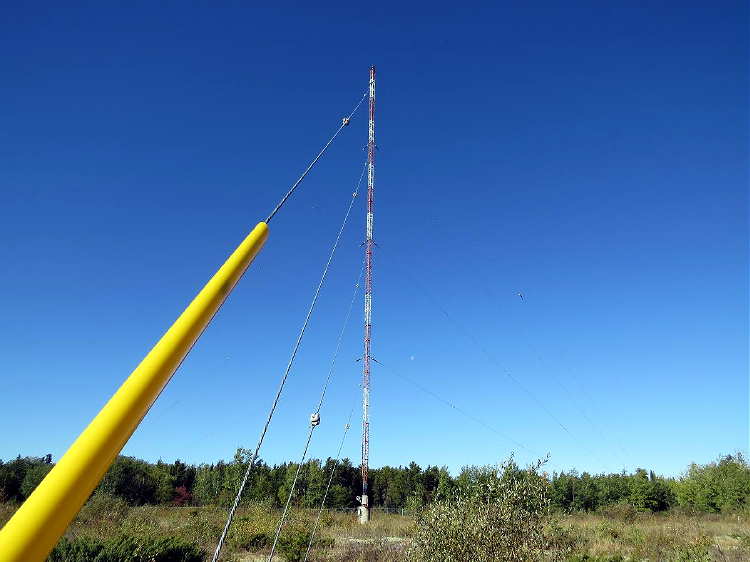 |
| YBV - 370kHz (VE3GOP) |
This coming weekend will see another CLE challenge. This time the hunting grounds will be: 370.0 - 384.9 kHz.
For those unfamiliar with this monthly activity, a 'CLE' is a 'Co-ordinated Listening Event', as NDB DXers around the world focus their listening time on one small slice of the NDB spectrum.
A nice challenge in this one is to hear the Berens River (Manitoba) NDB, 'YBV', on 370 kHz. 'YBV' is a 25-watter and is well heard, having been logged from coast-to-coast as well as in Europe. Look for 'YBV's CW identifier, repeated every 10.4 seconds, on 370.373 kHz with your receiver in the CW mode.
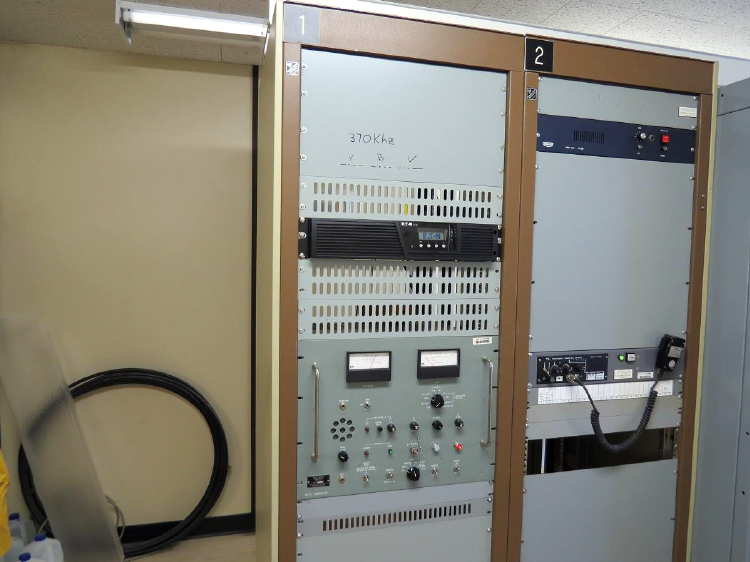 |
| YBV's 25W TX Rack (VE3GOP) |
When tuning for NDBs, put your receiver in the CW mode and listen for the NDB's CW identifier, repeated every few seconds. Listen for U.S. NDB identifiers approximately 1 kHz higher or lower than the published transmitted frequency since these beacons are modulated with a 1020 Hz tone approximately.
For example, 'AA' in Fargo transmits on 365 kHz and its upper sideband CW identifier is tuned at 366.025 kHz while its lower sideband CW ident can be tuned at 363.946 kHz. Its USB tone is actually 1025 Hz while its LSB tone is 1054 Hz.
Often, one sideband will be much stronger than the other so if you don't hear the first one, try listening on the other sideband.
Canadian NDBs normally have an USB tone only, usually very close to 400 Hz. They also have a long dash (keydown) following the CW identifier.
All NDBs heard in North America will be listed in the RNA database (updated daily) while those heard in Europe may be found in the REU database. Beacons heard outside of these regions will be found in the RWW database.
From CLE organizer Brian Keyte, G3SIA, comes the usual 'heads-up':
Please join us in our 221st coordinated Listening Event which starts
this Friday. All are very welcome.
CLEs are not contests - if you enjoy taking part you will be a winner!
54 of us sent logs for CLE204 back in February 2016 when we
Days: Friday 28 July - Monday 31 July
Range: 370 - 384.9 kHz
Just log all the NDBs that you can identify with their nominal (listed)
frequencies in the range (it includes 370 kHz, but not 385 kHz)
plus any UNIDs that you come across there.
Please send your CLE log to the List in a plain text email if possible
(not in an attachment) with 'CLE221' at the start of its title.
Show on each log line:
# The date (e.g. 2017-07-29, etc., or just 29) and UTC.
(the date changes at 00:00 UTC)
# kHz (the nominal published frequency, if known)
# The Call Ident.
Show those main items FIRST - other optional details such as Location
and Distance go LATER in the same line.
If you send interim logs, please also send a 'Final' (complete) log.
As always, tell us your own location and brief details of the equipment
that you were using during the weekend.
I'll send the usual 'Any More Logs?' email at about 17:00 UTC on
Tuesday - you can check from it that your log has been found OK.
All logs must arrive on the list by 08:00 UTC on Wednesday 2nd
August at the very latest.
Joachim has again offered to make the combined results which he
To help your listening, seeklists and maps for your part of the World
Good listening - enjoy the CLE
Brian
----------------------------------------------------------
From: Brian Keyte G3SIA ndbcle'at'gmail.com
Location: Surrey, SE England (CLE coordinator)
----------------------------------------------------------
These listening events serve several purposes. They:
- determine, worldwide, which beacons are actually in service and on-the-air so the online database can be kept up-to-date
- determine, worldwide, which beacons are out-of-service or have gone silent since the last CLE covering this range
- will indicate the state of propagation conditions at the various participant locations
- will give you an indication of how well your LF/MF receiving system is working
- give participants a fun yet challenging activity to keep their listening skills honed
Final details can be found at the NDB List website, and worldwide results, for every participant, will be posted there a few days after the event. If you are a member of the ndblist Group, results will also be e-mailed and posted there.
The very active Yahoo ndblist Group is a great place to learn more about the 'Art of NDB DXing' or to meet other listeners in your region. There is a lot of good information available there and new members are always very welcome. As well, you can follow the results of other CLE participants from night to night as propagation is always an active topic of discussion.
If you are contemplating getting started on 630m, listening for NDBs is an excellent way to test out your receive capabilities as there are several NDBs located near this part of the spectrum.
You need not be an ndblist member to participate in the CLEs and all reports, no matter how small, are of much value to the organizers.
'First-time' logs are always VERY welcome!
Reports may be sent to the ndblist or e-mailed to either myself or CLE co-ordinator, Brian Keyte (G3SIA), whose address appears above.
Please ... give the CLE a try ... then let us know what NDB's can be heard from your location! Your report can then be added to the worldwide database to help keep it up-to-date.
Good hunting!
Steve McDonald, VE7SL, is a regular contributor to AmateurRadio.com and writes from British Columbia, Canada. Contact him at [email protected].
Hunting For NDBs In CLE 221
|
| YBV - 370kHz (VE3GOP) |
This coming weekend will see another CLE challenge. This time the hunting grounds will be: 370.0 - 384.9 kHz.
For those unfamiliar with this monthly activity, a 'CLE' is a 'Co-ordinated Listening Event', as NDB DXers around the world focus their listening time on one small slice of the NDB spectrum.
A nice challenge in this one is to hear the Berens River (Manitoba) NDB, 'YBV', on 370 kHz. 'YBV' is a 25-watter and is well heard, having been logged from coast-to-coast as well as in Europe. Look for 'YBV's CW identifier, repeated every 10.4 seconds, on 370.373 kHz with your receiver in the CW mode.
|
| YBV's 25W TX Rack (VE3GOP) |
When tuning for NDBs, put your receiver in the CW mode and listen for the NDB's CW identifier, repeated every few seconds. Listen for U.S. NDB identifiers approximately 1 kHz higher or lower than the published transmitted frequency since these beacons are modulated with a 1020 Hz tone approximately.
For example, 'AA' in Fargo transmits on 365 kHz and its upper sideband CW identifier is tuned at 366.025 kHz while its lower sideband CW ident can be tuned at 363.946 kHz. Its USB tone is actually 1025 Hz while its LSB tone is 1054 Hz.
Often, one sideband will be much stronger than the other so if you don't hear the first one, try listening on the other sideband.
Canadian NDBs normally have an USB tone only, usually very close to 400 Hz. They also have a long dash (keydown) following the CW identifier.
All NDBs heard in North America will be listed in the RNA database (updated daily) while those heard in Europe may be found in the REU database. Beacons heard outside of these regions will be found in the RWW database.
From CLE organizer Brian Keyte, G3SIA, comes the usual 'heads-up':
Please join us in our 221st coordinated Listening Event which starts
this Friday. All are very welcome.
CLEs are not contests - if you enjoy taking part you will be a winner!
54 of us sent logs for CLE204 back in February 2016 when we
Days: Friday 28 July - Monday 31 July
Range: 370 - 384.9 kHz
Just log all the NDBs that you can identify with their nominal (listed)
frequencies in the range (it includes 370 kHz, but not 385 kHz)
plus any UNIDs that you come across there.
Please send your CLE log to the List in a plain text email if possible
(not in an attachment) with 'CLE221' at the start of its title.
Show on each log line:
# The date (e.g. 2017-07-29, etc., or just 29) and UTC.
(the date changes at 00:00 UTC)
# kHz (the nominal published frequency, if known)
# The Call Ident.
Show those main items FIRST - other optional details such as Location
and Distance go LATER in the same line.
If you send interim logs, please also send a 'Final' (complete) log.
As always, tell us your own location and brief details of the equipment
that you were using during the weekend.
I'll send the usual 'Any More Logs?' email at about 17:00 UTC on
Tuesday - you can check from it that your log has been found OK.
All logs must arrive on the list by 08:00 UTC on Wednesday 2nd
August at the very latest.
Joachim has again offered to make the combined results which he
To help your listening, seeklists and maps for your part of the World
Good listening - enjoy the CLE
Brian
----------------------------------------------------------
From: Brian Keyte G3SIA ndbcle'at'gmail.com
Location: Surrey, SE England (CLE coordinator)
----------------------------------------------------------
These listening events serve several purposes. They:
- determine, worldwide, which beacons are actually in service and on-the-air so the online database can be kept up-to-date
- determine, worldwide, which beacons are out-of-service or have gone silent since the last CLE covering this range
- will indicate the state of propagation conditions at the various participant locations
- will give you an indication of how well your LF/MF receiving system is working
- give participants a fun yet challenging activity to keep their listening skills honed
Final details can be found at the NDB List website, and worldwide results, for every participant, will be posted there a few days after the event. If you are a member of the ndblist Group, results will also be e-mailed and posted there.
The very active Yahoo ndblist Group is a great place to learn more about the 'Art of NDB DXing' or to meet other listeners in your region. There is a lot of good information available there and new members are always very welcome. As well, you can follow the results of other CLE participants from night to night as propagation is always an active topic of discussion.
If you are contemplating getting started on 630m, listening for NDBs is an excellent way to test out your receive capabilities as there are several NDBs located near this part of the spectrum.
You need not be an ndblist member to participate in the CLEs and all reports, no matter how small, are of much value to the organizers.
'First-time' logs are always VERY welcome!
Reports may be sent to the ndblist or e-mailed to either myself or CLE co-ordinator, Brian Keyte (G3SIA), whose address appears above.
Please ... give the CLE a try ... then let us know what NDB's can be heard from your location! Your report can then be added to the worldwide database to help keep it up-to-date.
Good hunting!
Steve McDonald, VE7SL, is a regular contributor to AmateurRadio.com and writes from British Columbia, Canada. Contact him at [email protected].
 Ham Radio Deluxe |
 W5SWL Electronics |
 Ham Radio Prep |
 KB3IFH QSL Cards  Hip Ham Shirts  HamRadioAuctions HamRadioAuctions Reliance Antennas Reliance Antennas Enigma Shop Enigma Shop |  morseDX  Ni4L Antennas  R&L Electronics R&L Electronics antennas.us antennas.us QRV QRV |
- Matt W1MST, Managing Editor
