 |
 TyMD380tools for Tytera MD-380
 15 October 2017 | by
 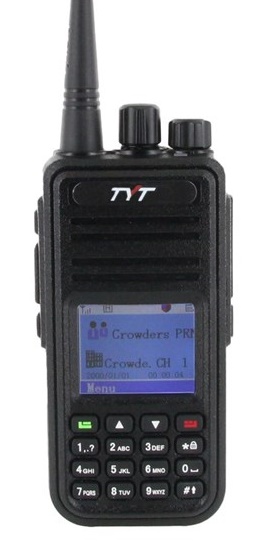 The Tytera MD-380 is an low cost radio for analog FM and DMR on the 70cm band (see video here). One of the limitations with the radio is that it only holds 1000 contacts…which seems like a lot of contacts but it fills up quickly. With DMR, each radio or user has a unique 7-digit radio ID number. For ham radio use, the DMR-MARC organization maintains a database that maps radio ID number to user name and callsign. If a user is in your contact list, the user’s name and callsign pops up in your radio’s display. Otherwise, you just see the radio ID which is not very helpful. There are over 63,000 users in the database with more being added on a daily basis.
There are a number of firmware updates to the MD380 and I have not checked them all out. I heard some guys talking about the TyMD380Tools on one of the DMR talkgroups, so I decided to give it a try. This software was developed by KG5RKI (go here) and is easily installed from Windows without a lot of messing around. This firmware upgrade loads the entire DMR-MARC database into the radio.
Now that I have the worldwide database of DMR users loaded onto the radio, its like having caller ID on my HT (see photo below). Actually, its better than that, it pulls up the other ham’s full name, callsign and location information.
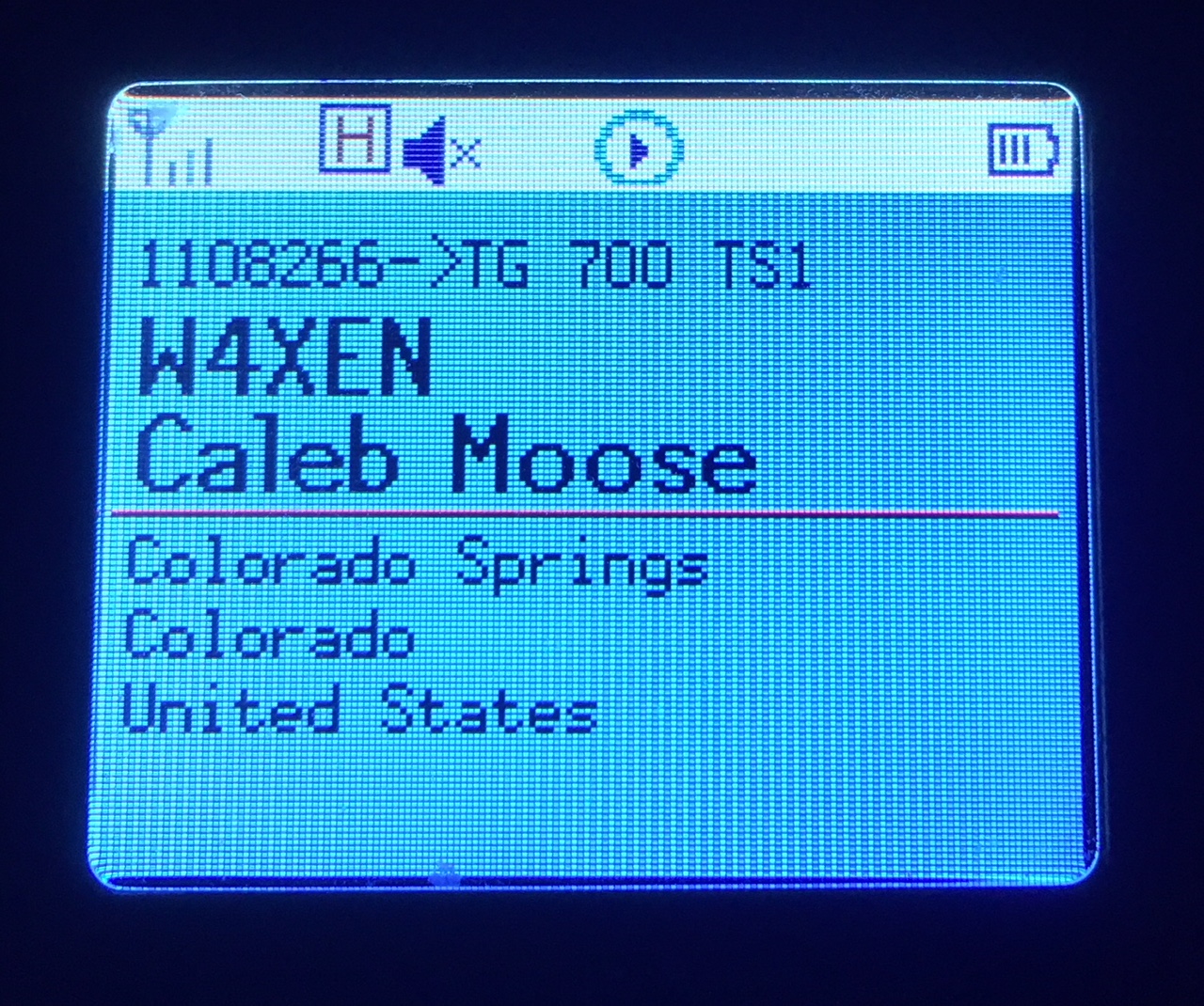 This may not seem like a big deal but I’ve found it to be surprisingly useful. I am often scanning a few channels or talkgroups with my radio and just listening casually. I may not be tracking who’s talking but I can just look at the radio to see who’s on the air. It’s one of those convenience features that makes me think “why don’t all of my radios do this?”
The TyMD380Tools implements a bunch of other features but increasing the number of contacts has been the most important one for me. This is a great example of radio amateurs adapting (“hacking”) commercial gear with improvements for ham radio use. KK4VCZ, DL4YHF and others contributed to this code. Check out the software…seems to work great.
73, Bob K0NR
The post TyMD380tools for Tytera MD-380 appeared first on The KØNR Radio Site.
Bob Witte, KØNR, is a regular contributor to AmateurRadio.com and writes from Colorado, USA. Contact him at [email protected].
Going about it the hard way…..WHY??
Last evening I finally had some time to get on the PC and check out what fellow ham radio bloggers were up too. For the past month I have been working every day and only having time to “fast read” a post and drop a short comment. While surfing the blog sphere last evening I came across KG3V’s blog, the subject of the blog caught my attention “Updating FTDX-3000 Firmware. Below is a link to what I only could call an “adventure”.
https://kg3v.com/2017/10/14/updating-ftdx-3000-firmware/
In the post Tom does a great job explaining how he went about the firmware upgrade and some issues he ran into. Tom also goes over the enhancements this firmware will forward to his FTDX-3000. It’s fantastic how far we have come in radio, in the past if you wanted the upgrades it meant selling what you had and purchasing the new and improved version. Today’s modern rigs can chat either over the internet or with pre-downloaded thumb drives and magic is worked within the rig to either over come an issue, enhance what is already there or add something new! Having said that I just can’t understand what the issue is with the process of the upgrade. It’s just not ham radio with our Nikon cameras to upgrade the firmware it’s…hold this while pushing that….make sure you don’t do this while doing that….and on and on and on. Resources are used writing the rigs new firmware upgrade, time and money is put into it and it’s to make the product better for the end user. If this is the case why the %&^* not make the process for the end user easy peasy!!

Having said the above and let me preface this with “I am not going to say what I am about to say just because I am a fan of Elecraft but if the shoe fits……” To upgrade my K3 or KX3 Elecraft has provided via their website a program that sits on your desktop, one of it’s functions is for firmware upgrades. The process is as follows:
1. Double click on desktop icon.
2. Click on Firmware tab.
3. Click on “Check versions now”
4. Below you will then see the firmware that is installed in your rig and new firmware that is available for your rig. You then click on “Send all new firmware to K3 or KX3.
Your rig will start to click, there will be “stuff” flashing on the rigs screen, sometimes even clicking noises from the rig and then your rig’s screen returns to normal and your done. I have owned Kenwood, Icom and Yeasu rigs and never has it been this easy and my question is WHY NOT!!! Now having said the above it is true I have not owned one of the above rigs for some time now so do comment if the process has changed…but is sure does not seem it has for the FTDX-3000 model rig!

OK I’m off my soapbox now….:))
Mike Weir, VE9KK, is a regular contributor to AmateurRadio.com and writes from New Brunswick, Canada. Contact him at [email protected].
ICQ Podcast Episode 250 – Building Mobile Station (Flossie), RSGB Online Exams and Yaesu DR-2X
In this episode, Colin M6BOY is joined by Leslie (G0CIB), Edmund (M0MNG), Bill (N3JIX) and Matthew (M0NJX) to discuss the latest Amateur / Ham Radio news and this episode’s feature is a triple from UK Hamfest - RSGB Online Examination, Building a Mobile Station (Flossie) and Yaesu tell us more about the DR-2X
We would like to thank Robert Mens (PD0RMX), Grant Porter (KG4SDR), Nick Major (G0HFL), two anonymous donors and our monthly and annual subscription donors for keeping the podcast advert free. To donate, please visit - http://www.icqpodcast.com/donate
- Traditional Ham Radio No Longer So Attractive
- RF pollution from LED bulbs in Germany
- FCC Tells Apple Turn on iPhone's FM Radio Chip
- School Students Ham Radio Link to Puerto Rico
- Newburgh Teen Supports with Amateur Radio
- Symbol Rate Restrictions - FCC Grants Temporary Waiver
Colin Butler, M6BOY, is the host of the ICQ Podcast, a weekly radio show about Amateur Radio. Contact him at [email protected].
AmateurLogic 109: ALTV’s 12th Anniversary
AmateurLogic.TV Episode 109 is now available for download.
Celebrate ALTV’s 12th Anniversary with us. Emile prepares for a spooky Halloween with Sonic Pi. Unveiling the new RigPi. Mike, VE3MIC updates us on recent projects. Icom/MFJ/Heil Sound/AmateurLogic IC-7300 base station giveaway.
1:40:13
George Thomas, W5JDX, is co-host of AmateurLogic.TV, an original amateur radio video program hosted by George Thomas (W5JDX), Tommy Martin (N5ZNO), Peter Berrett (VK3PB), and Emile Diodene (KE5QKR). Contact him at [email protected].
Sprat on DVD 2017
I have just been in touch with G3MFJ G-QRP club sales and he confirms
A new Sprat DVD is now available.
As I have explained before but for those that don't read things.
SPRAT is the journal of the G-QRP club and is well worth reading for all it's circuits
and QRP designs sent it via it's membership from around the world.
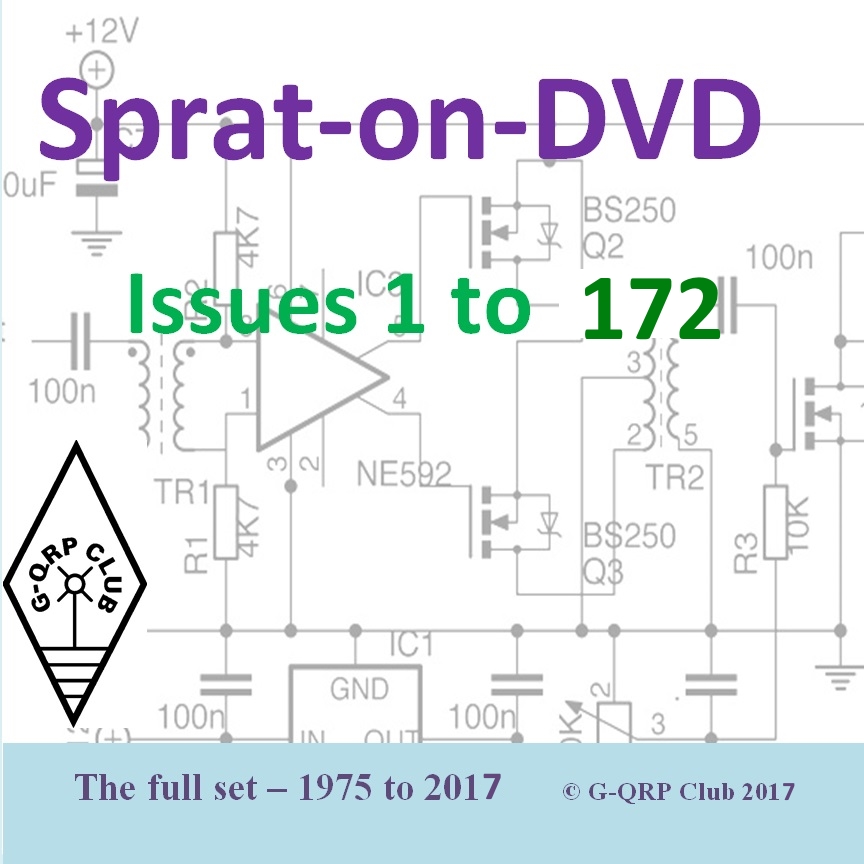
Price for "members only" is £5 (6.5 Euro, USA $8.0, AU$9.5, and NZ$10.5) plus p&p
non members price is £12 plus postage £1.20 (UK), £3.50 (EU), £5.00 (DX)
What they normally say to non members is join and you get a membership UK price for £6 which includes 4 Sprats per year, and then you can purchase the DVD at the membership price.
More details from the G-QRP Website http://www.gqrp.com/sales.htm
Join G-QRP club here http://www.gqrp.com/join.htm
Steve, G1KQH, is a regular contributor to AmateurRadio.com and writes from England. Contact him at [email protected].
Amateur Radio Weekly – Issue 177

NYC school’s radio club relays messages to and from Puerto Rico
The amateur radio club at the Garden School in Queens started just last year.
The Week
$400,000 FCC fine for interference
A Queens, New York man has admitted to making unauthorized transmissions on NYPD radio frequencies.
ARRL
Volunteers needed for RAC Canada 150 Award
Volunteers are needed to activate the 14 RAC stations for the RAC Canada 150 Award.
Southgate
Homemade 6 GHz FMCW radar
Frequency Modulated Continuous Wave (FMCW) radar works by transmitting a chirp which frequency changes linearly with time. This chirp is then radiated with the antenna, reflected from the target and is received by the receiving antenna.
Henrik’s Blog
Sputnik transmitter replica
PA3CNO continues to report about building a replica of the original Sputnik 1 transmitter.
radio.cc
Icom IC-R8600 wideband reciever
The IC-R8600 is a super wideband communication receiver that covers the radio spectrum from 10 kHz to 3 GHz.
Icom
Accidental satellite hijacks can rebroadcast cell towers
Engineers show how they identified their interference as GSM by its timing frames, and then how they narrowed down its source to Nigeria.
Hack A Day
Video
The future of amateur radio: Views from YOTA 2017
Five young radio amateurs from different countries explain what they think the future of amateur radio should look like.
RSGB
USB Morse Keyboard
I turned a 1950s Morse key into a USB keyboard.
YouTube
Amateur Radio Weekly is curated by Cale Mooth K4HCK. Sign up free to receive ham radio's most relevant news, projects, technology and events by e-mail each week at http://www.hamweekly.com.
The KiwiSDR Online Network
 Online SDRs (Software Defined Radio) continue to grow in numbers and popularity.
Listening on a receiver that is running in another state, province or country can fulfill a number of functions for you, depending on your particular interest.
The network that I have explored several times and one that works nicely with most web browsers (no software to download or 'extras' required) is the SDR.HU network of Kiwi SDRs ... just choose your receiver and away you go in a matter of seconds. It's all very slick and if you have never played with an SDR before, it affords a nice introduction to this amazing technology. Although it won't work with my ancient version of Internet Explorer running on Vista, it did fine with Firefox and even worked very well on my old I-Pad! Here is a 30-second YouTube video to give you an idea of what it looks like.
There are a huge number of choices from all over the world available on the Kiwi network. As I write this, there are presently 199 receivers online! Any particular receiver can support a maximum of four users at a time so if the one you want is full, simply check back later or go to your second choice.
Although all receivers have the same appearance online, not all will offer the same performance. Although most seem to cover 0-30MHz, I see at least one that is limited to the VHF range and several that don't go all the way to the bottom of the VLF band. The antennas used seem to favor wideband loops, both large wire styles and smaller active versions as well as active e-probes.
The best way to determine any particular receiver's operating performance is to try it out using test target signals that might indicate good performance from that location. If you're interested in BCB capability, test some of the European ones to see if they can hear any TA signals around sunrise in Europe. Many SWLs will use these receivers to compare what they are hearing at home with a receiver located closer to the suspected DX target signal. I myself found the network particularly handy for listening to my Tri-Tet-Ten transmitter on 10m CW a couple of years ago when the muf was much higher than it is nowadays. I'll be trying a few of them out this winter, listening for my 630m CW signal, at various locations.
Some of the receivers appear to offer good, low noise reception on LF, MF and the BCB but the vast majority are not DX machines oriented for this part of the spectrum ... this was the opinion of one notable BCB DXer who checked many of those in eastern NA as well as western EU. The jury is still out on the westerern NA receivers and those in the Pacific / Far East ... a worthwhile listening project when there is some spare time. Even though the receivers used on these lower frequencies did not usually offer stellar performance, they may be real workhorses within the ham bands or on the international shortwave bands.
It would be worthwhile to see some form of 'performance rating' or feedback page for each individual receiver. Although there is a 'vote' tally associated with each receiver it's not clear what this actually represents as receivers that have been online for longer periods would naturally have a higher tally.
A lot of additional information about the KiwiSDR network can be found here.
No doubt you can think of your own good reason to have a remote listen to some of the network's growing list of online receivers and put them to the test ... there may be some real treasures to be found.
Steve McDonald, VE7SL, is a regular contributor to AmateurRadio.com and writes from British Columbia, Canada. Contact him at [email protected].
 Ham Radio Deluxe |
 W5SWL Electronics |
 Ham Radio Prep |
 KB3IFH QSL Cards  Hip Ham Shirts  HamRadioAuctions HamRadioAuctions Reliance Antennas Reliance Antennas Enigma Shop Enigma Shop |  morseDX  Ni4L Antennas  R&L Electronics R&L Electronics antennas.us antennas.us QRV QRV |
- Matt W1MST, Managing Editor
