 |
 Do You Travel? Don’t Forget Your Ham Gear! – ETH087
 21 September 2017 | by
In this episode of the Everything Ham Radio Podcast, we talk with Vance Martin, N3VEM, about how he takes his Ham Radio Equipment with him when he goes on business trips. If you travel at all, you know the boringness of sitting in a hotel room after working all day, right? Maybe it is a new city, or maybe you have to be up early and don’t want to “go out” and be out late so you are able to function the next day.
So why not take your ham radio equipment with you while you travel and use that down time to make some contacts? This can also give you a chance to get out of your shack and get some fresh air and make some contacts to boot.
Vance and I talk about everything from what he does before he leaves, to what to do at the airport to how he operates while he has down time while traveling. Check out the show notes and listen to the episode by following the link below:
http://www.everythinghamradio.com/podcast/87
Curtis Mohr, K5CLM, is the author/owner of Everything Ham Radio Blog and Youtube channel. Contact him at [email protected].
Antenna Summer – part 3
Summer is over and we’re back to work full time. My much anticipated “Antenna Summer” ended rather uneventful. The weather was mostly to blame: it was either too hot to work outside (I burnt myself while working on the metal roof), too wet (two typhoons and a tropical storm passed) or too windy (“Wind! The thing feared most by ham radio operators and stamp collectors”). The only thing I could do was to prepare and prepare more. There are three antennas projects in the pipe-line now, but I still haven’t found the opportunity to put them up. Sigh!
The only antenna project which I could finish indoors was my big loop for medium- and longwave. I started this more than a year ago, but the first iteration was a size too big to be sturdy enough to withstand the strong winds here in Taiwan. A second -smaller- one was build, but not finished before last winter, so I shelved it. When I took it out I found that the wooden spreaders had split due to moisture and the old surplus wire had snapped in several places. Even several coats of lacquer can’t prevent wood from decaying here in the sub tropics, so it was back to the drawing board.

I pulled out my wallet and bought new, thicker wire and PVC pipe for new spreaders. I made a special vice to hold the PVC pipe, templates for the holes and rolled up all of the 180 meters of wire on an old garden hose reel. Being well prepared pays off because I already have half of the loop windings in place. I won’t be able to finish this antenna this summer, but it will be finished this fall.

Currently there are no typhoons heading our way and the temperature has gone from scorching hot to very hot, so the prospects look good. But that leaves me with a conundrum: should I call my next installment on antenna improvement “Antenna Fall” or not?
Hans "Fong" van den Boogert, BX2ABT, is a regular contributor to AmateurRadio.com and writes from Taiwan. Contact him at [email protected].
Hunting For NDBs In CLE 223
 |
| SN-408 courtesy: www.ve3gop.com |
This coming weekend will see another CLE challenge. This time the hunting grounds will be: 400.0 - 419.9 kHz.
For those unfamiliar with this monthly activity, a 'CLE' is a 'Co-ordinated Listening Event', as NDB DXers around the world focus their listening time on one small slice of the NDB spectrum.
A nice challenge in this one is to hear the Saint Catharines (Ontario) NDB, 'SN', on 408 kHz. 'SN' is a 15-watter and is well heard, having been logged from coast-to-coast. Look for 'SN's CW identifier, repeated every 10.5 seconds, on 408.398 kHz with your receiver in the CW mode.
Late summer CLEs can often be challenging, not because of poor propagation but more likely, lingering summer lightning storms ... hopefully it will be quiet for your location.
When tuning for NDBs, put your receiver in the CW mode and listen for the NDB's CW identifier, repeated every few seconds. Listen for U.S. NDB identifiers approximately 1 kHz higher or lower than the published transmitted frequency since these beacons are modulated with a 1020 Hz tone approximately.
For example, 'AA' in Fargo transmits on 365 kHz and its upper sideband CW identifier is tuned at 366.025 kHz while its lower sideband CW ident can be tuned at 363.946 kHz. Its USB tone is actually 1025 Hz while its LSB tone is 1054 Hz.
Often, one sideband will be much stronger than the other so if you don't hear the first one, try listening on the other sideband.
Canadian NDBs normally have an USB tone only, usually very close to 400 Hz. They also have a long dash (keydown) following the CW identifier.
All NDBs heard in North America will be listed in the RNA database (updated daily) while those heard in Europe may be found in the REU database. Beacons heard outside of these regions will be found in the RWW database.
From CLE organizer Brian Keyte, G3SIA, comes the usual 'heads-up':
Here is your Early Advice of our next Co-ordinated Listening Event.
We are back to a normal event looking for the NDBs in a narrow
frequency range - and celebrating the equinox on 22nd Sept.
All beginners, occasionals and regulars are very welcome to join in.
Days: Friday 22 Sept - Monday 25 Sept 2017
Times: Start and end at midday your LOCAL time
Range: 400 - 419.9 kHz
Just log all NDBs you can identify that are listed in the range (it includes
400 kHz but not 420 kHz) plus any UNIDs that you come across there.
We last had a close look at this frequency range in CLE208 at the
start of July 2016.
From the Ministry of Useless Information comes the advice that in CLE208
Europe listeners and Rest of the World listeners each heard 107 different
NDBs.
Please look out for the Final Details on Wednesday.
73
Brian
----------------------------------------------------------
From: Brian Keyte G3SIA ndbcle'at'gmail.com
Location: Surrey, SE England (CLE coordinator)
----------------------------------------------------------
- determine, worldwide, which beacons are actually in service and on-the-air so the online database can be kept up-to-date
- determine, worldwide, which beacons are out-of-service or have gone silent since the last CLE covering this range
- will indicate the state of propagation conditions at the various participant locations
- will give you an indication of how well your LF/MF receiving system is working
- give participants a fun yet challenging activity to keep their listening skills honed
Final details can be found at the NDB List website, and worldwide results, for every participant, will be posted there a few days after the event. If you are a member of the ndblist Group, results will also be e-mailed and posted there.
The very active Yahoo ndblist Group is a great place to learn more about the 'Art of NDB DXing' or to meet other listeners in your region. There is a lot of good information available there and new members are always very welcome. As well, you can follow the results of other CLE participants from night to night as propagation is always an active topic of discussion.
If you are contemplating getting started on 630m, listening for NDBs is an excellent way to test out your receive capabilities as there are several NDBs located near this part of the spectrum.
You need not be an ndblist member to participate in the CLEs and all reports, no matter how small, are of much value to the organizers.
'First-time' logs are always VERY welcome!
Reports may be sent to the ndblist or e-mailed to either myself or CLE co-ordinator, Brian Keyte (G3SIA), whose address appears above.
Please ... give the CLE a try ... then let us know what NDB's can be heard from your location! Your report can then be added to the worldwide database to help keep it up-to-date.
Have fun and good hunting!
Steve McDonald, VE7SL, is a regular contributor to AmateurRadio.com and writes from British Columbia, Canada. Contact him at [email protected].
Digital magazines
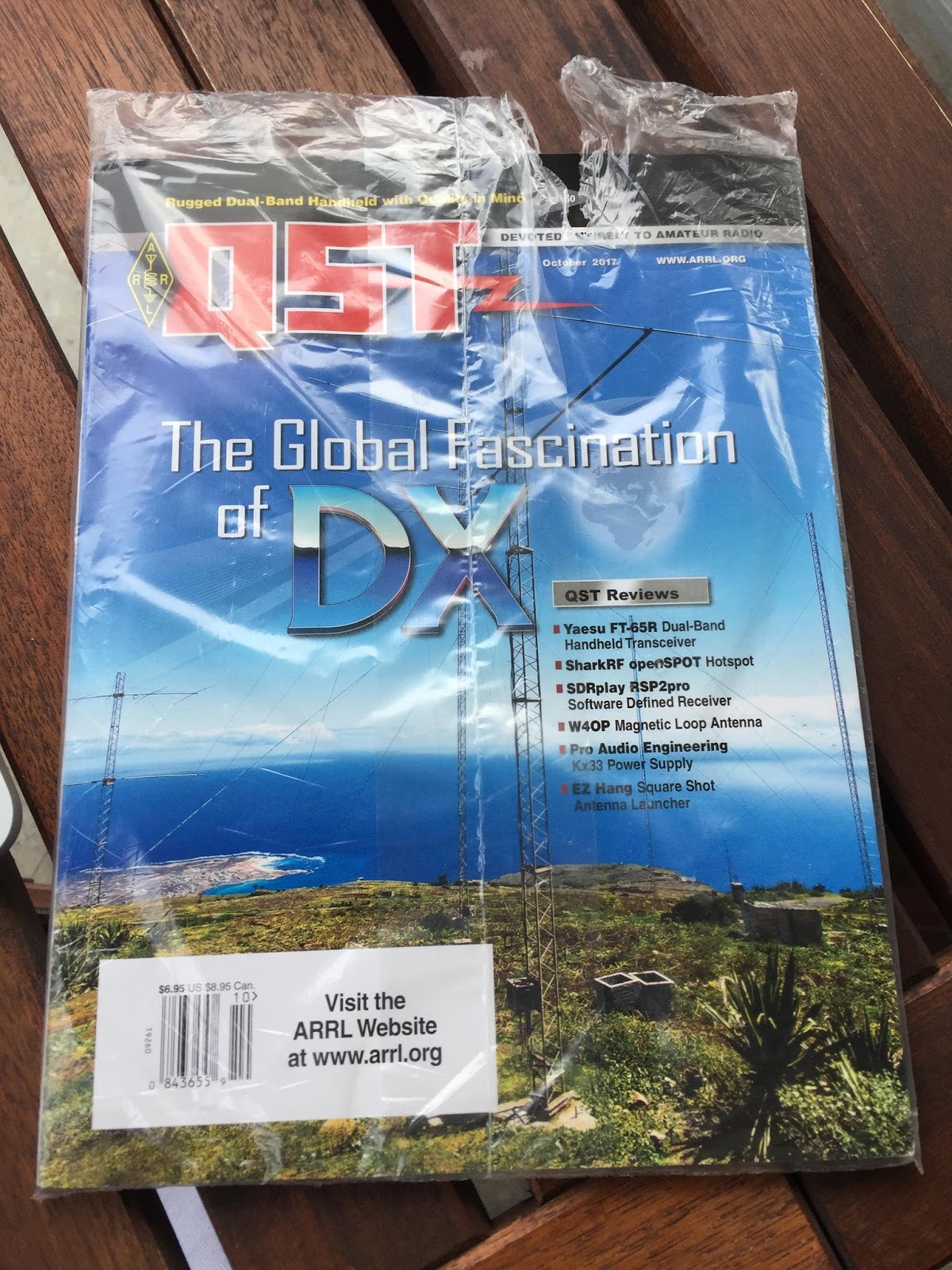 |
| Still in the bag |
For those of you where like me and have not as of yet jumped into the digital magazine world I will say it's a very interactive way of reading. CQ uses a program called Zinio to view their magazine and QST uses Pagesuite It may just be me but I find Pagesuite easier to use, nice graphics and well laid out and I hope one day CQ will start to use them as well as Zinio.
Some of the advantages I find with having a digital copy are:
- Ability to view videos (QST often has product reviews and a video to along with it)
- Web links that can take you to more content.
- Ability to enlarge the print which is good for me.
- You can't just roll up the tablet or PC under your arm and take it with you.
- To download a new addition the internet is needed.
- To take full advantage of the digital copy again the internet is needed.
Mike Weir, VE9KK, is a regular contributor to AmateurRadio.com and writes from New Brunswick, Canada. Contact him at [email protected].
The Joy of the QSO
So, I've asked myself, what is it about Ham Radio that's so important? Many of us spend a lot of time in the hobby, so where is the meaning, where is the value added to our lives? Many of us chase awards, join clubs, go on expeditions and have many significant achievements in our ham careers that bring a certain level of satisfaction. However, what we soon learn is that it's the chase, not the finish that's exciting. I've enjoyed very much chasing DXCC Honor Roll, WAE-TOP, IOTA, SOTA and competing in a variety of contests. However, once the objective is achieved, the excitement of working toward the goal is gone and the sense of accomplishment is not quite as satisfying as the thrill of the chase.
So in my thinking about what's lasting and important about ham radio, at least to me, starts from a simple QSO. QSO's bring joy in many ways, i.e., marking a needed entity of the list, working a new club member, getting that rare country that you never thought possible, whether QRP or QRO or perhaps a special contact on Top Band or the Magic Band. It's QSO's that bring joy. However, many of these QSO's are the 599, TU type of QSO and are more focused on accomplishment or earning some award than the relationship side of ham radio. As I've progressed or maybe matured or perhaps just gotten more sentimental, I get a lot of lasting joy from a simple rag-chew. Does a rag-chew bring my recognition, no. Will it qualify me for any awards, maybe, but probably not. But what it does do is allow me to meet real people with similar interests as me. Since I retired I find that I have more and more rag-chews with the most interesting people. And I am starting to come across guys multiple times and we pick up where we left off from the previous QSO. It's wonderful. I don't have to worry if I've already worked them on the band I'm on, they are glad, at least I think they are, to take my call and have a chat, I don't have to worry about getting a "worked B4" response.
I've found there's lots of unexpected pleasure in the simple things. A simple QSO gives me lots of satisfaction. Don't get me wrong, you may well hear my call in a DX pile up or calling CQ in a contest, but I've learned to stop and smell the roses and the roses of ham radio, to me, are the relationships you can build and develop through conversational ham radio.
My mode of choice is CW, but I don't suppose it really matters what mode you use. Just get on the air and have a real chat, you might find it brings a little more meaning to the hobby.
Mike Crownover, AD5A, is a regular contributor to AmateurRadio.com and writes from Texas, USA. Contact him at [email protected].
Magnitude X8 X-ray Flare of Sept 9 2017 (2nd Biggest in Cycle 24)
The sun erupted with an X8 solar flare, one of the largest of the current solar cycle (Sept. 10, 2017). Its source was the same sunspot region that produced an X9 flare last week. We show this in two wavelengths of extreme ultraviolet light at the same time, and each reveals different features. Both are colorized to identify in which wavelength they were observed. The coils of loops after the flare are the magnetic field lines reorganizing themselves after the eruption. The video clip covers about six hours.
Visit, subscribe: NW7US Radio Communications and Propagation YouTube Channel
Early Fall QRP on the Pemigewasset
There is a certain fragrance. The colors are shifting. The air is still except for the sound of crickets. It’s early fall on the Pemi. I stop at a bend in the dirt road and check out the giant pine tree for antenna possibilities.

I toss a line over an arching branch and pull up my 33 foot wire. I set up the KX3 on 20 meters. Now the sound of Morse mingles with the sound of crickets. Stations from Washington operating in the Salmon Run event are calling CQ.

I work six stations in a row and then switch to 30 meters. I call Jerry WA4FQN in TN. He gives me a 559 signal report and we chat for a while. Here’s my log:
17 Sep-17 1908 14.045 W7LKG CW 599 599 WA
17 Sep-17 1910 14.045 K7GS CW 599 599 WA
17 Sep-17 1911 14.052 N7KE CW 599 599 WA
17 Sep-17 1912 14.047 W7VXS CW 599 599 WA
17 Sep-17 1913 14.047 WC7Q CW 599 599 WA
17 Sep-17 1927 14.041 K7RI CW 599 599 WA
17 Sep-17 1928 10.121 WA4FQN CW 559 599 TN Jerry

You cannot imagine how precious these days are. They are the fleeting days of warm weather in New Hampshire. The hills and valleys soon turn to gold and orange and red. We are in a twilight zone before the cold of winter. The world is ours…. for a while.

Jim Cluett, W1PID, is a regular contributor to AmateurRadio.com and writes from New Hampshire, USA. Contact him at [email protected].
 Ham Radio Deluxe |
 W5SWL Electronics |
 Ham Radio Prep |
 KB3IFH QSL Cards  Hip Ham Shirts  HamRadioAuctions HamRadioAuctions Reliance Antennas Reliance Antennas Enigma Shop Enigma Shop |  morseDX  Ni4L Antennas  R&L Electronics R&L Electronics antennas.us antennas.us QRV QRV |
- Matt W1MST, Managing Editor
