 |
 LHS Episode #200: We Made It
 9 October 2017 | by
  Welcome to Episode #200 of Linux in the Ham Shack. We've come a long way in the last nine years but thanks to all of our listeners and supporters, we have made it to this milestone episode. We talk about a variety of Linux- and ham radio-related topics as well as chat with some old friends and new. Please be aware this episode is being released unedited. We don't believe there's anything in it you need to protect your children from; it's just rambling and unstructured--mostly. Thank you to everyone for all of your support throughout the years and we look forward to bringing you fresh new content in 2018.
73 de The LHS Crew
Russ Woodman, K5TUX, co-hosts the Linux in the Ham Shack podcast which is available for download in both MP3 and OGG audio format. Contact him at [email protected].
Amateur Radio Weekly – Issue 176

Hams in Puerto Rico install repeater, work with hospitals, reunification
The installation of a VHF Amateur Radio repeater on a mountain peak in El Yunque National Forest now gives radio coverage to approximately 60% of Puerto Rico.
ARRL
FCC grants temporary waiver to permit higher baud rates
The temporary waiver is limited to Amateur Radio operators in Puerto Rico using PACTOR 3 and PACTOR 4 emissions.
ARRL
New ham radio equipment for ISS
We will remove the 3 watt Ericsson handheld radio system, initially certified for flight in 1999, and the Packet module–both of which have recently had issues—and install a brand-new, specially modified 25 watt JVC Kenwood D710GA radio.
AMSAT UK
Autumn antenna adventures with Arduino
These guys from Italy took Atmel’s AVR chips and put them on a board with an easy to use USB interface and an integrated development environment, which uses a dialect of C. Weehee, could it get any better?
AmateurRadio.com
Discord for young Hams
Discord is a free voice and text chatting app well suited for gamers.
N0SSC
World’s largest telescope stopped by LED
Earlier this year a simple indicator LED brought the Keck 1 telescope, a 370 tons mass, to a halting stop. How exactly did an LED do this? Simple: it did nothing.
Hack A Day
Chicago Cubs special event
Members of the Metro DX Club will operate special event station W9C between October 2-8th, to celebrate the first anniversary of the Chicago Cubs winning the 2016 World Series.
Southgate
FCC chief tells Apple to turn on iPhone’s FM radio chip
Following the devastation from recent hurricanes, FCC Chairman Ajit Pai says Apple should “step up to the plate” and put Americans’ safety first.
CNET
Video
The lost art of tuning a radio
The BBC’s David Sillito asks young people to tune a radio.
BBC
Amateur Radio Weekly is curated by Cale Mooth K4HCK. Sign up free to receive ham radio's most relevant news, projects, technology and events by e-mail each week at http://www.hamweekly.com.
Autumn Antenna Adventures….
…with Arduino.
My relationship with computers is a love-hate one. They are too complex and fragile to be reliable and always let you down when you most need them. But there is a miniature computer I really love: the Micro Controller Unit (a.k.a. MCU). They are simple and reliable, because they do one thing and they do it well. For us hobbyist the two most well known are Microchip Technologies’ PIC and Atmel’s AVR. I dabbled with PICs before, but they are a pain to program and require special hardware to do so. Enter Arduino. These guys from Italy took Atmel’s AVR chips and put them on a board with an easy to use USB interface and an integrated development environment, which uses a dialect of C. Weehee, could it get any better?
MCUs are just like Legos: add some sensors and an LCD and you have made yourself a weather station. Add some wheels and a motor and you created a robot. The possibilities are endless. But just like Legos my Arduino projects have been build and then taken apart for the next project. This is about to change now. My loop antenna needed a way to switch between the 7, 14 and 28 loop turns and it had to do so remotely. “Well, use relays” you would rightly say and those happen to be one of the easiest things to hook up to an Arduino. Let me show you.

Two wires for power and one control line (here hooked up to the Arduino input/output “pin” number seven) so simple enough. But it won’t do a thing until you tell the Arduino to do something, using a program. For writing such programs there are computer languages, and they are just that: languages. Learn how to interpret a language into your own and you’re good to go. It might scare you off, but then isn’t electronics a kind of language as well? Remember, I honestly can’t call myself a programmer, but with a guide book and some advice from the experts I can go a long way in making something exciting. Don’t believe me? Let’s start with the basics.
Arduino programs are made up of three blocks of code:
1 – a block to declare and define the things you need later
2 – a block to set up those things
3 – a block that does stuff with those things over and over and over again
Can you spot the three blocks in this example?

The first block features only one line: “int relayPin = 7;“. Let’s put that in plain English: we use pin 7 of the Arduino to connect the relay to, and instead of “pin 7” we now call it “relayPin”. And because “7” is an integer we also declare that.
Every pin on the Arduino board can be used to either get signals in or out, so that’s what we define in the setup block: set the pinMode of the relayPin to OUTPUT.
Since we set the relayPin as an output pin we can activate it and that is what happens in the loop block. First we write to the relayPin and make it active, or HIGH. Then we have a slight delay of 1000 milliseconds, after which we write to relayPin and make it inactive, or LOW. After another 1000 millisecond delay the whole sequence in the loop block starts all over again. After compiling and uploading the program to the Arduino the result looks like this….
It might not seem very useful to have an oscillating relay, so we need other ways to control it. I’ll cover that next time.
In the mean time, Arduinos are pretty cheap and together with a breadboard, a bunch of wires and some LEDs you can already start playing around. At Banggood.com you can get a bare Arduino Uno for US$3.99. This is a knock-off version, but they work equally well. A whole starter kit is only a little more, so it won’t break your bank.
On the internet there are tons of tutorials, YouTube videos and forums to help you with your first Arduino/MCU steps. I’m sure that after the initial steps MCUs won’t be so intimidating anymore. So, try it and have fun.
Hans "Fong" van den Boogert, BX2ABT, is a regular contributor to AmateurRadio.com and writes from Taiwan. Contact him at [email protected].
A Weekend ’29 Transmitter Project
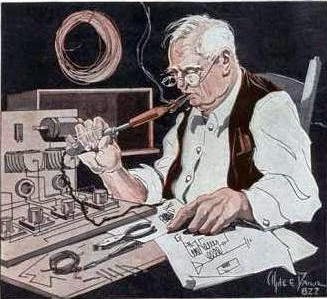 A recent posting to the Yahoo AWAGroup, reminded me of a wonderfully simple transmitter that would easily get anyone on-the-air for the Bruce Kelley '29 QSO Party coming up in December. The AWAGroup is largely composed of '29 builders and operators and is often the source of much good discussion related to these activities.
 When builders first tackle a '29 style rig, eligible for the BK Party, the first thought is often about finding an affordable tube that might make the transmitter a 'legal' entry. A suggestion of tubes and their relative availability can be found here in one of my earlier blogs. Although some of the tubes may not be typical junk-box items, one that is often very readily available and inexpensive is the '27' or the '227' / UX-227.
The '27 was a popular audio tube used in receivers back in the 20's and can easily be pressed into service as a self-excited oscillator on HF. When properly adjusted, the '27 can produce up to 4W of RF, more than enough for you to join the '29 fun a make plenty of contacts over the dual-weekend event.
Scott, WA9WFA, has produced a great article describing the construction of a 1929 Hartley oscillator using the 27. There is no need to utilize period-appropriate parts, other than the vacuum tube itself. If you are pressed for building time or just want to get something on the air, there's no need to be overly concerned about construction aesthetics ... there's plenty of time for that later, and besides, the uglier ones often work and sound the best!
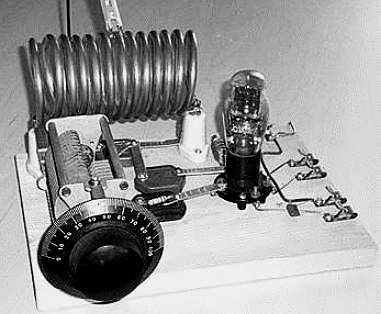 |
| WA9WFA's 27-Tubed Hartley |
Power supply requirements for the transmitter are pretty minimal and could even be an old receiver supply ... something that delivers 250-300 VDC at 35ma. An effective way to easily double the power of this transmitter is to add a second tube in parallel with the original one, providing your power supply can supply the extra current (~35ma) required. Although Scott's information describes an 80m Hartley, there is no reason why you could not wind a coil for 40 or for 160 and take advantage of any activity on those bands as well. Like most of these link-coupled outputs, you'll probably squeeze a little better efficiency from the circuit by adding a variable capacitor (~365pf) in series with the pick-up link and the hot-side of the coaxial feedline.
Nick, WA5BDU, wrote his description of building the 27 Hartley which can be found here. He also includes information on running the 2.5V filament from a 5V transformer.
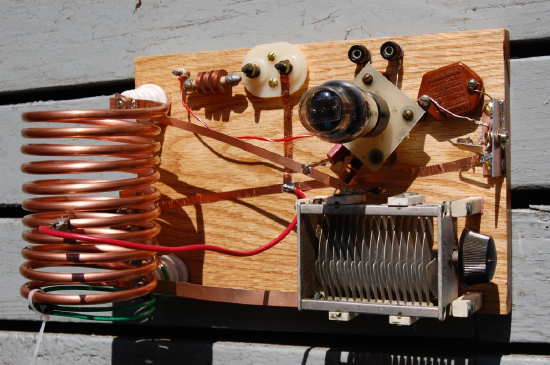 | |||||||
| WA5BDU's 27-Tubed Hartley |
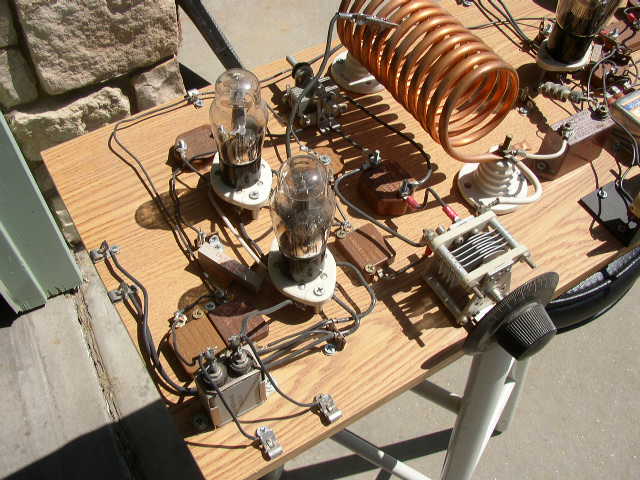 | ||
| ABØCW's Parallel 27s |
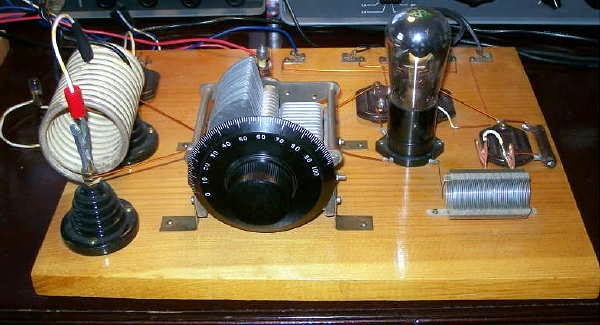 |
| WB2QMY's 80m 2W TNT |
Steve McDonald, VE7SL, is a regular contributor to AmateurRadio.com and writes from British Columbia, Canada. Contact him at [email protected].
Jamboree on The Air – 2017
Another source of information is the recent Episode of HamRadioNow which is a round-table of Scout leaders on the benefits and some methodology of JOTA. I was honored to be asked to participate. I think you will find the show to be informative with regard to JOTA.
Here is the link:
https://www.hamradionow.tv/episodes/2017/10/2/hrn-347-old-jota
Participate if you can.
Mike Crownover, AD5A, is a regular contributor to AmateurRadio.com and writes from Texas, USA. Contact him at [email protected].
ICQ Podcast Episode 249 – SDR Play
In this episode, Martin (M1MRB/W9ICQ) is joined by Chris Howard (M0TCH), Martin Rothwell (M0SGL), Dan Romanchik (KB6NU) and Ed Durrant (DD5LP) to discuss the latest Amateur / Ham Radio news. Colin M6BOY rounds up the news in brief, and this episode’s feature is SDR Play.
We would like to thank Dave Bowie (ZL4DRB) and our monthly and annual subscription donors for keeping the podcast advert free. To donate, please visit - http://www.icqpodcast.com/donate
- History of UK Special Contest Call Signs
- New Digital Voice Repeater for Southern Ireland
- Individual Licences Legal in Tunisia
- American Red Cross Asks ARRL’s Assistance with Puerto Rico Relief Effort
- VERON & Regulator to Discuss RF Pollution
- New US Personal Radio (Part 95) Rules Take Effect
- Ham Plans Community Station
- Falconsat-3 Available for Amateur Radio
- Yasme Foundation Grant to ARRL Ham Aid Fund
Colin Butler, M6BOY, is the host of the ICQ Podcast, a weekly radio show about Amateur Radio. Contact him at [email protected].
Amateur Radio Weekly – Issue 175
Hams are saving Puerto Rico one transmission at a time
Ham operators work shoulder to shoulder with public safety and utility officials to transmit information to other ham operators working with teams in the field.
CNN
Getting started on the new LF and MF bands
If you are thinking of getting on either of these new bands, particularly 630m, here is a short Q & A that may help you through the initial planning stage of how to get started.
VE7SL
Revised ARRL Frequency Chart available
The PDF chart has been updated to include our new bands at 2,200 and 630 meters.
ARRL
FalconSAT-3 now open for amateur radio use
The Air Force Academy satellite FalconSAT-3 is now open for amateur radio use as a digital store-and-forward system.
AMSAT UK
North Korea ‘aggressively’ jamming BBC’s radio service
Loud noise is deliberately broadcast over a foreign station to make it difficult or impossible to listen to.
The Telegraph
BITX40 QRP Transceiver overview
I made a few changes. I had a couple of 6mm shaft knobs that I wanted to use that did not fit the potentiometers that were supplied. I also wanted to implement a couple of the simplest and most useful mods.
High on Solder
Retrotechtacular: An oceanographic data station buoy for the 1960s
The film details the development through the early 1960s of one of the first automated remote ocean sensor buoys.
Hack A Day
View from above (antenna sunset photos)
As every amateur shutterbug has learned, it’s nigh on impossible to capture the true beauty of the setting sun. That is, unless of course you’re a ham radio antenna perched at the summit of a lofty tower, high in the heavens.
Delta Alfa
Video
N1MM Logger Spectrum Monitor Display
Logger Spectrum Monitor will not work unless the Icom 7300 Spectrum Scope is running. Change the Icom 7300 to CENTER and watch what you can do with the N1MM Logger Spectrum Monitor.
K0PIR
The SharkRF OpenSPOT review
This is the long version video of the QST review video (October 2017 edition).
YouTube
Amateur Radio Weekly is curated by Cale Mooth K4HCK. Sign up free to receive ham radio's most relevant news, projects, technology and events by e-mail each week at http://www.hamweekly.com.
 Ham Radio Deluxe |
 W5SWL Electronics |
 Ham Radio Prep |
 KB3IFH QSL Cards  Hip Ham Shirts  HamRadioAuctions HamRadioAuctions Reliance Antennas Reliance Antennas Enigma Shop Enigma Shop |  morseDX  Ni4L Antennas  R&L Electronics R&L Electronics antennas.us antennas.us QRV QRV |
- Matt W1MST, Managing Editor
