 |
 LHS Episode #222: The Weekender VIII
 20 April 2018 | by
  Welcome to the latest Weekender edition of Linux in the Ham Shack! It's a wonderful weekend in the neighborhood, ours and hopefully yours. In this episode, we bring you the regular assortment of amateur radio contests and special events coming up, some Open Source conferences to attend, some fun challenges, an interesting Linux distribution with a different idea of filesystem management, wine, whiskey and snacks. What could be better? Thanks so much for listening!
73 de The LHS Crew
Russ Woodman, K5TUX, co-hosts the Linux in the Ham Shack podcast which is available for download in both MP3 and OGG audio format. Contact him at [email protected].
Special Presentation: Clyde Haehnle Remembering WLW & VOA
AmateurLogic.TV Special Presentation is now available for download.
AmateurLogic.TV Special Presentation: Clyde Haehnle, Remembering WLW 500 KW Super Power and Building VOA Bethany Relay Station. Recorded May 17, 2014 at the National VOA Museum of Broadcasting. Clyde was the last surviving engineer from the WLW 500 KW era. His stories recount some of the major achievements in broadcasting during it’s heyday.
49:13
You will probably also like our special 2013 tour of the VOA Museum.
George Thomas, W5JDX, is co-host of AmateurLogic.TV, an original amateur radio video program hosted by George Thomas (W5JDX), Tommy Martin (N5ZNO), Peter Berrett (VK3PB), and Emile Diodene (KE5QKR). Contact him at [email protected].
LHS Episode #221: Svxlink Deep Dive
 Hello and welcome to this latest episode of Linux in the Ham Shack. In this episode, we take an in-depth look at the Linux-native Echolink client called Qtel, the server, called Svxlink, and the conference bridge called TheBridge. Most of the episode is devoted to getting your own Svxlink server up and running and connected to a radio for link or repeater service but we do touch on all aspects, clients and operations of Echolink. Thanks for listening and we hope you enjoy!
73 de The LHS Crew
Russ Woodman, K5TUX, co-hosts the Linux in the Ham Shack podcast which is available for download in both MP3 and OGG audio format. Contact him at [email protected].
Weekly Propagation Summary – 2018 Apr 16 16:10 UTC
Here is this week’s space weather and geophysical report, issued 2018 Apr 16 0126 UTC.
Highlights of Solar and Geomagnetic Activity 09 – 15 April 2018
Solar activity was at very low levels with a few isolated B-class flares observed.
No proton events were observed at geosynchronous orbit.
The greater than 2 MeV electron flux at geosynchronous orbit was at moderate levels on 09 Apr and high levels on 10-15 Apr. The largest flux of the period was 25,451 pfu observed at 12/2155 UTC.
Geomagnetic field activity was at quiet to active levels from 09-13 Apr due to negative polarity CH HSS effects. An isolated G1 (Minor) storm period was observed early on 11 Apr. Quiet conditions were observed on 14-15 Apr.
The period began with solar wind speeds at about 375 km/s, total field (Bt) at about 3 nT, Bz weakly negative to about -3 nT and the phi angle in a positive orientation. Early on the 9th, an SSBC from a positive to a negative orientation occurred coupled with a CIR in advance of a recurrent, negative polarity CH HSS. Winds speeds gradually increased in near 580 km/s by 11/0700 UTC, Bt peaked at 9 nT on the 11th and the Bz component was variable between +9 nT to -7nT early on 10 Apr. The period ended with wind speeds near 300 km/s coupled with a weak magnetic sturcture.
Forecast of Solar and Geomagnetic Activity 16 April – 12 May 2018
Solar activity is expected to be at very low levels throughout the period.
No proton events are expected at geosynchronous orbit.
The greater than 2 MeV electron flux at geosynchronous orbit is expected to be high levels on 16-30 Apr and 07-12 May due to recurrent CH HSS effects. Normal to moderate levels are expected from 01-06 May.
Geomagnetic field activity is expected to be unsettled to active levels on 19-20 Apr and 06-10 May due to recurrent CH HSS effects. Mostly quiet levels are expected for the remainder of the outlook period.
Don’t forget to visit our live space weather and radio propagation web site, at: http://SunSpotWatch.com/
Live Aurora mapping is at http://aurora.sunspotwatch.com/
If you are on Twitter, please follow these two users: 1. https://Twitter.com/NW7US 2. https://Twitter.com/hfradiospacewx
Check out the stunning view of our Sun in action, as seen during the last five years with the Solar Dynamics Observatory (SDO): https://www.youtube.com/watch?v=zXN-MdoGM9g
= = = = =
BOOK SALE: Space Weather and Sun Science – get these from Amazon, and help us stay online!
NOTICE: When you buy this (or any item after starting with this link), you are helping us keep our SunSpotWatch.com and other resources “on the air” (up and running!). In other words, you are helping the entire community. So, check out this book:
Here is the link to Amazon: http://g.nw7us.us/fbssw-aSWSC
We’re on Facebook: http://NW7US.us/swhfr
Visit, subscribe: NW7US Radio Communications and Propagation YouTube Channel
AmateurLogic 116: Friday The 13th
AmateurLogic.TV Episode 116 is now available for download.
Emile completes the ‘Cheap Old Loop’, Peter loves his FRG-7, Tommy & George experiment with the D-Star apps for iOS and Android with an Icom ID-4100 and Kenwood TH-D74A, Mike joins us for a look at his Inverted VE3MIC OCF Antenna, plus more lots fun and information.
1:27:07
George Thomas, W5JDX, is co-host of AmateurLogic.TV, an original amateur radio video program hosted by George Thomas (W5JDX), Tommy Martin (N5ZNO), Peter Berrett (VK3PB), and Emile Diodene (KE5QKR). Contact him at [email protected].
ICQ Podcast Episode 264 – Intro to Decibels
In this episode, Colin M6BOY is joined by Dan Romanchik KB6NU, Ed Durrant DD5LP and Martin M1MRB to discuss the latest Amateur / Ham Radio news. Colin M6BOY rounds up the news in brief, and this episode’s feature is an Introduction to Decibels.
- 30,000+ New Ham Licensees and 7,000 Amateur Radio Exam Sessions in 2017
- Ham Radio Clubs Embrace 'Hour of Circuits' Program?
- Negative Ham Radio Story Sunday Times
- Problem Buying Radio Equipment from Liquidated Supplier
- New Ham Radio Club Enforces School Values
- World Amateur Radio Day 2018
- First UK 136 kHz Ham radio Transatlantic Contact with USA
- New Award for CW and Digimode on HS4
Colin Butler, M6BOY, is the host of the ICQ Podcast, a weekly radio show about Amateur Radio. Contact him at [email protected].
Are Recent Technicians Getting on the Air?
Our radio club (Tri-Lakes Monument Radio Association) offers a 2-day Technician license class which has resulted in over 300 new Technician licenses in past years. We also offer a number of activities to help new licensees get started in ham radio. Still, we wonder how many of our newly-minted Techs have actually gotten on the air and are actively using amateur radio.
To assess that, I surveyed 258 people that went through our Technician license class from 2010 to 2017. We’ve actually had more students than that get their license but I don’t have valid email addresses for all of them. To improve the response rate, I kept the survey short at 5 questions.
The response rate was 42% which is quite good for this type of survey. I suspect there is a response bias in that active ham radio folks are probably more likely to reply to this survey. People that have lost interest are less likely to reply. That’s just my opinion; I don’t have data to support that.

Almost half of our Technician class students upgraded to General but only a few went on to Extra. Overall, I see this as a good result but I expected to see a few more Extra class licensees.

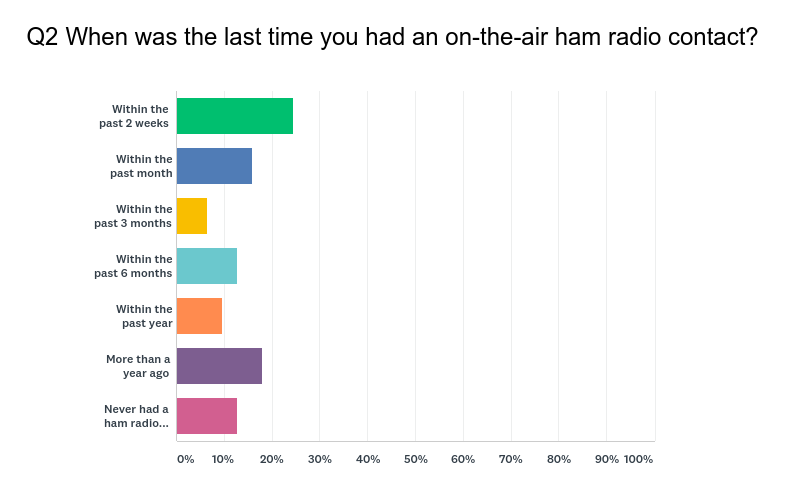
Most of the respondents have been on air recently: 60% of them have made a radio contact in the past 6 months. On the other hand, that means about 40% of not made a contact in half a year. It is disappointing to see that 13% have never made a ham radio contact.

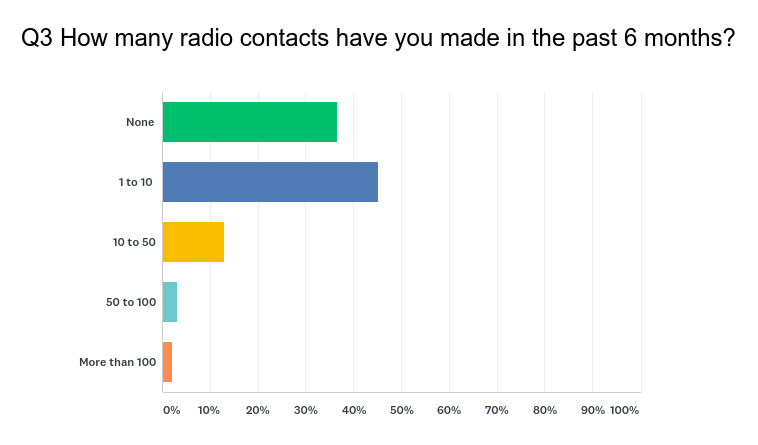
There is quite a range on how active the respondents are with 45% making 10 or fewer contacts in 6 months.

About one half of the survey respondents are members of our radio club. Some of them are also members of other radio clubs in the area. Some of our students travel a long distance, up to 100 miles, to attend this class so it makes sense that they find a radio club near their home.
Most of the respondents reported being active on 2m/70cm FM. About 18% of them are on HF Phone. The total for all forms of HF operating (CW, digital and phone) is not shown on the chart but it is roughly 20%. While roughly half of the respondents have their General or Extra class license, only 20% are actually using the resulting HF privileges.
Conclusions
My broad conclusion is that our radio club should continue to provide opportunities for our members to develop their operating skills and expand their radio operating. I filtered the responses to our club members only to see if our club member responses are any different from the larger group. Basically, our members indicate they are somewhat more active than the rest of the respondents but the overall story does not change.
Obviously, this is a small slice of data relevant to our local situation. It may not apply to other parts of the country.
What do you think?
73, Bob K0NR
The post Are Recent Technicians Getting on the Air? appeared first on The KØNR Radio Site.
Bob Witte, KØNR, is a regular contributor to AmateurRadio.com and writes from Colorado, USA. Contact him at [email protected].
 Ham Radio Deluxe |
 W5SWL Electronics |
 Ham Radio Prep |
 KB3IFH QSL Cards  Hip Ham Shirts  HamRadioAuctions HamRadioAuctions Reliance Antennas Reliance Antennas Enigma Shop Enigma Shop |  morseDX  Ni4L Antennas  R&L Electronics R&L Electronics antennas.us antennas.us QRV QRV |
- Matt W1MST, Managing Editor
